How to Launch an Online Store That Gets Sales Fast
You have decided to sell online. That was the easy decision. The hard ones start now, and most of them get made badly because nobody tells you they are decisions at all.
Which products go live first. Whether you charge for shipping or bury it in the price. Which payment methods your buyers actually use — and they are different in Mumbai, Manchester, Melbourne and Minneapolis. Whether you are building a shop or building a brand. Whether the platform you pick takes a percentage of every order you will ever make.
This guide covers the whole path: choosing what to sell, sourcing it, building the store, the pre-launch checklist that prevents the expensive mistakes, and the growth plan for the first 90 days. It is written by the team behind Shopaccino, which has taken more than 1,000 brands live across 25+ countries — so the failure points below are ones we have watched happen, not ones we imagined.
The 60-second version
- Validate before you buy stock. Search demand, three competitor prices, real margin maths, and ten people who say they would buy it.
- Launch 20 products, not 200. You cannot photograph, describe or market 200 properly.
- Pick the platform on total cost, not sticker price. Subscription + transaction fee + the apps you will need in six months.
- Support the payment methods your market actually uses. Cards alone will lose you sales in most countries outside North America.
- Show shipping cost on the product page. Revealing it at checkout is the most common cause of abandoned carts worldwide.
- Build the audience before the store goes live. A shop opening on an empty street does not get orders.
- Spend on retention, not only acquisition. Abandoned-cart recovery and post-purchase messaging pay back faster than any ad.
What this guide covers
1. Decide what to sell — and validate it before you spend anything
The standard advice is "follow your passion". It is half right. Passion keeps you going through month four when sales are flat, but passion alone has launched a lot of stores selling things nobody searches for.
What you want is the overlap between three things: something you understand well enough to write about convincingly, something people are already searching for, and something you can source at a margin that survives shipping and advertising.
Four ways to find a product worth selling
- Solve a problem you personally hit. The strongest founders started as frustrated customers. If you looked properly and could not find it, other people are looking too.
- Sell what is already moving around you. A maker in your city with no distribution. A category your family business already stocks offline. Existing supply with no digital channel is the lowest-risk start there is.
- Go narrower than the market leader. You will not win "running shoes". You might win "running shoes for wide feet". Narrow categories have cheaper ads, higher conversion, and customers who talk about you.
- Read demand instead of guessing at it. Search volume in your target country, marketplace bestseller ranks, questions in category communities, the "people also ask" box. If nobody is asking, you will be paying to create demand.
Validate before you commit inventory
- Check search demand on your top five product terms — in the country you will actually sell to, not globally. Flat or falling is a signal, not a challenge.
- Price the competition. Three sellers, their price, shipping policy and delivery promise. That is the bar you have to clear.
- Do the margin maths. Landed cost + duties + packaging + shipping + payment processing + expected returns + platform fees. If under 30% is left, paid advertising will eat you.
- Get ten pre-orders or ten honest refusals. Ten people saying "yes, I would buy that at that price" is worth more than any amount of research.
The margin most new sellers forget
A product you buy at $5 and sell at $12 looks like a 58% margin. Subtract $1.00 shipping, $0.30 packaging, $0.35 payment processing and a 6% return rate, and you are at roughly $4.95 — before a cent of advertising.
Now subtract a platform transaction fee. At 2% of order value that is another $0.24 per order, every order, forever. Shopaccino charges 0% platform transaction fees on every plan — that money stays with you. On 500 orders a month it is $120; on 5,000 it is $1,200 a month you keep. See what each plan includes →
2. Get the product — make, manufacture or resell
There are three ways to end up with something to sell, and they trade control against speed. Pick deliberately; switching later is expensive.
| Make it yourself | Manufacture under your brand | Buy wholesale / resell | |
|---|---|---|---|
| Upfront capital | Low to medium | High — MOQs are real | Medium |
| Time to first sale | Slow | Slowest — 8–16 weeks typical | Fastest |
| Margin | Highest | High | Lowest |
| Brand ownership | Complete | Complete | None — you are one of many |
| Quality control | Complete | Good, with inspection | None |
| Main risk | Does not scale past your own hours | Capital locked in unsold stock | Competing on price alone |
| Best for | Handmade, custom, made-to-order | A differentiated product, with capital | Testing a category, or taking an offline business online |
Strong Mixed Weak
Most first-time sellers start in the third column and move left as they learn what sells. That is a sound path — you are buying market data with your first few thousand in turnover rather than with a guess.
Already selling wholesale? Do not rebuild as a retail store.
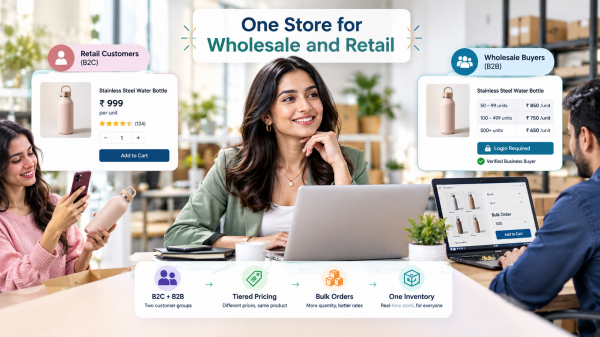
Many businesses going online are already distributors, wholesalers or manufacturers with a dealer network. You need different things: customer-specific pricing, minimum order quantities, credit terms, and a catalogue your competitors cannot see. Shopaccino runs B2B and B2C off one catalogue and one stock pool, so you can open a retail storefront without exposing your wholesale rates. How B2B ecommerce works →
3. Set up the business — name, domain, compliance
Name it in a way you will not regret
The rules are dull but they hold: short, easy to say out loud, easy to spell after hearing it once, and not boxed in by a category you will outgrow. "Cotton Kurtis Jaipur" is a great name until you want to sell dresses; so is "Brooklyn Candle Supply" until you add homeware.
Before you commit, check all four in one sitting: the .com and your local country domain, the social handles, a trademark search in every market you plan to sell in, and a plain search for anyone already trading under it.
Get the domain right
Buy your own domain. Not a subdomain of a platform, not a marketplace seller page — a domain you own and control.
This matters more than it sounds. Your domain is the only asset in this entire list that appreciates. Every unit of SEO, every returning customer who types your name, every email address you collect, accrues to that domain. If it belongs to a marketplace or a platform, so does your business.
The compliance basics
The specifics differ by country, but the shape of the list does not. Get these in place before launch, not after the first order:
- Business registration — sole trader, LLC, Ltd, Pvt Ltd or the local equivalent, depending on scale and liability
- Tax registration — sales tax, VAT or GST depending on your market, plus registration in any country where you cross a distance-selling threshold
- A business bank account in the trading name
- Payment provider verification (KYC) — this takes days, not hours; start it early
- Policy pages — shipping, returns, refunds, privacy and terms. Payment providers ask for these before approving you, and buyers read them more often than you would think
- Privacy compliance — GDPR in the EU and UK, CCPA in California, and the local equivalent elsewhere. A cookie banner and a real privacy policy are the minimum
Brand assets you actually need
- A logo legible at 40 pixels — that is the size it renders at in a browser tab and a chat profile
- Two or three brand colours, used consistently
- Product photography on a clean, consistent background: front, back, detail and one in-use or on-model shot per product
- A 50-word brand story you repeat identically on your About page, your social bios and your packaging insert
On photography — you do not need a studio. A window, a white sheet and a recent phone camera beat most of what is live today. What matters is consistency: same angle, same crop, same lighting. A grid that looks like one store converts better than a grid that looks like five.
4. Build the store — and understand what your platform decides for you
This is the step most guides rush. It is the one that determines your cost structure, your conversion rate and how much of your revenue you keep for the next five years. Your platform quietly decides four things:
- What every order costs you. Some platforms charge a percentage of every sale on top of the subscription. That fee scales with your success and never stops.
- What you have to buy separately. A low headline price often means abandoned-cart recovery, multi-currency, product options and B2B pricing are paid apps. Four apps at $20/month is $960 a year that was not in the sticker price.
- How fast your store loads. Hosting, CDN and image optimisation decide whether a buyer on a mid-range phone and an average mobile connection ever sees your product page.
- Who owns the customer. Marketplace or platform-owned checkout means their customer. Your own domain and database means yours.
What to look for in an ecommerce platform
| Requirement | Why it decides the outcome |
|---|---|
| No transaction fee on orders | A 2% cut compounds. At $600,000 annual turnover it is $12,000 a year paid to your software vendor |
| Local payment methods | Cards are not enough in most of the world. The checkout has to carry what your buyers already use |
| Carrier integration with auto-labels | Creating shipping labels by hand works at 5 orders a day and collapses at 50 |
| Real inventory management | One stock pool across web, app and marketplaces, or you will oversell |
| Multi-currency and tax rules | The moment you take a second country, price display and tax treatment both have to change |
| Native mobile app | Repeat buyers convert far better in an app than in a mobile browser |
| SEO built in | Schema, clean URLs, sitemaps, meta control — not a paid plugin |
| Compliant invoicing | Correct tax treatment and document format for each market, generated automatically |
| Support in your timezone | The day your checkout breaks, response time is the only feature that matters |
Why brands build on Shopaccino Our platform
0% platform transaction fees
- On every plan — StartUp, Scale, ProCommerce and TailorMade
- No commission on order value, no revenue share
- You pay your payment provider its processing rate and nothing to us on what you sell
- Cloud hosting, image CDN and SSL included in the subscription
Included, not sold back as apps
- Abandoned-cart recovery
- SEO toolkit — schema, sitemap, meta control
- Inventory and tax management
- Order notifications by email and SMS
- Automated backups and recovery
Built for how the world actually pays and ships
- 48 payment gateways across cards, wallets, bank transfer, BNPL and local methods
- 26 carrier integrations with automatic label generation and live tracking
- Multi-currency pricing and region-based catalogues
- 7 ERP and inventory connectors, plus Product and Order APIs
Room to become more than a shop
- Native iOS and Android app under your own brand
- B2B pricing, MOQ and credit terms when dealers start ordering
- Multi-warehouse routing when one location is not enough
- Localised storefronts when you add a second market
Independently rated: 4.7/5 on G2 across verified merchant reviews, NASSCOM Excellence Award for Transformation Catalyst for SMEs, ET Leadership Excellence Award 2023, and Crozdesk Leader and Happiest Users. 1,000+ brands live across 25+ countries.
Try it on your own catalogue
14 days free, no credit card, full platform, 0% transaction fees.
Start free trialOr book a live demo and a product expert will walk through your category and a realistic go-live timeline.
5. Payments — support what your market actually uses
This is the single most under-planned part of a launch, and it is where the money physically stops. A checkout that only takes international cards will quietly lose a third of its sales in most countries outside North America — not because buyers changed their minds, but because their normal way of paying was not there.
| Market | Expected alongside cards | What happens if it is missing |
|---|---|---|
| India | UPI, net banking, wallets, cash on delivery | Severe drop-off — UPI is the default way to pay |
| United States & Canada | Cards, PayPal, Apple / Google Pay, BNPL | Moderate — cards carry most of it, BNPL lifts AOV |
| United Kingdom & EU | Local bank methods (iDEAL, Bancontact, SEPA), Klarna, PayPal | High in the Netherlands, Germany and the Nordics |
| Latin America | PIX in Brazil, OXXO in Mexico, instalments | Severe — instalment payment is the norm, not a perk |
| Middle East | Cash on delivery, local wallets, Tabby / Tamara | High — COD is still a majority method in several markets |
| Southeast Asia | E-wallets (GrabPay, GCash, OVO), bank transfer, COD | Severe — card penetration is low in several markets |
| Australia & NZ | Cards, PayPal, Afterpay / Zip | Moderate — BNPL is widely expected in fashion and homeware |
6. The pre-launch checklist: 14 things to do before you go live
This is where launches go wrong. Not the product, not the design — the unglamorous operational details nobody checks until a real customer hits them. Each line represents a store we have watched lose orders.
Storefront
Shipping
Checkout
Post-purchase
7. Choosing a shipping strategy
Three options, each right for a different set of economics.
| Strategy | Effect on conversion | Best for | Watch out for |
|---|---|---|---|
| Free above a threshold | Highest — and raises order value | Light goods with room in the margin | Set the bar at roughly 1.3× your current average order value |
| Charge actual carrier rates | Costs conversions if revealed late | Heavy, bulky or long-distance goods | Show the estimate on the product page, not at checkout |
| Flat rate | Good — predictable for both sides | Catalogues with consistent size and weight | Weigh and measure your catalogue first, and model your zone mix |
8. Launch week: how to get your first orders
A store that goes live with nobody waiting for it is a shop opening on an empty street. The work that produces launch-day orders happens in the two weeks before launch.
Before you go live
- Build a waiting list. A page saying "we launch on the 14th, first 50 people get 15% off" collects emails and phone numbers for two weeks. That list is your launch-day traffic and it costs nothing.
- Tell the people who already know you. Your first twenty orders will almost certainly come from people who already trust you. That is not cheating — it is how every store starts.
- Seed the content. Have three or four pieces ready for launch week: the founder story, how the product is made, one genuine tester photo. Publishing into silence is much harder than publishing into momentum.
Launch day and the week after
- Go live quietly first, loudly second. Publish, place two real orders yourself, confirm everything fires, then announce. Twenty-four hours of soft launch catches what the checklist missed.
- Announce everywhere on the same day. One concentrated day beats a week of trickle.
- Start search ads on product terms, not your brand name. Nobody is searching for your brand yet. Start small and give it two weeks before you judge it.
- Set up your social shops. Free surface area, and product tagging shortens the path from scroll to cart.
- Reply to everything within an hour. In month one you are your own support desk, and fast replies convert. This is the one advantage you have over every large competitor.
What to measure from day one
| Metric | What it tells you | Healthy range |
|---|---|---|
| Sessions | Whether anyone is arriving | Growing week on week |
| Conversion rate | Whether the store works | 1–3% early; under 0.5% means something is broken |
| Average order value | Whether bundling and thresholds work | Compare against your free-shipping bar |
| Cart abandonment | Where you are losing the sale | 60–75% normal; over 80% means checkout friction |
| Repeat purchase rate | Whether you have a business or a campaign | Anything above zero in month one is a good sign |
9. The first 90 days: turning first-time buyers into repeat customers
Acquiring a customer costs money. Keeping one costs a well-timed message. Most new stores spend everything on the first and nothing on the second, which is why they plateau at whatever their ad budget buys. Here is the retention stack, in the order it is worth building.
1. Recover abandoned carts
Roughly seven in ten carts are abandoned. A sequence of three messages — a reminder at one hour, a nudge at 24 hours, a small incentive at 72 — recovers a meaningful share. This is the highest-return automation in ecommerce and it runs without you. Included on every Shopaccino plan with automated abandoned cart notifications.
2. Own the post-purchase experience
The window between "order placed" and "parcel opened" is when a customer pays you the most attention they ever will. Most stores waste it.
- Order confirmation within seconds, dispatch notification with a working tracking link, delivery confirmation
- A packaging insert: a thank-you, a reorder code, and one line telling them how to reach you
- A review request three days after delivery — long enough to have used it, soon enough to remember
3. Collect and show reviews
Reviews are the cheapest conversion lift available to a new store, because a store with no reviews asks a stranger to go first. Ask every buyer, make it one tap, display them on the product page.
4. Build the email and SMS list deliberately
Your list is the only marketing channel you own outright. Ad costs rise and algorithms change; an email list is yours. Email for storytelling and depth, SMS strictly for time-sensitive things — dispatch, restocks, a real deadline. Respect local consent rules: explicit opt-in is legally required across the EU, UK, Canada and Australia, and it is good practice everywhere else.
Your database of past and potential customers needs regular nurturing to turn into new sales. Modern marketing automation tools like GetResponse can help you set up condition-based workflows that nurture subscribers based on their buying history and turn them into repeat customers. Shopaccino also connects with email tools such as Mailchimp, Klaviyo and Brevo, so you can run these flows using your store data.
5. Launch a mobile app once you have repeat buyers
Once you have a few hundred returning customers, an app changes the economics. Push notifications cost nothing, reach directly, and convert better than email. A branded iOS and Android ecommerce mobile app is included on Shopaccino, so it is not a six-month development project.
6. Segment, then personalise
Split customers at minimum into first-time buyers, repeat buyers and lapsed. Three segments with relevant messages beat one list getting everything.
Five questions that tell you whether your store is working
- Do you know your conversion rate this week, without looking it up?
- Does an abandoned cart trigger a message without you doing anything?
- Can a returning customer reorder in under three taps?
- Do you know what share of last month's revenue came from repeat buyers?
- If your best traffic channel disappeared tomorrow, could you still reach your customers?
Fewer than three yeses means the problem is your operations, not your traffic. That is good news — operations are fixable this month.
10. Selling across borders without a second platform
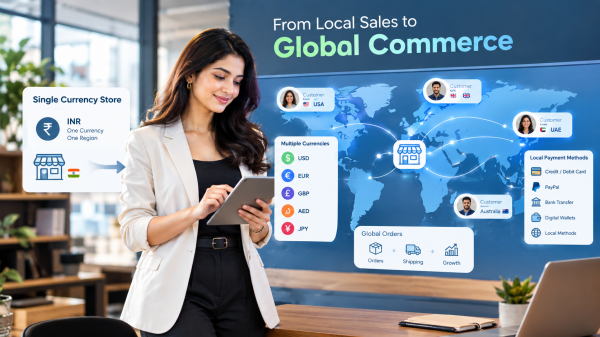
Most stores add their second country before they expect to — usually because a customer abroad orders anyway, or because the home market is smaller than the product's audience. Handled properly it is a growth channel. Handled badly it is a support queue full of surprise customs bills.
The five things that change when you cross a border
- Currency. Show prices in the buyer's currency. Converting at checkout, after they have decided, costs conversions.
- Tax. VAT, GST or sales tax applies differently by destination, and several markets have distance-selling registration thresholds you can cross without noticing.
- Duties. Decide whether the buyer pays on delivery (DDU) or you collect it at checkout (DDP). DDP costs more and generates far fewer refused parcels and angry messages.
- Shipping and returns. Cross-border returns are expensive. Either build the cost into the price or state clearly that returns are at the buyer's cost — but say which.
- Catalogue. Not everything should be sold everywhere. Restricted goods, voltage and sizing differences, and licensing all argue for region-based catalogues rather than one global list.
11. How to grow past the first plateau
Every store hits a ceiling where the launch audience is exhausted and ad spend is the only thing moving the number. Getting past it means building channels that compound instead of channels you rent.
- SEO — slowest to start, cheapest to sustain. Product pages with real descriptions and schema markup, category pages that answer how people actually search, and a blog that solves problems adjacent to your product. Three to six months to show up, then it keeps paying. It is also increasingly how AI assistants find and recommend you. Read: ecommerce SEO in the AI era →
- Content that answers real questions. "How to choose", "how to care for", "X vs Y". This is how a stranger who has never heard of you ends up on your site.
- Paid advertising — fast, honest and rented. Search for intent, social for discovery. Both work. Neither is an asset: the day you stop paying, it stops.
- Social and community. Slow to compound and impossible to fake, but it produces the customers who come back without being paid for twice.
- Marketplaces — a channel, not a foundation. Amazon and its regional equivalents give you volume and give you nothing else: not the customer, not the data, not the brand. Businesses built entirely on marketplace volume find out how little they own the day the algorithm changes.
- New channels on the same catalogue. Growth is often a second channel rather than more spend on the first: a mobile app, a B2B side for dealers, or a second currency. Whether that is cheap or painful depends entirely on whether your platform supports it natively. Read: the complete guide to ecommerce sales channels →
12. What does it cost to launch an online store?
Honest ranges for a first store, in US dollars. Your local figures will differ, but if your plan is wildly outside these, check your assumptions.
| Item | Realistic first-year range | Notes |
|---|---|---|
| Domain | $10–20 / year | Buy the .com and your local country domain |
| Ecommerce platform | $290–800 / year | Watch for transaction fees on top — that is the number that grows |
| Platform transaction fees | $0 on Shopaccino | Elsewhere, 1–2% of everything you ever sell |
| Payment processing | ~2–3% per transaction | Charged by the payment provider, not the platform. Unavoidable |
| Product photography | $0–1,200 | A phone and a window is a legitimate starting point |
| Initial inventory | Highly variable | The largest line item for most sellers |
| Launch advertising | $400–2,000 | Treat the first month as buying data, not sales |
| Logo and brand basics | $0–700 | Diminishing returns above that for a first store |
The line that surprises people is the third one. A platform transaction fee does not look like much at launch — 2% of a $60 order is $1.20. But it is charged on every order you will ever place, it grows exactly as fast as you do, and it is charged whether that month was profitable or not.
At $120,000 annual turnover, 2% is $2,400 — usually more than the subscription itself. At $1.2 million it is $24,000. Shopaccino charges 0% platform transaction fees on every plan, which means your software cost stays flat while your revenue does not.
13. Seven mistakes we see on almost every first launch
- Launching with 200 products. You cannot photograph, describe or market 200 properly. Launch 20 you believe in, then add more once you know which sell.
- Not testing checkout on a real phone. Your desktop test proves nothing. Most of your buyers are on a mid-range phone on an ordinary connection.
- Hiding shipping cost until checkout. The most common cause of abandoned carts, everywhere.
- Offering only card payment. In most of the world, cards alone leave a third of your buyers without a way to pay you.
- No analytics until week three. You can never recover the baseline data you did not collect.
- Spending on ads before the store converts. If the checkout is broken, ad spend buys expensive proof that the checkout is broken.
- Choosing a platform on sticker price alone. Add the transaction fee, the four apps you will need within six months, and the replatforming cost when you outgrow it. That is the real price.
Start with the next decision, not the whole plan
Nobody launches a store by following a guide end to end in one sitting. You make the next decision, then the one after it. What separates the stores still trading in year three is not a better product — it is that they made the unglamorous decisions deliberately: what shipping costs, what the checkout accepts, what happens after the parcel arrives, and what share of every sale leaves the business for good.
Get those right and the rest is iteration.
See it configured for your business
Start the 14-day free trial — no credit card, full platform, 0% transaction fees. Or book a live demo and a product expert will walk through your category, your catalogue and a realistic go-live timeline.
Start free trial Book a live demoSales & Partnership: +91-99502 44448
FAQs
Choose a product and validate demand, register the business and complete tax registration for your market, buy your own domain, build the store on an ecommerce platform, set up local payment methods and carrier integration, work through a pre-launch checklist, then launch to an audience you built beforehand. Most sellers get from decision to live store in two to four weeks once the product is decided.
Budget roughly $290–800 a year for a good ecommerce platform and 2–3% per transaction to your payment provider, plus inventory and launch advertising. Watch for platform transaction fees on top of the subscription — Shopaccino charges 0% platform transaction fees on every plan, so your software cost does not grow with your revenue.
Yes. A hosted ecommerce platform handles hosting, security, payments and shipping integrations, and you customise a ready theme without touching code. Most Shopaccino stores are set up by the business owner, not a developer.
Once your product photography and descriptions are ready, the store itself takes days rather than weeks. The realistic bottleneck is catalogue preparation and payment provider verification, which takes a few working days. Most stores go live within two to four weeks of starting.
Cards plus whatever your market treats as normal: UPI and cash on delivery in India, PayPal and buy-now-pay-later in the US and Australia, local bank methods such as iDEAL and Klarna across Europe, PIX in Brazil, e-wallets across Southeast Asia. A checkout that only takes international cards loses a significant share of sales in most countries outside North America. Shopaccino connects 48 payment gateways covering these.
In most markets yes, and payment providers usually ask for the registration during onboarding. The specifics vary: GST registration is required for most online sellers in India, VAT registration applies above a threshold in the UK and EU, and US sellers may owe sales tax in states where they cross an economic nexus threshold. Confirm your own position with a local accountant, and start early because it gates everything downstream.
Judge on total cost rather than sticker price: platform transaction fees, which features are included versus sold as apps, local payment method support, carrier integration, and whether it grows with you into mobile apps, B2B or international selling.
Both, in that order of priority. Marketplaces give you reach without giving you the customer, the data or the brand. Your own store is where margin, repeat purchase and brand value accumulate. Use marketplaces as a channel and your own store as the foundation.
Build a waiting list before launch, announce to everyone who already knows you on the same day, run a small search campaign on product terms rather than your brand name, and reply to every message within the hour. Your first twenty orders almost always come from your existing network.
1–3% is normal in the early months. Below 0.5% usually means something specific is broken — checkout friction, unclear shipping, a missing local payment method, weak trust signals or slow mobile load — rather than a traffic problem.
Yes, if your platform supports multi-currency pricing, per-country tax and shipping rules, and region-based catalogues. Decide early whether you collect duties at checkout or leave the buyer to pay on delivery — the second is cheaper for you and generates most of the complaints. Shopaccino supports multi-currency checkout, international tax configuration, international gateways and localised storefronts.
Yes, if your platform supports it natively. Shopaccino runs B2B and B2C off one catalogue and one stock pool — a retail visitor sees retail pricing, a logged-in dealer sees their negotiated rate, their minimum order quantity and their credit balance. How B2B ecommerce works →
Yes — 14 days, no credit card required. Start your free trial →