


Business Background
What the Client Does
Kedia Pavitra is the food venture of Kedia Homes, an established Rajasthan real estate group with over 40 years of built trust. The brand was founded on a simple conviction — that food, like a home, is sacred to every Indian family. It carries the same “No Middle Man” ideology that defines the group’s real estate projects: by collaborating directly with farmers and stripping out intermediaries across the supply chain, the journey from farm to food is kept to a maximum of four steps.
Product Range & USP
The catalogue spans everyday Indian kitchen staples — Flour, Grains, Rice, Whole Spices, Powdered Spices, Blended Spices, Pulses, Edible Oils, Dry Fruits, Brews, Sweeteners, and Snacks. The brand’s USP is purity through directness: no adulteration, superior-grade ingredients at lower cost, and time-honoured methods like slow grinding, natural drying, and minimum processing — no chemicals, no shortcuts.
Target Audience
Kedia Pavitra serves two distinct customer types on one platform: B2C consumers buying household quantities for their kitchens, and B2B buyers — retailers, wholesalers, and institutional customers — purchasing in box and case quantities at business-specific pricing, serviced by dedicated Sales Account Managers.
Challenges / Problem Statement
Selling pure food staples to both consumers and businesses — from a network of 40+ warehouses — created a set of challenges that generic e-commerce platforms are not built to handle:
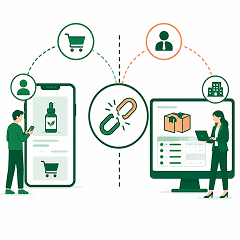
No Unified Online Presence for B2C and B2B
Consumers and business buyers have fundamentally different needs — retail quantities and prices for one; box/case MOQs and business pricing for the other. Kedia Pavitra needed one platform to serve both without running two separate systems.

Manual, Phone-Dependent Order Capture
Orders arrived through phone calls and manual follow-ups, making order capture dependent on staff availability, prone to entry errors, and impossible to scale to 24x7 availability.
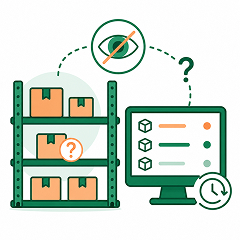
No Real-Time Inventory Visibility Across 40+ Warehouses
With stock spread across dozens of warehouses and no live synchronisation with SAP, the team risked stock-outs, over-selling, and slow fulfillment decisions.
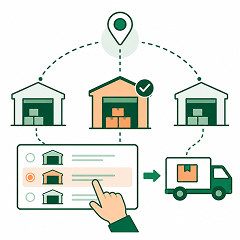
Manual Warehouse Selection for Every Order
Deciding which warehouse should fulfill each order was a manual judgement call — slowing dispatch, raising logistics cost, and making consistent delivery timelines across Rajasthan hard to maintain.
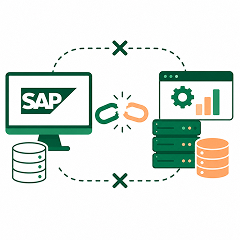
Disconnected SAP ERP
Orders, inventory, and delivery statuses lived in separate silos from SAP, forcing duplicate data entry and delaying processing — with no automated flow of order or delivery information between systems.
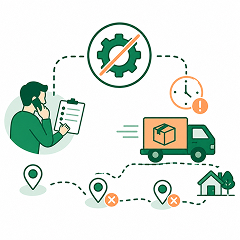
No Automation in the Last Mile
Deliveries lacked digital tracking, proof of delivery, and real-time status — limiting visibility for both the operations team and the customer.
Objectives / Goals
Kedia Pavitra approached Shopaccino with a clear set of business objectives:
- Launch a unified online store serving both B2C and B2B customers from a single catalogue
- Open four digital order channels — Website, Mobile App (iOS & Android), POS for order-on-call, and WhatsApp
- Enforce B2B rules automatically: box/case MOQs and business-specific pricing
- Achieve real-time inventory and order sync with SAP, including delivery status updates
- Auto-assign every order to the right warehouse among 40+ locations for quick fulfillment
- Digitise last-mile delivery with a rider application
- Equip Sales Account Managers to manage and place B2B orders from the mobile app
- Reduce manual effort and order processing time across the operation
Solution Provided by Shopaccino
Shopaccino implemented a unified B2C + B2B omnichannel commerce solution designed around Kedia Pavitra’s farm-to-food business — combining platform implementation, purpose-built features, and deep integrations.
Platform Implementation
A fully customised Shopaccino-powered storefront was built at kediapavitra.com along with native mobile applications for iOS and Android. The theme and UX were designed to reflect the brand’s purity-first identity — clean category navigation across the full staples range, trust-led storytelling, and a frictionless path from browse to checkout. Critically, the same platform serves two audiences: consumers see retail quantities and prices, while approved B2B customers see box/case quantities and their business pricing — all from one catalogue and one admin.
Features Used
Four Omnichannel Sales Channels
Orders are captured through four channels, all flowing into one order pipeline:

Website
24x7 ordering for consumers and B2B buyers with real-time stock visibility.

Mobile App (iOS & Android)
on-the-go ordering, order tracking, and push-notification engagement for repeat purchases.

POS for Order-on-Call
office staff convert incoming phone orders into system orders in seconds with quick customer and product search, eliminating manual order entry errors.

WhatsApp Commerce
customers browse, order, and reorder on the channel they use every day, powered by the Mulltiply.ai integration.

B2C + B2B on One Platform
Shopaccino’s B2B module lets Kedia Pavitra sell in box and case quantities with enforced minimum order quantities (MOQs) and B2B-specific product pricing. Business buyers get a purchasing experience built for their scale, while the brand manages a single catalogue — no duplicate listings, no parallel systems.
Multi-Warehouse Management with Auto Order Assignment
All 40+ warehouses are managed on the platform with real-time stock levels. When an order is placed on any channel, the system automatically assigns it to the right warehouse for quick fulfillment — removing the manual warehouse-selection step, speeding up dispatch, and lowering logistics cost across Rajasthan.


Sales Account Manager Ordering via Mobile App
Sales Account Managers use the mobile app to manage their B2B customers and place orders on their behalf — with the customer’s B2B pricing and MOQ rules applied automatically. This keeps field-driven B2B sales inside the same system as every other channel.
Rider App for Last-Mile Delivery
Deliveries are executed through the Shopaccino Rider App, giving riders their assigned deliveries and giving the operations team real-time delivery visibility with digital proof of delivery — closing the loop from order to doorstep.

Integrations

Shopaccino is integrated with Kedia Pavitra’s SAP ERP for real-time inventory and order synchronisation, including order delivery status updates flowing back into SAP. Stock levels on every sales channel always reflect SAP, and every order — from any channel — lands in SAP without manual re-entry, keeping one source of truth across commerce and ERP.

The Mulltiply.ai integration powers conversational commerce on WhatsApp — capturing sales orders directly from WhatsApp conversations and feeding them into the same unified order pipeline as the website, app, and POS.

Secure payment gateway integration gives customers the flexibility to pay through their preferred online mode, supporting both consumer checkouts and B2B order flows.
Execution Strategy
The implementation was executed in planned phases. The Shopaccino team began with a detailed scoping exercise — mapping the product catalogue across all categories, defining B2C and B2B pricing structures, box/case MOQ rules, the 40+ warehouse network, and SAP data flows. The platform was architected for automated warehouse assignment and live SAP synchronisation from the ground up — not retrofitted later.
The catalogue was structured and uploaded with clean category architecture matching the brand’s range — from flours and spices to dry fruits and snacks — with SEO foundations in place: clean URLs, optimised metadata, and structured product data. The website and mobile apps were launched alongside the POS for order-on-call, followed by WhatsApp commerce via Mulltiply.ai. Office staff, Sales Account Managers, and delivery riders were onboarded to their respective tools, and SAP sync plus the auto warehouse-assignment engine were tested against live order flows before full go-live.
Results & Performance Metrics
Each capability deployed by Shopaccino addressed a specific pain point in Kedia Pavitra’s operations and customer experience:
- Impact of Four-Channel Order Capture With the Website, Mobile App, POS, and WhatsApp all feeding one order pipeline, Kedia Pavitra moved from phone-dependent, staff-limited ordering to 24x7 omnichannel order capture. Phone orders that once required manual handling are now logged in seconds through the POS, while WhatsApp — the channel customers already live on — became a direct sales channel through Mulltiply.ai.
- Impact of B2C + B2B on One Platform - Serving consumers and business buyers from a single catalogue — with automatic MOQ enforcement in box/case quantities and B2B pricing — eliminated the need for parallel systems and manual price negotiation on routine orders. B2B buyers now self-serve or order through their Sales Account Manager’s mobile app, with every rule applied automatically.
- Impact of Auto Warehouse Assignment Across 40+ Warehouses Automatic order-to-warehouse assignment removed the single biggest fulfillment bottleneck. Orders route instantly to the right warehouse for quick fulfillment — cutting dispatch delays, lowering logistics cost, and delivering consistently faster across Rajasthan.
- Impact of SAP Integration Real-time inventory and order sync with SAP — including delivery status — eliminated duplicate data entry and inventory guesswork. Every channel shows accurate, live stock, and the ERP always reflects the true state of orders and deliveries.
- Impact of the Rider App Digitised last-mile delivery gave the operations team real-time delivery visibility and customers a reliable delivery experience — completing an unbroken digital chain from order placement to doorstep confirmation.
Combined Business Impact
Together, these capabilities transformed Kedia Pavitra from a phone-and-paper operation into a fully automated, omnichannel commerce business — with sharply reduced manual effort, faster order processing and fulfillment, and a single system of record spanning four sales channels, 40+ warehouses, SAP, and the last mile.
“Shopaccino gave us one platform for everything — our website, mobile apps, order-on-call POS, and even WhatsApp orders through Mulltiply.ai, all synced live with SAP. Orders are auto-assigned across our 40+ warehouses, our Sales Account Managers place B2B orders right from the app, and our riders deliver with full tracking. Most importantly, it lets us scale our ‘No Middle Man’ promise of pure, honest food without adding manual work. It feels like the platform was built around the way we operate.”

Before vs After Comparison
Highlights
One platform, two businesses - B2C and B2B served from a single catalogue with automatic MOQ (box/case) and business-pricing rules.
Four channels, one pipeline Website, Mobile App, POS for order-on-call, and WhatsApp (via Mulltiply.ai) all feed a unified order flow.
Auto fulfillment at scale - orders auto-assigned across 40+ warehouses for quick dispatch.
ERP-native commerce real-time SAP sync for inventory, orders, and delivery status.
Complete digital chain - from Sales Account Manager app ordering to Rider App delivery confirmation.
What sets Shopaccino apart is that these are native, integrated capabilities — not bolt-on workarounds — designed around the real operating model of an omnichannel B2C + B2B food rameshwarbairar04@gmail.com business.
Future Plans
With four live sales channels, automated warehouse fulfillment, and real-time SAP synchronisation, Kedia Pavitra now has the foundation to scale confidently. The same automation that removed manual effort also makes the business ready for a larger catalogue, new territories beyond Rajasthan, and higher order volumes — without adding operational workload.
Going forward, Kedia Pavitra can deepen mobile app adoption among consumers and B2B buyers, grow its B2B network through Sales Account Manager-led onboarding, expand WhatsApp commerce further with Mulltiply.ai automation, and layer in marketing automation and additional growth capabilities from the Shopaccino ecosystem as the business evolves.
Selling B2C & B2B from many locations?
Get a store built for omnichannel, multi-warehouse commerce.
Start Free 14-Day Trial Talk to a commerce specialistExecution Process
The platform was implemented in structured phases - focused on automation, multi-warehouse fulfillment, and a unified B2C + B2B buying experience.

Scoping & Mapping
Mapped the catalogue, B2C & B2B pricing, box/case MOQ rules, the 40+ warehouse network, and SAP data flows.
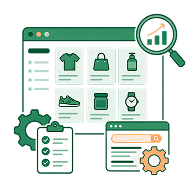
Catalogue & SEO Setup
Structured the full staples range with clean category architecture and SEO foundations - clean URLs, metadata, and structured product data.
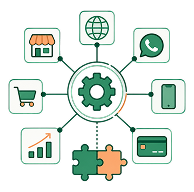
Channels & Integrations
Launched Website, apps, and POS, added WhatsApp via Mulltiply.ai, and wired live SAP sync with the auto warehouse-assignment engine.

Testing & Launch
Onboarded staff, Sales Account Managers, and riders, tested SAP sync and auto-assignment against live orders, then went fully live.