


Roopantaran is a textile manufacturing business that sells directly to both businesses and consumers through a single brand, with a clear focus on global availability.
Business Background
Roopantaran offers a wide range of textile and lifestyle products, including:
- Bedding
- Pillows and cushions
- Dining products
- Bags and totes
- Kantha quilts and throws
- Garments
- Block-printed fabrics
The brand positions itself around four promises: products available globally, a focus on high quality, fast delivery, and support for transactions in multiple currencies.
Its customers include business buyers and individual consumers in India and around the world. The United States, Canada, the European Union, the United Kingdom and Australia are among its prominent markets. With a global customer base, the online store needs to work as an international sales channel, not only a domestic one.
Challenges
A textile manufacturer selling to buyers around the world faces challenges that a domestic-only store does not. For Roopantaran, these were the main requirements to address.

Reaching International Customers
With customers across global markets, Roopantaran needed an ecommerce presence that could present its products to overseas buyers as clearly as to customers in India. A global storefront is the starting point for international expansion, because it is often the first place a new buyer judges whether a brand can serve them.

Selling Across Multiple Currencies
A shopper in Toronto, London or Sydney is more comfortable when prices appear in a currency they recognise. Showing prices only in Indian rupees forces international buyers to convert amounts themselves, which adds effort and uncertainty to the purchase. Roopantaran needed a way to present pricing that suits each market.

Managing Country-Specific Import Duties
Import duties vary by destination country. International buyers often want to know, before they pay, whether duties are included in their order or whether they will need to pay them when the parcel arrives. If this is not made clear, it can lead to unexpected charges, refused deliveries and unhappy customers. Roopantaran needed a clear way to communicate who is responsible for import duties on each order.

Serving Business and Retail Buyers Together
As a hybrid business, Roopantaran sells to both business customers and individual consumers. These two groups buy differently, and international business buyers add another layer of requirements. The store had to support both without splitting the brand into separate operations.
Objectives
Roopantaran’s ecommerce objectives were to:
- Expand its ecommerce business into international markets
- Address import duty requirements that differ by delivery destination
- Support multi-currency ecommerce operations
- Accommodate the requirements of both B2B and B2C customers
- Support international B2B sales through Global B2B capabilities
- Build an ecommerce foundation that can support continued business growth
These goals are closely linked. International expansion is not just about making products visible to overseas customers. It also means creating a buying experience that accounts for currency preferences, the needs of business buyers, and import duty responsibilities, all within one store.
Solution Provided by Shopaccino
Rather than treating Roopantaran as a standard online store, the Shopaccino setup was built around its two defining traits: a hybrid B2B and B2C model, and a global customer base.
Platform Implementation
Roopantaran’s online store at roopantaran.com runs on Shopaccino and serves both domestic and international customers, as well as both business and retail buyers, from a single storefront.
Platform Capabilities Configured

Geo-Tagged Multi-Currency
Shopaccino’s geo-tagged multi-currency functionality links the currency shown on the store to the customer’s geography. For a business selling worldwide, this means international shoppers, whether in the US, the UK, Australia or elsewhere, can view prices in a currency that is relevant to them.
This supports one of Roopantaran’s core brand promises, multi-currency transactions, and makes the store easier to use for buyers outside India. Prices become easier to understand and compare, which removes one common point of hesitation in cross-border shopping.
B2B Ecommerce Modules and Global B2B
A textile manufacturer that sells to both businesses and consumers has to cater to two different types of buyer. Business customers often buy for resale or commercial use, while individual consumers buy for themselves. Shopaccino’s B2B ecommerce modules allow Roopantaran to serve business buyers alongside its retail customers within the same ecommerce operation.

Global B2B extends this to international business customers. For a manufacturer serving global markets, the ability to support business buyers in different countries through ecommerce is directly tied to its expansion goals. It allows Roopantaran to use its online store as a channel for international trade buyers, not only for overseas retail shoppers.
Global B2B works as part of the wider setup. International trade still involves payment, shipping and compliance considerations that the business continues to manage.
Import Duty Management
Shopaccino lets customers choose between two ways of handling import duties on international orders.
Option 1: Pay import duties while placing the order . The store owner configures the applicable import duties for each country. Customers can then pay these configured duties at checkout. This shows duty costs upfront, so the customer knows the full amount before completing the purchase.
Option 2: Pay import duties separately on delivery . Customers can instead choose to pay import duties themselves when the shipment is delivered. In this case, the store owner is not liable for those duties. This makes the customer’s responsibility clear before the order is placed.
Since duty arrangements differ by destination, giving customers this choice helps Roopantaran handle international orders more transparently. The duty rates themselves are set by the store owner, so the business remains responsible for checking the customs requirements of each country it sells to.
Integrations
Payment Gateway : PayPal
Roopantaran uses PayPal as its payment gateway. PayPal is a widely recognised online payment option, which makes it relevant for a business with customers around the world.

Marketing Measurement: Meta Pixel
Meta Pixel is part of Roopantaran’s setup. It tracks website activity so the business can measure and optimise its advertising on Meta platforms, subject to the relevant configuration and consent requirements.
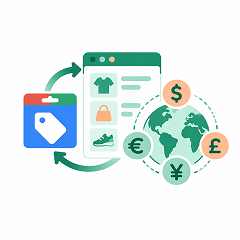
Product Discovery: Google Merchant Center Catalogue Sync with Multi-Currency Feed
Roopantaran’s product catalogue is synchronised with Google Merchant Center through a multi-currency feed. Keeping catalogue data in sync means product information shared with Google stays consistent with the store, while the multi-currency feed supports the currency needs of selling in different markets.
Execution Strategy
The setup was shaped around Roopantaran’s international and hybrid requirements: currency display for overseas shoppers, B2B modules including Global B2B for business buyers, import duty options for cross-border orders, and integrations for payments, marketing measurement and product discovery.
Results
Since Roopantaran started its ecommerce journey with Shopaccino, it has grown continuously. Each part of the setup addresses a specific requirement of selling textiles internationally to both business and retail buyers.

Impact of Geo-Tagged Multi-Currency
International shoppers can view prices in a currency relevant to their location. This delivers on Roopantaran’s multi-currency brand promise and makes the store more approachable for buyers worldwide.

Impact of B2B Modules and Global B2B
Roopantaran can serve business buyers and individual consumers within one ecommerce operation, and extend its B2B selling to international markets. This gives the business a single platform for both sides of its hybrid model, rather than separate systems.

Impact of Import Duty Management
Customers can choose whether to pay import duties at checkout or on delivery, so duty responsibility is clear before an order is placed. This adds transparency to cross-border orders, where unclear duty charges are a common source of friction.

Impact of Integrations
PayPal supports online payments from customers in different countries, Meta Pixel helps the team measure advertising activity, and the Google Merchant Center multi-currency feed keeps product data consistent for discovery across markets.

Combined Business Impact
Together, these capabilities give Roopantaran an ecommerce setup built for international, hybrid selling. The business has continued to grow since starting with Shopaccino, with a foundation that supports further expansion.
Requirements vs Capabilities
The table below maps Roopantaran’s business requirements to the capabilities in its current Shopaccino setup.
Highlights
- International ecommerce requires more than putting a product catalogue online. Currency, duties and buyer type all shape the experience.
- Showing prices in a relevant currency matters when selling across several markets.
- Import duty responsibility should be clear to customers before they place an international order.
- B2B and B2C buyers have different needs, and both can be served within one ecommerce operation.
- Global B2B capabilities are relevant to manufacturers that want to reach international business customers online.
- Payment gateways and marketing tools such as PayPal, Meta Pixel and Google Merchant Center are important parts of a complete ecommerce setup.
- An ecommerce platform should be judged on how well it fits the business’s real requirements, not on a feature checklist alone.
- Shopaccino’s capabilities for multi-currency, Global B2B and import duty management make it a strong fit for textile manufacturers and exporters selling worldwide.
Future Plans
With multi-currency pricing, Global B2B and import duty options in place, Roopantaran has an e-commerce foundation that can support continued expansion: reaching more international buyers, growing its business customer base, and building on its existing marketing and product discovery integrations as the business evolves.
Are you a fashion brand with a story worth telling and a product worth discovering - online and across the world?
Shopaccino gives fashion brands the tools to build a brand, not just a store - with embedded video, mobile apps, global commerce, smart cataloguing, and the automation to scale without adding overhead.
Start Free 14-Day Trial Talk to a commerce specialistExecution Process
The platform was implemented in structured phases - focused on automation, multi-warehouse fulfillment, and a unified B2C + B2B buying experience.

Scoping & Mapping
Mapped the catalogue, B2C & B2B pricing, box/case MOQ rules, the 40+ warehouse network, and SAP data flows.

Catalogue & SEO Setup
Structured the full staples range with clean category architecture and SEO foundations - clean URLs, metadata, and structured product data.

Channels & Integrations
Launched Website, apps, and POS, added WhatsApp via Mulltiply.ai, and wired live SAP sync with the auto warehouse-assignment engine.

Testing & Launch
Onboarded staff, Sales Account Managers, and riders, tested SAP sync and auto-assignment against live orders, then went fully live.