How Manufacturers and Wholesalers Can Digitize Their B2B Sales Process
For decades, manufacturers and wholesalers ran their business through traditional channels—distributors, field sales teams, phone orders, and manual invoicing. But today, buyers expect the same speed and convenience in B2B that they enjoy in B2C. Procurement managers no longer want long email chains or PDF catalogs. They want instant pricing, self-service ordering, transparent availability, and faster delivery.
This shift has made B2B eCommerce one of the fastest-growing digital segments. According to global reports, B2B eCommerce is already several times larger than B2C and continues expanding rapidly. Manufacturers who go digital now gain a massive competitive advantage—better margins, wider reach, automated operations, and more control over the customer lifecycle.
This is exactly where Shopaccino, an all-in-one ecommerce and automation platform, helps manufacturers and wholesalers move online smoothly—without developers or heavy IT investment.
This guide explains the challenges, solutions, and a full step-by-step path for manufacturers and wholesalers to adopt B2B eCommerce successfully.
Challenging Areas Manufacturers & Wholesalers Face Before Going Digital
While digital transformation is essential, the shift is not always easy. Many manufacturers and wholesalers face major roadblocks such as:
Complex pricing structures
B2B businesses work with different pricing for dealers, distributors, and bulk buyers. Managing tier-based pricing manually becomes unmanageable.
Inefficient order processing
Email-based or phone-based orders create delays, errors, and miscommunication—especially during peak demand.
Large and complicated catalogs
Manufacturers often sell thousands of SKUs with variations, technical specs, and bulk packaging units. Presenting this digitally is a challenge.
Dependence on manual work
Manual inventory updates, manual invoicing, and manual dispatch sheets slow down the business.
Limited customer reach
Traditional offline sales restrict customer acquisition and expansion into new regions.
Slow transparency in production availability
Buyers need real-time data on stock availability and lead time.
Lack of digital experience for buyers
Procurement teams prefer quick ordering, account dashboards, online payments, and order tracking—but manufacturers often cannot offer these features.
These challenges make it difficult for manufacturers to scale smoothly and keep up with modern buying behavior.
Their Customers' Challenging Areas
Manufacturers’ and wholesalers’ customers—distributors, bulk buyers, retailers, and procurement teams—face their own pain points:
No easy way to check stock availability
Retailers often don’t know what’s in stock unless they call repeatedly.
No visibility into pricing tiers
Distributors want clear pricing structures; they expect automated dealer pricing or volume pricing.
Slow ordering process
Sending repeated emails or calls slows down restocking for retailers.
Poor order tracking
Buyers need real-time tracking, dispatch details, and status updates.
Difficulty comparing products
In traditional catalog formats, buyers cannot quickly compare prices, variants, specs, or packaging units.
Lack of digital payment options
Modern B2B buyers expect online transfer, UPI, credit options, and instant receipts.
When manufacturers do not offer a digital experience, B2B customers shift to competitors who do.
Solution: How Shopaccino Enables B2B eCommerce for Manufacturers & Wholesalers
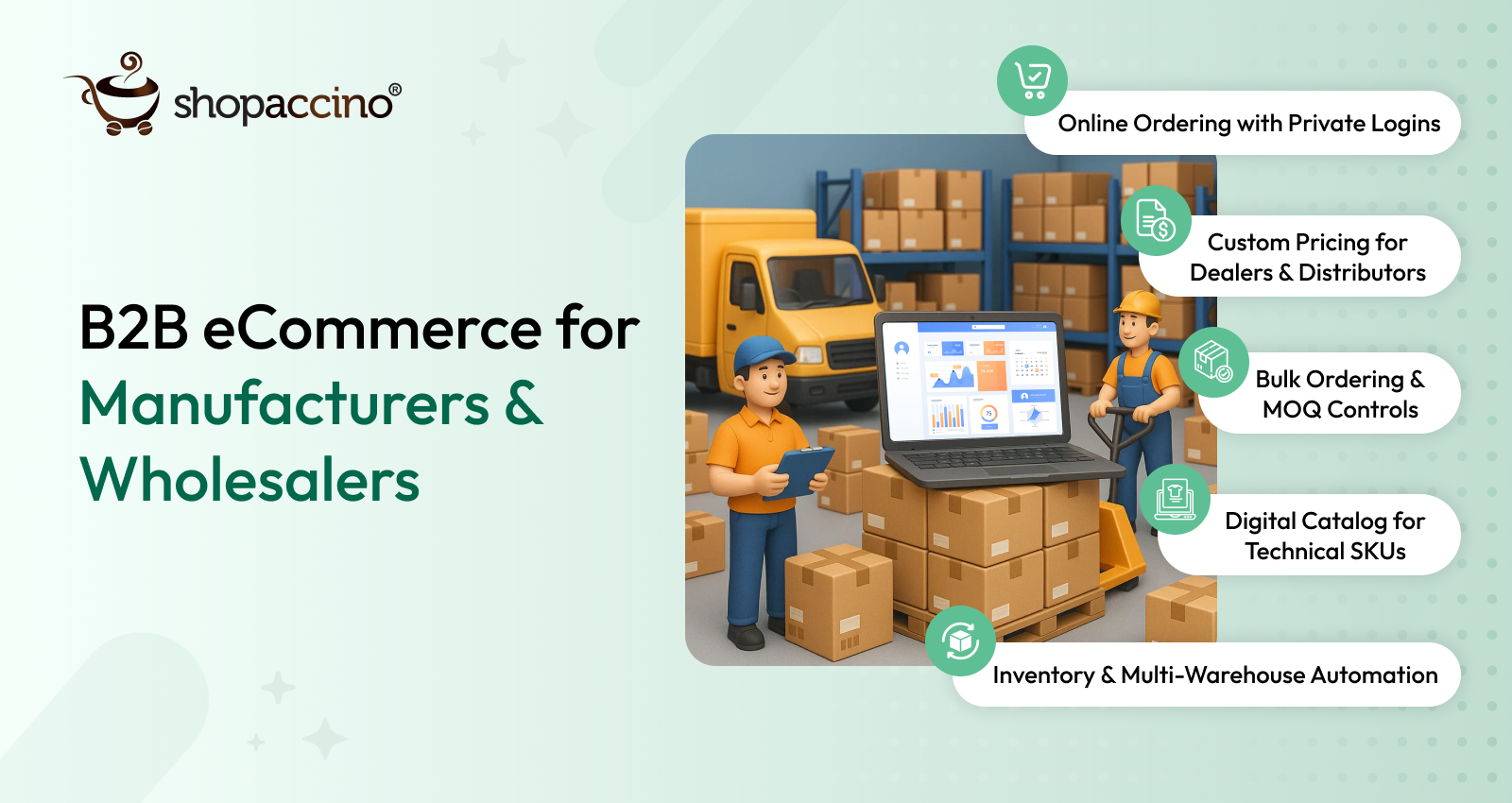
Shopaccino solves the biggest B2B challenges by offering a complete, scalable B2B eCommerce ecosystem, purpose-built for manufacturers and wholesalers.
Here’s how Shopaccino supports B2B growth:
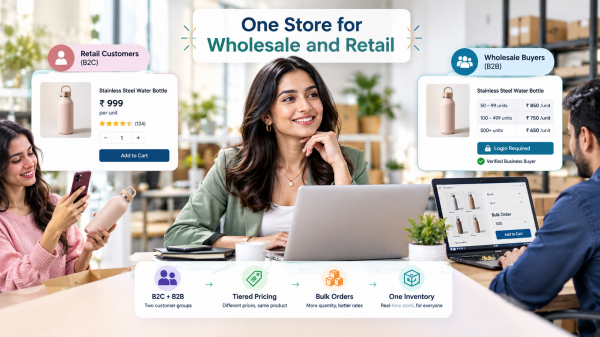
Multiple Pricing Structures for B2B
- Dealer pricing
- Distributor pricing
- Customer-specific pricing
- Bulk/volume-based pricing
Manufacturers can assign different pricing rules to each buyer group.
Bulk Order Management
Shopaccino supports high-volume orders with:
- Bulk ordering grids
- Quick order forms
- Minimum order quantities
- Cart rules for wholesale buyers
Digital Catalog with Rich Specifications
Perfect for businesses selling technical or multi-variant products.
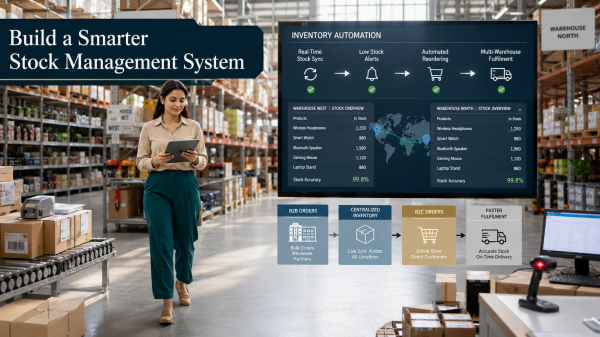
Real-time Inventory Automation
Inventory sync prevents over-selling, increases transparency, and automates stock updates.
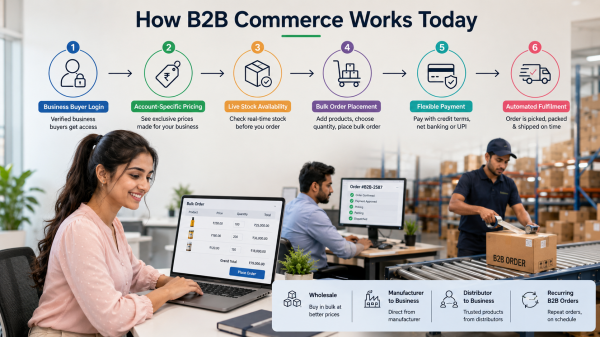
Faster Ordering for B2B Buyers
Buyers get:
- Private login
- Pre-set pricing
- Saved carts
- Reorder option
- Purchase history
This reduces sales dependency and increases repeat income.
Multi-warehouse & Region-based Stock
Manufacturers can assign distributors and orders based on region or warehouse availability.
Integrated Payments & Accounting Support
B2B-friendly:
- Online transfers
- UPI
- Credit options
- Automated invoices
Advanced B2B Marketing Tools
- Email/SMS campaigns
- WhatsApp notifications
- Automated reminders
- Custom offers for loyal partners
Role-based Access for Teams
Manufacturers can onboard agents, sales reps, and distributors with access controls.
Shopaccino combines everything manufacturers need—catalog, orders, pricing, logistics, and customer management—into one system.
How to Implement B2B eCommerce: Step-by-Step Guide
Step 1: Analyze Your B2B Structure
Understand buyer groups: dealers, resellers, distributors, corporate clients.
Step 2: Set Up Your Digital Catalog on Shopaccino
Upload products, variants, packaging details, and technical specifications.
Step 3: Configure B2B Pricing Models
Assign custom pricing for each buyer or group.
Step 4: Set Minimum Order Quantities & Bulk Rules
Optimize for wholesale orders (e.g., cartons, bundles, cases).
Step 5: Automate Inventory & Order Management
Connect warehouses, integrate shipping partners, set automated invoicing.
Step 6: Create Buyer Accounts & Access
Let distributors log in and place orders anytime.
Step 7: Enable Convenient Digital Payments
Activate UPI, bank transfer, wallets, credit options.
Step 8: Launch Your Store and Promote Digitally
Use email, WhatsApp, social media, and direct outreach.
Step 9: Train Sales Teams & Distributors
Help them use the online system for repeat ordering.
Step 10: Track Performance & Scale
Evaluate best-selling products, order cycles, customer behavior, and repeat frequency.
Benefits: Why B2B eCommerce Accelerates Growth for Manufacturers & Wholesalers
1. Increased Order Efficiency
Buyers place orders directly without waiting for calls or approvals.
2. Higher Customer Loyalty
Digital convenience increases repeat ordering.
3. Improved Accuracy
Eliminates manual errors in pricing, catalogs, or stock.
4. Lower Operational Costs
Automation reduces staff dependency and administrative costs.
5. Wider Market Reach
You can acquire distributors and B2B clients from new regions.
6. Faster Payment Cycles
Digital payments improve cash flow.
7. Data-Driven Decision Making
Analytics help identify top-selling categories, high-value clients, and purchase patterns.
8. Competitive Advantage
Businesses offering digital convenience gain immediate advantage over traditional competitors.
Conclusion
B2B eCommerce is no longer a choice—it’s a growth requirement for manufacturers and wholesalers who want to expand, scale, and stay competitive. The shift to digital streamlines operations, increases transparency, automates bulk ordering, and enhances customer satisfaction.
Shopaccino makes this transformation easy by offering a complete B2B-first ecommerce platform that helps manufacturers go digital without technical struggles. Whether you need custom pricing, bulk ordering, inventory automation, or distributor management—Shopaccino brings everything into one seamless system.
For manufacturers and wholesalers ready to digitize, this is the right time to start—and the right platform to scale confidently.
FAQs
Yes. Shopaccino supports dual-mode selling—public store for B2C and private login for B2B buyers.
Yes. It supports MOQ, bulk packs, carton units, and wholesale shipping rules.
Absolutely. You can assign pricing rules per customer or group.
Yes. You can hide products or categories based on buyer roles.
Yes. You can assign orders to warehouses automatically.
Yes. With role-based access, your sales reps can place orders on behalf of clients.