How Indian Ecommerce Brands Can Increase Conversion Rate by 30%
Every ecommerce brand in India wants more traffic.
But here’s the truth most brands ignore:
Traffic does not guarantee sales.
You can run ads. You can get Instagram followers. You can bring thousands of visitors to your website. But if those visitors are not buying, your business does not grow.
The real game in 2026 is not only traffic. It is conversion.
If you can increase ecommerce conversion rate even by 1–2%, your revenue can grow significantly without increasing ad spend.
Imagine increasing your conversion rate by 30%.
Same traffic.
Same marketing budget.
Much higher sales.
This guide will explain exactly how Indian ecommerce brands can boost ecommerce sales by improving performance, trust, experience, and backend systems — not just discounts.
And yes, this is especially important for brands operating in the competitive ecommerce conversion rate India market.
Average Ecommerce Conversion Rate in India
The average ecommerce conversion rate in India typically falls between 1% and 2%, lower than the global average, largely due to high COD reliance, RTO losses, and mobile checkout friction. D2C and niche categories vary: fashion and jewelry often sit below 1.5%, while well-optimized stores with streamlined checkout and prepaid incentives can push toward 2.5–3%. Knowing your baseline is the first step — the sections below cover how to improve it.
What Is Ecommerce Conversion Rate?
Before we talk about growth, let’s understand this clearly.
Ecommerce conversion rate is the percentage of website visitors who complete a purchase.
If 1,000 people visit your website and 20 buy something, your conversion rate is 2%.
It sounds simple. But improving it requires strategy.
Most ecommerce brands in India operate between 1% to 3% conversion rate depending on category.
Now think about this:
If your store converts at 2% and you improve it to 2.6% or 3%, your revenue increases without spending extra on ads.
That is the power of optimization.
Why Conversion Rate Matters More Than Traffic in India
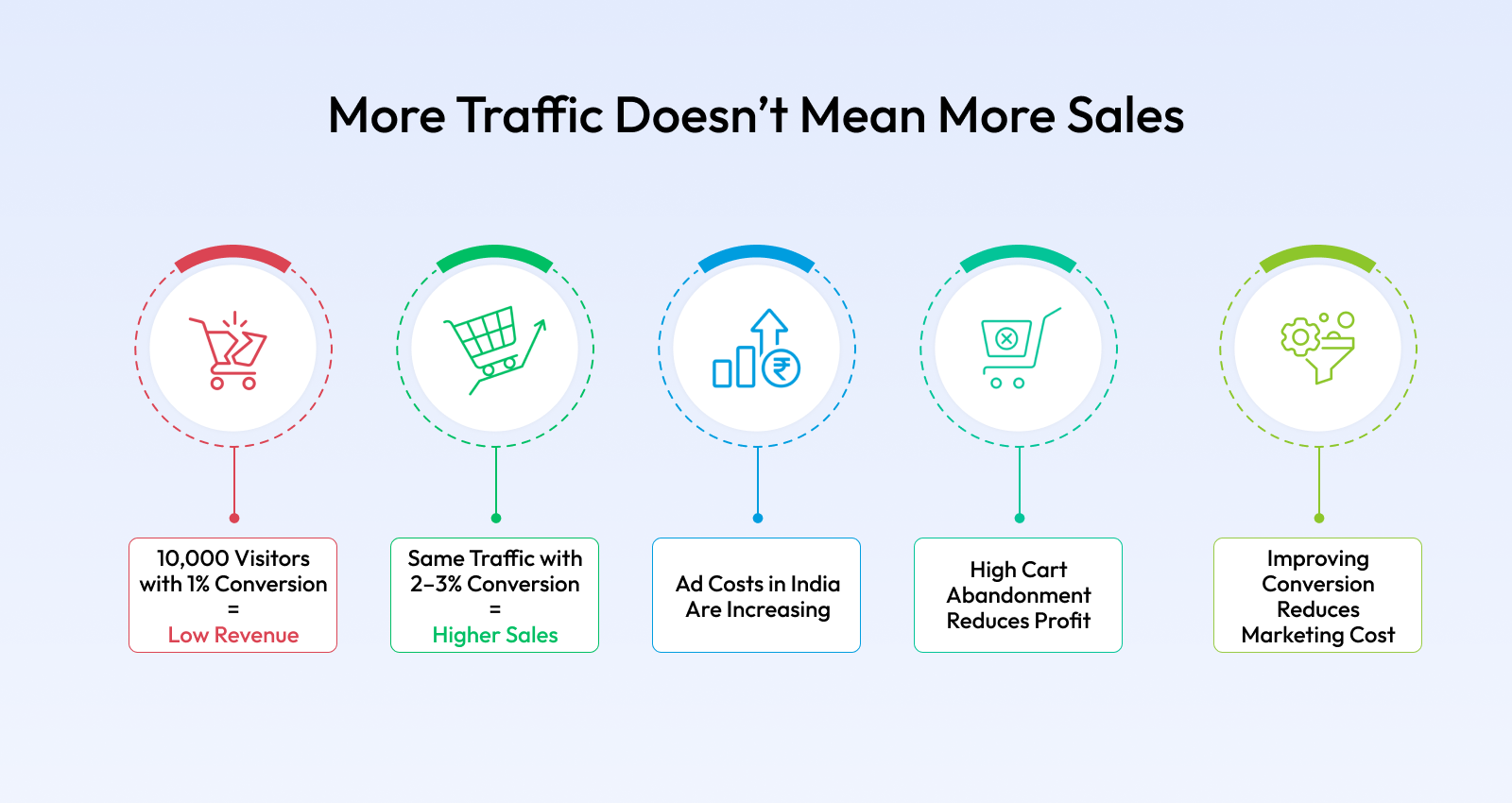
Digital advertising costs in India are increasing. Competition is rising. Customer attention span is shrinking.
If you focus only on bringing new visitors, your marketing cost keeps rising.
But if you improve how your website converts existing visitors, you reduce customer acquisition cost and increase profitability.
This is how smart brands boost ecommerce sales sustainably.
Key Stats:
Even a 0.5% improvement in conversion rate can significantly impact revenue.
Indian customers compare multiple websites before purchasing.
Cart abandonment rate in India is among the highest globally.
Impact:
If you do not optimize your website, you are leaving money on the table every day.
Now let’s understand the real reasons Indian ecommerce brands struggle to increase ecommerce conversion rate.
The Real Reasons Indian Ecommerce Stores Fail to Convert
Most brands assume low sales mean weak marketing.
In reality, conversion problems usually come from:
Poor website speed
Weak mobile experience
Lack of trust
Complicated checkout
Unclear product information
High abandoned cart rate
But these are surface-level issues.
Let’s go deeper.
Read Also : How Great UX Turns Ecommerce Traffic into Sales
Problem 1: Indian Customers Are Extremely Price-Conscious
India is a price-sensitive market.
Customers compare prices across websites before buying. They look for offers, coupons, free shipping, and cash-on-delivery options.
If your pricing strategy and presentation are not clear, customers leave and compare elsewhere.
To increase ecommerce conversion rate in India, you must understand buyer psychology.
Customers want:
Transparency
Value for money
Trust
Fast delivery
Clear return policy
Your website must communicate these clearly.
Shopaccino enables brands to create structured offers, coupon campaigns, and loyalty programs that make pricing feel attractive without damaging margins.
Problem 2: Trust Gap in Online Shopping
Despite digital growth, many Indian customers still hesitate to buy from new or lesser-known brands.
They worry about:
Product quality
Fake websites
Delayed delivery
Complicated returns
If your website does not build trust instantly, customers hesitate at checkout.
Trust-building is not just about design. It includes:
Clear policies
Secure payment badges
Visible contact details
Customer reviews
Professional layout
A strong ecommerce website builder like Shopaccino helps brands present a structured and credible online presence, which directly impacts conversion rates.
Impact:
Higher trust equals lower abandoned cart rate.
Problem 3: Mobile Experience Is Weak
More than 60% of ecommerce traffic in India comes from mobile devices.
But many ecommerce websites are still desktop-focused.
If your mobile website is slow, hard to navigate, or complicated during checkout, customers drop off immediately.
To reduce abandoned cart rate, mobile performance must be smooth, fast, and simple.
Customers should be able to:
Browse easily
Filter quickly
Add to cart smoothly
Checkout in minimal steps
Mobile optimization is no longer optional.
Shopaccino supports mobile-first ecommerce architecture, which is critical to improve ecommerce conversion rate India.
Read Also : How Mobile-First Experiences Drive Ecommerce Growth
Step 1: Improve Website Speed and Performance
Speed directly affects conversion.
If your website takes more than 3 seconds to load, many customers leave before even seeing your products.
Indian users often browse on mobile networks. Slow loading increases frustration.
Performance optimization includes:
Fast hosting
Optimized images
Clean backend structure
Minimal technical errors
Brands that upgrade their infrastructure see measurable improvements in conversion rates.
Key Insight:
Speed is not a technical issue. It is a revenue issue.
Impact:
Faster websites reduce bounce rate and increase completed purchases.
Step 2: Simplify the Buying Journey
Many ecommerce brands unintentionally complicate checkout.
Too many form fields.
Too many steps.
Too many distractions.
Indian customers prefer simple, fast checkout — especially on mobile.
To increase ecommerce conversion rate:
Reduce unnecessary steps
Enable guest checkout
Offer multiple payment options
Auto-fill address where possible
Checkout friction is one of the biggest reasons for abandoned carts.
Shopaccino allows brands to create smoother checkout flows that improve purchase completion rates.
Step 3: Optimize Product Pages for Clarity
Customers abandon carts when they are unsure.
Your product page must remove all doubts.
It should clearly explain:
Benefits
Specifications
Delivery time
Return policy
Pricing details
High-quality images and simple descriptions build confidence.
When customers feel informed, they are more likely to buy.
Impact:
Better product clarity reduces return rates and improves overall conversion performance.
Step 4: Use Smart Pricing Psychology to Increase Ecommerce Conversion Rate
Indian customers are careful buyers.
They compare prices across multiple websites. They look for discounts. They calculate value before making a decision.
But conversion improvement is not always about lowering prices.
It is about how you present pricing.
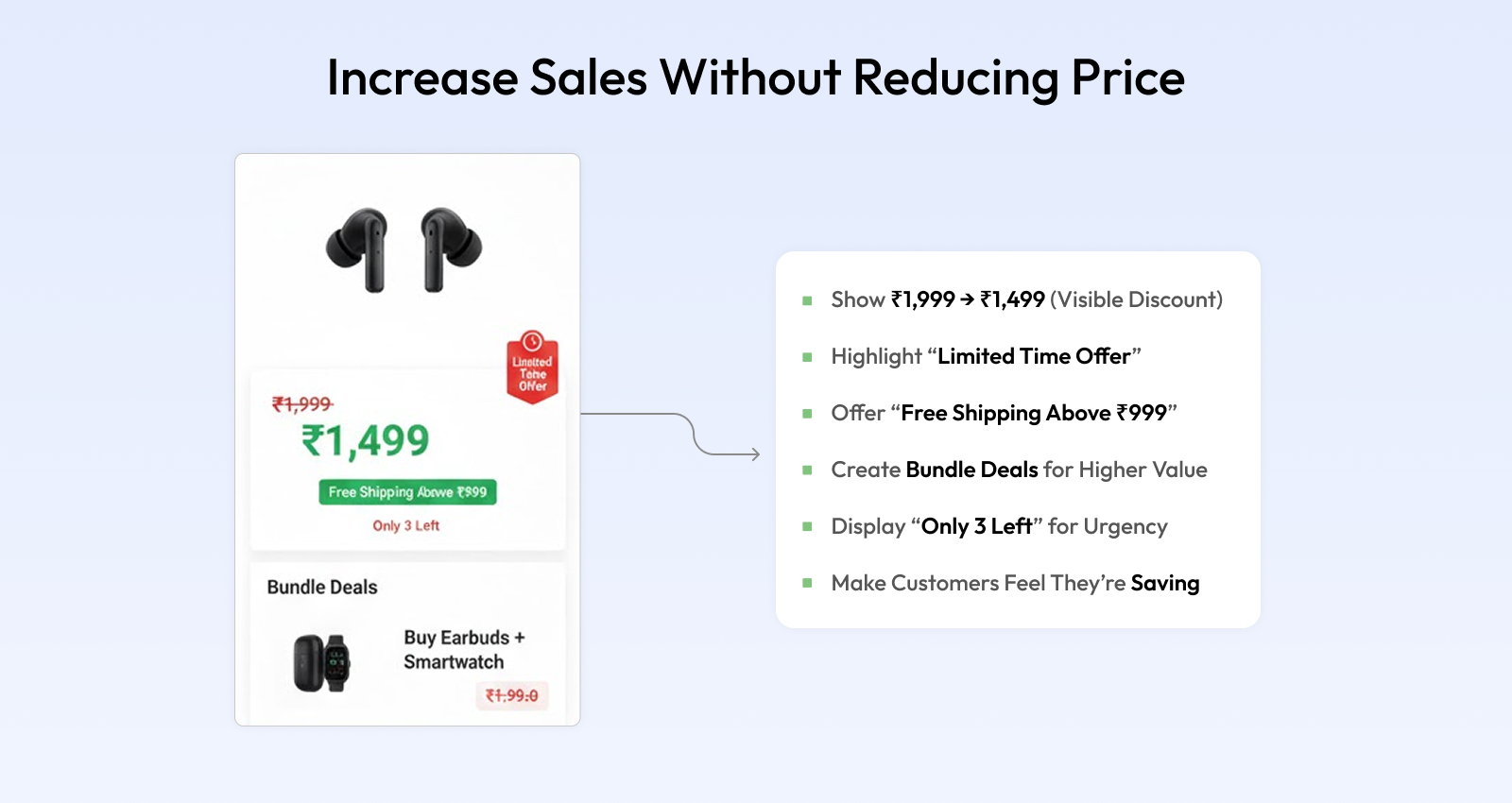
For example, showing the original price next to a discounted price creates perceived value. Highlighting “Limited Time Offer” or “Festive Deal” creates urgency. Offering bundled products increases average order value without aggressive discounting.
Many brands struggle to boost ecommerce sales because they focus only on traffic. But when pricing is positioned strategically, customers feel they are getting a better deal — even if margins remain healthy.
Shopaccino allows structured offer management, coupon systems, and campaign-based pricing. This helps brands create urgency and excitement without constantly reducing prices.
Key Insight:
Customers don’t always buy the cheapest option. They buy the option that feels like the best value.
Impact:
Strategic pricing presentation can increase conversion rate significantly without increasing marketing cost.
Step 5: Reduce Abandoned Cart Rate with Smart Recovery Systems
Cart abandonment is one of the biggest challenges in ecommerce conversion rate India.
Customers add products to cart. They reach checkout. Then they leave.
Why does this happen?
Sometimes they get distracted.
Sometimes they want to compare prices.
Sometimes shipping cost surprises them.
Sometimes payment fails.
To reduce abandoned cart rate, brands must act quickly.
Sending automated reminders through email or WhatsApp brings customers back. Offering a small limited-time incentive can encourage them to complete the purchase.
This is where marketing automation becomes powerful.
Instead of manually following up, automated systems work 24/7. Shopaccino supports abandoned cart recovery tools that help brands re-engage customers automatically.
When customers receive a reminder within a few hours, the chances of recovery increase significantly.
Key Stats:
A large percentage of abandoned carts can be recovered with timely follow-up communication.
Impact:
Reducing abandoned cart rate even by a small percentage can dramatically increase revenue without spending more on ads.
Read Also : Reduce Cart Drop-Offs with Smarter Checkout
Step 6: Build Strong Social Proof Across the Website
In India, word-of-mouth matters.
Even in online shopping, customers rely heavily on reviews, ratings, and testimonials.
If your product pages do not show customer reviews, new visitors hesitate.
Social proof reduces fear.
When customers see that others have purchased and are satisfied, trust increases.
Encourage buyers to leave reviews. Showcase testimonials clearly. Display user-generated images if possible. As review volume grows, managing customer reviews online helps brands keep feedback organized and respond while purchase intent is still high.
Established brands that integrate customer feedback systems see stronger conversion rates.
Shopaccino enables structured product management where reviews and engagement elements can be incorporated easily.
Key Insight:
People trust people more than brands.
Impact:
Strong social proof increases confidence and pushes undecided buyers toward purchase.
Step 7: Personalize the Shopping Experience
Generic websites convert less.
Personalized websites convert more.
When a returning visitor sees relevant product suggestions, recently viewed items, or customized offers, engagement increases.
Indian consumers appreciate personalized recommendations — especially in fashion, electronics, beauty, and home categories.
Personalization helps boost ecommerce sales by making customers feel understood.
For example, showing related products during checkout increases average order value. Offering loyalty points to returning customers encourages repeat purchases.
Shopaccino supports structured marketing automation and reward programs that allow brands to configure personalized engagement strategies.
Impact:
Personalization increases repeat purchase rate and improves customer lifetime value.
Read Also : How AI, AR & Voice are Transforming Online Shopping
Step 8: Improve Trust During Checkout
Many customers abandon purchases at checkout because of last-minute doubts.
They worry about payment security. They hesitate about return policy. They question delivery timelines.
To increase ecommerce conversion rate, checkout must feel secure and transparent.
Clearly display:
Secure payment icons
Refund and return information
Estimated delivery date
Contact support details
Avoid hidden charges. Surprise costs increase abandonment.
Checkout page design should be clean and distraction-free.
Established brands using structured ecommerce platforms like Shopaccino can customize checkout flow to ensure clarity and simplicity.
Key Insight:
Checkout is not just a payment step. It is a trust confirmation step.
Impact:
Improved checkout transparency directly reduces abandoned cart rate.
Step 9: Optimize for Speed and Stability During High Traffic
Indian ecommerce experiences traffic spikes during festivals, sales events, and promotions.
If your website slows down during high traffic, conversion drops instantly.
Performance under load is critical.
Customers do not wait for pages to refresh during flash sales.
A scalable ecommerce website builder ensures smooth performance even during traffic surges.
Shopaccino is designed to support growing brands that experience fluctuating traffic patterns.
Impact:
Stable performance during peak sales events protects revenue and brand reputation.
Step 10: Use Clear Call-to-Action (CTA) Placement
Sometimes conversion problems are simple.
Customers do not know what to do next.
If “Add to Cart” buttons are unclear or placed poorly, conversion drops.
CTAs must be visible, simple, and action-driven.
On mobile devices, buttons should be easy to tap. On product pages, CTAs should stand out visually.
Small design improvements can create noticeable improvements in ecommerce conversion rate India.
Impact:
Clear CTAs reduce confusion and increase buying decisions.
Step 11: Focus on Return and Refund Simplicity
Indian customers are more comfortable buying when return policies are easy.
If return information is hidden or complicated, hesitation increases.
Clearly explain return timelines, refund process, and conditions.
When customers feel safe about returns, they are more likely to purchase.
Brands that simplify return management often see higher conversion rates.
Shopaccino supports structured order and return management, helping businesses maintain operational clarity while building customer trust.
Key Insight:
Easy returns increase buying confidence.
Step 12: Use Data to Make Smart Conversion Decisions
Many brands try random changes and hope conversions improve.
That is not strategy.
If you truly want to increase ecommerce conversion rate, you must rely on data.
Your ecommerce store gives you valuable information every day:
Where visitors come from
Which product pages get most views
Where customers drop off
Which devices convert better
How long users stay on pages
Instead of guessing, analyze patterns.
For example, if many customers reach checkout but don’t complete payment, the issue is checkout friction.
If visitors leave from product pages, the issue is clarity or pricing.
If mobile users convert less than desktop users, the issue is mobile experience.
Established brands must treat conversion optimization as an ongoing process.
Shopaccino provides structured dashboards and performance tracking tools that help businesses monitor key metrics clearly.
Key Insight:
Data removes emotion from decisions. It shows exactly where revenue is leaking.
Impact:
Continuous data analysis can gradually improve conversion rates month after month.
Step 13: Increase Average Order Value Along With Conversion
Sometimes brands focus only on increasing number of buyers.
But increasing average order value (AOV) also boosts ecommerce sales significantly.
When customers add one product, suggest a related item.
Offer bundles at a slightly discounted price.
Provide free shipping above a certain cart value.
Indian buyers respond well to value-based offers.
Instead of pushing heavy discounts, structure your pricing smartly.
When AOV increases along with conversion rate, revenue growth multiplies.
Shopaccino enables brands to configure product bundles, discount rules, and structured promotional campaigns easily.
Impact:
Higher average order value improves profitability without increasing traffic.
Read Also : One-Page or Multi-Step Checkout: Which Should You Use?
Step 14: Build Long-Term Customer Loyalty
If you want sustainable growth in ecommerce conversion rate India, you must focus on loyalty.
A returning customer converts faster than a new visitor.
They trust your brand.
They know your delivery experience.
They understand your product quality.
To boost ecommerce sales consistently, reward repeat customers.
Offer loyalty points.
Create referral programs.
Send personalized offers.
Give early access to new collections.
When customers feel valued, they return.
Shopaccino supports structured loyalty and reward systems that help brands create long-term engagement strategies.
Key Stats:
Repeat customers typically convert at a much higher rate compared to first-time visitors.
Impact:
Strong loyalty programs reduce dependency on expensive paid ads.
Step 15: Reduce Cognitive Overload on Your Website
Sometimes conversion problems are not technical.
They are psychological.
If your website has too many banners, too many offers, too many popups, or too many choices, customers feel overwhelmed.
Indian shoppers like clarity.
Keep your homepage focused.
Highlight bestsellers clearly.
Guide users toward top categories.
Simplification often increases conversion.
Clean layout, focused messaging, and structured navigation reduce confusion.
Shopaccino’s ecommerce framework supports structured design layouts that prioritize clarity and usability.
Key Insight:
When customers feel less confused, they buy faster.
Step 16: Strengthen Customer Support for Faster Decisions
In India, many customers want quick answers before purchasing.
They may have questions about size, delivery time, warranty, or product compatibility.
If support is slow, customers leave.
Adding live chat, WhatsApp support, or quick response systems can reduce hesitation.
Fast support builds trust and helps reduce abandoned cart rate.
Even a simple FAQ section answering common doubts can improve conversion.
Impact:
Quick customer support reduces uncertainty and increases purchase completion.
Step 17: Prepare for Seasonal and Festive Conversion Spikes
Indian ecommerce sees massive spikes during festivals like Diwali, Navratri, Eid, and year-end sales.
During these periods, customers actively look for deals.
If your website is not optimized for high traffic and strong promotional campaigns, you miss opportunity.
Plan seasonal strategies in advance.
Create landing pages.
Promote bundles.
Use urgency timers.
Ensure inventory availability.
A scalable ecommerce website builder like Shopaccino supports campaign management and structured operations during peak demand.
Impact:
Well-planned festive campaigns can increase ecommerce conversion rate significantly within short timeframes.
Common Mistakes That Stop Conversion Growth
Even established brands make errors that hurt performance.
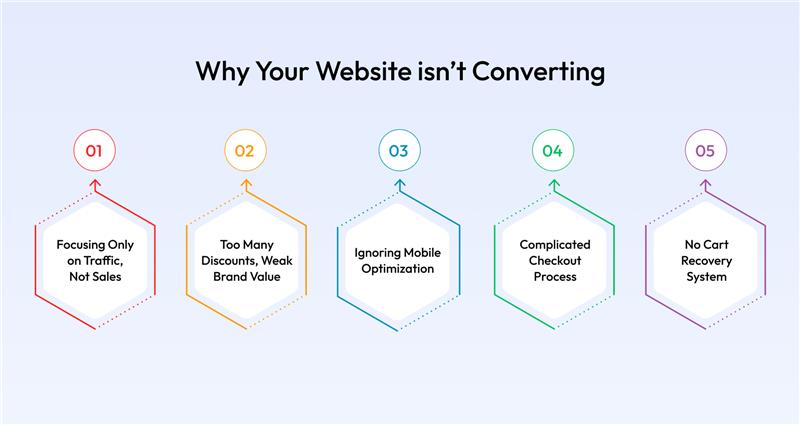
They constantly change design without data.
They offer too many discounts and reduce brand value.
They ignore mobile optimization.
They fail to test checkout improvements.
They focus only on traffic and ignore user experience.
Conversion improvement requires consistency and structured optimization.
Small improvements compound over time.
Can You Really Increase Ecommerce Conversion Rate by 30%?
Yes — but not overnight.
Increasing ecommerce conversion rate by 30% usually happens through combined improvements:
Speed optimization
Checkout simplification
Trust building
Cart recovery
Personalization
Loyalty programs
Data-driven decisions
Each improvement may add 2–5% growth. Together, they create powerful impact.
The key is systematic execution.
Brands that treat conversion optimization as an ongoing strategy see continuous growth.
Final Roadmap for Indian Ecommerce Brands
If your goal is to boost ecommerce sales in India, focus on this framework:
Improve website performance
Build strong product clarity
Reduce abandoned cart rate
Create trust signals
Optimize checkout flow
Leverage automation
Analyze data regularly
Strengthen customer retention
When these elements work together, conversion improves naturally.
Shopaccino provides a structured ecommerce ecosystem that supports performance optimization, marketing automation, loyalty systems, and scalable backend management — all essential for serious brands looking to grow in the competitive Indian market.
Conclusion: Growth Comes From Optimization, Not Just Traffic
In 2026, the brands that win are not the ones with the biggest ad budget.
They are the ones with the smartest conversion systems.
If you focus only on traffic, your marketing cost keeps increasing.
If you focus on conversion, your profitability increases.
Increasing ecommerce conversion rate is the fastest way to improve revenue without increasing ad spend.
And in the competitive ecommerce conversion rate India market, optimization is no longer optional — it is essential.
FAQs
A good ecommerce conversion rate in India usually ranges between 1% to 3%, depending on the industry. However, optimized brands with strong trust signals, fast websites, and smooth checkout systems can achieve higher rates. Continuous testing and improvement help increase ecommerce conversion rate over time.
You can increase ecommerce conversion rate by improving website speed, simplifying checkout, adding social proof, optimizing product pages, and recovering abandoned carts. Small improvements in user experience often generate higher sales without spending extra on marketing campaigns.
Website speed directly impacts user behavior. If your site loads slowly, visitors leave before exploring products. Faster websites improve user experience, reduce bounce rate, and increase purchase completion. Speed optimization is one of the quickest ways to boost ecommerce sales.
To reduce abandoned cart rate, simplify checkout, avoid hidden charges, offer multiple payment options, and send automated reminders through email or WhatsApp. Transparent pricing and clear delivery timelines also help customers complete their purchase confidently.
Yes. Since most Indian users shop through smartphones, mobile optimization is critical. A smooth mobile experience with fast loading, easy navigation, and simple checkout can significantly improve ecommerce conversion rate India and overall revenue performance.
Clear and detailed product descriptions reduce customer doubts and increase buying confidence. When customers understand features, benefits, delivery timelines, and return policies, they are more likely to complete the purchase, which helps increase ecommerce conversion rate.