Inventory Management for E-commerce: Complete Guide for Online Businesses
Running an e-commerce business may look simple from the outside. Products are listed on the website, customers place orders, and shipments go out. But behind that visible process lies one of the most critical elements of online success — inventory control.
The real challenge in e-commerce is not just selling products. It is knowing exactly what you have in stock, where it is stored, how fast it is moving, and when you need to reorder. If you don’t have clarity on these areas, even a high-traffic online store can struggle with profitability.
This is where inventory management for e-commerce becomes the backbone of your operations.
Inventory is not just about counting products. It directly affects cash flow, customer experience, marketing performance, and long-term growth. A single stock mistake can lead to cancelled orders, negative reviews, refund complications, and loss of customer trust.
In today’s competitive digital market, especially in 2026, where ecommerce is expanding rapidly, customers expect accurate stock visibility and fast order fulfillment. They do not tolerate “Out of Stock” messages after payment. They do not forgive delivery delays caused by backend errors. That means your e-commerce inventory management system must be structured, automated, and reliable.
This complete guide will help you understand how inventory works in ecommerce, why manual tracking fails as you scale, and how a modern inventory management system for ecommerce can help online businesses operate smoothly and profitably
Why Inventory Management Is the Backbone of Ecommerce Growth
When ecommerce businesses think about growth, they usually focus on marketing, ads, and website design. But backend operations are what actually sustain growth.
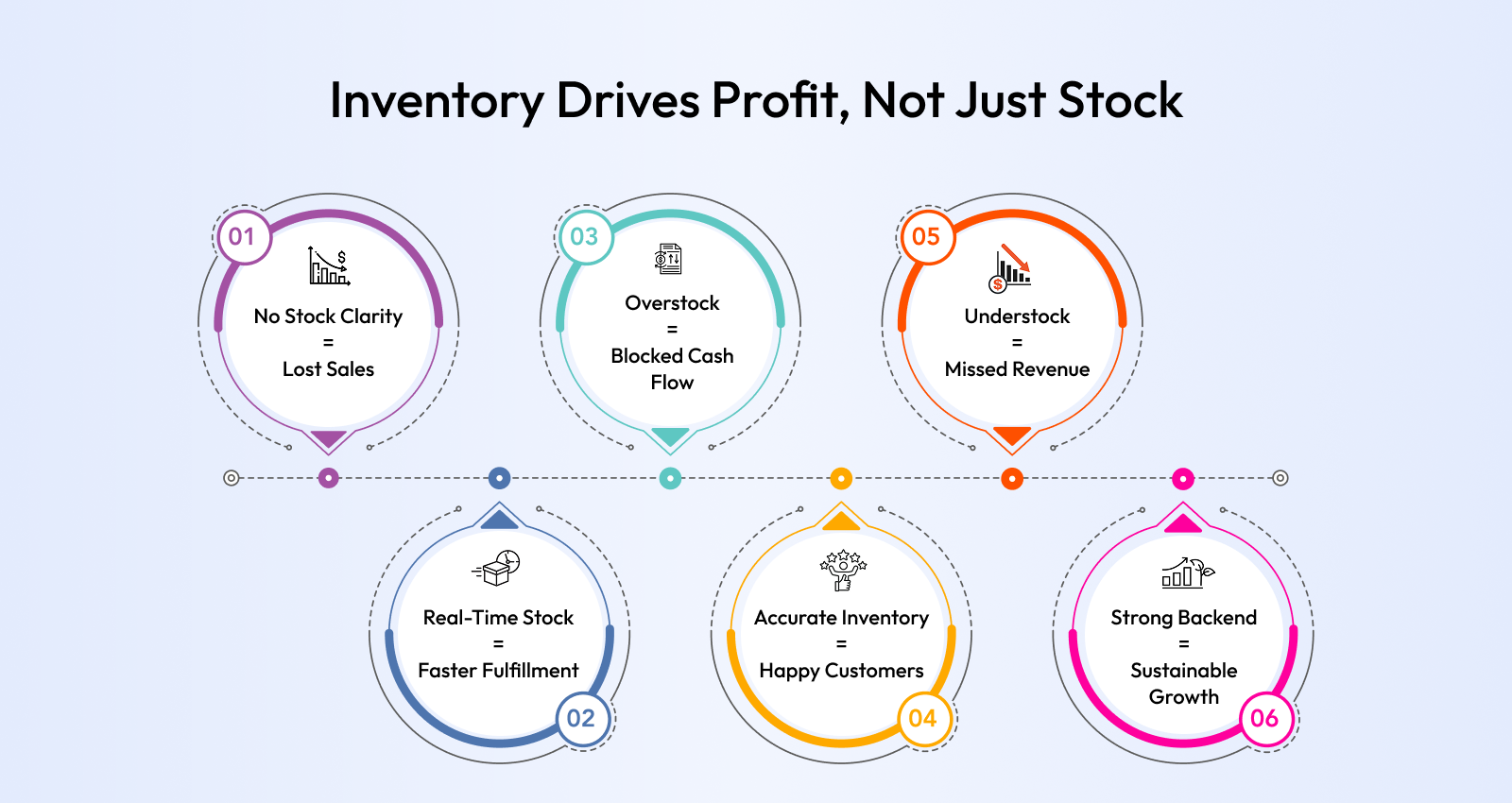
Imagine running a promotional campaign for your bestselling product. Traffic increases. Orders start coming in. But due to inaccurate tracking, your stock runs out faster than expected. Customers continue placing orders even though inventory is no longer available. Now you must cancel orders, issue refunds, and respond to frustrated buyers.
In this situation, marketing performed well. Sales interest was high. But weak stock management for ecommerce destroyed the opportunity.
Inventory mistakes hurt in multiple ways. You may overstock slow-moving products and lock up capital that could have been used elsewhere. Or you may understock fast-moving items and lose potential revenue. Both situations reduce profitability.
An effective online inventory management software ensures that stock levels are visible in real time. It helps you understand which products are selling faster, which variants are nearly exhausted, and which items require restocking.
When inventory is managed properly, marketing becomes more efficient, order fulfillment becomes faster, and customer satisfaction increases.
Understanding How Inventory Flows in an E-commerce Business
To build strong inventory control, you must first understand how products move within your system.
Inventory flow begins when products are procured from suppliers or manufactured. From there, they are stored in warehouses, listed on your ecommerce website, sold to customers, shipped out, and sometimes returned.
Every stage affects stock accuracy.
If inbound inventory is not recorded properly, your available stock becomes inaccurate.
If orders are not deducted instantly, overselling can occur.
If returned items are not updated correctly, your system shows wrong availability.
This is why growing ecommerce businesses cannot rely on spreadsheets for long. Manual tracking may work when product count is small. But as the catalog expands, human error increases.
A structured e-commerce inventory management system ensures real-time synchronization between orders and stock. It allows businesses to monitor inventory movement clearly and avoid unexpected shortages or surplus accumulation.
Shopaccino, for example, supports centralized backend operations where inventory tracking is directly linked with order management. This reduces the gap between what customers see on the website and what actually exists in the warehouse.
The Hidden Costs of Poor Inventory Management
Inventory problems are not always visible immediately. But their financial impact is significant.
Overstocking increases storage cost and blocks working capital. That capital could be used for marketing, new product launches, or operational improvements. When products remain unsold for long periods, businesses often resort to heavy discounting, which reduces margins.
Understocking, on the other hand, leads to missed sales opportunities. Customers who encounter out-of-stock messages may move to competitors and never return.
Another major issue is order cancellation due to stock errors. Each cancellation reduces customer trust. Over time, this affects brand credibility.
A reliable inventory management system for ecommerce prevents these problems by offering real-time updates, low-stock alerts, and structured product-level control.
When inventory is aligned with sales velocity and demand forecasting, businesses maintain balance between availability and profitability.
Managing Product Variants Without Chaos
One of the biggest challenges in ecommerce inventory is handling product variants.
A single product may have multiple sizes, colors, or packaging options. Each variant has its own stock quantity. If these are not tracked separately, errors happen quickly.
For example, if a T-shirt is available in five sizes and two colors, each combination must be tracked independently. If the system does not update correctly, customers may order a size that is no longer available.
An advanced ecommerce inventory management system must track stock at the variant level. It should automatically update availability as soon as orders are placed.
Shopaccino’s backend structure allows businesses to manage complex catalogs with variant-level tracking. This ensures that stock visibility remains accurate across the website.
Multi-Warehouse and Multi-Channel Complexity
Modern ecommerce brands often operate across multiple warehouses or sell through multiple channels.
You may have inventory stored in different cities. You may sell through your own website and marketplaces simultaneously.
In such cases, inventory synchronization becomes critical.
If stock updates in one channel but not in another, overselling can occur. If warehouse allocation is not optimized, delivery delays increase.
A scalable online inventory management software must centralize stock data while allowing warehouse-level visibility.
Shopaccino supports structured inventory tracking that helps businesses manage stock across locations and align it with order processing.
Why Structured Systems Matter for Growing Brands
As ecommerce businesses grow, operational complexity increases.
More products.
More orders.
More returns.
More suppliers.
Without a structured inventory management for ecommerce strategy, operations become reactive instead of proactive.
The goal is not just to know how much stock is available. The goal is to control inventory in a way that supports growth, reduces waste, and improves customer experience.
A modern inventory management system for ecommerce is not just a backend tool. It is a strategic asset.
When inventory is accurate, marketing campaigns perform better. When stock data is reliable, delivery timelines improve. When operations are organized, scaling becomes easier.
Read Also : Your Inventory Can Make or Break Your Ecommerce Sales
Choosing the Right Inventory Management System for Ecommerce
Once your product catalog grows and order volume increases, manual inventory tracking becomes risky. At this stage, selecting the right inventory management system for ecommerce becomes one of the most important decisions for your business.
Many businesses make the mistake of choosing a tool based only on price. But inventory control is not an area where you should compromise.
A strong ecommerce inventory management system must do more than just show stock numbers. It should connect inventory directly with orders, returns, product variants, and warehouse locations. It should update stock automatically when a sale happens. It should reduce manual intervention.
If your system requires constant manual correction, it is not scalable.
Growing brands need a centralized platform where inventory, orders, and operations work together. Shopaccino supports this type of structured integration, helping businesses avoid disconnected tools and data mismatches.
When choosing an online inventory management software, look for automation, real-time updates, reporting visibility, and scalability support.
The right system does not just track stock. It prevents revenue loss.
The Role of Automation in Stock Management for Ecommerce
Automation is the difference between reactive management and proactive control.
Without automation, teams spend hours updating spreadsheets, correcting stock errors, and checking warehouse numbers. This slows down operations and increases human error.
Automation ensures that when an order is placed, stock reduces instantly. When a return is processed, inventory updates correctly. When stock falls below a certain level, alerts notify the team.
This reduces panic situations.
In ecommerce, timing matters. If a product suddenly trends due to marketing or influencer promotion, demand may spike quickly. A structured stock management for ecommerce process ensures that you can track movement in real time and adjust procurement accordingly.
Shopaccino’s backend supports structured automation where inventory levels sync directly with order activity. This reduces operational stress and increases accuracy.
Automation is not just about saving time. It is about preventing costly mistakes.
Understanding Inventory Forecasting for Ecommerce Growth
Forecasting is one of the most overlooked aspects of inventory management for ecommerce.
Many businesses restock based on intuition rather than data.
But ecommerce provides valuable insights. You can track sales history, seasonal spikes, and purchasing patterns. This data should guide your restocking decisions.
For example, if a particular product sells heavily during festive seasons, you should prepare stock in advance. If another product consistently moves slowly, ordering large quantities may create an unnecessary storage burden.
An advanced ecommerce inventory management system helps analyze sales velocity and reorder timing.
Forecasting also protects cash flow. Instead of locking capital in slow-moving stock, businesses can allocate resources strategically.
The goal is balance — not overstocking, not understocking.
Managing Multiple Warehouses Efficiently
As ecommerce brands expand, they often operate from more than one warehouse.
Multiple locations help reduce delivery time and shipping cost. But they also increase complexity.
You must track:
How much stock is available in each warehouse
Which location fulfills which order
How inventory moves between warehouses
How to avoid duplication errors
Without structured control, multi-location operations become chaotic.
A strong inventory management system for ecommerce should provide location-based tracking while maintaining centralized visibility.
Shopaccino supports structured backend management, allowing businesses to maintain operational clarity even when handling multiple storage points.
When warehouse visibility improves, delivery efficiency improves as well.
Read Also : Multi-Warehouse System Simplifies Operations—Effortlessly
Handling Returns and Reverse Logistics Properly
Returns are a natural part of e-commerce.
But if not managed correctly, they create inventory confusion.
When a customer returns a product, the item must be inspected and updated correctly in the system. If it is resellable, stock should increase. If it is damaged, it should be recorded separately.
Without a proper online inventory management software, returned items often remain unaccounted for. This leads to stock mismatches.
Returns also affect forecasting. If a product has a high return rate, future stock planning must consider that factor.
Shopaccino’s integrated order and return management helps businesses track reverse logistics in a structured way, ensuring inventory accuracy remains intact.
Handling returns efficiently improves both financial control and customer trust.
The Importance of Real-Time Reporting
Inventory decisions should not rely on guesswork.
Real-time reports provide clarity.
You should be able to see:
Current stock levels
Low-stock alerts
Top-selling products
Slow-moving items
Stock aging reports
When visibility improves, decision-making improves.
An advanced ecommerce inventory management system offers dashboards that show performance clearly.
This helps businesses identify which products need promotional push and which require restocking urgency.
Shopaccino provides centralized reporting visibility, enabling brands to manage inventory alongside orders and operational metrics.
Data-driven inventory decisions reduce risk.
Scaling Inventory Without Losing Control
As your ecommerce business grows, complexity increases naturally.
More SKUs.
More warehouses.
More marketing campaigns.
More returns.
If your inventory structure is weak, growth will expose its flaws quickly.
Scaling requires systems that can handle:
High order volume
Variant complexity
Multi-channel sales
Seasonal spikes
A scalable inventory management for ecommerce approach ensures that backend operations grow along with frontend sales.
Shopaccino is designed for growing brands that need structured backend control without constant manual oversight.
Inventory should support growth — not restrict it.
Read Also : Easy Multi-Warehouse Management for eCommerce
Avoiding Common Inventory Mistakes
Many ecommerce businesses repeat the same errors.
They ignore data and rely only on intuition.
They delay investing in proper systems.
They separate inventory tracking from order management.
They fail to monitor slow-moving stock.
These mistakes reduce profit margins gradually.
A well-structured stock management for ecommerce system eliminates these weaknesses.
Inventory should not feel stressful. It should feel controlled.
Turning Inventory Into a Growth Engine, Not Just an Operational Task
Many businesses treat inventory as a backend responsibility. Something that needs to be “managed” but not optimized.
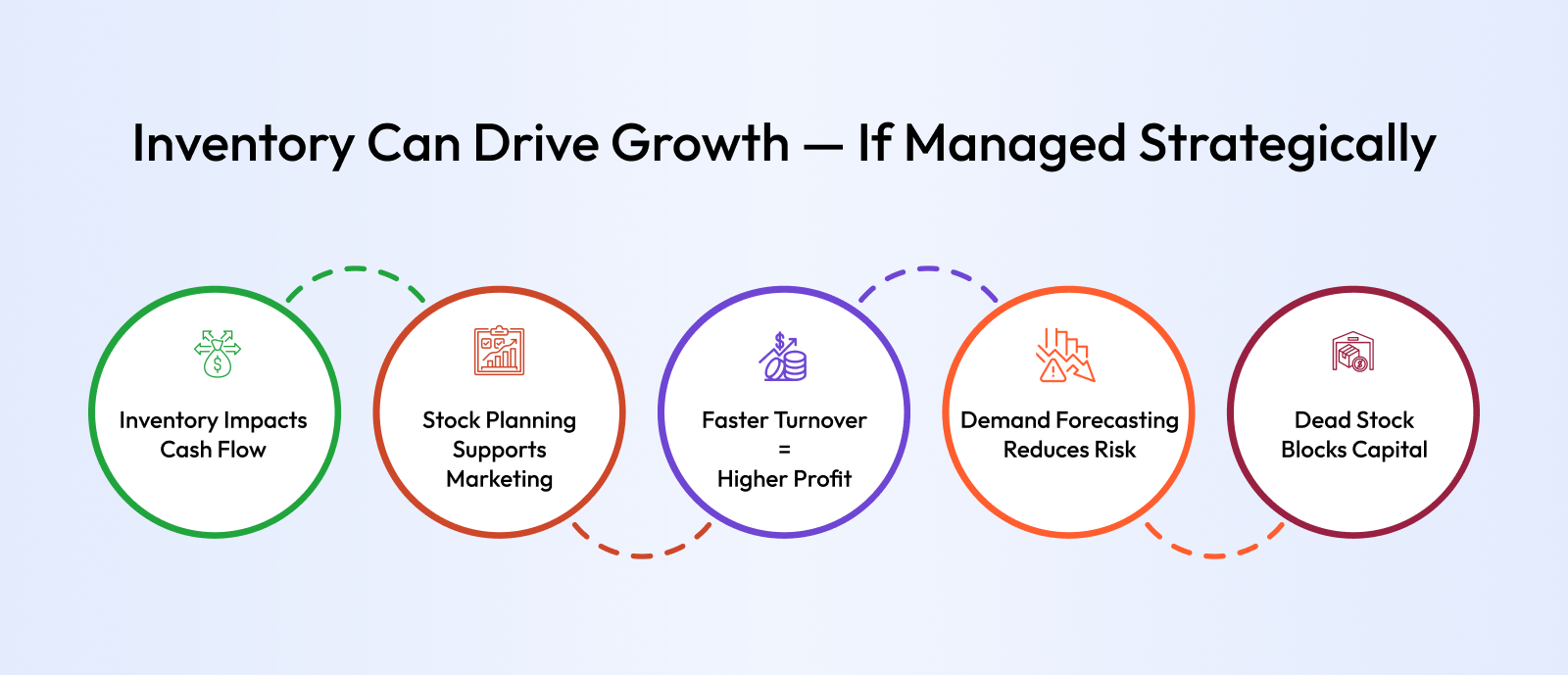
However, in modern ecommerce, inventory management for ecommerce is not just about tracking products. It is about aligning stock strategy with growth strategy.
Inventory directly impacts:
Cash flow
Customer experience
Marketing campaigns
Profit margins
Scalability
When inventory is optimized, everything else performs better.
When it is mismanaged, even strong marketing fails.
To truly improve performance, businesses must move from reactive stock control to proactive inventory planning.
Advanced Inventory Optimization Strategies
Once your basic system is stable, the next step is optimization.
Optimization means improving efficiency, reducing waste, and increasing turnover.
One powerful method is analyzing stock turnover rate. This shows how quickly products sell and how often they are restocked. Products with high turnover indicate strong demand and efficient capital usage. Products with low turnover signal overstocking or weak demand.
A modern e-commerce inventory management system should allow you to track turnover trends over time.
Another advanced approach is safety stock planning. Safety stock acts as a buffer during unexpected demand spikes. Without it, a sudden surge in sales can lead to stockouts. With proper planning, businesses maintain availability even during peak traffic.
Demand-based purchasing is also critical. Instead of ordering fixed quantities every month, analyze historical data and seasonal patterns.
An intelligent inventory management system for e-commerce helps automate these calculations and provide insights instead of raw numbers.
Optimization turns inventory from a cost center into a performance driver.
Connecting Inventory With Marketing Strategy
One of the biggest mistakes ecommerce brands make is separating marketing from inventory planning.
Marketing teams run promotions without checking stock levels. Sales spike, inventory runs out, and customer disappointment follows.
To truly boost revenue, inventory and marketing must work together.
Before launching campaigns:
Check stock availability.
Review supplier lead times.
Forecast expected demand increase.
A structured stock management for ecommerce process ensures that marketing efforts are supported by sufficient inventory.
Shopaccino’s centralized backend allows businesses to align marketing campaigns with available stock, preventing overselling and missed opportunities.
When marketing and inventory operate in sync, conversion rates improve and customer satisfaction increases.
Read Also : Warehouse Automation Guide for Modern Online Stores
Managing Dead Stock and Improving Cash Flow
Dead stock silently reduces profitability.
These are products that remain unsold for long periods. They occupy storage space and block capital.
Without proper reporting, dead stock may go unnoticed.
An advanced online inventory management software should provide aging reports that show how long products have remained in storage.
Once identified, businesses can:
Run clearance promotions
Bundle slow-moving items
Adjust pricing strategy
Improve product positioning
Clearing dead stock improves liquidity and frees capital for better-performing products.
Inventory health directly affects financial health.
Demand Planning for Long-Term Stability
Demand planning is not guessing. It is structured prediction based on data.
By analyzing:
Sales history
Seasonal spikes
Marketing impact
Supplier lead time
Businesses can create a demand forecast model.
For example, if sales double every festive season, inventory planning should reflect that pattern.
An intelligent ecommerce inventory management system provides insights that support data-driven forecasting.
Shopaccino’s structured reporting helps businesses analyze product performance trends and make informed decisions.
Demand planning reduces panic ordering and emergency procurement costs.
Technology Trends in Ecommerce Inventory Management
In 2026 and beyond, technology plays an increasing role in backend optimization.
Modern inventory systems focus on:
Real-time synchronization
Cloud-based access
Automated alerts
Integrated order management
Multi-location tracking
Cloud-based inventory management for ecommerce allows businesses to monitor stock from anywhere. This is especially useful for growing brands managing multiple warehouses.
Automation ensures accuracy. Real-time syncing prevents overselling. Centralized dashboards reduce confusion.
Platforms like Shopaccino combine ecommerce operations and inventory tracking within one ecosystem. This reduces dependency on disconnected third-party tools.
Integrated systems are more efficient and scalable.
Read Also : Simplified COD Orders & Reconciliation
Inventory and Customer Experience: The Hidden Link
Customers may not see your inventory dashboard, but they experience its impact.
When products are always available, delivery is fast, and returns are handled smoothly, customers feel confident.
When stock is inaccurate, deliveries are delayed, and orders are cancelled, customers lose trust.
As order volume grows, inventory accuracy alone is not enough. Brands also need a dependable order fulfillment company that can keep warehouse operations, shipping updates, and returns moving in sync with the store’s inventory data. When fulfillment and inventory systems work together, customers get clearer delivery expectations and fewer order issues, which makes the overall buying experience feel much more reliable. That matters a lot. Even small delays or stock mismatches can quickly affect trust and repeat purchases.As order volume grows, inventory accuracy alone is not enough. Brands also need a dependable order fulfillment company that can keep warehouse operations, shipping updates, and returns moving in sync with the store’s inventory data. When fulfillment and inventory systems work together, customers get clearer delivery expectations and fewer order issues, which makes the overall buying experience feel much more reliable. That matters a lot. Even small delays or stock mismatches can quickly affect trust and repeat purchases.
Accurate inventory management for e-commerce improves:
Delivery timelines
Order accuracy
Refund efficiency
Customer satisfaction
Satisfied customers are more likely to return and recommend your brand.
Inventory excellence leads to brand credibility.
Preparing for Scale Without Chaos
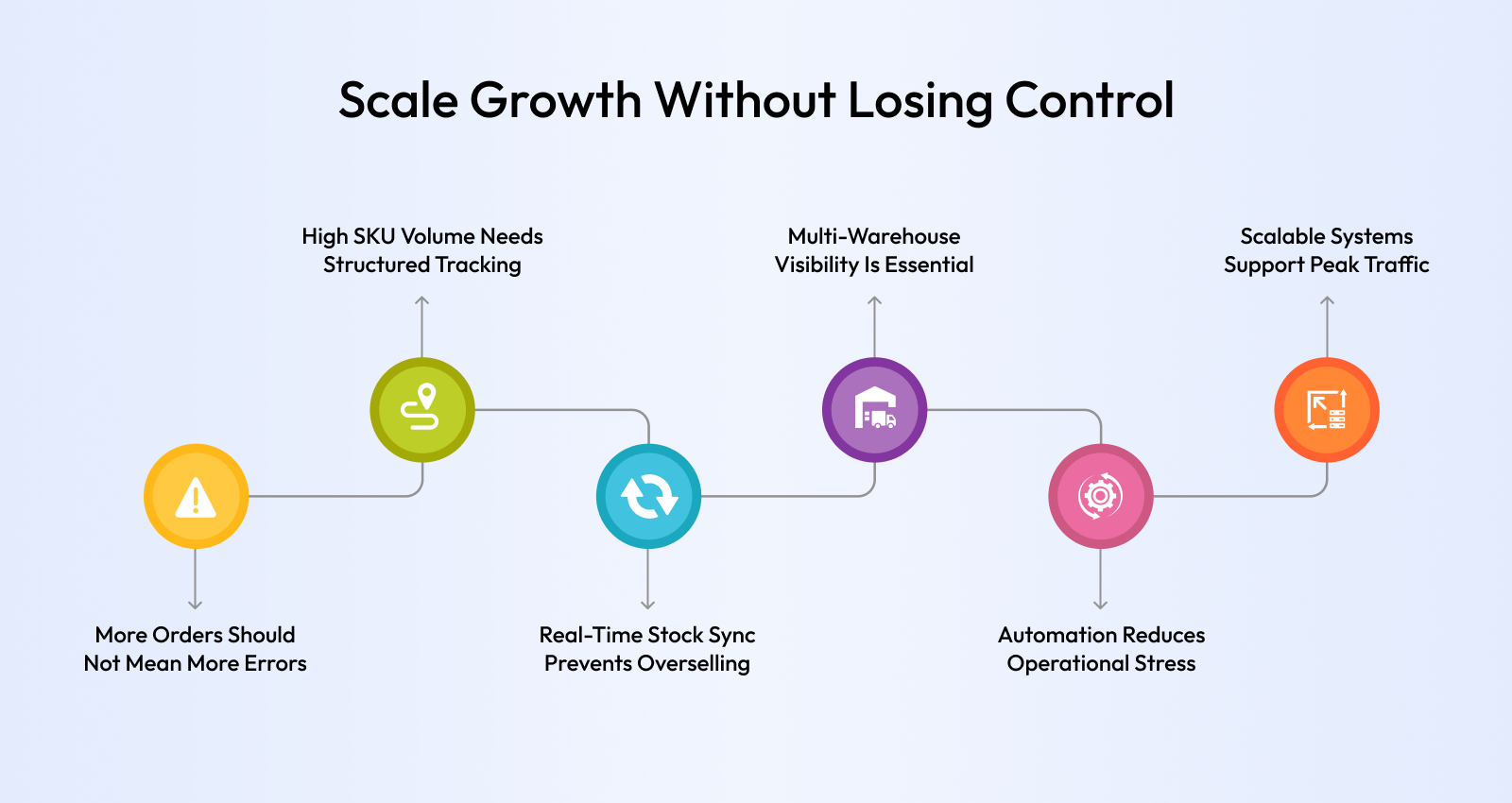
Scaling ecommerce operations without proper inventory control creates operational stress.
As order volume increases, manual corrections become impossible. Errors multiply. Teams struggle to keep up.
A scalable inventory management system for ecommerce must handle:
Thousands of SKUs
Variant-level tracking
Multi-channel integration
High traffic during peak seasons
Real-time updates
Shopaccino is designed to support growing and established businesses with structured backend systems that scale smoothly.
When inventory processes are automated and centralized, businesses grow confidently instead of reactively.
Final Framework for Strong Inventory Management
To build a powerful ecommerce inventory management system, focus on:
Clarity in inventory flow
Real-time stock synchronization
Automation of updates
Forecasting based on data
Variant-level tracking
Multi-location management
Return reconciliation
Marketing alignment
Continuous performance monitoring
When these elements work together, inventory becomes a competitive advantage rather than a daily headache.
Conclusion: Inventory Is Strategy, Not Just Stock
Inventory management is often underestimated in ecommerce.
But the truth is simple.
Without structured inventory management for ecommerce, growth becomes unstable.
With the right system, growth becomes predictable.
A powerful online inventory management software ensures operational clarity.
A scalable ecommerce inventory management system supports long-term expansion.
Strong stock management for ecommerce protects profitability.
Shopaccino provides an integrated ecommerce ecosystem where inventory, orders, returns, and operations work together seamlessly.
If you want your ecommerce business to scale without chaos, inventory must be treated as a strategic pillar — not just a backend task.
FAQs
Inventory management for ecommerce is the process of tracking, organizing, and controlling product stock in an online store. It ensures accurate stock levels, prevents overselling, reduces stockouts, and supports smooth order fulfillment across sales channels.
Proper inventory management prevents order cancellations, improves customer trust, and protects cash flow. When stock levels are accurate and updated in real time, ecommerce businesses can avoid losses caused by overstocking or understocking.
An ecommerce inventory management system is software that tracks stock levels, updates inventory automatically after each order, manages product variants, and synchronizes stock across multiple sales channels. It reduces manual errors and improves operational efficiency.
An inventory management system for ecommerce prevents overselling, identifies slow-moving stock, and provides low-stock alerts. This helps businesses restock at the right time, avoid emergency purchases, and reduce storage and holding costs.
Yes. Modern online inventory management software allows businesses to track stock across multiple warehouse locations. It provides centralized visibility while maintaining location-level control, ensuring accurate order fulfillment and faster delivery.
Effective stock management for ecommerce ensures products are available when customers want to buy them. Accurate stock visibility reduces cancellations and delivery delays, which improves trust and increases repeat purchase rates.