How the Right Grocery App Development Company Helps Businesses Launch Apps
The grocery industry is experiencing one of the biggest digital transformations in retail. For decades, grocery shopping meant visiting nearby stores, selecting products manually, and carrying bags home. While this model still exists, consumer behavior has changed dramatically with the rise of smartphones, digital payments, and on-demand delivery services.
Today, customers expect convenience. They want the ability to browse products, place orders, and schedule deliveries directly from their mobile phones. Instead of spending time in traffic or waiting in checkout lines, people prefer to order groceries through apps and receive them at their doorstep.
This shift has opened new opportunities for grocery retailers, supermarket chains, distributors, and even local neighborhood stores. Businesses that adapt to this trend by investing in grocery delivery app development can expand their reach, increase sales, and build stronger relationships with customers.
However, launching a successful grocery delivery platform requires more than just building a mobile application. Grocery platforms must manage product catalogs, real-time inventory, order processing, delivery logistics, and secure payments.
Shopaccino helps businesses simplify this process by providing a scalable ecommerce platform that supports grocery store management, mobile app integration, and delivery operations. With the right digital infrastructure, grocery retailers can launch their own branded grocery delivery apps without managing complex technical systems.
This is where an experienced Grocery App Development Company becomes essential. The right technology partner helps businesses design scalable grocery platforms that support real-world retail operations.
In this guide, we will explore how the right development partner helps businesses build powerful grocery delivery platforms and launch successful apps in the growing digital grocery market.
The Rapid Growth of Online Grocery Shopping
Online grocery shopping is one of the fastest growing segments of ecommerce worldwide. Several factors have contributed to this rapid growth.
Urban lifestyles have become increasingly busy, leaving people with less time to visit physical stores. Ordering groceries online allows customers to complete their shopping in minutes instead of hours.
At the same time, improvements in internet connectivity and smartphone adoption have made mobile shopping accessible to millions of users. Digital payment systems such as credit cards, mobile wallets, and instant bank transfers have also made online purchases easier and more secure.
Because of these developments, businesses across the world are investing heavily in online grocery shopping app development.
A well-designed Grocery Ecommerce Mobile App allows customers to browse products, compare prices, and place orders conveniently. For grocery retailers, this digital platform becomes a powerful tool for reaching new customers and improving operational efficiency.
Retailers who previously relied only on physical stores are now launching mobile apps to stay competitive in the digital marketplace.
How Grocery Apps Are Transforming Retail Businesses
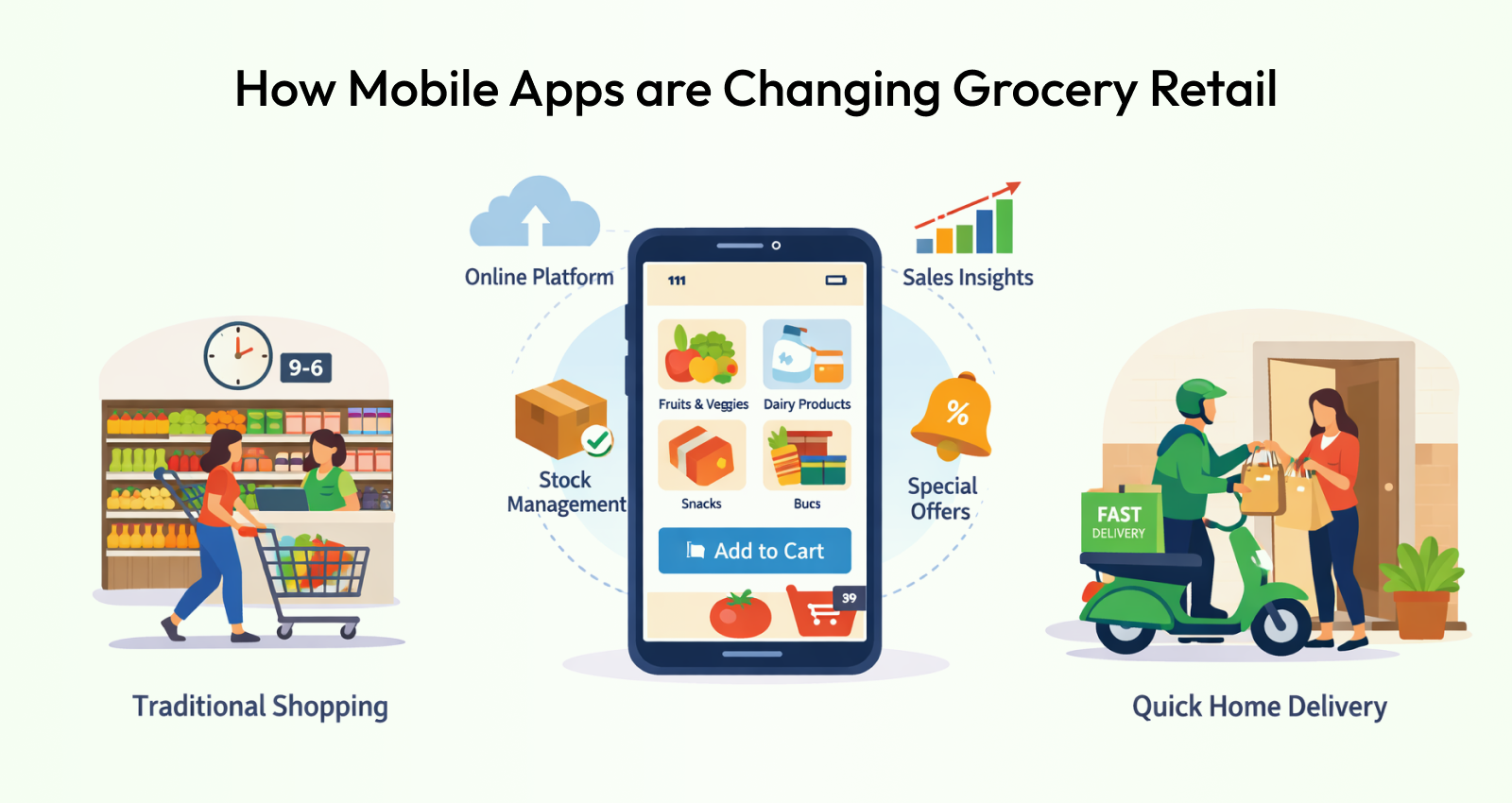
Mobile apps are no longer just an additional sales channel. For many grocery businesses, they have become the central system that manages daily operations.
When businesses invest in grocery mobile app development, they gain the ability to digitize several important processes.
For example, a grocery app can manage product listings, update inventory levels in real time, process customer orders, and coordinate deliveries. Store owners can monitor sales performance, track popular products, and analyze customer buying patterns.
These digital capabilities allow grocery businesses to operate more efficiently and make better decisions.
Another major advantage is customer engagement. A mobile app allows businesses to communicate directly with their customers through push notifications, promotions, and personalized recommendations.
This direct communication channel helps businesses increase repeat purchases and build long-term customer loyalty.
Mobile apps are no longer just an additional sales channel. For many grocery businesses, they have become the central system that manages daily operations.
When businesses invest in grocery mobile app development, they gain the ability to digitize several important processes.
For example, a grocery app can manage product listings, update inventory levels in real time, process customer orders, and coordinate deliveries. Store owners can monitor sales performance, track popular products, and analyze customer buying patterns.
These digital capabilities allow grocery businesses to operate more efficiently and make better decisions.
Another major advantage is customer engagement. A mobile app allows businesses to communicate directly with their customers through push notifications, promotions, and personalized recommendations.
This direct communication channel helps businesses increase repeat purchases and build long-term customer loyalty.
Why Businesses Are Investing in Grocery App Development
The growing demand for online grocery shopping has encouraged businesses of all sizes to explore digital solutions. From small neighborhood stores to large supermarket chains, many retailers are launching mobile apps to serve their customers.
Some of the main reasons businesses are investing in grocery app development in India and globally include:
Read Also: Your Traffic Means Nothing Without Conversions
Expanding Customer Reach
A physical store can only serve customers who live nearby. A mobile app allows businesses to reach customers across a wider geographic area.
Customers can place orders from their homes, offices, or even while traveling. This expanded reach helps businesses increase their potential customer base.
Increasing Order Frequency
When customers install a grocery app on their phone, ordering groceries becomes extremely convenient. Instead of visiting a store, they can reorder products with just a few taps.
This convenience often leads to higher order frequency and increased sales.
Improving Operational Efficiency
Digital platforms automate many operational processes such as order management, billing, and delivery tracking.
Businesses working with an experienced grocery delivery app development company can streamline their operations and reduce manual work.
Access to Customer Insights
A digital platform collects valuable data about customer behavior. Businesses can analyze which products sell the most, when customers place orders, and how purchasing patterns change over time.
These insights help retailers improve product selection and marketing strategies.
Grocery App Development in India: A Growing Market
India has become one of the fastest growing markets for digital grocery platforms. Rapid smartphone adoption, affordable mobile internet, and widespread digital payment systems have accelerated the shift toward online shopping.
Millions of customers in Indian cities now prefer ordering groceries online rather than visiting crowded stores.
Because of this trend, many retailers are actively exploring grocery app development company India solutions.
Local grocery stores, supermarket chains, and emerging ecommerce startups are launching mobile platforms to serve this growing demand.
Working with an experienced grocery app development company India helps businesses build platforms tailored to the Indian market. These platforms support local payment systems, regional language interfaces, and flexible delivery options suitable for different cities.
The Role of a Grocery App Development Company
Launching a grocery delivery platform involves several technical and operational challenges. Businesses must manage product catalogs, synchronize inventory, integrate payment gateways, and coordinate delivery logistics.
An experienced grocery delivery app developer understands these complexities and designs systems that address them effectively.
Professional online grocery app developers typically build three interconnected systems that form the backbone of a grocery platform:
- Customer mobile application
- Admin management dashboard
- Delivery partner application
Together, these systems allow businesses to manage the entire grocery ecosystem efficiently.
For example, when a customer places an order through the mobile app, the system automatically updates inventory, sends order details to store staff, and assigns delivery partners.
This level of automation ensures smooth operations and improves customer satisfaction.
Read Also : Your Checkout is Where Sales are Won or Lost
Grocery App Builder vs Custom Development
Businesses planning to launch grocery platforms often face an important decision: whether to build a custom app or use a ready-made Grocery Delivery App Builder.
Each approach offers different advantages depending on the business goals and available resources.
A grocery app builder provides a pre-built framework that allows businesses to launch apps quickly. These platforms usually include essential ecommerce features such as product catalogs, order management, and payment integration.
On the other hand, custom grocery delivery app development offers greater flexibility and scalability. Businesses can design features specifically tailored to their operations.
An experienced grocery app development company helps businesses evaluate which approach is best suited for their requirements.
Why Choosing the Right Development Partner Matters
Not all app development companies understand the operational complexity of grocery ecommerce.
A grocery platform must support real-time inventory updates, delivery scheduling, multiple payment methods, and large product catalogs.
Working with a specialized grocery delivery app development company ensures that these systems are designed correctly.
The right development partner helps businesses build reliable platforms that can handle increasing order volumes and expanding delivery networks.
For retailers planning long-term digital growth, selecting the right online grocery app development partner can make the difference between success and failure.
Essential Features of a Successful Grocery Delivery App
After understanding why mobile apps are becoming essential for grocery retail businesses, the next important step is identifying the features that make these apps successful.
A grocery delivery platform is much more complex than a standard ecommerce app. It must handle thousands of products, manage real-time inventory, coordinate deliveries, and process payments securely.
When businesses work with an experienced Grocery App Development Company, one of the first steps is defining the core features of the platform. These features ensure that the app provides a seamless shopping experience for customers while also supporting efficient store operations.
A well-designed grocery platform usually includes three main components:
- Customer mobile application
- Admin management dashboard
- Delivery partner application
Each component plays a critical role in the overall grocery ecosystem.
Let’s explore the most important features that every Grocery Ecommerce Mobile App should include.
Read Also : Is Your E-commerce Website Killing Your Sales?
App Features for Customers That Improve the Shopping Experience
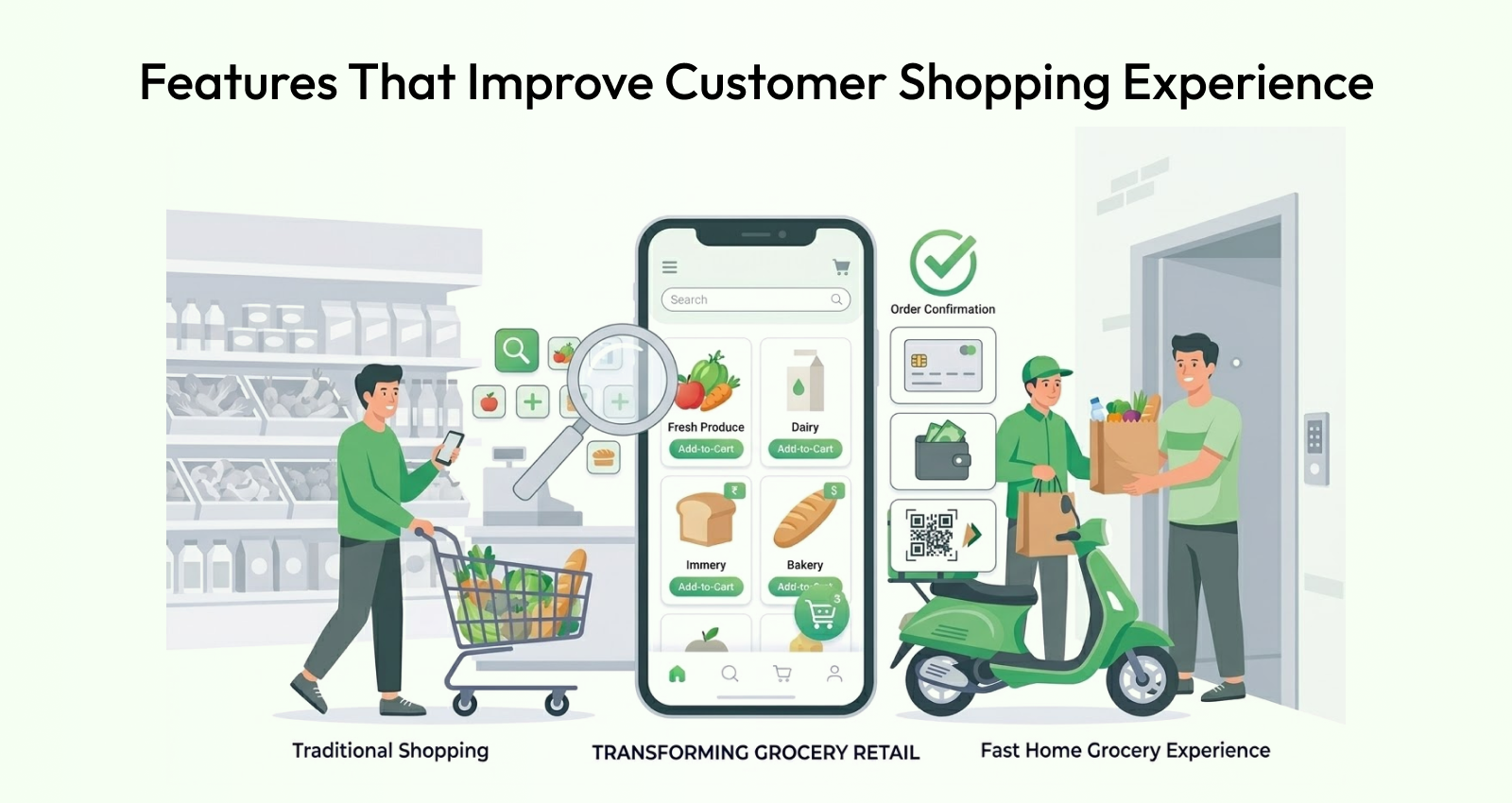
The mobile application is the main touchpoint between a grocery business and its customers. It plays a crucial role in shaping how customers discover products, place orders, and interact with the brand. A well-designed grocery app makes shopping faster, easier, and more convenient, which directly improves customer satisfaction and encourages repeat purchases.
When businesses invest in grocery shopping app development, they must ensure that the mobile app provides a simple and smooth user experience. Customers should be able to search for products, browse categories, add items to their cart, and complete payments without confusion or unnecessary steps. A clear layout, fast loading speed, and easy navigation are essential for keeping users engaged.
Modern online grocery shopping app development platforms focus on creating intuitive interfaces that make digital grocery shopping as convenient as possible. Features such as smart product search, organized product categories, quick checkout options, and secure payment systems help customers complete their purchases quickly and comfortably.
Platforms like Shopaccino simplify this process by providing built-in ecommerce tools that support product catalog management, order processing, and payment integration. With such solutions, businesses can launch a fully functional Grocery Ecommerce Mobile App and focus on delivering a better shopping experience for their customers while growing their online grocery business.
Smart Product Search and Category Navigation
Grocery stores usually offer a large number of products across different categories such as fruits, vegetables, dairy, snacks, beverages, and household essentials.
Without a well-organized product catalog, customers may struggle to find what they need.
A well-designed Grocery Ecommerce Mobile App includes advanced product search and category navigation features.
Customers should be able to search products by name, brand, or keyword. Many modern grocery apps also provide auto-suggestions that display relevant products while users type in the search bar.
Products are usually organized into categories such as:
- Fruits and Vegetables
- Dairy Products
- Packaged Foods
- Snacks and Beverages
- Personal Care
- Household Supplies
This structured organization makes browsing easier and improves the overall shopping experience.
Personalized Shopping Experience
Personalization has become an important feature in modern ecommerce platforms. Customers appreciate apps that remember their preferences and recommend relevant products.
A well-developed grocery platform uses customer purchase history to create a personalized shopping experience.
For example, if a customer regularly buys milk, bread, and eggs every week, the app can suggest these items during their next visit.
Personalized features may include:
- Frequently purchased products
- Smart product recommendations
- Personalized offers and discounts
- Saved shopping lists
Businesses investing in professional online grocery app development often use personalization to increase customer engagement and repeat purchases.
Read Also : When Instagram Stops Scaling Your Business
Easy Cart Management and Quick Checkout
The checkout experience plays a major role in converting users into paying customers.
If the checkout process is complicated or slow, customers may abandon their carts before completing the purchase.
A well-designed grocery app allows users to easily add products to their cart, adjust quantities, remove items, and view their order summary before checkout.
Modern grocery delivery app development platforms also support features such as quick reorder options.
This feature allows customers to reorder previously purchased items with a single tap, saving time and making the shopping process more convenient.
Multiple Secure Payment Options
Payment flexibility is another important factor that influences customer satisfaction.
Customers prefer having multiple payment options so they can choose the method that is most convenient for them.
A professionally built Grocery Ecommerce Mobile App typically supports several payment methods such as:
- Credit and debit cards
- Mobile wallets
- UPI payments
- Net banking
- Cash on delivery
Secure payment gateway integration ensures that all transactions are processed safely.
Businesses working with a reliable grocery delivery app development company can integrate trusted payment systems that protect customer data and build trust.
Real-Time Order Tracking
Customers expect transparency when ordering groceries online. They want to know when their order has been confirmed, when it is being prepared, and when it will arrive.
Real-time order tracking allows customers to monitor the progress of their deliveries.
Through integrated logistics systems, customers can view updates such as:
- Order confirmed
- Order packed
- Out for delivery
- Delivered successfully
Push notifications can also inform customers about delivery updates and estimated arrival times.
Real-time tracking is one of the most important features of successful grocery mobile app development projects.
Admin Panel Features for Grocery Store Management
While customers interact with the mobile app, store owners manage operations through the admin dashboard.
A professional grocery app development company builds powerful admin panels that allow businesses to control their entire grocery platform from a single interface.
The admin dashboard typically includes tools for product management, order processing, and performance analytics.
Read Also : Choosing the Right Ads to Grow Your Ecommerce Business
Product and Inventory Management
Grocery stores handle a constantly changing inventory. Fresh products may run out quickly, and new products are added regularly.
The admin panel allows store owners to manage product details such as:
- Product names and descriptions
- Pricing information
- Product images
- Stock availability
Real-time inventory updates ensure that customers only see products that are currently available.
This feature is particularly important for businesses investing in online grocery store development.
Order Management System
An efficient order management system helps grocery businesses process orders quickly and accurately.
When customers place orders through the mobile app, the admin panel displays complete order details.
Store staff can then prepare the order, update its status, and assign it to delivery personnel.
Many advanced grocery delivery app developers also integrate automated workflows that simplify order processing and reduce manual work.
Sales Analytics and Business Insights
Data analytics is one of the most powerful tools available to modern grocery businesses.
The admin dashboard can provide valuable insights such as:
- Most popular products
- Peak ordering times
- Customer purchasing patterns
- Delivery performance metrics
- Revenue trends
These insights help businesses make better inventory decisions and improve their marketing strategies.
Businesses investing in grocery mobile app development often rely on these analytics tools to grow their operations.
Delivery Partner App Features
Efficient delivery operations are essential for maintaining customer satisfaction.
Delivery personnel use a dedicated mobile application that helps them manage delivery assignments and track routes.
This delivery app ensures that orders move smoothly from the store to the customer.
Read Also : Accurate Billing From Delivery to Payment
Delivery Assignment and Route Optimization
Once an order is packed, the system assigns it to a delivery partner.
The delivery partner receives order details such as pickup location, delivery address, and customer contact information.
Integrated navigation tools help delivery personnel find the fastest route to the destination.
Professional grocery delivery app developers often integrate route optimization technology to improve delivery efficiency.
Delivery Status Updates
Delivery partners can update the order status through the delivery app.
These updates automatically appear in the customer app, allowing customers to track their orders in real time.
This transparency improves customer satisfaction and reduces support queries.
Grocery App Builder vs Custom Grocery App Development
Businesses launching grocery platforms often need to decide whether to use a Grocery Delivery App Builder or invest in custom development.
Both options have advantages depending on business requirements.
|
Factor |
Grocery App Builder |
Custom Grocery App Development |
|
Development Time |
Faster launch |
Longer development timeline |
|
Cost |
Lower initial cost |
Higher development investment |
|
Customization |
Limited customization |
Fully customizable features |
|
Scalability |
Suitable for small businesses |
Highly scalable |
|
Feature Control |
Predefined features |
Complete feature flexibility |
Many startups begin with a grocery mobile app builder to launch quickly, while larger businesses prefer custom grocery delivery app development for long-term scalability.
Many modern ecommerce platforms such as Shopaccino support multiple grocery business models including single-store apps, hyperlocal delivery platforms, and multi-vendor marketplaces. This flexibility allows grocery businesses to choose the model that best fits their operations and growth strategy.
Why Feature Planning Is Important
Choosing the right features is one of the most critical steps in online grocery app development.
The features of the platform should support both customer convenience and business efficiency.
An experienced grocery app development company India helps businesses prioritize features that align with their operational goals and customer expectations.
Proper feature planning ensures that the grocery platform is reliable, scalable, and capable of handling high order volumes.
Grocery App Business Models – Choosing the Right Approach
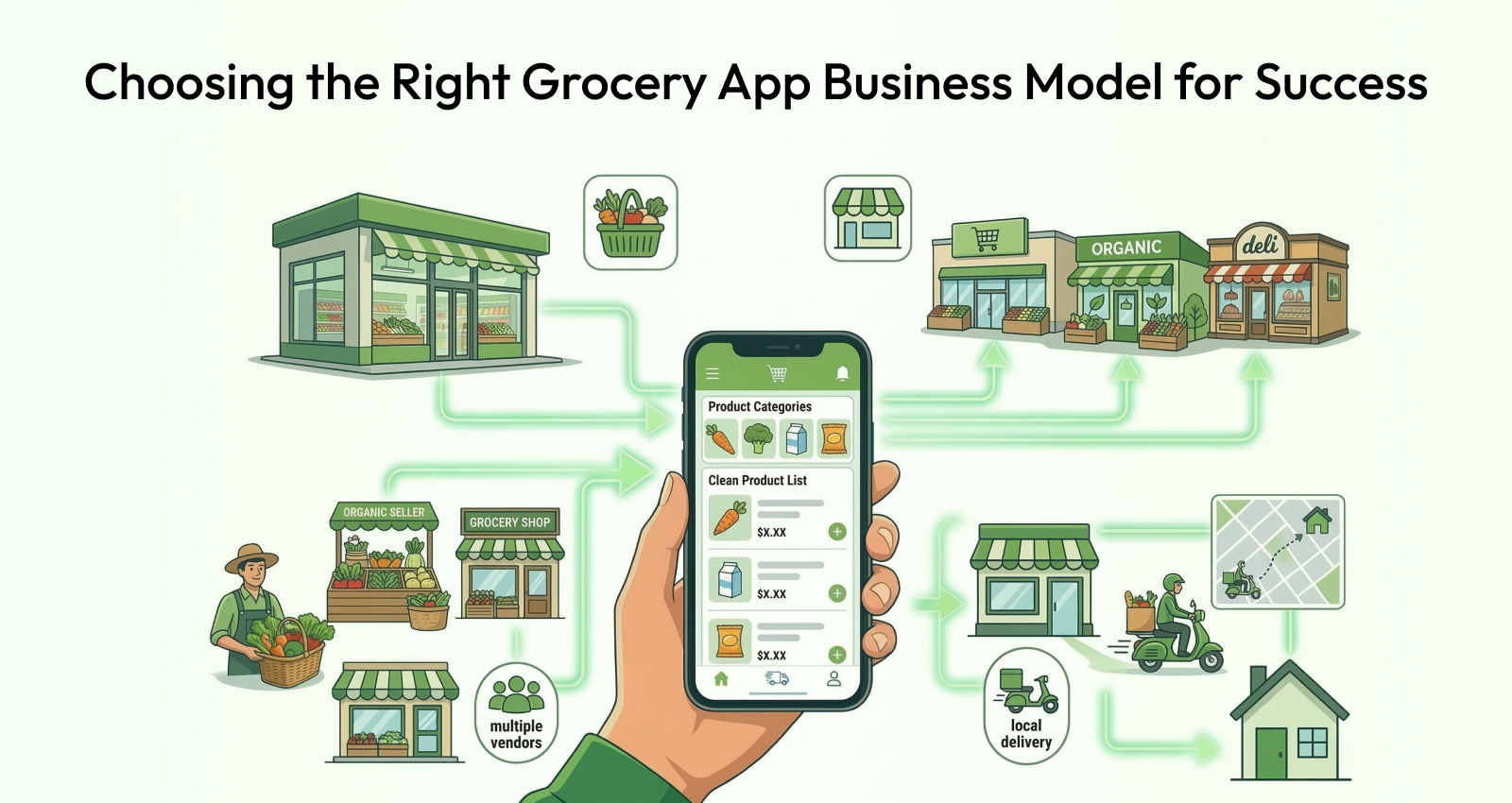
When businesses decide to launch a grocery delivery platform, one of the most important decisions they must make is selecting the right business model. The structure of a grocery platform determines how products are sourced, how orders are processed, and how the business generates revenue.
Many entrepreneurs focus only on the technical side of grocery delivery app development, but the long-term success of the platform depends heavily on choosing a model that aligns with the business strategy.
An experienced Grocery App Development Company usually helps businesses analyze their target market, operational capabilities, and growth plans before deciding on the most suitable model.
Some grocery apps represent a single retail store, while others operate as marketplaces connecting multiple vendors and customers. Each model offers unique advantages depending on the scale and goals of the business.
Understanding these models helps businesses design a more effective Grocery Ecommerce Mobile App.
Read Also : From ₹1L to ₹1Cr in Ecommerce Sales
Single Store Grocery Delivery Apps
The single-store model is one of the most common approaches used by grocery retailers entering the digital market.
In this model, the mobile app represents a specific grocery store or supermarket brand. Customers browse products from that store, place orders through the app, and receive deliveries directly from the store’s inventory.
Many traditional retailers adopt this approach when transitioning into digital commerce through online grocery store development.
One of the biggest advantages of this model is complete control over operations. Businesses manage their own product catalogs, pricing strategies, inventory, and delivery services.
For established retailers, launching a grocery app through grocery mobile app development helps strengthen their brand identity while providing customers with a convenient ordering experience.
Single-store platforms are also easier to manage because all orders are fulfilled from one inventory source.
Local grocery stores, supermarket chains, and specialty food retailers often choose this model when working with a grocery app development company India.
Multi-Store Grocery Platforms
A multi-store grocery platform connects several grocery retailers within a single application.
Instead of representing one store, the platform allows customers to browse products from multiple nearby stores and choose where they want to purchase their groceries.
This model is commonly used by grocery aggregators and regional ecommerce startups.
Customers benefit from greater product variety and price comparison options. Businesses operating the platform can generate revenue through commissions, delivery charges, or service fees.
Building such platforms requires more advanced grocery delivery app development because the system must manage multiple vendors, product catalogs, and order workflows.
An experienced grocery delivery app development company builds vendor management systems that allow each store to manage its own products and orders independently.
Multi-store platforms are particularly effective in urban markets where customers have access to many grocery retailers.
Read Also : Faster Mobile Shopping for Fashion Brands
Marketplace Grocery Delivery Apps
Marketplace grocery platforms are more complex and scalable compared to single-store or multi-store apps.
In this model, the platform acts as a digital marketplace where different sellers can list their products. These sellers may include grocery stores, organic food suppliers, farmers, and specialty food vendors.
Customers can browse products from multiple sellers and place orders through a single mobile application.
Developing a marketplace requires advanced grocery mobile app development because the system must support multiple stakeholders including vendors, customers, and delivery partners.
Each vendor typically has access to a dedicated dashboard where they can manage product listings, update prices, track inventory, and process orders.
Professional online grocery app developers design marketplace platforms with features such as vendor onboarding, commission management, and automated payment settlements.
While marketplace platforms require more technical investment, they offer significant growth potential.
Hyperlocal Grocery Delivery Platforms
Hyperlocal grocery platforms focus on delivering groceries from nearby stores within a limited geographic area.
In this model, customers place orders through the mobile app and the system connects them with the nearest available grocery store.
Hyperlocal delivery services prioritize speed and convenience. Customers expect deliveries within a short timeframe, often within one or two hours.
Developing hyperlocal systems requires strong logistics integration. A professional grocery delivery app developer integrates features such as location tracking, delivery route optimization, and real-time inventory updates.
Many businesses exploring grocery app development in India are adopting hyperlocal models because they align well with urban consumer behavior.
Cities with high population density are particularly suitable for hyperlocal grocery platforms.
Subscription-Based Grocery Delivery Platforms
Another emerging model in online grocery app development is subscription-based grocery delivery.
Instead of placing individual orders each time, customers subscribe to regular deliveries of essential items such as milk, vegetables, fruits, or packaged groceries.
This model offers convenience for customers while providing predictable revenue streams for businesses.
Customers can choose delivery schedules such as daily, weekly, or monthly deliveries.
A well-designed Grocery Ecommerce Mobile App supports subscription management features such as recurring billing, delivery scheduling, and subscription modifications.
Businesses selling fresh produce, dairy products, or organic groceries often benefit from subscription-based grocery platforms.
Working with an experienced grocery app development company ensures that subscription features are implemented effectively.
Read Also : Faster Dealer Approvals in Wholesale
Comparison of Grocery Delivery Business Models
Understanding the differences between these models can help businesses make better strategic decisions.
|
Business Model |
Description |
Best For |
Operational Complexity |
Scalability |
|
Single Store App |
One retailer sells through its own app |
Local grocery stores, supermarket chains |
Low |
Moderate |
|
Multi-Store Platform |
Multiple stores sell through one platform |
Regional grocery aggregators |
Medium |
High |
|
Marketplace Platform |
Multiple vendors and sellers |
Large ecommerce platforms |
High |
Very High |
|
Hyperlocal Delivery |
Orders fulfilled by nearby stores quickly |
Urban quick delivery services |
Medium |
High |
|
Subscription Grocery |
Recurring deliveries of essential items |
Dairy and fresh produce businesses |
Medium |
Moderate |
Each model serves different business objectives, and the right choice depends on the company’s operational resources and growth strategy.
How to Choose the Right Grocery App Model
Selecting the right business model requires careful evaluation of several factors.
Businesses should consider their existing infrastructure, delivery capabilities, and target audience.
For example, retailers with established stores may find it easier to launch single-store grocery apps. Entrepreneurs entering the grocery delivery market without their own inventory may prefer marketplace or multi-store platforms.
Delivery logistics is another important consideration. Businesses targeting fast delivery services may benefit from hyperlocal models.
Working with experienced grocery delivery app developers allows businesses to evaluate these options and design a platform that supports their long-term strategy.
Choosing the right model ensures that the online grocery shopping app development project aligns with the company’s growth plans.
Why Business Model Planning Matters
The business model influences several important aspects of the platform, including platform architecture, vendor management systems, revenue strategies, and delivery logistics.
An experienced grocery app development company India helps businesses plan these aspects carefully before starting development.
A well-structured online grocery app development strategy ensures that the platform is scalable and capable of handling future growth.
Without proper planning, businesses may face operational challenges after launching their grocery platform.
Read Also : B2B Ecommerce for Manufacturers & Wholesalers
How to Choose the Right Grocery App Development Company
Launching a grocery delivery platform is a major investment for any retail business. While many companies focus on features and design, the most important factor that determines the success of a grocery platform is the development partner behind it.
A reliable Grocery App Development Company does more than just build a mobile application. It helps businesses design a complete digital ecosystem that supports product management, inventory updates, order processing, delivery coordination, and customer engagement.
The grocery ecommerce industry has unique operational challenges. Businesses must handle thousands of products, manage perishable inventory, coordinate delivery schedules, and process payments securely.
Because of these complexities, choosing the right partner for grocery delivery app development becomes a critical decision.
Working with an experienced development partner ensures that the platform is scalable, reliable, and capable of supporting long-term growth.
Industry Experience and Grocery Domain Expertise
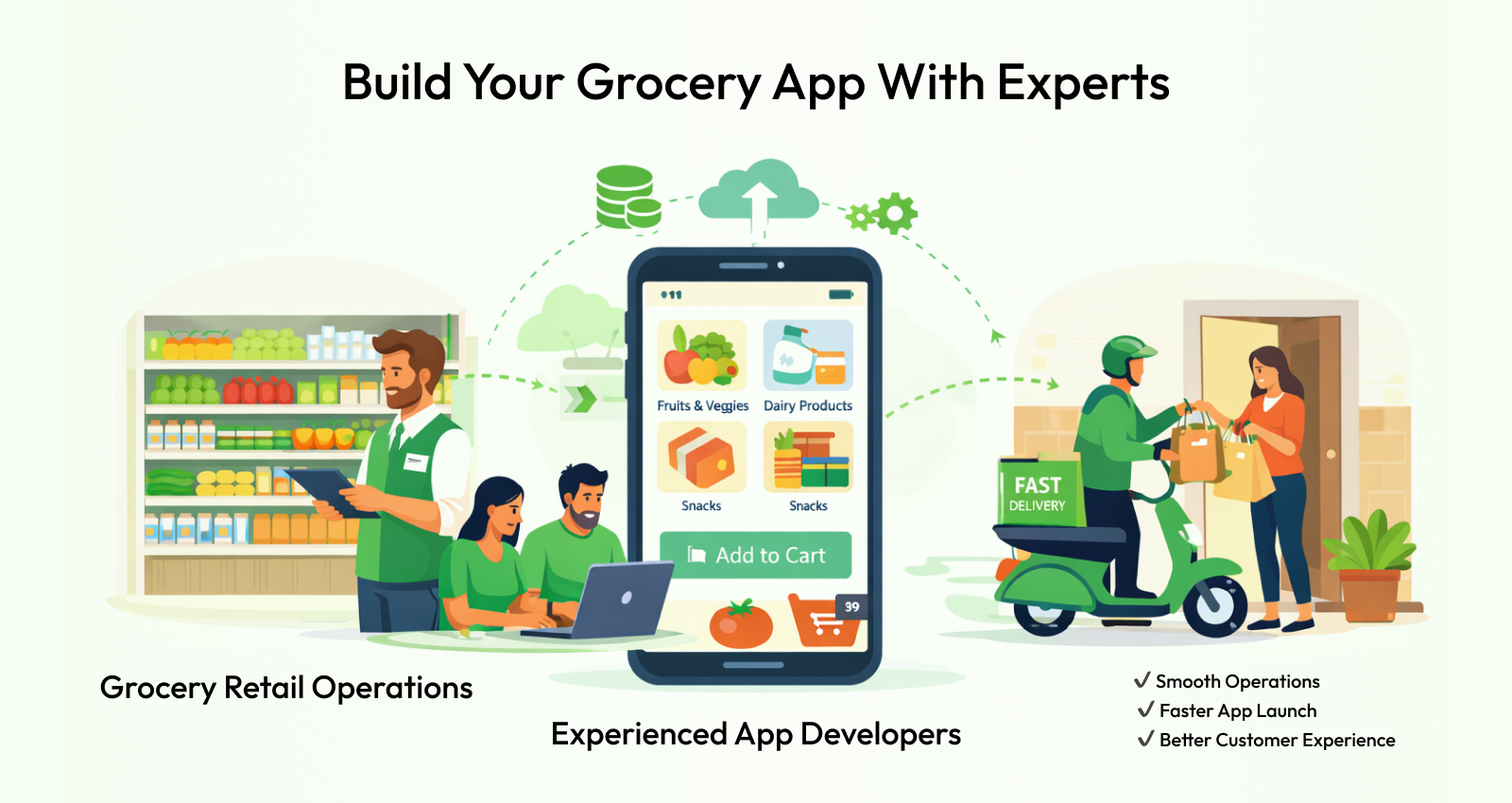
One of the first factors businesses should evaluate when selecting a grocery app development company is industry experience.
Not all mobile development agencies understand the operational requirements of grocery ecommerce. Grocery platforms involve real-time inventory management, order fulfillment systems, delivery tracking, and customer communication tools.
A development company with experience in online grocery shopping app development understands these requirements and designs platforms accordingly.
For example, grocery stores often deal with constantly changing stock levels. Products such as fruits, vegetables, and dairy items may go out of stock quickly.
A professional grocery delivery app developer builds systems that update inventory automatically to prevent customers from ordering unavailable products.
This level of operational understanding is essential for building a successful grocery platform.
Technology Infrastructure and Platform Scalability
Another important factor when choosing a grocery delivery app development company is the technology stack used to build the platform.
Grocery apps often experience traffic spikes during peak shopping hours, holidays, and promotional campaigns. If the platform is not built with scalable infrastructure, it may slow down or crash during high demand.
Experienced online grocery app developers use cloud-based architecture that allows the system to scale automatically as traffic increases.
Scalable infrastructure also supports business expansion. A grocery platform may start in one city but later expand to multiple regions.
A well-designed Grocery Ecommerce Mobile App should be able to handle:
- Multiple store locations
- Large product catalogs
- High order volumes
- Multiple delivery zones
Businesses working with professional grocery mobile app development teams benefit from platforms that can grow along with their operations.
Customization and Business Flexibility
Every grocery business operates differently. Some stores specialize in fresh produce, while others offer thousands of packaged products and household items.
Because of these differences, customization is an essential feature of modern grocery platforms.
A professional grocery app development company India provides flexible customization options that allow businesses to configure their platform according to their operational needs.
For example, grocery platforms may require features such as:
- Same-day delivery services
- Scheduled delivery slots
- Subscription-based grocery orders
- Bulk ordering options
- Discount campaigns and loyalty rewards
Custom development ensures that the platform supports the business model rather than forcing businesses to adjust their operations.
This flexibility is one of the major advantages of working with experienced online grocery app development teams.
Read Also : Ecommerce Trends Defining Online Store Success in 2026
Integration with Business Systems
Modern grocery platforms rarely operate as standalone applications. They typically integrate with multiple business systems to ensure smooth operations.
For example, a grocery app may need to integrate with:
- Payment gateways
- Inventory management systems
- Delivery management tools
- Customer relationship management platforms
- Marketing automation systems
A skilled grocery delivery app development company ensures that these integrations work seamlessly.
Proper system integration reduces manual work and improves operational efficiency.
For example, when a customer places an order through the app, the system can automatically update inventory, generate invoices, and notify delivery personnel.
Such automated workflows are essential for successful online grocery store development.
Security and Payment Protection
Security is one of the most critical aspects of any ecommerce platform. Grocery apps handle sensitive customer information including delivery addresses, phone numbers, and payment details.
A professional grocery app development company implements strong security measures to protect customer data.
These security measures may include encrypted data storage, secure authentication systems, and trusted payment gateway integrations.
Businesses that invest in secure grocery mobile app development build stronger trust with their customers and reduce the risk of fraud or data breaches.
Post-Launch Support and Continuous Improvement
Launching a grocery app is only the first step in the digital journey. After the platform goes live, businesses need continuous technical support to maintain performance and introduce new features.
Customer expectations evolve quickly, and grocery platforms must adapt to new market trends.
A reliable grocery delivery app development company provides ongoing services such as:
- Bug fixes and performance optimization
- Security updates
- Feature enhancements
- System monitoring
Long-term support ensures that the platform remains competitive and continues to deliver a smooth user experience.
Businesses that maintain strong relationships with their grocery delivery app developers often achieve better long-term results.
Comparison: Choosing the Right Development Partner
To better understand what businesses should look for in a development partner, the table below compares experienced development companies with inexperienced ones.
|
Evaluation Factor |
Professional Grocery App Development Company |
Inexperienced Development Partner |
|
Industry Knowledge |
Deep understanding of grocery ecommerce |
Limited domain expertise |
|
Platform Scalability |
Cloud-based scalable infrastructure |
Basic system architecture |
|
Customization |
Flexible and customizable features |
Limited feature flexibility |
|
Integration Capabilities |
Supports multiple system integrations |
Limited integration options |
|
Security |
Strong security protocols |
Weak security practices |
|
Post-Launch Support |
Continuous updates and maintenance |
Minimal support after launch |
This comparison highlights why choosing the right grocery app development company is essential for building a reliable grocery platform.
Questions Businesses Should Ask Before Hiring Developers
Before selecting a development partner, businesses should ask several important questions.
These questions help determine whether the company has the expertise required to build a scalable grocery platform.
Some important questions include:
- Does the company have experience in grocery delivery app development?
- Have they previously worked on online grocery app development projects?
- Can the platform handle large product catalogs and high order volumes?
- Does the company provide customizable grocery app builder solutions?
- What type of post-launch support is available?
These questions help businesses identify the most suitable development partner for their grocery platform.
Why the Right Development Partner Becomes a Long-Term Technology Partner
When businesses work with the right grocery delivery app developer, the relationship often extends beyond the initial project.
As the business grows, the platform may require new features such as multi-location operations, subscription services, advanced analytics, and marketing automation.
A capable grocery delivery app development company helps businesses implement these upgrades smoothly.
This long-term collaboration allows businesses to continuously improve their Grocery Ecommerce Mobile App and maintain a competitive advantage.
Read Also : Scale Your Online Kirana, The Right Way
The Step-by-Step Process of Grocery App Development
After choosing the right business model and selecting a reliable Grocery App Development Company, the next step is understanding how a grocery delivery platform is actually built.
Developing a grocery app involves much more than designing a mobile interface. A complete platform must integrate multiple systems including customer apps, admin dashboards, inventory management tools, payment gateways, and delivery tracking systems.
A professional grocery delivery app development company follows a structured development process to ensure that the platform is stable, scalable, and capable of handling real grocery operations.
Understanding this process helps businesses plan their digital strategy more effectively and avoid common development challenges.
Let’s explore the key stages involved in online grocery app development.
Market Research and Business Planning
Every successful grocery platform begins with strong research and planning. Before development starts, businesses must clearly define their goals, target customers, and operational model.
During this stage, businesses analyze market demand, customer expectations, and competitor platforms. This research helps identify what features and services the grocery app should offer.
An experienced grocery app development company India often assists businesses with this planning phase. They help identify opportunities in the market and determine the best technical approach for the project.
Some important questions businesses consider during this stage include:
- Who are the target customers for the app?
- Which geographic areas will the platform serve?
- What product categories will be available?
- What delivery options will customers expect?
- Which payment methods should be supported?
Proper planning ensures that the Grocery Ecommerce Mobile App is designed around real business requirements.
Designing the Platform Architecture
Once the planning stage is complete, the next step is defining the platform architecture.
A modern grocery delivery platform usually consists of several interconnected components:
- Customer mobile application
- Admin management dashboard
- Delivery partner application
- Backend infrastructure
An experienced grocery delivery app developer designs these systems so they communicate smoothly with each other.
For example, when a customer places an order through the mobile app, the backend system must update inventory levels, notify store staff, and assign delivery personnel automatically.
This integrated architecture allows businesses to manage operations efficiently.
Professional online grocery app developers focus heavily on scalability during this stage to ensure that the platform can support future growth.
Read Also : Build & Scale Your Online Store in India
User Experience and Interface Design
The user experience of a grocery app plays a major role in customer satisfaction. Even the most powerful backend system cannot compensate for a confusing or slow mobile interface.
This is why grocery shopping app development begins with detailed UI and UX design.
Design teams create wireframes and prototypes that show how customers will interact with the app.
The goal is to create a shopping experience that is intuitive, fast, and visually appealing.
Important elements of a good Grocery Ecommerce Mobile App design include:
- Easy product navigation
- Clear product images and descriptions
- Fast product search functionality
- Simple cart management
- Smooth checkout process
Apps with strong user experience design often achieve higher conversion rates and better customer retention.
Mobile App and Backend Development
Once the design is finalized, the development team begins building the platform.
During this stage, developers create the mobile application and backend systems that power the grocery platform.
Professional grocery mobile app development projects typically include apps for both Android and iOS platforms.
Meanwhile, backend developers build systems that manage product catalogs, order processing, delivery scheduling, and customer accounts.
The development team also integrates third-party services such as:
- Payment gateways
- SMS and push notification systems
- Mapping and delivery tracking tools
- Analytics platforms
These integrations transform the grocery app into a complete digital ecosystem.
Businesses working with experienced online grocery app development teams benefit from stable and efficient systems.
Testing and Quality Assurance
Before launching the app, thorough testing is required to ensure that all features work correctly.
Testing helps identify potential issues related to performance, security, and usability.
A professional grocery delivery app development company performs several types of testing including:
- Functional testing
- Performance testing
- Security testing
- Device compatibility testing
Testing ensures that the platform performs well across different devices, operating systems, and internet connections.
This step is especially important because grocery apps handle real-time transactions and must operate reliably.
Read Also : Quick Reorder for Repeat Grocery Shopping
Launching the Grocery Delivery Platform
Once testing is completed, the platform is ready for launch.
The mobile application is published on major app stores such as Google Play and Apple App Store. At the same time, the backend infrastructure begins processing real orders.
Many businesses start with a soft launch in a limited geographic area before expanding their services.
This strategy allows businesses to monitor system performance and collect feedback from early users.
An experienced grocery delivery app developer usually assists businesses during the launch phase by monitoring the platform and resolving any technical issues.
Scaling the Grocery Platform After Launch
After the app is launched, businesses focus on growth and expansion.
As the number of customers increases, the platform must handle higher traffic, larger product catalogs, and more delivery operations.
Scalable infrastructure becomes essential during this stage.
Professional grocery mobile app development solutions allow businesses to expand their platform by adding new features such as:
- Multiple store locations
- Additional delivery zones
- Advanced analytics tools
- Customer loyalty programs
Businesses that invest in scalable online grocery store development solutions can grow their digital operations without major technical limitations.
Why the Development Process Matters
Following a structured development process ensures that the grocery platform is reliable, scalable, and capable of supporting business growth.
Businesses that skip important planning stages often face operational challenges after launching their apps.
Working with an experienced grocery app development company helps businesses avoid these issues and launch successful platforms.
The right development partner ensures that every stage of grocery delivery app development is executed properly.
Launching, Growing, and Scaling a Successful Grocery App
Building a grocery delivery platform is a major milestone for any retail business. However, the success of a grocery app does not depend only on development. The real growth begins after the platform is launched and customers start using the service.
Many businesses invest in grocery delivery app development but struggle to attract users or generate consistent orders because they overlook the importance of launch strategies and marketing.
A successful grocery platform requires a combination of strong technology, efficient operations, and effective customer engagement strategies.
Working with the right Grocery App Development Company ensures that businesses not only build a powerful platform but also prepare for long-term growth in the digital grocery market.
In this section, we will explore how businesses can launch their grocery apps successfully and scale their operations over time.
Launching a Grocery Delivery App Successfully
The launch phase is one of the most important stages of the entire online grocery app development journey.
Before making the app available to the public, businesses should ensure that all systems are working smoothly. Product catalogs should be accurate, payment gateways must function correctly, and delivery operations should be well coordinated.
Many businesses start with a soft launch in a limited geographic area. This approach allows them to test the platform with a smaller group of customers before expanding to larger markets.
During the launch stage, businesses typically focus on:
- Testing order processing workflows
- Monitoring delivery performance
- Gathering feedback from early users
- Fixing minor technical issues
An experienced grocery delivery app development company often assists businesses during this stage by monitoring the system and providing technical support.
A well-planned launch helps create a strong first impression for customers.
Read Also : Smooth Multi-Warehouse Operations
Customer Acquisition Strategies for Grocery Apps
Once the platform is live, attracting customers becomes the next priority.
Even the most advanced Grocery Ecommerce Mobile App will not succeed if customers are unaware of its existence.
Businesses launching grocery platforms must focus on marketing strategies that promote the app and encourage downloads.
Several marketing channels can help businesses acquire their first set of customers.
Search Engine Optimization
SEO plays a crucial role in driving organic traffic to grocery platforms. Businesses that create optimized landing pages and blog content can attract customers searching for grocery delivery services online.
Publishing helpful content related to online grocery shopping app development and grocery ecommerce can improve search visibility and increase website traffic.
Social Media Promotion
Social media platforms allow grocery businesses to reach local audiences effectively. Businesses can promote discounts, seasonal offers, and new product arrivals through targeted campaigns.
Social media also helps businesses build a brand presence and interact directly with customers.
Referral Programs
Referral marketing is a powerful growth strategy for grocery apps.
Customers who invite their friends to use the app can receive rewards such as discounts or loyalty points.
This strategy encourages word-of-mouth promotion and helps the app reach more users.
Push Notifications and Promotions
Push notifications allow businesses to communicate directly with app users.
Promotions such as flash sales, discount codes, and limited-time offers can encourage customers to place orders more frequently.
Businesses working with experienced online grocery app developers often integrate marketing automation tools that make it easier to send targeted offers.
Customer Retention Strategies for Grocery Platforms
Acquiring new customers is important, but long-term success depends on retaining those customers.
Grocery shopping is a recurring activity, which means businesses have an opportunity to build long-term relationships with their users.
A well-designed grocery mobile app development strategy focuses on creating a convenient and reliable experience that encourages repeat purchases.
Some effective retention strategies include:
Loyalty Programs
Reward programs encourage customers to continue using the platform. Customers can earn points for every purchase and redeem them for discounts or free products.
Personalized Recommendations
Using customer purchase data, the app can suggest products that match customer preferences.
Personalized recommendations make shopping easier and improve customer satisfaction.
Subscription-Based Grocery Services
Some businesses offer subscription options for frequently purchased products such as milk, vegetables, or pantry essentials.
Subscription models provide convenience for customers and predictable revenue for businesses.
Businesses that implement these features through professional online grocery app development platforms often achieve higher customer retention rates.
Scaling and Expanding the Grocery Platform
Once the grocery app begins generating consistent orders, businesses can focus on expanding their operations.
Growth opportunities may include expanding to new cities, adding more product categories, or partnering with additional vendors.
A scalable platform developed through professional grocery mobile app development makes expansion easier.
Some common growth strategies include:
- Expanding delivery coverage to new locations
- Increasing product variety
- Introducing express delivery services
- Partnering with local vendors and suppliers
- Launching loyalty and subscription programs
Businesses that invest in scalable online grocery store development solutions can expand their operations without major technical challenges.
Future Trends in Grocery Mobile Commerce
The grocery ecommerce industry continues to evolve as technology advances and customer expectations change.
Several emerging trends are shaping the future of grocery platforms.
Artificial Intelligence and Smart Recommendations
AI-powered systems can analyze customer behavior and recommend products based on purchase history.
These personalized experiences improve customer satisfaction and increase order value.
Voice-Based Grocery Shopping
Voice assistants and smart home devices are beginning to support grocery ordering. Customers can place orders using voice commands through connected devices.
Predictive Inventory Management
Advanced analytics systems can predict demand for specific products based on historical data.
This helps grocery businesses maintain optimal inventory levels and reduce stock shortages.
Businesses that invest in innovative grocery app development in India and globally will be better positioned to adapt to these trends.
Why the Right Grocery App Development Company Makes the Difference
Throughout this guide, we have explored the many factors involved in launching a successful grocery platform.
From selecting the right business model and defining essential features to choosing the right technology partner and planning growth strategies, every stage plays a critical role.
A reliable Grocery App Development Company provides the technical expertise and strategic guidance required to build a powerful grocery platform.
Experienced grocery delivery app developers design scalable systems that support real-world grocery operations, including inventory management, order processing, and delivery coordination.
Working with the right partner ensures that businesses can launch their grocery apps confidently and expand their digital operations over time.
Conclusion
The grocery retail industry is undergoing a major transformation as more consumers choose digital shopping experiences over traditional store visits.
Businesses that adapt to this change by investing in grocery delivery app development gain the ability to reach more customers, improve operational efficiency, and increase sales.
A well-designed Grocery Ecommerce Mobile App allows businesses to manage inventory, process orders, coordinate deliveries, and engage customers through personalized experiences.
However, building a successful grocery platform requires the right technology partner.
An experienced Grocery App Development Company helps businesses design scalable platforms that support long-term growth and evolving customer expectations.
As online grocery shopping continues to expand worldwide, businesses that invest in reliable online grocery store development solutions will be better positioned to succeed in the competitive digital marketplace.
FAQs
A Grocery App Development Company helps businesses design, develop, and launch mobile apps for online grocery ordering and delivery. These platforms include customer apps, admin dashboards, and delivery management systems that allow grocery retailers to manage inventory, orders, and deliveries efficiently.
The cost of grocery delivery app development depends on features, customization, platform type, and development complexity. Basic grocery apps using a Grocery Delivery App Builder may cost less, while fully customized grocery ecommerce mobile apps require higher investment but offer greater scalability and flexibility.
A successful Grocery Ecommerce Mobile App should include product search, category browsing, real-time inventory updates, secure payment integration, delivery tracking, push notifications, and easy checkout. Admin dashboards and delivery partner apps are also essential for managing orders and logistics efficiently.
Grocery mobile app development allows businesses to reach more customers, increase order frequency, and streamline operations. With online grocery shopping becoming more popular, mobile apps help retailers provide convenient ordering, faster deliveries, and personalized shopping experiences.
A grocery app builder provides ready-made templates and basic features to launch grocery apps quickly. Custom grocery delivery app development offers complete flexibility, advanced features, and scalability. Businesses with long-term growth plans often prefer custom solutions built by experienced developers.
The development time for a grocery delivery app depends on the platform complexity and feature set. A basic app built using a grocery mobile app builder may take a few weeks, while a fully customized online grocery app development project can take several months.
Hyperlocal grocery delivery refers to delivering groceries from nearby stores within a limited geographic area. Customers place orders through a mobile app, and local stores fulfill them quickly. Many businesses use hyperlocal grocery app development to provide faster deliveries in urban areas.