
AI Search Optimization: How eCommerce Brands Can Rank in ChatGPT in 2026
The way customers discover products online has fundamentally changed. For over a decade, eCommerce growth depended heavily on ranking on traditional search engines like Google. Brands invested in keyword research, backlinks, technical SEO, and content marketing to secure page-one visibility. But in 2026, the discovery journey is no longer limited to search engine results pages. Consumers are increasingly turning to AI-driven platforms like ChatGPT developed by OpenAI to ask detailed, conversational questions before making purchase decisions.
Instead of typing “best protein powder,” users now ask, “What is the best plant-based protein powder for muscle gain without bloating?” Instead of browsing ten websites, they expect one intelligent, structured answer that summarizes options, compares features, and recommends brands.
This shift has created a new competitive landscape. Ranking on ChatGPT and other AI systems is not about gaming an algorithm. It is about becoming the most structured, credible, and contextually relevant source in your niche. It requires a new discipline known as AI SEO or LLM SEO (Large Language Model Search Optimization).
In this in-depth 2026 guide, you will learn:
- How ChatGPT decides which brands to mention
- What LLM SEO really means for eCommerce
- How to structure your website for AI understanding
- How to optimize product pages for AI recommendations
- How to build brand authority that AI systems trust
- How to create a complete AI visibility framework
If you want your eCommerce website and products to appear inside AI-generated answers, this guide will give you the blueprint.
Understanding How ChatGPT and LLMs Choose Brands
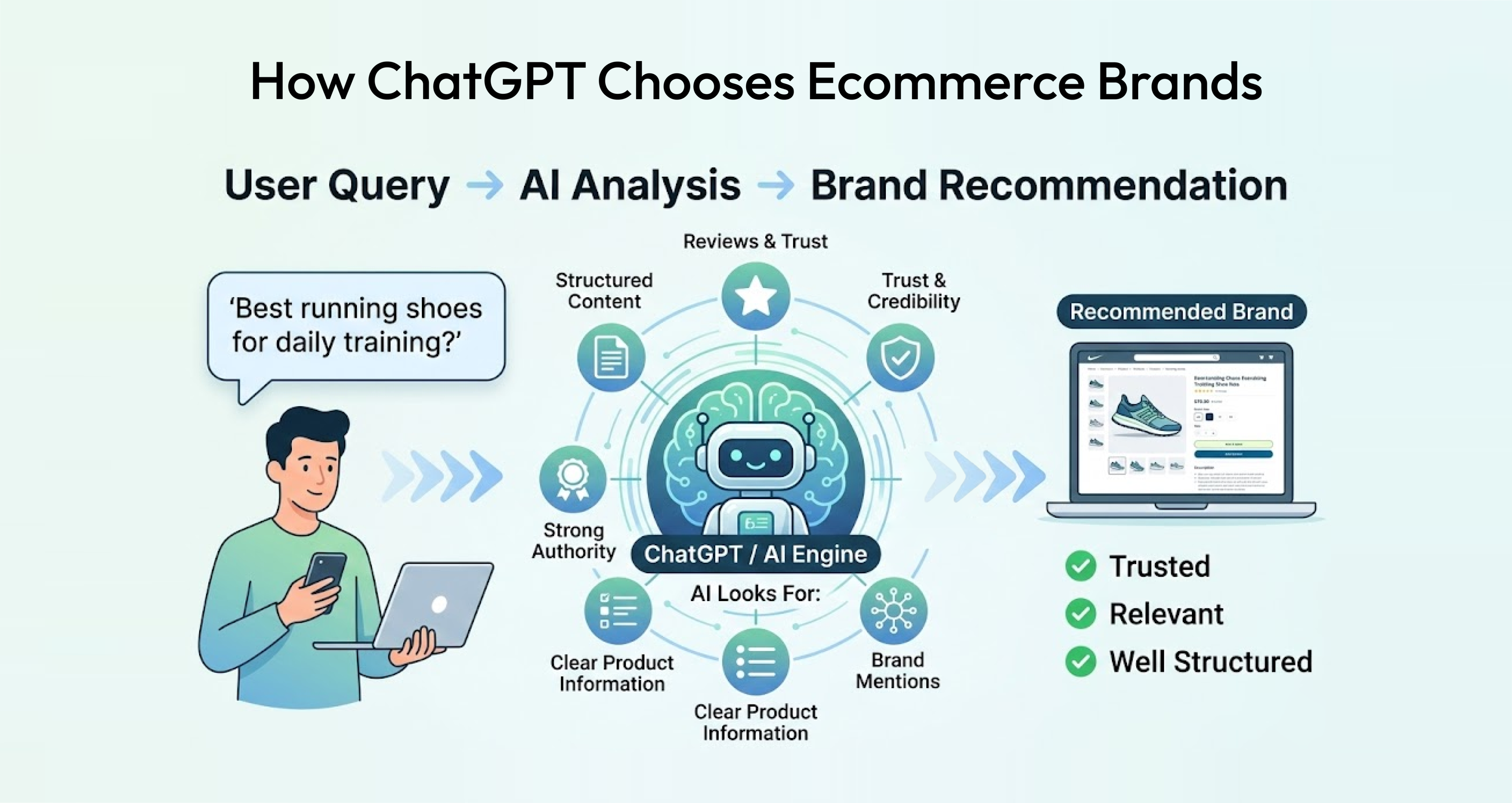
Before optimizing for ChatGPT, it is essential to understand how large language models (LLMs) function. Unlike traditional search engines that rank pages primarily through backlinks and keyword matching, LLMs operate by understanding context, semantics, and probability patterns across vast data sets.
ChatGPT does not “crawl and rank” pages in the traditional sense. Instead, it generates answers based on:
- Structured knowledge patterns
- Contextual relationships between entities
- Brand authority signals
- Clarity of information
- Trustworthiness and credibility
When a user asks for product recommendations, the model synthesizes structured information from recognized sources and presents summarized insights.
This means your goal is not just ranking pages. Your goal is becoming:
- Machine-readable
- Contextually relevant
- Authoritative in your niche
- Consistently referenced across digital ecosystems
LLM SEO focuses on optimizing your digital presence so that AI systems confidently recognize, understand, and reference your brand.
Read Also : First 1000 Orders Strategy for New E-commerce
What is LLM SEO (Large Language Model SEO)?
LLM SEO is the practice of optimizing your website and brand for AI systems that generate answers rather than list links. It overlaps with traditional SEO but extends beyond it.
Traditional SEO focuses on:
- Keyword rankings
- Backlinks
- On-page optimization
- Technical health
LLM SEO focuses on:
- Semantic clarity
- Entity recognition
- Structured information
- Contextual completeness
- Brand authority signals
- Conversational alignment
In simple terms, traditional SEO helps users find your website. LLM SEO helps AI recommend your website.
Both are now essential.
Building Topical Authority in Your Niche
Topical authority is the cornerstone of both traditional SEO and LLM SEO. AI systems favor brands that demonstrate comprehensive expertise in a specific area rather than websites that publish scattered content across unrelated categories.
If you sell fitness equipment, your website should not only list products but also provide in-depth educational resources about workouts, injury prevention, training techniques, equipment comparisons, and buyer guides. When your domain covers a topic comprehensively, AI systems recognize it as a knowledge hub rather than just a store.
Topical authority increases your probability of being referenced in AI-generated answers.
To build strong topical authority:
- Create in-depth pillar pages for core product categories
- Publish supporting long-form blog articles
- Cover subtopics and related questions extensively
- Use internal linking to connect related content
- Update content regularly to maintain freshness
The deeper your coverage, the stronger your AI credibility footprint.
Structuring Product Pages for AI Understanding
Most eCommerce websites prioritize visuals and promotional copy. While visuals matter for conversion, AI systems rely heavily on structured, descriptive, and context-rich content.
A product page optimized for AI should clearly answer:
- What is this product?
- Who is it for?
- What problem does it solve?
- What are its key features?
- How is it different from alternatives?
- When should someone choose it?
AI systems perform better when information is structured logically. Your product pages should include:
- Clear product titles
- Detailed descriptions (not generic sales copy)
- Specifications and materials
- Use-case explanations
- FAQ sections
- Comparison tables
- Customer reviews
Structure improves machine interpretation. The clearer your content, the easier it becomes for AI to summarize and recommend your product.
Read Also : How AI Is Powering Smarter Ecommerce Growth
Implementing Structured Data and Schema Markup
Structured data is critical for AI comprehension. Schema markup helps define your content in machine-readable formats.
Important schema types include:
- Product schema
- Offer schema
- Review schema
- FAQ schema
- Organization schema
- Breadcrumb schema
Schema provides clarity about price, availability, ratings, brand name, and category. It reduces ambiguity and improves AI confidence.
Without structured data, your content may be understood partially. With structured data, your content becomes precise and machine-friendly.
Optimizing for Conversational Queries
LLMs are designed for natural conversation. Therefore, your content must align with how real customers speak.
Instead of focusing only on short keywords, your content should include:
- Long-tail question-based headings
- Natural language phrasing
- Scenario-driven examples
- Problem-based solutions
- Buyer intent explanations
For example, instead of just optimizing for “office chair,” create sections like:
- What is the best office chair for lower back pain?
- Are ergonomic chairs worth it for remote workers?
- How to choose an office chair for long sitting hours?
Conversational alignment significantly improves contextual matching within AI responses.
Read Also : From ₹1L to ₹1Cr in Ecommerce Sales
Strengthening Brand Signals and Mentions
AI systems assess brand authority based on digital presence. The more your brand appears across credible sources, the stronger its recognition.
Brand signals include:
- Media coverage
- Industry citations
- Guest blogging
- Social proof
- Influencer mentions
- Customer reviews
- Directory listings
If your brand exists only on your website, AI confidence is lower. If your brand appears across multiple trusted ecosystems, AI recognition increases.
Digital PR is now part of LLM SEO.
Improving E-E-A-T for AI Recognition
Experience, Expertise, Authoritativeness, and Trustworthiness remain powerful indicators of credibility. AI systems favor content backed by real expertise and transparency.
You can improve E-E-A-T by:
- Publishing expert-written content
- Displaying author credentials
- Showing customer testimonials
- Providing transparent contact details
- Including return, shipping, and privacy policies
- Showcasing real brand stories
Trust signals reduce uncertainty and increase AI recommendation likelihood.
Creating AI-Friendly Content Formats
AI systems extract information more effectively from comprehensive and well-structured formats. Thin blog posts rarely get referenced.
Effective AI-friendly formats include:
- Long-form buying guides
- Product comparisons
- “Best for” roundups
- How-to tutorials
- Industry research articles
- FAQ-based blog posts
Depth and clarity increase extractability.
Read Also : why commission reduces profits and how to sell smarter
Technical Performance Still Matters
Even in the AI era, technical SEO remains foundational. If your website is slow or difficult to crawl, it reduces accessibility and credibility.
Focus on:
- Fast loading speed
- Mobile-first design
- Secure HTTPS
- Clean site architecture
- XML sitemaps
- Proper indexing
Technical stability supports both search engines and AI systems.
Leveraging Reviews and User-Generated Content
User-generated content provides real-world context that AI systems value. Detailed reviews often contain natural language descriptions of use cases, benefits, and scenarios.
Encourage customers to share:
- Specific experiences
- Problems solved
- Comparisons
- Context of use
Rich reviews increase semantic depth and contextual coverage.
Tracking AI Visibility
AI visibility tracking is still evolving, but brands can monitor performance indirectly.
You can:
- Test common conversational queries manually
- Track branded search growth
- Monitor long-tail organic impressions
- Observe referral sources
- Track increases in direct traffic
AI visibility often reflects in brand awareness and contextual mentions.
Building a Content + Commerce Ecosystem
In 2026, eCommerce success depends on integrating content and commerce. Stores that only sell without educating will struggle in AI environments.
Your ecosystem should combine:
- Educational blogs
- Structured product pages
- Internal linking
- Authority-building PR
- Customer engagement
Content builds trust. Commerce converts trust.
The Strategic Framework for Ranking on ChatGPT in 2026
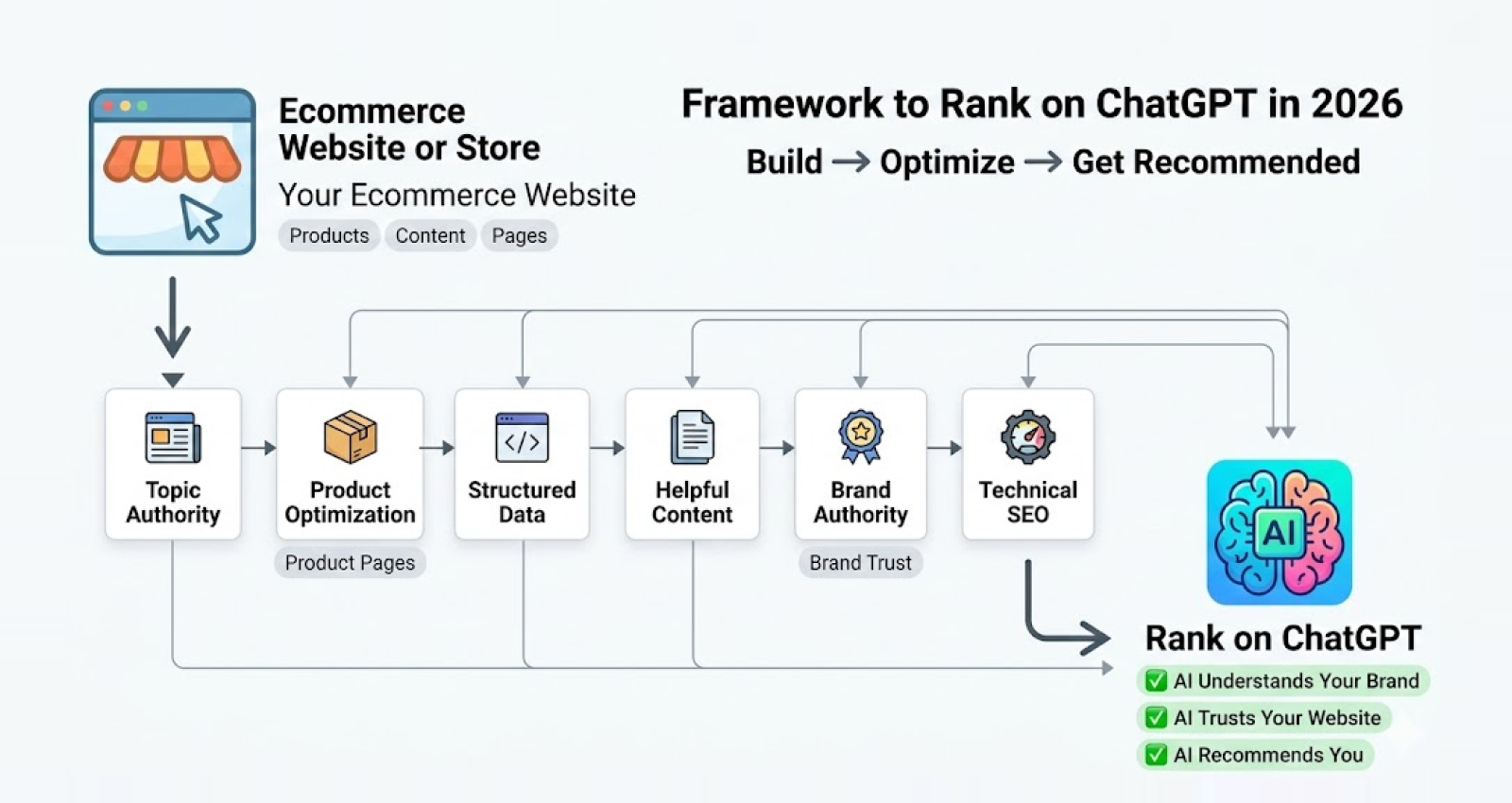
Ranking your eCommerce website on ChatGPT requires a systematic approach that integrates traditional SEO, LLM SEO, structured data, brand authority, and content depth.
Your strategic execution roadmap:
- Build deep topical authority in your niche.
- Optimize product pages with clarity and structured detail.
- Implement comprehensive schema markup.
- Align content with conversational queries.
- Strengthen brand signals through PR and mentions.
- Improve E-E-A-T trust indicators.
- Publish long-form AI-friendly content.
- Maintain strong technical SEO foundations.
- Encourage detailed user-generated reviews.
- Monitor and refine AI visibility strategy continuously.
Read Also : Ecommerce Trends Defining Online Store Success in 2026
Final Thoughts: The Future of AI Commerce
The future of eCommerce discovery is conversational, contextual, and AI-driven. Platforms powered by large language models are reshaping how consumers search, compare, and decide.
Ranking on ChatGPT in 2026 is not about shortcuts. It is about clarity, authority, trust, and semantic depth. Brands that invest in LLM SEO today will build durable visibility advantages for years to come.
The question is no longer, “Are you ranking on page one?”
The real question is:
When someone asks AI for the best products in your category, does it recommend your brand?
FAQs
An ecommerce website can rank on ChatGPT by providing structured, clear, and trustworthy content. AI systems prefer websites with detailed product information, helpful guides, strong brand authority, and well-organized pages that are easy to understand.
AI SEO (LLM SEO) is the process of optimizing your ecommerce website so AI platforms like ChatGPT can understand and recommend your products. It focuses on structured content, topical authority, conversational queries, and strong brand signals instead of just keywords.
Yes, traditional SEO still helps improve ChatGPT visibility. Technical SEO, content quality, backlinks, and topical authority support AI understanding. However, AI SEO also requires structured content and conversational optimization.
Product pages should clearly explain what the product is, who it is for, and what problem it solves. Detailed descriptions, specifications, FAQs, and comparisons help AI systems understand and recommend products more confidently.
Structured content helps AI systems interpret information accurately. Clear headings, organized sections, schema markup, and logical content flow make it easier for AI to extract useful information and include your brand in recommendations.
AI visibility usually improves gradually as your website builds authority and structured content. Consistent publishing, strong brand signals, and technical optimization can increase the chances of being recommended over time.