B2B Order Management in 2026: How to Handle Bulk Orders Faster and With Fewer Errors
The B2B landscape has transformed dramatically over the last decade, and in 2026, bulk order management has become more demanding than ever. Manufacturers, wholesalers, exporters, distributors, and even established D2C brands now operate in a market where speed, accuracy, and operational transparency define business success. Whether you're fulfilling large-volume orders for retail chains or catering to regional distributors with time-sensitive demands, the pressure to process bulk orders efficiently has never been greater.
For many MSMEs and mid-sized B2B companies, bulk orders are both an opportunity and a challenge. These orders bring revenue stability but also come with high expectations—error-free fulfilment, real-time updates, predictable pricing, and faster delivery cycles. Yet, many businesses still rely on outdated systems, manual workflows, and scattered communication methods that slow down operations and create avoidable errors.
As we move deeper into a digitally driven, efficiency-first era, B2B brands are exploring smarter ways to streamline order management. One of the most effective approaches has been the shift from manual processing to integrated ecommerce platforms that centralise workflows, automate repetitive tasks, and offer buyers a more professional ordering experience. Platforms like Shopaccino are helping brands build a structured ecosystem where bulk orders flow smoothly, without the bottlenecks that traditionally slow down B2B operations.
This blog explores the real challenges behind bulk order management, what B2B buyers expect today, and how digital transformation is reshaping order fulfilment for better speed, accuracy, and scalability.
Challenging Area: The Biggest Bulk Order Management Challenges for B2B Brands
Bulk orders create complexity at every stage—order capture, verification, fulfilment, warehouse coordination, dispatch, communication, and documentation.
Across Manufacturers, Wholesalers, Exporters, Established D2C Brands, and Distributors, the challenges remain strikingly similar.
Unstructured Order Capture
Many businesses still receive bulk orders through:
- WhatsApp messages
- Phone calls
- Spreadsheets
- Email threads
- Paper notes through sales representatives
These unstructured channels force teams to manually re-enter data, increasing the chances of mistakes and slowing down fulfilment.
High Risk of Human Errors
Bulk orders contain:
- Multiple SKUs
- Variant-level details
- Case quantities
- Custom requirements
Any error—even a small miscalculation—can delay dispatch or lead to expensive returns.
No Real-Time Inventory Alignment
When customers place orders without knowing real-time stock availability, it leads to:
- Overselling
- Partial fulfilment
- Cancelled line items
- Delivery delays
Warehouse teams often operate on outdated stock reports, making the problem worse.
Slow Internal Coordination
Bulk order processing requires coordination between:
- Sales teams
- Warehouse teams
- Accounts teams
- Dispatch partners
Without a centralised system, communication becomes slow and scattered.
Difficulty Managing Customer-Specific Pricing
Bulk buyers often demand:
- Volume discounts
- Contract-based pricing
- Special rates
- Freight adjustments
Manually applying these conditions increases workload and error rates.
Time-Consuming Approvals
Approval cycles for large orders can take hours or days when handled manually, especially when teams must validate pricing, stock, or credit limits.
Their Customer Challenging Area: What Bulk Buyers Expect in 2026
B2B customers have evolved. They expect the same convenience and transparency they experience in consumer ecommerce platforms—just tailored for bulk, high-volume purchases.
They Expect Instant Ordering Without Delays
Business buyers want a simple, fast ordering experience without waiting for a sales representative to respond.
They Want Full Transparency
Bulk buyers want real-time clarity on:
- Stock availability
- Expected dispatch timelines
- Pricing and discounts
- Delivery charges
They Expect Zero Errors
A mistake in variant, quantity, or pricing can affect their business operations, so accuracy is non-negotiable.
They Want Easy Reordering
Since their purchases are repetitive, they prefer to reorder past items with one click—something WhatsApp or calls can't support efficiently.
They Want Trackable, Documented Transactions
Bulk buyers want clear documentation:
- Invoices
- Order summaries
- Dispatch records
- Delivery notes
They Expect Independence Over Dependence
Self-serve ordering is becoming a standard expectation in B2B ecommerce.
Solution: How Ecommerce Platforms Solve Bulk Order Management Challenges
Modern ecommerce solutions bring structure to the unstructured, clarity to the uncertain, and speed to the slow-moving workflows of traditional B2B order management.
Platforms such as Shopaccino help brands automate bulk order workflows and centralise everything in one place.
Here’s how ecommerce simplifies bulk order management in 2026:
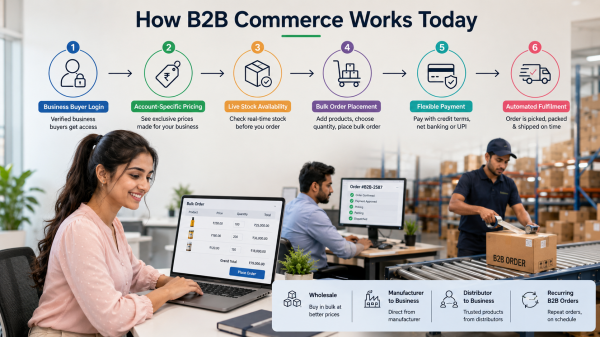
Centralised & Structured Order Capture
Instead of decoding WhatsApp messages or interpreting handwritten notes, buyers place orders through:
- A dedicated portal
- A mobile app
This removes ambiguity and minimises errors.
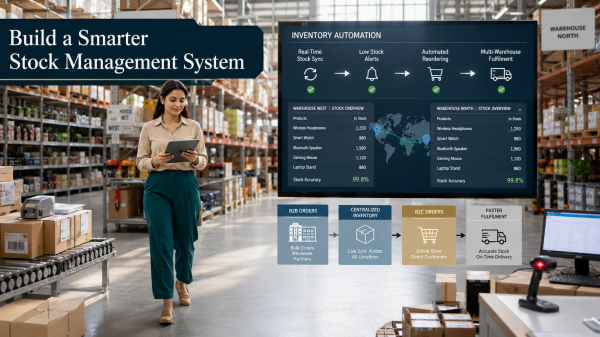
Real-Time Inventory Visibility
Buyers see:
- Available stock
- Variant-level quantities
- Warehouse-wise availability
This prevents overselling and reduces rework.
Automated Customer-Specific Pricing
The system automatically applies:
- Bulk discounts
- Region-wise rates
- Tiered pricing rules
Accuracy becomes standard.
Streamlined Bulk Ordering Experience
The platform allows buyers to place large-volume orders with ease through:
- Structured product catalogs
- Clear variant selection
- Predefined quantity rules
This reduces confusion, speeds up order creation, and ensures bulk orders enter the system accurately from the start.
Simplified Multi-Warehouse Fulfilment
Orders can be routed automatically to the closest warehouse, ensuring faster delivery and lower logistics cost.
Complete Order History & Documentation
The entire process becomes traceable:
- Previous orders
- Invoices
- Dispatch details
- Reorder templates
This improves transparency and communication.
Integrated Communication & Alerts
Automatic notifications keep buyers updated at each step—confirmation, dispatch, and delivery.
Ecommerce becomes the backbone of modern bulk ordering—fast, error-free, and scalable.
How to Implement Digital Bulk Order Management (Step-by-Step)
Here’s a simple, beginner-friendly approach to help B2B brands shift from manual processes to digital excellence.
Step 1: Digitise Your Product Catalog
List all SKUs with:
- Images
- Variants
- Pack sizes
- Pricing
- Quantity rules
Make the catalog crystal clear so buyers make accurate selections.
Step 2: Build Customer Groups and Price Lists
Divide buyers into:
- Distributors
- Wholesalers
- Exporters
- Retail chains
Assign custom pricing to each group.
Step 3: Sync Real-Time Inventory Across Warehouses
Ensure the ecommerce platform updates stock instantly whenever:
- Orders are placed
- Orders are cancelled
- Returns are accepted
- Inventory is transferred
Step 4: Enable Self-Serve B2B Ordering
Give buyers secure login access so they can:
- Browse catalog
- See custom pricing
- Place bulk orders anytime
Step 5: Automate Approvals & Internal Workflows
Set rules for:
- Stock alerts
- High-value orders
- Credit approval
- Dispatch workflow
Step 6: Train Sales & Warehouse Teams
Your teams should know how to:
- Process digital orders
- Update stock
- Print picking lists
- Manage fulfilment
Step 7: Use Data & Analytics for Planning
Track:
- High-demand items
- Customer-wise volume
- Seasonal spikes
- Warehouse performance
This helps brands prepare better for large orders.
Benefits: Why Digital Bulk Order Management Is Essential for 2026
Faster Order Processing
Digital workflows eliminate back-and-forth communication, helping brands fulfil orders quickly.
Significantly Fewer Errors
Because buyers select products from a structured catalog, mistakes almost disappear.
Improved Customer Satisfaction
Bulk buyers enjoy independence, transparency, and real-time updates.
Better Internal Coordination
Sales, warehouse, and accounts teams work from the same system, improving accuracy.
Higher Operational Efficiency
Automation reduces manual workload and increases speed.
More Predictable Cash Flow
With structured approvals and accurate documentation, payment cycles become consistent.
Scalable for Multi-Region Growth
Digital systems support expansion without additional stress.
Conclusion
Bulk order management is the backbone of B2B commerce, and in 2026, the expectations around speed and accuracy are higher than ever. Businesses that continue relying on manual workflows will face rising errors, longer fulfilment cycles, and frustrated customers. The future belongs to brands that embrace structure, automation, transparency, and self-serve ordering for B2B buyers.
Ecommerce platforms like Shopaccino empower manufacturers, wholesalers, distributors, and exporters to manage bulk orders with ease. From real-time stock visibility to custom pricing and automated workflows, digital transformation ensures orders move faster, with fewer errors, and with complete confidence on both sides.
B2B brands that take the digital leap today will be the ones leading their industry tomorrow.
FAQs
Because bulk orders involve multiple SKUs, custom pricing, warehouse coordination, and manual communication—making errors more likely and processes slower.
It centralises catalog data, automates pricing, syncs inventory in real time, and ensures customers place structured, error-free orders.
Yes, even small businesses benefit because digital systems reduce manual work and support faster fulfilment.
It prevents overselling, improves transparency, and ensures customers know what’s available before placing large orders.
Yes, modern ecommerce platforms automatically apply volume-based and customer-specific pricing.
Absolutely. Automation reduces manpower efforts, errors, and unnecessary communication cycles.
Yes, orders can be routed automatically to the nearest warehouse, improving delivery speed and reducing logistics cost.