
B2B vs B2C Ecommerce: Which Platform Model Actually Fits Your Business?
Pick the wrong model and you spend the next two years fighting your own store. That is the real cost of getting B2B vs B2C ecommerce mixed up. On the surface the two look like cousins. Both sell products online, both need a checkout, both live and die by how easy they are to use. Underneath, they run on completely different logic. One is built to win a single shopper in ninety seconds. The other is built to keep a buyer who reorders every month for the next decade.
This guide breaks down how the B2B vs B2C ecommerce models really differ, where most owners get tripped up, and how to choose a platform that fits the way you actually sell, whether you ship to one city or forty countries. No jargon dumps, no vague theory. Just the practical stuff that decides whether your store grows or stalls.
What Does B2B vs B2C Ecommerce Actually Mean?
Strip away the buzzwords and the difference comes down to one thing: who is on the other side of the screen.
B2C ecommerce, short for business to consumer, is selling to individuals for personal use. Someone lands on your site, drops a pair of shoes into their cart, taps to pay, and moves on with their day. The relationship is often a single transaction. You might never hear from that buyer again, or they resurface in three months when they need something else.
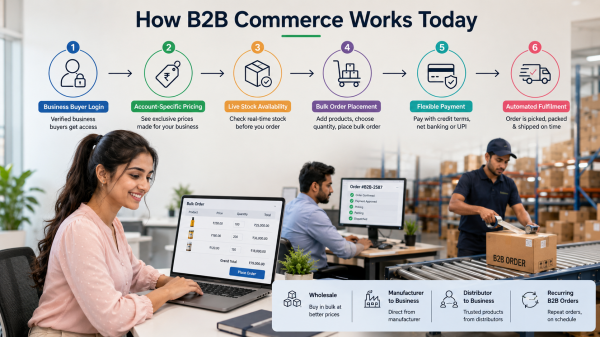
B2B ecommerce, business to business, is selling to other companies. Think of a retail chain restocking its shelves, a café ordering coffee beans every week, or a factory sourcing raw material by the pallet. The buyer is purchasing to run or resell, not to enjoy. Orders are bigger, they repeat far more often, and they usually pass through more than one person before anyone hits confirm. This is the heart of wholesale ecommerce.
That single shift, an individual versus an organisation, ripples through everything downstream: your pricing, your payment terms, the size of a typical order, how much guidance a buyer needs, and how your platform has to be built to support it. That is why the B2B vs B2C ecommerce debate is less about which is better and more about which one matches your reality.
How Do B2B and B2C Buyers Behave Differently?
Buyer psychology is where the two worlds split the hardest, and it explains almost every other difference on this list.
The B2C buyer moves fast and buys on feeling
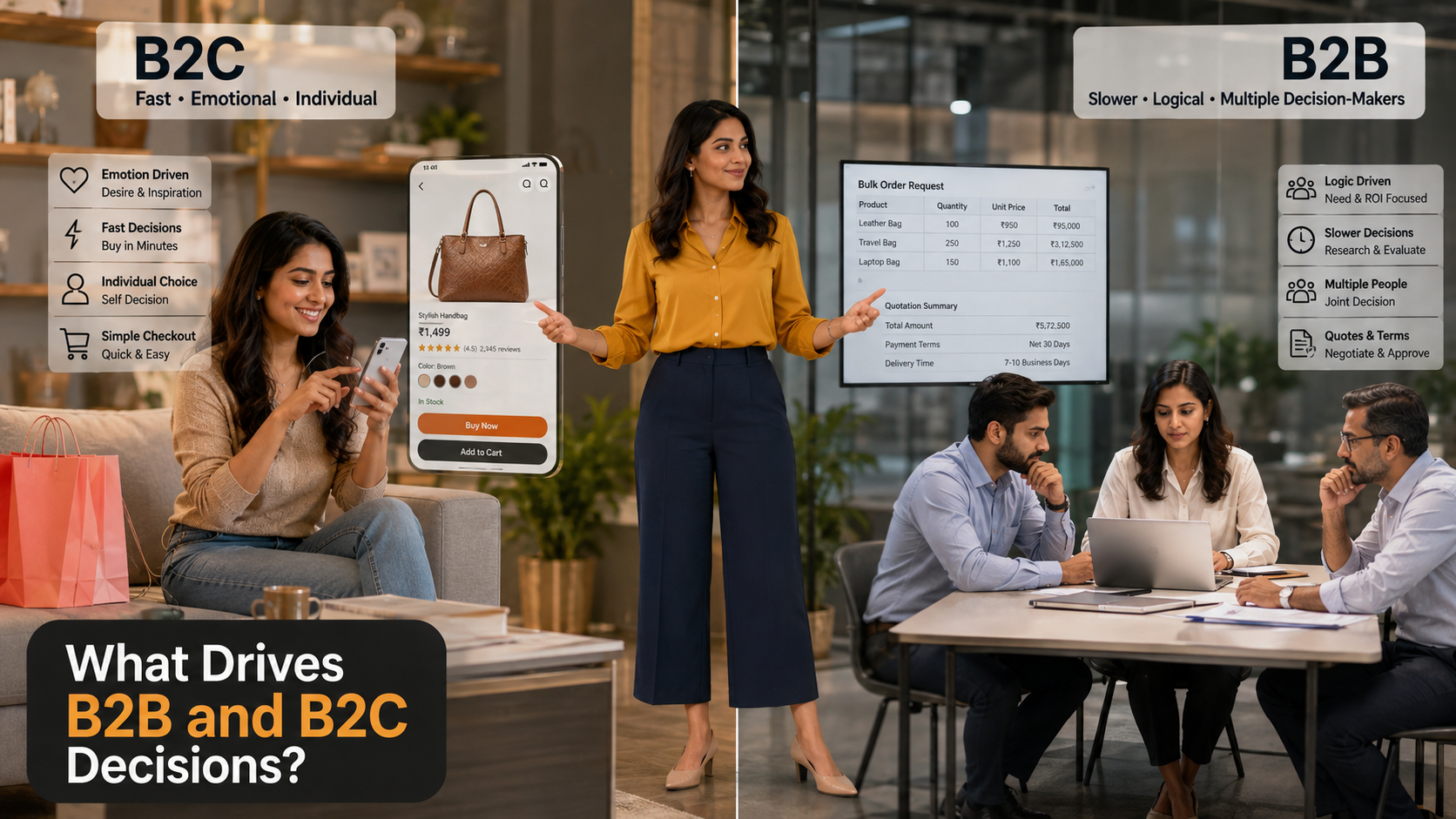
A consumer buys on emotion and buys quickly. They see it, they want it, they check out. The whole journey can be under two minutes. Price sensitivity is high, brand and reviews carry real weight, and a clunky mobile checkout will lose the sale on the spot. Decisions are personal, sometimes impulsive, and rarely need anyone else's approval. Your job is to remove every scrap of friction between wanting and owning.
The B2B buyer moves slowly and buys on logic
A business buyer takes their time and buys on reason. A single purchase might involve a procurement manager, a finance head, and whoever actually uses the product day to day. They compare quotes, request samples, negotiate terms, and weigh the total cost over a year rather than the sticker price today. Loyalty runs deep here because switching suppliers is genuinely painful, so once you win a business account, they tend to stick around and reorder for years.
Here is how those behaviours line up side by side.
Factor | B2C Ecommerce | B2B Ecommerce |
Who buys | An individual consumer | A business or organisation |
Order size | Small, one or two items | Large, bulk quantities |
Decision speed | Minutes, driven by emotion | Days to weeks, driven by logic |
Pricing | Fixed and public | |
Payment | Card or wallet, paid upfront | |
Relationship | Mostly transactional | Long term and sticky |
Read that table again and you can feel why a store designed for one column often breaks when you try to force the other column through it. The mechanics of bulk ordering and credit terms simply do not exist in a checkout built for impulse buys.
What Changes on the Platform Side When You Sell B2B vs B2C?
This is where a lot of business owners get burned. They pick a platform built for one model, grow into the other, and then spend months bolting on features the software was never meant to handle.
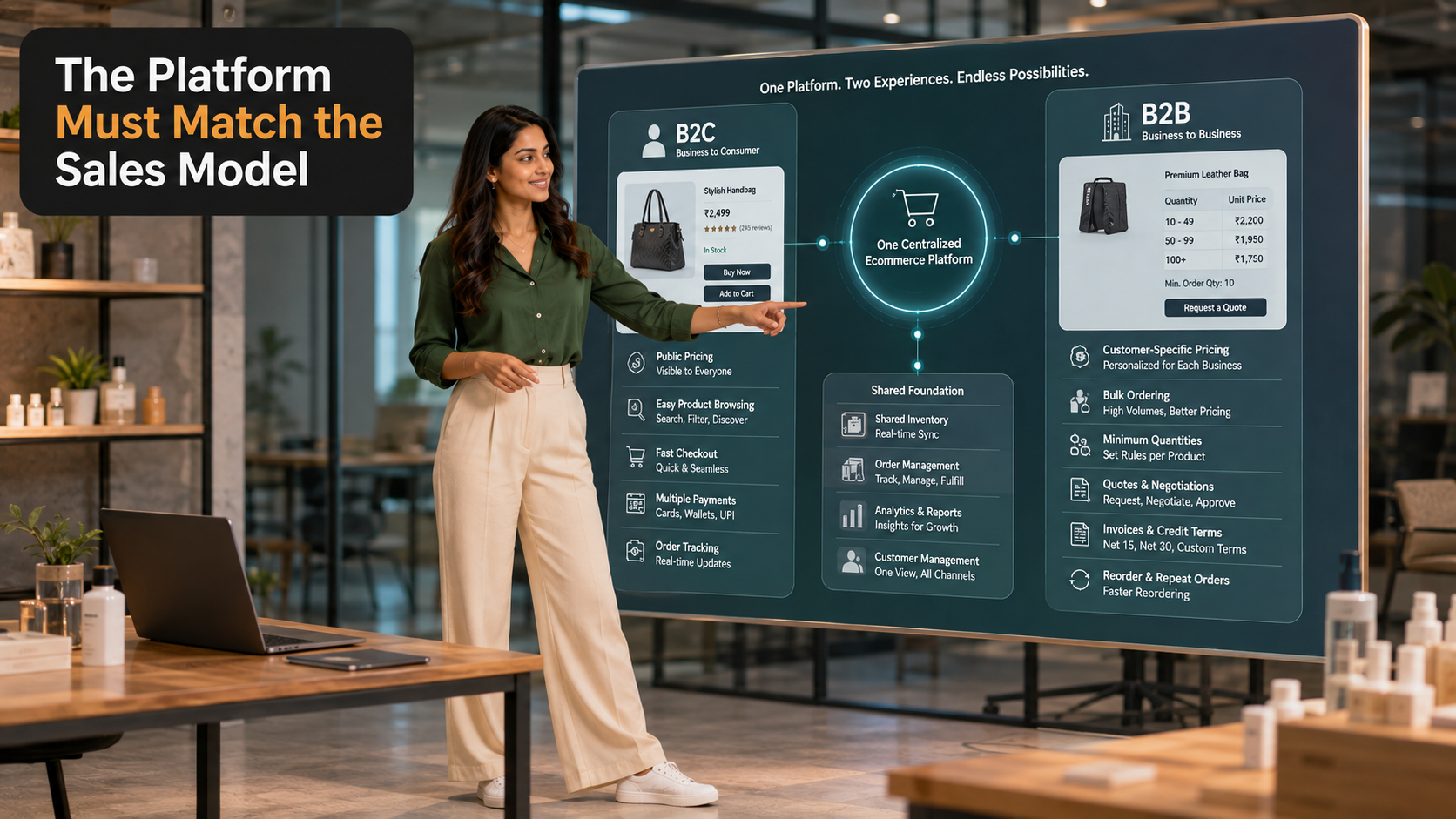
A B2C store is tuned for browsing and speed. Clean product pages, guest checkout, wishlists, upsells, one-tap payment options, and fast loads on mobile. Everything points toward a quick, confident yes. The whole experience is designed to shorten the distance between landing and paying.
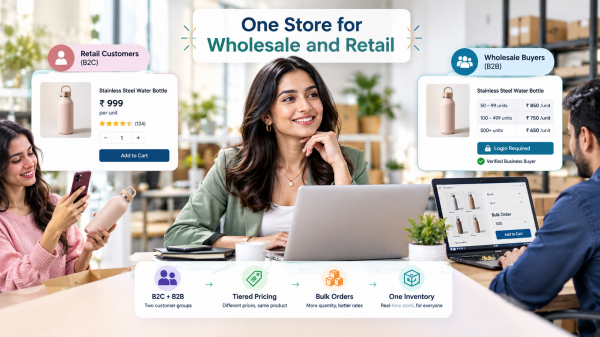
A B2B store needs a very different toolkit. Buyers usually log in to see their own negotiated pricing, not a public price everyone can see. You need customer specific price lists, minimum order quantities, bulk order forms, quote requests, credit limits, and the ability to reorder a past cart in a single click. Tax handling gets more complex too, especially once you sell across borders. Catalogues are often gated so only approved accounts can view wholesale rates.
Then there is payment, and this trips up more sellers than anything else. B2C runs on cards and digital wallets. B2B frequently runs on invoices, purchase orders, and net 30 or net 60 credit terms. If your platform cannot handle a buyer who says bill me at month end, you are quietly locking out a huge slice of business customers before they ever reach checkout.
At a minimum, a serious wholesale ecommerce setup should support:
- Tiered and customer specific pricing, so different accounts see different rates
- Bulk ordering and one click reorder for buyers who purchase the same items repeatedly
- Quote requests and negotiated carts for larger, non standard orders
- Minimum order quantities to keep small orders from eating your margins
- Credit terms and invoicing alongside cards and wallets
- Login gated catalogues that hide wholesale pricing from the public
Which Model Costs More to Run, and Why?
On paper, B2C looks cheaper to launch. Lower average order value, simpler payments, faster setup, fewer moving parts. The catch is that margins are thin and customer acquisition is brutal. You are competing for attention against thousands of stores, paying ad costs that climb every year, and a good chunk of your budget goes toward winning a shopper who might only ever buy once.
B2B carries higher order values and stickier customers, which sounds like effortless money, but the operational load is heavier. Longer sales cycles, custom pricing to maintain, more back and forth, credit risk to manage, and often a real human in the loop for the bigger accounts. The payoff is lifetime value. One solid wholesale account can be worth hundreds of casual shoppers, and it keeps paying out month after month.
So the honest answer is that neither is cheaper across the board. B2C spends more on marketing to earn each sale. B2B spends more on operations and relationship management to keep each account. Which one suits you depends on your product, your margins, and the kind of growth you actually want. When people frame the B2B vs B2C ecommerce choice purely around cost, they usually miss this trade off.
What If Your Business Sells Both B2B and B2C?
For a growing number of brands, this is the real situation, and it is probably the most important section here.
A jewellery maker sells finished pieces to shoppers online and also supplies boutiques by the tray. A marble and stone supplier ships slabs to contractors in bulk while selling decorative pieces to homeowners. A skincare D2C brand runs a direct site and also wholesales to salons. Manufacturers and exporters almost always straddle both worlds by default. Selling to businesses and consumers at the same time is fast becoming the norm, not the exception.
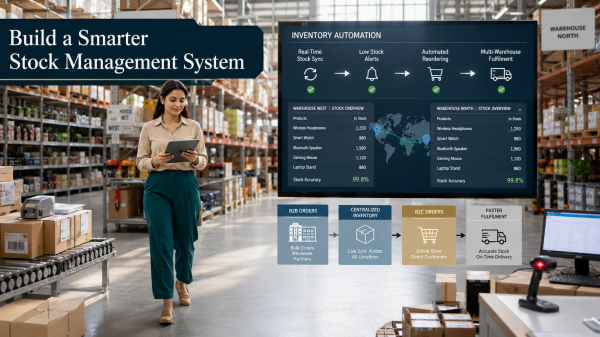
Running two separate systems to cover both is a slow tax on your business. Duplicate inventory, mismatched stock counts, two dashboards, and two sets of orders to reconcile at the end of every day. Stock you sold on the consumer side quietly disappears from the shelf your wholesale buyer was counting on, and nobody notices until an order ships short.
The math here is simple once you see it. If a homeowner buys the last three units of a decorative tile at retail on Monday, a distributor system that shares one live inventory instantly reflects that, so the contractor placing a bulk order on Tuesday sees the accurate count. Split that across two disconnected systems and you get oversells, angry buyers, and refunds that quietly erode both your margin and your reputation.
The smarter setup is one platform that handles both from a single backend. Same inventory, same catalogue, but the front end shifts depending on who logs in. A consumer sees retail pricing and a fast checkout. A verified business buyer logs in and sees wholesale tiers, bulk ordering, and credit terms. One system, two experiences, zero reconciliation nightmares. That is the setup most hybrid sellers should be aiming for, and it is exactly the gap that platforms like Shopaccino were built to close.
How Do You Choose the Right Ecommerce Platform for Your Model?
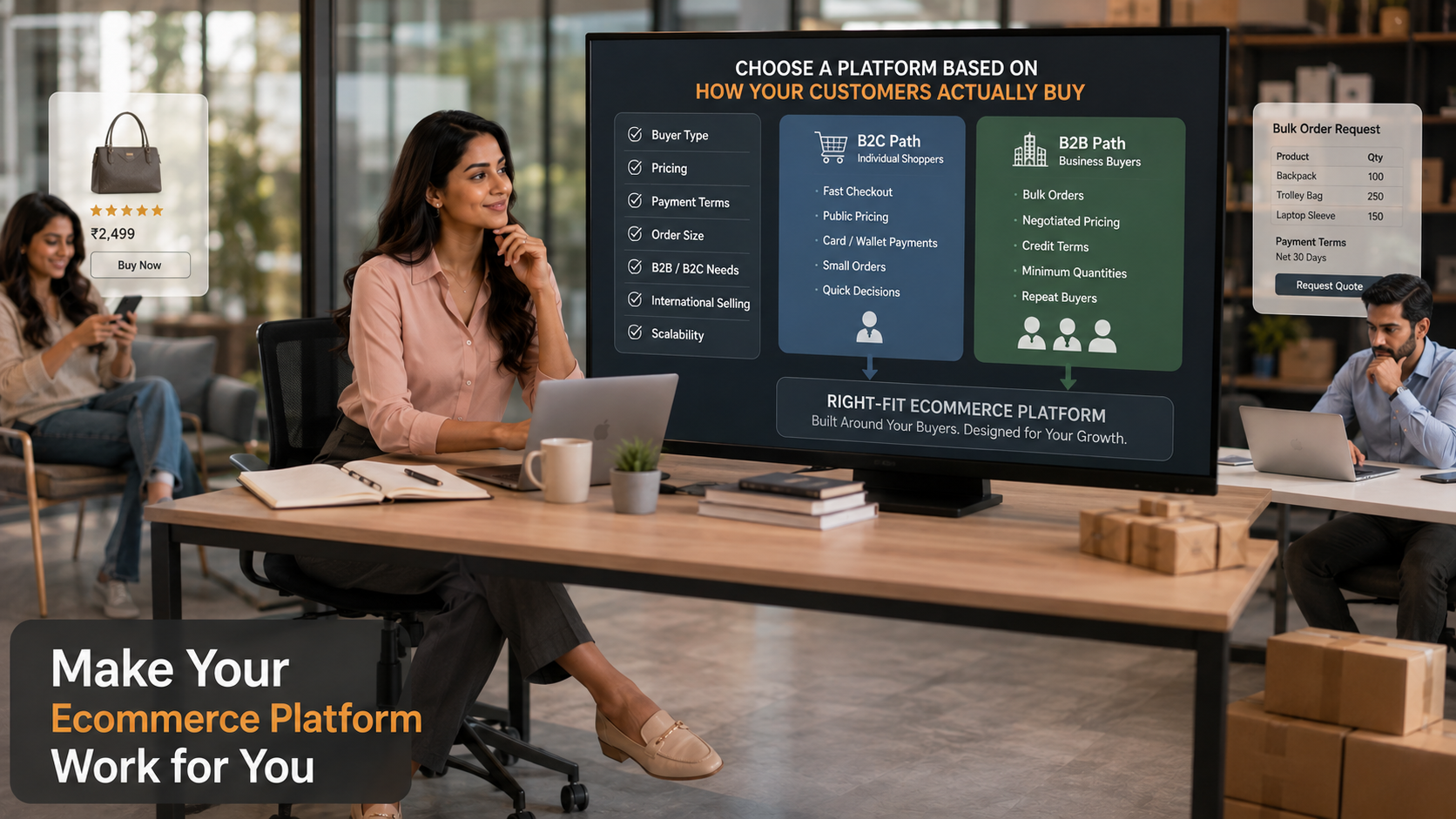
Before you commit to any ecommerce platform, walk through these six questions. Your answers will point you toward the right model far more reliably than any feature list.
- Who is my primary buyer today, and who will they be in two years?
- Do I need customer specific pricing, or is one public price enough?
- Will buyers pay upfront, or do I need to offer credit and invoicing?
- Am I selling in one country or many, and does cross-border selling change my needs?
- Do I need bulk ordering, minimum quantities, or quote workflows?
- Will I ever want to run B2B and B2C together under one roof?
If most of your answers point toward individual shoppers, fast checkout, and single prices, a lean B2C platform will serve you well. If you keep landing on businesses, bulk, negotiated pricing, and repeat contracts, you need real B2B capability baked in, not tacked on. And if you see both patterns, do not pick a single lane platform and hope for the best. Choose one that supports both models natively.
There is a hidden cost worth naming here: replatforming. Outgrowing your first platform and migrating everything to a new one is one of the most expensive, disruptive moves an online business can make. Product data, order history, customer accounts, SEO rankings, and integrations all have to be rebuilt, and sales usually dip during the switch. Choosing a platform that can already stretch across the B2B vs B2C ecommerce spectrum saves you from that migration two years down the line, which is often the single most valuable thing an owner can plan for early.
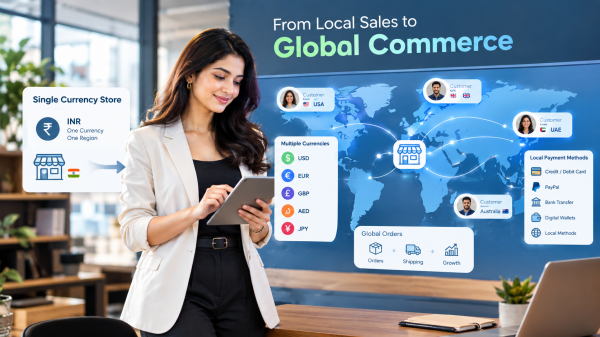
Selling internationally deserves its own flag. The moment you cross a border, you need multi-currency pricing, multiple languages, region based rates, international payment methods, and shipping that plays nicely with global carriers. A platform that treats these as core features rather than paid add ons will save you an enormous amount of pain as you scale. This is often the deciding factor in the B2B vs B2C ecommerce decision for brands
with global ambitions, because exporters and international wholesalers cannot function without it.
Where Does Shopaccino Fit Into the B2B vs B2C Decision?
Shopaccino was built by studying where exporters, manufacturers, distributors, and D2C brands actually get stuck, rather than shipping a generic one size fits all tool and hoping it works for everyone. The result is a platform that runs both B2B and B2C from a single system, so you manage one inventory, one catalogue, and one dashboard while serving consumers and business buyers side by side.
For brands selling across borders, the cross-border selling features come built in. Multi currency, multi language, international payments, region based pricing, and international shipping through carriers like FedEx and DHL all sit inside the platform. Exporters can sell globally without stitching together a dozen plugins that break every time one of them updates.
On the operations side, inventory, payments, logistics, and multi warehouse order fulfilment are handled in one place, with automation that trims the manual work you would otherwise do by hand. And because there are zero transaction fees on the platform, you keep your full earnings instead of handing a slice to the software on every single sale. Whether you lean B2C, run a wholesale heavy operation, or need both at once, the model bends to fit your business instead of forcing your business to bend to the software.
So Which Model Wins the B2B vs B2C Ecommerce Debate?
The B2B vs B2C ecommerce question was never really about which model is better in the abstract. It is about which one matches how your customers actually buy, and whether your platform can keep pace as that changes. B2C rewards speed and volume. B2B rewards relationships and repeat orders. And plenty of the fastest growing brands quietly do both at once.
Get clear on who you are selling to, map out the features that model genuinely demands, and then choose a platform that fits you today and still fits when you grow into new markets and new customer types. That one decision quietly shapes everything that comes after it. If you want a system that handles B2B, B2C, or both from a single dashboard and sells worldwide right out of the box, Shopaccino is worth a serious look. Start free and see how it maps to the way you actually sell.
FAQs
B2C ecommerce sells to individual consumers for personal use, with small, fast, emotional purchases. B2B ecommerce sells to other businesses in bulk, with negotiated pricing, longer decisions, and repeat orders. The core difference is the buyer: one person versus an entire organisation.
Yes. A capable platform lets consumers see retail pricing and a fast checkout, while verified business buyers log in to wholesale tiers, bulk ordering, and credit terms, all from one inventory and dashboard. Shopaccino is built to run both models from a single system.
Neither wins outright. B2C brings higher volume but thinner margins and costly customer acquisition. B2B brings larger orders and loyal repeat buyers but heavier operations. Real profitability depends on your product, your margins, and how efficiently you run each model day to day.
Both can sell globally, but success hinges on cross border features like multi currency, multiple languages, region based pricing, and international shipping. B2B exporters especially need bulk and credit tools. A platform with these built in makes global selling far simpler than bolting on plugins.
Look at who buys from you, whether you need custom pricing or credit terms, your typical order sizes, and where you sell. If you serve both consumers and businesses, pick a platform that natively supports both rather than forcing one model to behave like the other.
No. Shopaccino charges zero transaction fees on the platform, so you keep your full earnings on every sale. It also includes built in automation, integrated inventory, payments, logistics, and multi warehouse fulfilment to run B2B and B2C operations from one place.