How Location-Based Pricing Helps Grocery Brands Survive High Delivery Costs
Grocery ecommerce looks simple on the surface. Customers order essentials, delivery happens, payment is collected, and the cycle repeats. But behind this everyday flow sits one of the most difficult challenges grocery brands face today—delivery cost management. Unlike other e-commerce categories, groceries involve frequent orders, low margins, and tight delivery windows. Even small inefficiencies can quietly turn growth into losses.
Many grocery brands make a critical mistake early on: they keep the same product price across all locations. A tomato costs the same whether it is delivered to a dense urban colony or a far-off residential area with sparse demand. At first, this feels fair and easy to manage. Over time, it becomes dangerous.
In 2026, grocery brands that survive are not necessarily the fastest or the cheapest. They are the ones who price intelligently. Location-based pricing has emerged as a practical way to protect margins, manage delivery costs, and expand sustainably without shutting down loss-making zones. This blog explains why delivery costs vary so widely, why fixed pricing quietly kills profitability, what customers actually expect, and how location-based pricing offers a realistic path forward.
Challenging Area: Why Fixed Pricing Breaks Grocery Economics
Most grocery brands start with a simple idea—keep prices uniform, avoid confusion, and scale quickly. Unfortunately, grocery logistics does not work on uniform assumptions.
Delivery Cost Is Never the Same Everywhere
Delivery expenses change dramatically based on distance, traffic patterns, order density, and rider availability. A 2-kilometre delivery in a crowded market area may take more time and cost more than a 7-kilometre delivery to a low-density residential pocket. Yet fixed pricing ignores this reality completely.
Losses Accumulate in Low-Density Zones
Areas with fewer orders create a hidden drain on profitability. Riders travel longer distances for fewer deliveries, fuel costs rise, and time per order increases. When pricing does not reflect this, brands end up subsidising these zones unknowingly.
High-Performing Zones Carry the Burden
Uniform pricing forces profitable, high-density locations to compensate for loss-making ones. While this may balance numbers temporarily, it limits how aggressively brands can grow in strong markets.
Forced Shutdown of Non-Profitable Areas
Eventually, brands reach a breaking point. Delivery costs rise, margins shrink, and leadership decides to shut down certain pincodes entirely. Customers lose access, brand trust suffers, and growth momentum slows.
Operational Decisions Become Guesswork
Without location-based visibility, teams cannot accurately measure zone-wise profitability. Decisions are reactive instead of data-driven, leading to repeated mistakes.
Fixed pricing feels simple, but it slowly erodes the foundation of a grocery business.
Their Customer Challenging Area: What Buyers Actually Expect
One common fear grocery brands have is customer backlash. Many assume that customers want identical pricing everywhere. In reality, buyer expectations are far more nuanced.
Customers Understand Distance and Convenience
Consumers already accept different pricing models in transport, food delivery, and ride-hailing. They intuitively understand that farther or harder-to-serve locations cost more.
Reliability Matters More Than Uniform Pricing
Customers prefer reliable delivery over artificially low prices. If a brand shuts down service in their area due to losses, price fairness becomes irrelevant.
Transparency Builds Trust
When pricing differences are explained clearly—through delivery fees, zone-based pricing, or minimum order values—customers respond more positively than brands expect.
Local Availability Feels Valuable
For customers in less-connected areas, access itself has value. Paying slightly more is often acceptable if it ensures consistent service.
Price Sensitivity Varies by Area
Dense urban areas often prioritise speed and convenience, while suburban customers prioritise availability. Treating all zones the same ignores real behavioural differences.
Understanding this mindset helps grocery brands move beyond fear-driven pricing decisions.
Solution: How Location-Based Pricing Solves Delivery Cost Challenges
Location-based pricing does not mean random price changes. It means structured, rule-driven adjustments that align pricing with actual delivery economics.
Dynamic Pricing by Delivery Location
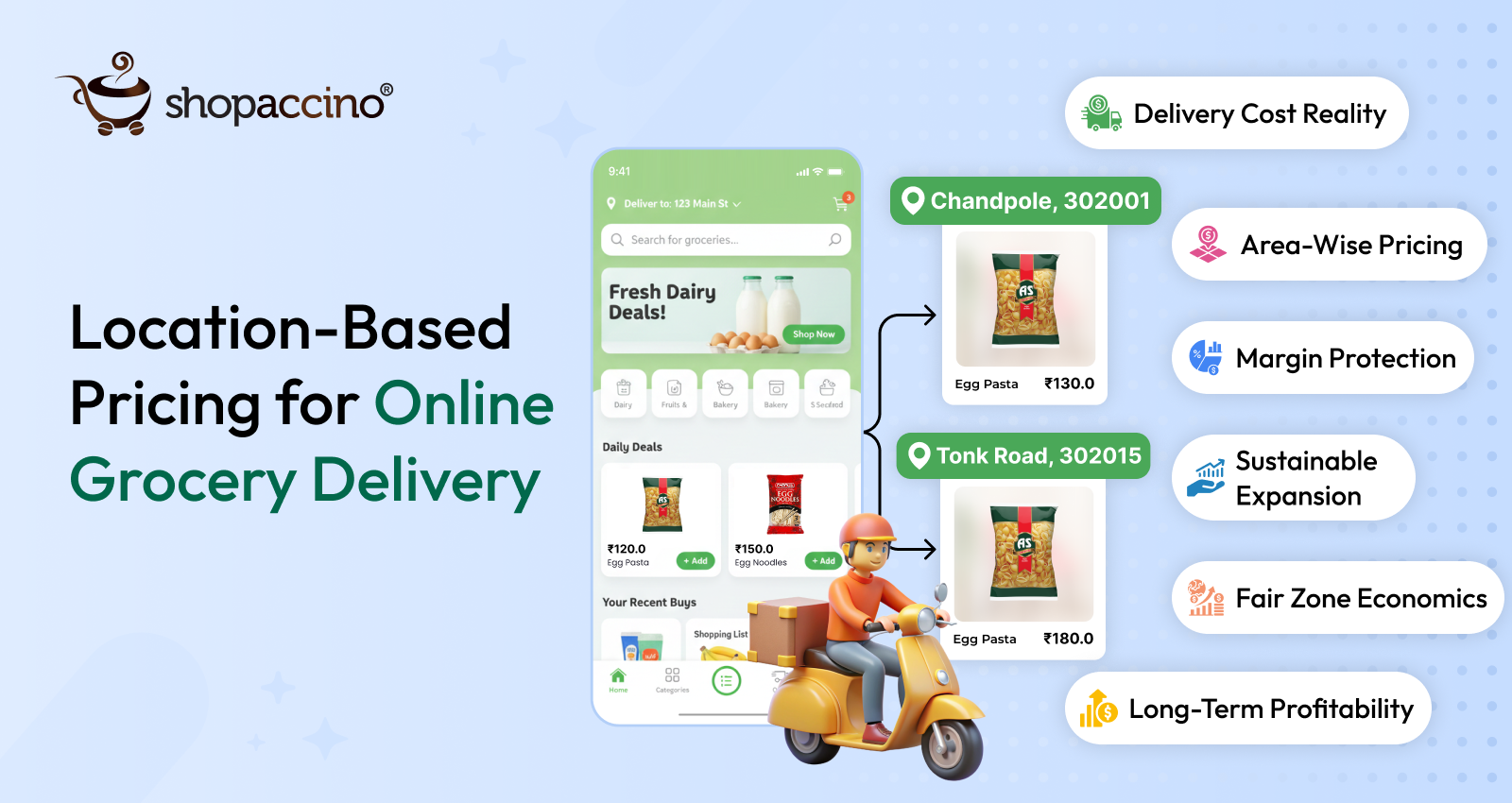
Instead of one universal price, grocery brands can adjust product pricing or delivery charges based on the customer’s pincode. This ensures that high-cost deliveries do not silently eat into margins.
Area-Wise Price Rules Protect Margins
Brands can define pricing rules for specific zones—dense areas, mid-range zones, and far-off locations. Each area reflects its true delivery cost, protecting profitability without extreme measures.
Margin Protection for High-Cost Zones
Instead of shutting down expensive areas, brands can keep them operational with adjusted pricing. This maintains customer access while avoiding losses.
Better Forecasting and Planning
When pricing reflects reality, demand becomes more predictable. Brands can plan inventory, rider allocation, and delivery slots with greater confidence.
Sustainable Expansion Instead of Aggressive Retraction
Location-based pricing allows grocery brands to expand into new areas gradually, testing economics without committing to uniform pricing that may fail later.
Platforms like Shopaccino enable grocery businesses to configure such location-based pricing rules directly into their ecommerce setup, allowing brands to scale responsibly instead of reacting to losses after they occur.
How to Implement Location-Based Pricing (Step-by-Step)
Location-based pricing sounds complex, but it becomes manageable with a structured approach.
Step 1: Study Delivery Cost by Pincode
Start by analysing average delivery cost per order across different zones. Include rider time, distance, fuel, and order density.
Step 2: Group Areas by Cost Behaviour
Instead of managing hundreds of pincodes individually, group them into logical zones such as core areas, extended areas, and remote areas.
Step 3: Define Pricing Adjustments Clearly
Decide how pricing will differ—product price adjustments, delivery fees, minimum order values, or combinations of all three.
Step 4: Apply Area-Wise Price Rules
Configure pricing rules that activate automatically based on delivery location. This removes manual intervention and ensures consistency.
Step 5: Communicate Transparently With Customers
Use simple messaging at checkout to explain pricing differences. Clarity prevents confusion and builds trust.
Step 6: Monitor Performance and Refine
Track order volume, margins, and customer retention by zone. Adjust pricing gradually based on real data rather than assumptions.
This approach transforms pricing from a risk into a strategic tool.
Benefits of Location-Based Pricing for Grocery Brands
Sustainable Margin Protection
Pricing aligned with delivery costs ensures that growth does not come at the expense of profitability.
Wider Service Coverage
Brands can serve more areas without shutting down non-profitable zones.
Reduced Operational Stress
Teams stop firefighting losses and start planning proactively.
Fairer Cost Distribution
Each location contributes appropriately to delivery expenses instead of relying on cross-subsidies.
Improved Long-Term Trust
Customers value consistency and availability. Sustainable pricing supports both.
Smarter Expansion Decisions
New areas can be tested safely without risking overall business health.
Conclusion
High delivery costs are not a temporary challenge in grocery ecommerce—they are structural. Brands that try to hide them behind fixed pricing eventually pay the price through shrinking margins, service shutdowns, or stalled growth. The future belongs to grocery businesses that accept reality and design systems around it.
Location-based pricing is not about charging more everywhere. It is about charging right—based on distance, density, and delivery economics. By aligning pricing with actual costs, grocery brands protect margins, maintain service coverage, and build businesses that can grow without bleeding money.
With solutions like Shopaccino enabling location-based pricing at the ecommerce level, grocery brands can move beyond survival mode and build operations designed for long-term sustainability.
FAQs
Delivery costs vary due to distance, traffic, order density, rider availability, and time spent per delivery. Dense areas cost less per order, while low-density or distant areas increase operational expenses significantly.
Yes, when implemented transparently. Customers already accept variable pricing in many services and prefer reliable delivery over artificially low prices that lead to service shutdowns.
In many cases, customers in remote areas value access more than discounts. Slightly higher pricing often maintains demand while protecting margins.
Absolutely. Small brands benefit even more because it prevents losses early and allows controlled expansion without financial strain
Pricing should be reviewed periodically based on delivery cost trends, fuel prices, and order density. Frequent changes are not required if rules are set thoughtfully.
Not when managed through an integrated ecommerce platform. Automation ensures pricing adjusts seamlessly without manual effort.