Best Ecommerce Platform in India for SMEs & D2C Brands (2026 Comparison Guide)
Seven platforms, compared the way you'd actually compare them — section by section, with real INR pricing, the fees nobody puts on the pricing page, and an honest note on where each one is the wrong choice.
Most "best ecommerce platform in India" lists are ranked by who pays the biggest affiliate commission. This one is not, and we'll be upfront about the obvious conflict: we build Shopaccino. So we've done the opposite of what a vendor blog usually does — every section below names the platforms that beat us, and there's a section near the end that tells you plainly when you should not pick Shopaccino.
The reason is simple. A platform migration eighteen months in costs an Indian SME between ₹2 lakh and ₹15 lakh in agency fees, lost SEO and staff retraining. Talking you onto the wrong platform is bad business for both of us. What follows is the comparison we'd want if we were on your side of the table.
What's in this guide
- The 60-second answer
- How we compared them
- Master comparison table
- True year-one cost
- Payments: UPI, COD, fees
- GST & compliance
- Catalogue & inventory
- B2B + B2C together
- Marketing, loyalty & retention
- Shipping, COD & returns
- Design & customisation
- APIs, apps & headless
- Speed & SEO
- Support when it breaks
- Lock-in & exit
- Platform-by-platform verdicts
- Pick by your situation
- Best platform by industry
- Five expensive mistakes
- FAQs
The 60-second answer
If you read nothing else:
- Best all-round for an Indian SME or D2C brand doing ₹25L–₹10Cr: Shopaccino — GST, COD, UPI, loyalty and B2B are built in rather than bolted on, and there's no platform cut of your revenue.
- Best if you're going global and want the biggest app ecosystem: Shopify — unmatched third-party ecosystem and brand trust, but you'll pay for apps and for the extra transaction fee India-based stores can't avoid.
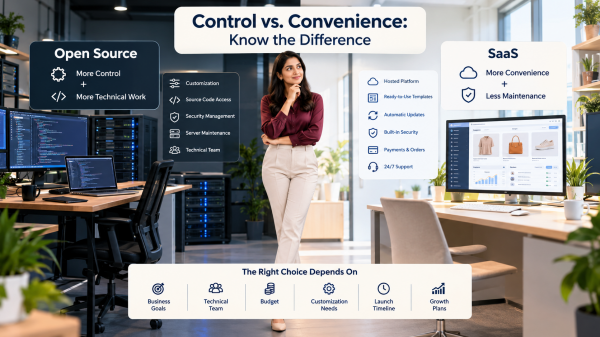
- Best if you have a developer and want total control: WooCommerce — free licence, endless flexibility, and a real ongoing maintenance bill.
- Best for content-led or service-led brands with small catalogues: Wix — fastest to a good-looking site; thin on Indian commerce operations.
- Best if you already run Zoho Books/Inventory: Zoho Commerce — the accounting integration is the whole argument.
- Best for complex, high-SKU enterprise commerce: Magento / Adobe Commerce — enormous capability, enterprise budget and a permanent dev team required.
- BigCommerce: solid SaaS, but its plan-level GMV caps and open-gateway fees bite Indian merchants specifically. Read the cost section before shortlisting it.
How we compared them (and what we ignored)
Feature-count comparisons are useless. A platform with 400 features and no GST invoice is worse for an Indian store than one with 120 features that gets the invoice right. So we scored on the things that actually decide whether an Indian online store makes money:
- True cost over 12 months — subscription plus transaction fees plus apps plus the developer you'll need. Not the sticker price.
- India payment reality — UPI, COD, EMI/BNPL, partial-COD, and who takes a cut.
- Compliance out of the box — GST-compliant invoices, HSN, e-invoicing, e-way bills, place-of-supply logic.
- Operations — inventory, multi-warehouse, courier automation, RTO and returns.
- Growth headroom — B2B alongside B2C, international selling, marketplace, APIs.
- Who fixes it at 11pm during a sale — support channel, language, time zone.
- How hard it is to leave — because one day you might want to.
Pricing below was checked against each vendor's own published pricing page in September 2026. USD figures are converted at approximately ₹88/$ and are indicative — always confirm on the vendor's page before you sign.
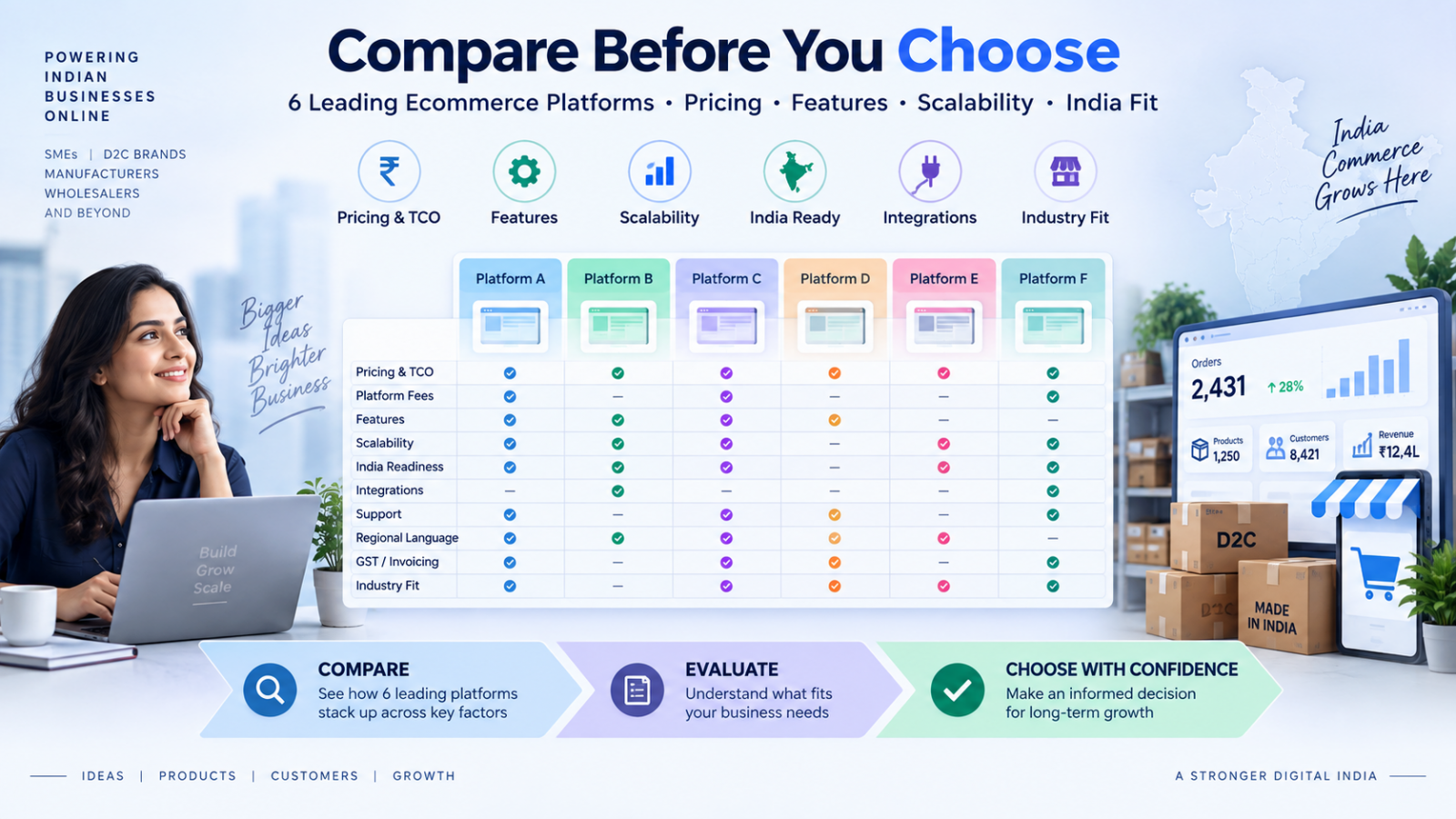
Master comparison: all seven at a glance
native / included partial, add-on or app not available or needs custom build
| Factor | Shopaccino | Shopify | WooCommerce | BigCommerce | Wix | Magento | Zoho Commerce |
|---|---|---|---|---|---|---|---|
| Entry price | ₹1,899/mo ₹18,984/yr annual |
₹1,994/mo ₹1,499/mo annual |
Free licence + hosting |
$39/mo $29 annual (~₹2,550) |
~$29.77/mo (~₹2,620) |
Free (Open Source) Adobe: quote |
From ₹99/mo annual billing |
| Platform cut of sales | 0% all plans | Extra fee Shopify Payments N/A in India |
0% | 2% / 1% / 0.6% on open gateways |
0% | 0% | 0% |
| GMV cap on plan | None | None | None | $30K / $100K TTM | None | None | None |
| GST invoicing | built in | app | plugin | app | app | extension | via Zoho Books |
| COD + partial COD | app | plugin | app | limited | extension | ||
| B2B + B2C, one store | ProCommerce | Plus only | plugins | higher tiers | strong | Premium | |
| Multi-warehouse | up to 5 | plugin | Premium | ||||
| Loyalty / rewards | app | plugin | app | app | extension | ||
| Developer needed | No | Rarely | Yes | Rarely | No | Always | No |
| App ecosystem | Focused | Largest | Huge | Good | Good | Large | Zoho suite |
| Free trial | 14 days | 3 days | n/a | 15 days | Free plan | n/a | 14 days |
| Support | Phone, chat, email, WhatsApp (IST) | 24/7 chat & email | Community / your dev | Chat, email, phone | Chat, callback | Community / partner | Email, chat, phone |
1. True year-one cost — what you'll actually pay
Every platform's pricing page shows one number. Your accountant sees four: subscription, the platform's cut of sales, apps and extensions, and people. Here's all four, modelled on a realistic Indian D2C brand doing ₹50 lakh GMV in year one with roughly 3,000 orders.
Quick compare
| Platform | Subscription | Platform fee on sales | Apps / extensions | Dev & setup | Year-one total |
|---|---|---|---|---|---|
| Shopaccino (Scale) | ₹49,980 | ₹0 | ₹0–20,000 | ₹0–25,000 | ₹50,000–95,000 |
| Shopify (Grow) | ₹67,188 | ₹25,000–1,00,000* | ₹30,000–80,000 | ₹25,000–1,50,000 | ₹1,47,000–4,00,000 |
| WooCommerce | ₹0 licence | ₹0 | ₹30,000–80,000 | ₹1,00,000–3,50,000 | ₹1,60,000–4,80,000 |
| BigCommerce (Growth) | ~₹83,000 | ~₹50,000 (1%) | ₹25,000–60,000 | ₹40,000–1,50,000 | ₹2,00,000–3,45,000 |
| Wix (Business) | ~₹42,000 | ₹0 | ₹20,000–50,000 | ₹0–40,000 | ₹62,000–1,32,000 |
| Magento Open Source | ₹0 licence | ₹0 | ₹50,000–2,00,000 | ₹5,00,000–25,00,000 | ₹6,00,000–28,00,000 |
| Zoho Commerce | ₹1,200 (Starter) higher tiers vary |
₹0 | ₹0–40,000 | ₹0–50,000 | ₹1,200–1,50,000 |
* Shopify does not operate Shopify Payments in India, so every Indian store uses a third-party gateway and pays Shopify's additional third-party transaction fee on top of the gateway's own MDR. The rate falls as you move up plans; confirm your exact rate with Shopify before signing. The range above models roughly 0.5%–2% of ₹50L.
What the numbers actually mean
The subscription is the smallest line for everyone except Shopaccino, Wix and Zoho. On Shopify and BigCommerce, the platform's cut of your sales plus the app stack routinely exceeds the subscription by year two. On WooCommerce and Magento, the people cost dwarfs everything — the licence is free, the developer is not.
The percentage fee is the one that scales against you. A 1% platform fee looks harmless at ₹50 lakh (₹50,000). At ₹5 crore it's ₹5,00,000 a year. Your subscription won't have grown tenfold; that fee will have. This is why "0% transaction fees" is not a marketing line for Indian SMEs — it's the single biggest structural cost difference between the platforms on this page.
BigCommerce's GMV caps deserve a specific warning for Indian merchants. Its Core plan is capped at $30,000 trailing-twelve-month GMV — about ₹26 lakh. A modest Indian D2C brand crosses that in year one and is pushed to Growth. And because Indian gateways (Razorpay, PayU, CCAvenue, Cashfree) are "open" rather than "embedded" payment providers in BigCommerce's classification, Indian stores pay the open-provider fee — 2% on Core, 1% on Growth — that a US store on Stripe or PayPal pays zero of. Same plan, different economics, purely because of where you sell.
WooCommerce's free licence is real; its free cost is not. WooCommerce's own pricing page puts hosting at $25–$350/month and extensions at $29–$299/year each, and its published case studies show total cost landing at 1.7%–4.5% of revenue. That's an honest set of figures from the vendor itself, and it's roughly what Indian agencies quote too once you add a retainer.
Magento is not in the same conversation. Magento Open Source is genuinely free to download, and that fact traps a lot of Indian SMEs. A production-grade Magento store needs a build (₹5L–₹25L), managed hosting (₹15,000–₹60,000/month) and ongoing developers. Adobe Commerce, the paid tier, is quote-based and sized for enterprise budgets. If your annual GMV is under ₹5 crore, Magento is almost certainly the wrong economic answer.
2. Payments — UPI, COD and who takes a cut
India's payment mix is unlike anywhere else. UPI dominates digital checkout, COD still carries a large share of orders outside metros, and EMI/BNPL materially lifts conversion on anything above ₹5,000. A platform that treats these as edge cases will cost you conversions every day.
Quick compare
| Capability | Shopaccino | Shopify | WooCommerce | BigCommerce | Wix | Magento | Zoho |
|---|---|---|---|---|---|---|---|
| Indian gateways (Razorpay, PayU, CCAvenue, Cashfree) | native | plugin | as "open" provider | limited set | extension | ||
| UPI at checkout | via gateway | via gateway | via gateway | via gateway | |||
| Cash on Delivery | native, with rules | app for rules | plugin | app | basic | extension | |
| Partial COD / advance on COD | app | plugin | custom | ||||
| EMI & BNPL on PDP + checkout | Scale+ | app | plugin | app | extension | ||
| Platform's own cut | 0% | Extra fee applies | 0% | 0.6–2% | 0% | 0% | 0% |
| Multi-currency / intl. payments | Scale+ | best in class | plugin | 2–5 currencies |
What the numbers actually mean
Everyone supports UPI — through your gateway. No platform on this list has its own UPI rail; they all hand off to Razorpay, PayU, Cashfree or similar. So UPI support isn't a differentiator. What differentiates is COD intelligence: can you restrict COD by pincode, by cart value, by product category, by customer history? Can you take ₹100 upfront to cut RTO? Those rules are where Indian merchants lose or save real money, and they're native on Shopaccino and Zoho, an app purchase nearly everywhere else.
Shopify's India payment situation is structural, not a bug. Shopify Payments is available in roughly 40 countries and India is not one of them. That means every Indian Shopify store routes payments through a third-party gateway — and Shopify charges its additional third-party transaction fee on those orders, on top of the gateway's MDR. You are paying two intermediaries for one transaction. It's not a reason to rule Shopify out, but it is a reason to model it properly before you commit.
BigCommerce's fee structure has the same shape. Stores using its "embedded" providers (Stripe, PayPal, Adyen, Klarna and similar) pay nothing extra. Indian gateways sit outside that list, so Indian merchants pay the open-provider percentage. Again: same product, worse economics, because of geography.
3. GST, e-invoicing and compliance
This is the section where global platforms quietly fail Indian merchants. A GST-compliant tax invoice isn't a PDF with a tax line; it needs the seller and buyer GSTIN, HSN/SAC codes, correct CGST/SGST versus IGST split based on place of supply, invoice series continuity, and — above a turnover threshold — IRN and QR code from the e-invoicing portal.
Quick compare
| Requirement | Shopaccino | Shopify | WooCommerce | BigCommerce | Wix | Magento | Zoho |
|---|---|---|---|---|---|---|---|
| GST-format tax invoice | built in | paid app | plugin | app | app | extension | Zoho Books |
| HSN codes per product | |||||||
| CGST/SGST vs IGST by place of supply | automatic | app logic | plugin | ||||
| Per-warehouse GSTIN | ProCommerce | custom | custom | ||||
| E-invoicing (IRN/QR) | via integration | third party | third party | third party | third party | Zoho Books | |
| Accounting sync (Tally / Zoho) | Scale+ | app | plugin | app | native |
What the numbers actually mean
Shopify, BigCommerce, Wix and Magento were all designed for markets without GST. They handle tax well in the abstract — rates, zones, inclusive/exclusive pricing — but a compliant Indian invoice comes from an app or an accountant working in parallel. In practice most Indian Shopify stores run a GST invoicing app at ₹800–₹2,500/month, or export orders to Tally each week and issue invoices from there. It works. It's also a permanent monthly cost and a permanent failure point.
The two platforms that treat GST as a first-class citizen are Shopaccino (built for the Indian market from the start) and Zoho Commerce (because Zoho Books sits behind it). If you're selling from multiple states, per-warehouse GSTIN handling stops being nice-to-have and becomes the thing your CA calls you about — and that's the narrowest field of all, essentially Shopaccino and custom builds.
4. Catalogue, inventory and multi-warehouse
Quick compare
| Capability | Shopaccino | Shopify | WooCommerce | BigCommerce | Wix | Magento | Zoho |
|---|---|---|---|---|---|---|---|
| Products on entry plan | 1,000 | Unlimited | Unlimited | Unlimited | Unlimited | Unlimited | 25 |
| Products on mid plan | 5,000–20,000 | Unlimited | Unlimited | Unlimited | Unlimited | Unlimited | 500–10,000 |
| Variants per product | Up to 400 values, 3 options | Plan-dependent — check yours | Unlimited | High | Moderate | Unlimited | Limited |
| Bulk import / update | |||||||
| Multi-warehouse stock | 5 (ProCommerce) | plugin | unlimited | 3 (Premium) | |||
| Auto order routing by warehouse | custom | ||||||
| ERP / inventory-tool sync | Tally, Zoho, Unicommerce, EasyEcom, Gofrugal | app | plugin | app | custom | Zoho Inventory |
What the numbers actually mean
Here's a genuine point against us: Shopaccino, Wix and Zoho meter product counts; Shopify, WooCommerce, BigCommerce and Magento don't. If you're a distributor with 40,000 SKUs, the metered platforms will cost you more or won't fit, and that's a real reason to look elsewhere. Zoho's 25-product Starter plan in particular is a micro-store tier, not a business tier — budget for Professional or Premium if you have a real catalogue.
Where metered plans stop mattering is at typical D2C scale. A fashion brand with 600 styles and colour/size variants, a jewellery brand with 2,000 SKUs, a food brand with 150 — all sit comfortably inside a mid-tier plan, and the variant depth matters more than the raw count. On that measure Shopaccino's 400 variant values across three options is unusually generous for a SaaS platform. Variant ceilings differ by plan on most of the others, so if you sell apparel or footwear with large size-colour matrices, confirm the number on the specific plan you're quoted rather than the platform in general.
Multi-warehouse is where the field thins out fast. Wix simply doesn't do it. WooCommerce and Zoho need help. If you hold stock in more than one city — and any brand shipping nationwide with a decent delivery promise eventually does — this row should carry heavy weight in your decision.
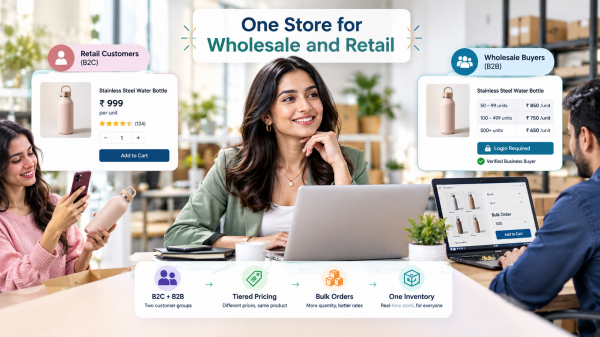
5. Running B2B and B2C on one platform
This is the quietest deal-breaker in Indian ecommerce. An enormous number of Indian SMEs sell both ways: a D2C storefront to consumers, and a wholesale or dealer channel with negotiated pricing, MOQs and credit terms. Most global platforms force you to buy the enterprise tier — or run two stores.
Quick compare
| Capability | Shopaccino | Shopify | WooCommerce | BigCommerce | Wix | Magento | Zoho |
|---|---|---|---|---|---|---|---|
| Customer-group pricing | ProCommerce | Plus only | plugin | Scale+ | Premium | ||
| Minimum order quantity | app | plugin | |||||
| Sell on credit / payment terms | Plus only | plugin | quotes | ||||
| Restricted / private catalogues | Plus only | plugin | |||||
| Quote requests / RFQ | app | plugin | Premium | ||||
| Sales reps / territory assignment | TailorMade | custom | |||||
| Entry cost for real B2B | ₹9,999/mo | ₹1,75,000/mo (Plus) | Plugins + dev | Scale tier ($299+/mo) | n/a | Build cost | Premium tier |
What the numbers actually mean
Look at the last row. That's the whole section. Shopify's B2B functionality is genuinely excellent — customer companies, catalogues, payment terms, the lot — and it lives on Shopify Plus, which starts at around ₹1,75,000 per month. For an Indian SME doing ₹3 crore with a dealer network, that's not a pricing objection; it's a different universe.
Magento handles B2B properly and always has — it's arguably the most capable B2B platform here. The cost is the build. If you have the budget and the SKU complexity to justify it, Magento's B2B module is the benchmark.
WooCommerce can do most of this via plugins (B2BKing, Wholesale Suite and similar), which is a legitimate route if you already have a developer. Expect to stitch three or four plugins together and to own the compatibility problem at every WordPress update.
Shopaccino's position here is straightforward: B2B pricing, MOQ, credit sales, restricted catalogues and B2B/B2C customer segmentation sit on the ProCommerce plan at ₹9,999/month, on the same store as your consumer storefront. That's the gap the platform was designed around, and it's the clearest single reason Indian hybrid sellers end up here.
6. Marketing, loyalty and retention
Quick compare
| Capability | Shopaccino | Shopify | WooCommerce | BigCommerce | Wix | Magento | Zoho |
|---|---|---|---|---|---|---|---|
| Abandoned cart recovery | all plans | plugin | higher plans | extension | |||
| Loyalty & reward points | native | app (~₹2,000+/mo) | plugin | app | app | extension | |
| Coupons, volume & tiered discounts | |||||||
| WhatsApp commerce | Scale+ (via Interakt etc.) | app | plugin | app | |||
| Meta / Google product feed | plugin | ||||||
| Third-party marketing app depth | Moderate | Exceptional | Exceptional | Good | Good | Good | Zoho Marketing Plus |
What the numbers actually mean
Two different philosophies collide here, and both are defensible.
Shopify's answer is the ecosystem. Whatever growth tactic you read about this morning, there's an app for it by lunchtime — Klaviyo, Yotpo, LoyaltyLion, Rebuy, Triple Whale. If your marketing team is sophisticated and wants best-in-class tools for each job, nothing else comes close. The cost is that a serious Shopify stack routinely runs ₹15,000–₹40,000/month in app subscriptions, and each app is another integration to maintain, another checkout script, another vendor invoice.
Shopaccino's answer is inclusion. Loyalty, abandoned cart, coupons, product feeds and the engagement integrations ship with the plan. You get 80% of the capability at 0% of the incremental cost. If your team is two people and one of them also packs orders, that trade is usually correct. If you have a growth lead who lives in Klaviyo flows, it isn't.
Be honest with yourself about which of those you are. The most common expensive mistake we see is a three-person brand buying the platform built for a thirty-person marketing team.
7. Shipping, COD reconciliation and returns
Quick compare
| Capability | Shopaccino | Shopify | WooCommerce | BigCommerce | Wix | Magento | Zoho |
|---|---|---|---|---|---|---|---|
| Indian courier aggregators (Shiprocket, Delhivery, etc.) | native | app | plugin | app | extension | ||
| Auto waybill & label generation | Scale+ | app | plugin | ||||
| Live tracking & auto status updates | app | plugin | |||||
| Pincode serviceability rules | app | plugin | |||||
| Hyperlocal / own-rider delivery | Scale+ | app | plugin | custom | |||
| Returns / RTO workflow | plugin |
What the numbers actually mean
RTO — return to origin on undelivered COD orders — is the tax nobody budgets for. Indian D2C brands routinely see 15–30% RTO on COD orders, and every one costs you forward freight, return freight and a re-picked SKU. The tooling that fights it is unglamorous: pincode serviceability checks before the customer commits, COD limits by cart value, address verification, and a partial-advance option on COD.
Platforms built for India treat these as core. Platforms built elsewhere treat them as app-store problems, which means you solve RTO with three subscriptions and hope they agree with each other. Wix essentially doesn't participate in this conversation at all — if you're shipping physical goods across India at volume, it's the wrong tool.
Shopify deserves credit here: its app ecosystem for Indian logistics is now genuinely mature, and Shiprocket/Delhivery integrations are well maintained. You're paying for them, but they work.
8. Design, themes and customisation
Quick compare
| Aspect | Shopaccino | Shopify | WooCommerce | BigCommerce | Wix | Magento | Zoho |
|---|---|---|---|---|---|---|---|
| Theme library size | Moderate | Very large | Enormous | Moderate | Very large | Moderate | Moderate |
| Visual editor, no code | via builder | best | |||||
| Full template/code access | Liquid | PHP | Stencil | limited | full | ||
| Custom PDP layouts | |||||||
| Designer/dev skill needed for a custom look | Low–medium | Medium | Medium–high | Medium | Very low | High | Low |
What the numbers actually mean
If pure visual freedom with zero technical skill is your priority, Wix wins and it isn't close. Its editor is the best consumer-grade design tool in this comparison. The catch is everything in the previous three sections.
Shopify and WooCommerce have the deepest theme markets, which matters more than it sounds — a ₹15,000 premium theme that fits your category saves weeks of design work. Shopaccino's library is smaller but every theme is built with Indian commerce patterns already in place (COD messaging, EMI widgets, size charts, trust badges), which is a different kind of head start.
Magento gives you absolute control and demands a front-end developer to exercise it. That's the whole Magento bargain, repeated in every section.
9. APIs, integrations and headless
Quick compare
| Aspect | Shopaccino | Shopify | WooCommerce | BigCommerce | Wix | Magento | Zoho |
|---|---|---|---|---|---|---|---|
| Public product & order APIs | Scale+ | REST | |||||
| Webhooks | |||||||
| Headless / custom front end | via APIs | Hydrogen | WP REST | strong | PWA Studio | ||
| ERP connectors ready-made | Tally, Zoho, Unicommerce, EasyEcom, Gofrugal | via apps | via plugins | custom | Zoho suite | ||
| Marketplace of apps | Focused set | ~13,000 apps | ~60,000 WP plugins | Around a thousand | Several hundred | Thousands | Zoho ecosystem |
What the numbers actually mean
On raw extensibility, Shopify, WooCommerce and Magento win — and we should say that plainly. If your roadmap includes a custom headless storefront, a proprietary recommendation engine or an integration nobody has built yet, those three give you the most room.
But there's a distinction worth drawing: app count is not integration readiness. Shopaccino ships ready-made connectors to the systems Indian SMEs actually run — Tally for accounting, Unicommerce and EasyEcom for order management, Gofrugal for retail POS. Finding an equivalent on a global platform usually means a paid third-party connector or a developer. Thirteen thousand apps is a wonderful number right up until none of them speaks to Tally.
10. Speed, SEO and Core Web Vitals
Quick compare
| Aspect | Shopaccino | Shopify | WooCommerce | BigCommerce | Wix | Magento | Zoho |
|---|---|---|---|---|---|---|---|
| Hosting, CDN & SSL included | you buy it | you buy it | |||||
| Editable meta, schema, sitemap | Yoast/RankMath | ||||||
| Full URL structure control | forced /products/ etc. | full | |||||
| Performance ceiling | High (managed) | High (managed) | Depends on you | High | Moderate | Very high, with work | Moderate |
| Blog / content engine | shoppable articles | best (WordPress) | weak |
What the numbers actually mean
Two honest points, one in each direction.
First, against the SaaS platforms including our own: WordPress + WooCommerce is still the best content-SEO machine in this comparison. If your acquisition strategy is primarily organic content — recipes, guides, buying advice — WordPress's editorial tooling and plugin depth are a genuine advantage. Magento, conversely, has the weakest blog of the seven; content-led Magento brands usually run a separate WordPress install.
Second, in favour of managed platforms: on WooCommerce and Magento, performance is your job. Core Web Vitals on a self-hosted store are a function of your hosting, your caching layer, your image pipeline and how many plugins you've installed. Plenty of Indian WooCommerce stores are fast. Plenty are catastrophically slow, and the ones that are slow usually don't know it. Managed platforms take that variable away in exchange for taking some control away too.
11. Support — who fixes it during your sale
Quick compare
| Aspect | Shopaccino | Shopify | WooCommerce | BigCommerce | Wix | Magento | Zoho |
|---|---|---|---|---|---|---|---|
| Phone support | callback | ||||||
| WhatsApp support | |||||||
| IST business-hours team | 24/7 global | ||||||
| Onboarding / migration help | Plus only | your agency | your partner | ||||
| Who fixes a broken checkout | Vendor | Vendor | You | Vendor | Vendor | You | Vendor |
The row that matters is the last one. On WooCommerce and Magento, a broken checkout at 9pm on a Diwali sale is your emergency — you, your agency, or your freelancer, at whatever notice they can manage. On managed platforms it's the vendor's emergency. Merchants consistently underrate how much this is worth until the first time it happens.
Shopify's support is 24/7 and competent, but it's chat and email against a global queue. For a lot of Indian SME owners, being able to phone a person who answers in Hindi or Gujarati and understands that today is a GST filing deadline is worth more than a faster first-response SLA.
12. Lock-in and how hard it is to leave
Nobody plans their exit while signing up. Plan it anyway.
| Aspect | Shopaccino | Shopify | WooCommerce | BigCommerce | Wix | Magento | Zoho |
|---|---|---|---|---|---|---|---|
| Export products, orders, customers | full DB | limited | full DB | ||||
| Own your hosting/database | |||||||
| Theme portable to another platform | |||||||
| Practical switching cost | Moderate | Moderate | Low (you hold the data) | Moderate | High | Low (you hold the data) | Moderate |
Every SaaS platform locks you in to some degree — your theme, your URL structure, your app configuration and your staff's muscle memory don't travel. Open-source (WooCommerce, Magento) is the genuinely portable choice because you hold the database. Wix is the hardest to leave of the SaaS options; its export tooling is the most limited here.
Platform-by-platform verdicts
Shopaccino Best all-round for Indian SMEs
Pricing: ₹1,899/mo (StartUp) · ₹4,999/mo (Scale) · ₹9,999/mo (ProCommerce) · custom (TailorMade) — monthly billing, plus 18% GST. Billed annually: ₹18,984 / ₹49,980 / ₹99,984 per year — roughly two months free. 0% platform transaction fees on every plan. 14-day free trial, no card.
Pick it if
- You need GST, COD rules, UPI and Indian courier automation working on day one
- You sell B2B and B2C, or will within two years
- You want loyalty and abandoned cart without app invoices
- You'd rather phone someone in IST than open a ticket
- You want platform costs that don't scale with your revenue
Don't pick it if
- You have 25,000+ SKUs on a budget plan — product counts are metered
- Your growth team needs a specific best-in-class app (Klaviyo flows, advanced CRO suites) that isn't in the ecosystem
- You want a fully headless storefront as your primary architecture
- Your business is almost entirely outside India and multi-region selling is the core requirement
Shopify Best ecosystem & global reach
Pricing (India): Basic ₹1,994/mo (₹1,499 annual) · Grow ₹7,447/mo (₹5,599 annual) · Advanced ₹30,164/mo (₹22,680 annual) · Plus from ₹1,75,000/mo. 3-day trial. Note: Shopify Payments is not available in India, so a third-party gateway and Shopify's additional transaction fee apply.
Pick it if
- You sell internationally or plan to, in multiple currencies
- Your marketing stack depends on specific best-in-class apps
- You want the largest partner and agency talent pool in the world
- Brand trust with investors or partners matters to you
Don't pick it if
- You're cost-sensitive and India-focused — the extra transaction fee plus app stack adds up fast
- You need real B2B without paying for Plus
- You need GST invoicing natively rather than through an app
- Apparel with very deep variant matrices — confirm your plan's variant ceiling before migrating
WooCommerce Best for control & content SEO
Pricing: Free plugin. WooCommerce's own published guidance puts hosting at $25–$350/month and extensions at $29–$299/year each; its case studies show all-in cost landing at roughly 1.7%–4.5% of revenue.
Pick it if
- You have a developer, an agency retainer or in-house technical skill
- Content marketing is your main acquisition channel
- You want to own your data and hosting outright
- Your requirements are unusual enough that no SaaS platform fits
Don't pick it if
- Nobody on your team can debug a PHP error
- You want a vendor to answer the phone when checkout breaks
- You're underestimating maintenance — plugin conflicts and security patching are permanent work
- You need GST and COD logic working this week
BigCommerce Capable, but check the India maths
Pricing: Core $39/mo ($29 annual) · Growth $105/mo ($79 annual) · Scale $399/mo ($299 annual) · Performance from $1,499/mo. GMV caps: $30K TTM on Core, $100K TTM on Growth. Open payment provider fee: 2% Core, 1% Growth, 0.6% Scale. 15-day trial.
Pick it if
- You want strong native B2B and multi-storefront on a SaaS platform
- Your payment provider is one of BigCommerce's embedded partners (no fee)
- You want headless flexibility with managed hosting
Don't pick it if
- You're an India-only store using Razorpay/PayU/Cashfree — you'll pay the open-provider fee US merchants avoid
- You're growing fast — the GMV caps force upgrades on a schedule that isn't yours
- You need GST or Indian courier integrations natively
Wix eCommerce Best for small catalogues & fast launch
Pricing: Light ~$17.77/mo · Core ~$29.77/mo · Business ~$39.77/mo · Business Elite ~$159.77/mo (prices and currency vary by location). Payment acceptance starts on the Core plan.
Pick it if
- You have under ~200 products and a simple fulfilment model
- Design and speed-to-launch matter more than operations depth
- You're a service business, creator or studio adding a small shop
- Nobody on your team is technical and nobody wants to be
Don't pick it if
- You hold stock in more than one location
- COD and GST are central to your business
- You'll ever want B2B pricing
- You want an easy exit later — export tooling is limited
Magento / Adobe Commerce Enterprise only
Pricing: Magento Open Source is free to download. Adobe Commerce is quote-based and enterprise-scaled. Realistic Indian implementation: ₹5L–₹25L build, ₹15,000–₹60,000/month managed hosting, ongoing developer capacity.
Pick it if
- You run tens of thousands of SKUs across multiple brands or regions
- Your B2B requirements are genuinely complex — contract pricing, approval workflows, punch-out
- You have or can hire a permanent development team
- Your GMV justifies a seven-figure annual technology budget
Don't pick it if
- You're an SME attracted by the word "free" — this is the most common and most expensive mistake in this guide
- Your annual GMV is under ₹5 crore
- Content marketing is central (the blog is weak)
- You need to launch in weeks, not quarters
Zoho Commerce Best if you already run Zoho
Pricing: From ₹99/mo (Starter, billed annually — 1 user, 25 products). Higher tiers scale users, products and storage: Standard (2 users, 500 products, 50GB), Professional (5 users, 2,500 products, multi-currency, WhatsApp commerce), Premium and Plus (10 users, 10,000 products, price lists, quote requests, multiple inventory locations). 0% transaction fees. 14-day trial. ONDC sales channel available.
Pick it if
- You already use Zoho Books, Inventory or CRM — the integration is the entire argument
- You want GST handled properly at a very low price point
- Your catalogue is modest and your operations are simple
- You want to sell on ONDC
Don't pick it if
- You're not in the Zoho ecosystem — the standalone storefront is less mature than the alternatives
- You need deep D2C marketing and loyalty tooling
- You need multi-warehouse with automatic order routing
- You expect the ₹99 plan to run a real store — it's a 25-product micro-store tier
Pick by your situation
| If this is you… | Start here | Also consider | Why |
|---|---|---|---|
| First store, ₹0–₹50L expected, India-only | Shopaccino StartUp | Zoho Commerce, Wix | GST, COD and UPI working on day one; no revenue share; no developer |
| D2C brand ₹50L–₹5Cr, scaling fast | Shopaccino Scale | Shopify Grow | Courier automation, APIs and international selling without a percentage cut |
| Selling wholesale + retail | Shopaccino ProCommerce | Magento, BigCommerce Scale | Real B2B without Shopify Plus pricing |
| Global brand, multi-currency first | Shopify | BigCommerce | Best multi-currency, markets and international app ecosystem |
| Content-led brand, blog drives sales | WooCommerce | Shopaccino (shoppable articles) | WordPress is still the best editorial engine |
| Small catalogue, design-led, service business | Wix | Shopaccino StartUp | Fastest route to an attractive small shop |
| Already running Zoho Books / Inventory | Zoho Commerce | Shopaccino (Zoho sync) | Accounting and stock already reconciled |
| 30,000+ SKUs, multi-brand, dev team in place | Magento / Adobe Commerce | BigCommerce Enterprise | Only platforms built for that complexity |
| Migrating off a failing site, need it stable fast | Shopaccino | Shopify | Migration assistance plus managed hosting and IST support |
Best ecommerce platform by industry
| Industry | Non-negotiable requirements | Strongest fit |
|---|---|---|
| Fashion & apparel | Deep variant matrices, size charts, high return rates, COD control, lookbooks | Shopaccino, Shopify |
| Jewellery | Dynamic gold-rate pricing, certification display, high-value COD limits, zoom imagery, insurance-grade tracking | Shopaccino, Magento |
| Food & FMCG | Batch/expiry, hyperlocal delivery, subscriptions, pincode serviceability, FSSAI details on invoice | Shopaccino, WooCommerce |
| Dairy & daily essentials | Recurring orders, delivery slots, own-rider routing, wallet/prepaid balance | Shopaccino |
| Health, wellness & nutra | Subscriptions, compliance labelling, loyalty, bundle pricing | Shopaccino, Shopify |
| Electronics & appliances | EMI/BNPL on PDP, serial-number tracking, warranty registration, comparison tables, high-value fraud checks | Shopaccino, Magento |
| Handicrafts & home décor | Made-to-order lead times, artisan storytelling, international shipping, made-in-India provenance | Shopaccino, Shopify, Wix |
| Wholesale & distribution | Dealer pricing tiers, MOQ, credit terms, restricted catalogues, sales-rep ordering | Shopaccino ProCommerce, Magento |
| Industrial & B2B parts | Huge SKU counts, RFQ, spec sheets, per-customer catalogues | Magento, BigCommerce |
| Services, studios, creators | Bookings, small product range, strong visual design | Wix, WooCommerce |
Five expensive mistakes Indian SMEs make choosing a platform
1. Comparing subscription prices instead of total cost
A ₹1,499/month plan with a 1% revenue cut and ₹25,000/month of apps costs multiples of a ₹4,999/month plan with neither. Build the year-one and year-three model for your actual GMV before you shortlist. Use the cost table above as a template.
2. Treating "free" open source as free
Magento Open Source and WooCommerce both have a licence cost of zero and an operating cost that is emphatically not zero. If the developer time is coming out of your own evenings, price your evenings.
3. Buying for the business you'll have in five years
Brands routinely buy enterprise capability they won't use for three years, and pay for it monthly the whole time. Almost every platform here lets you upgrade. Buy for the next 18 months and upgrade when the constraint is real.
4. Ignoring GST and COD until after launch
These are the two things most likely to force a migration in year two. Both are cheap to solve at selection time and expensive to retrofit. Ask for a sample GST invoice and a demo of COD rules before you sign anything.
5. Not accounting for who runs it
The best platform for your business is partly a function of who logs in every morning. A platform your ops person can operate confidently beats a more powerful one they need a developer to change. Run your actual team through the trial — not the founder, the person who'll use it daily.
Not sure which one fits your business?
Tell us your category, your monthly order volume and whether you sell B2B. We'll give you a straight answer — including when another platform is the better fit for you.
Talk to an ecommerce specialistOr start a 14-day free trial — no credit card, no transaction fees on any plan.
FAQs
The best ecommerce platform in India for SMEs in 2026 depends on scalability, pricing transparency, integration depth, and operational simplicity. SMEs should prioritize SaaS-based, all-in-one platforms that offer centralized inventory, marketing compatibility, and reliable support.
D2C brands prefer SaaS ecommerce platforms because they offer cloud hosting, automatic updates, predictable pricing, and reduced technical dependency. This allows brands to focus on marketing and product growth instead of managing infrastructure.
All in one ecommerce platforms combine storefront, inventory, order management, and analytics into a single system. This reduces tool fragmentation, lowers operational complexity, improves data accuracy, and enables faster business decisions.
SMEs should evaluate scalability, cost predictability, marketing integrations, inventory control, checkout optimization, and local market support. The platform should support long-term growth without frequent migrations or heavy developer dependency.