How to Automate Inventory and Order Sync Across Warehouses
As ecommerce grows more competitive and customer expectations escalate toward faster deliveries, real-time visibility, and error-free fulfillment, businesses are discovering that warehouse operations are no longer a backend task—they are a core driver of customer experience. Especially for MSMEs and D2C brands moving from single-store operations to multi-location inventory setups, managing stock manually is no longer sustainable.
Today’s digital shoppers judge brands based on the accuracy of stock availability, the speed of shipping, and the transparency of order updates. This means businesses must ensure that every item in every warehouse is tracked, updated, and dispatched with precision. But this becomes difficult when operations expand across multiple warehouses, dark stores, offline locations, or regional distribution hubs.
That’s where automated inventory and order sync comes in.
Instead of relying on spreadsheets, manual stock updates, or disconnected systems, brands now use integrated ecommerce platforms—like Shopaccino—that synchronize inventory and orders instantly across all locations. This helps avoid overselling, reduces human error, improves profitability, and provides customers with a seamless buying experience.
This guide breaks down the challenges businesses face, the expectations customers hold, the role of integrated platforms, and the step-by-step approach to automating warehouse operations.
Challenging Area – What Businesses Struggle With in Multi-Warehouse Operations
Managing multiple warehouses sounds exciting from a scale perspective, but the operational strain increases rapidly. Most MSMEs and mid-scale ecommerce brands face several challenges once they start operating beyond a single inventory location.
Fragmented Stock Visibility
Without automation, brands try to manage inventory through:
- Offline records
- Individual warehouse logs
- Excel sheets
- Manual reports
This causes stock discrepancies, delays, and confusion—especially during peak seasons.
When visibility is fragmented, businesses cannot plan replenishment, prioritize fast-moving products, or accurately monitor inventory health.
Overselling and Order Errors
Overselling is one of the most common issues in multi-location inventory setups. When platforms fail to sync stock across warehouses, the system may show availability even when the product is sold out. This results in:
- Cancellations
- Customer dissatisfaction
- Delayed refund cycles
- Negative reviews
Manual systems simply cannot update fast enough to avoid these errors.
Complex Order Routing Decisions
When orders come from different regions, deciding which warehouse should fulfill them is complicated.
Teams often struggle with:
- Determining nearest warehouse
- Checking stock
- Checking delivery feasibility
- Ensuring courier serviceability
Without automated order routing, each decision becomes time-consuming and prone to mistakes.
Slow Fulfillment and Dispatch Delays
A small delay in picking or confirming an order due to mismanaged stock can cascade into a bigger fulfillment issue.
Slow dispatch times impact:
- Delivery speed
- Customer trust
- Brand reputation
Brands without inventory automation often see slower fulfillment cycles.
High Dependency on Warehouse Staff
Warehouse staff manually checking stock or updating systems increases inconsistencies. Even a single small mistake—like wrong stock entry—can create significant operational issues across the business.
Inaccurate Demand Forecasting
When real-time stock is not available, forecasting becomes guesswork.
This leads to:
- Overstocking
- Understocking
- Missed sales
- Increased storage cost
Accurate forecasting depends on synchronized data.
Difficulty Managing Returns and Reverse Logistics
Returns often end up in the wrong warehouses due to lack of clarity.
This disrupts:
- Stock alignment
- Restocking
- Replacements
- Refund timelines
Without synced systems, returns handling becomes messy and time-consuming.
Businesses need a system that provides a single source of truth for stock and orders across all warehouses—updated instantly, without manual intervention.
Their Customer Challenging Area – What Buyers Expect from Multi-Warehouse Brands
Customers rarely think about warehouses. But they instantly notice any issue arising from poor warehouse coordination. Their expectations are shaped by ecommerce giants offering instant delivery, transparent stock visibility, and predictable timelines.
Accurate and Real-Time Stock Availability
Customers expect that what they see online is actually available.
If they add items to their cart only to learn they’re out of stock, trust drops sharply.
Faster Delivery Through Nearest Warehouse
Shoppers now look for delivery:
- Same day
- Next day
- Within 48 hours
Using the closest warehouse ensures speed—customers expect brands to optimize fulfillment automatically.
Transparent and Timely Order Updates
Customers want clarity at each step:
- Order confirmed
- Packed
- Shipped
- Out for delivery
If warehouses delay updates or misroute orders, transparency collapses.
Accurate Replacement/Return Handling
When returns or replacements are needed, buyers expect quick processing. Poorly synchronized warehouse systems slow this down.
Reliable Product Availability Across Regions
Customers expect consistency. Whether they shop from one city or another, product availability should not fluctuate unnecessarily.
Meeting these expectations requires automated systems, not manual coordination.
Solution – How an Integrated eCommerce Platform Simplifies Inventory and Order Sync
To eliminate these challenges, ecommerce brands need a unified backend where every warehouse, every order, and every stock update flows automatically. Platforms like Shopaccino provide this end-to-end structure with full automation.
Centralized Inventory Management
All warehouses operate within one system.
Brands get:
- Real-time stock visibilit
- Unified dashboards
- Variant-level tracking
- Live SKU updates
This creates a single source of truth.
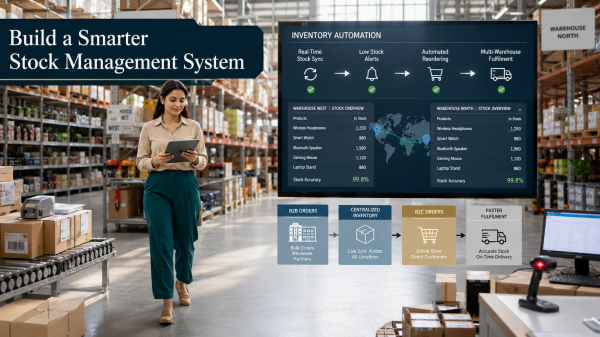
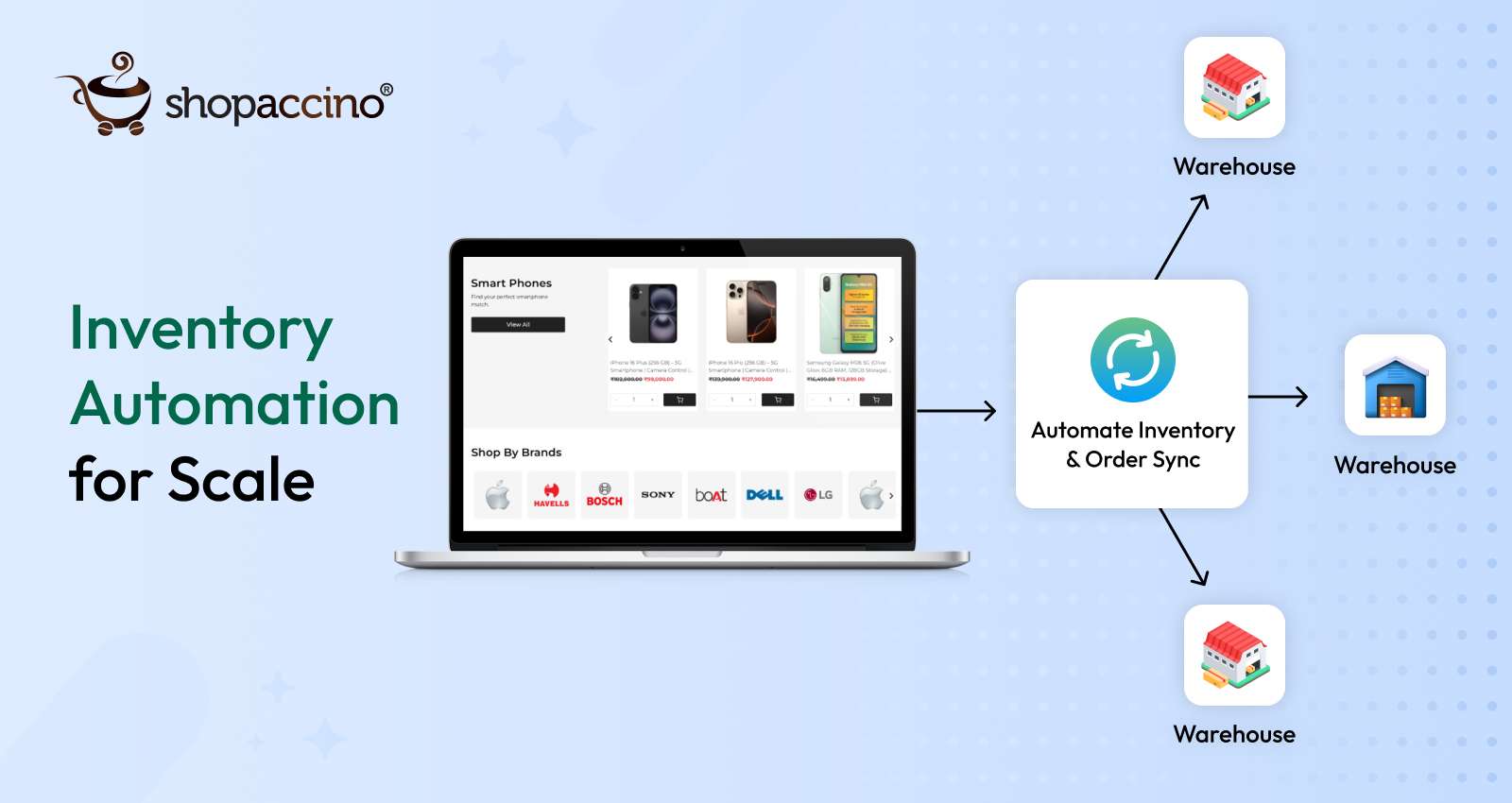
Automated Stock Sync Across All Warehouses
When a purchase is made or stock changes:
- Inventory is updated instantly
- All channels reflect the change
- Overselling is prevented
Automation reduces errors dramatically.
Rule-Based Order Routing
The system automatically decides which warehouse fulfills the order based on:
- Customer location
- Warehouse priority settings
- Stock availability
- Delivery areas
See how Multi-Warehouse Locations helps map delivery zones automatically.
Warehouse-Level Permissions
Each warehouse can process:
- Picking
- Packing
- Stock adjustments
- Returns
While the central admin retains full control.
Integrated Returns & Replacement Handling
Stock gets updated as soon as returns are processed.
This prevents stock discrepancies and improves accuracy.
Detailed Warehouse-Wise Analytics
Brands can view metrics like:
- Region-wise sales
- Warehouse performance
- Fast-moving SKUs
- Inventory turnover
- Aging stock
Data fuels better planning and forecasting.
This combination of features ensures businesses run multi-warehouse operations seamlessly at any scale.
How to Implement Automated Inventory and Order Sync – Step-by-Step
Here is a practical and actionable roadmap to setting up automation across warehouses.
Step 1: Map Your Warehouse Locations
Identify your:
- Primary warehouse
- Secondary warehouses
- Regional dark stores
- Offline store stock points
This structure helps define your inventory network.
Step 2: Add All Warehouses into Your Ecommerce System
Within platforms like Shopaccino, add warehouse profiles that include:
- Names
- Locations
- Addresses
- Serviceable pin codes
- Delivery zones
This forms the foundation of automated sync.
Step 3: Allocate and Organize Stock Warehouse-Wise
Distribute stock thoughtfully based on:
- Regional demand trends
- Inventory movement speed
- Warehouse capacity
Organized stock ensures smooth automation.
Step 4: Set Up Order Routing Conditions
Define rules such as:
- “Nearest warehouse first”
- “Warehouse priority order”
- “Stock-based assignment”
Automation takes care of routing without manual review.
Step 5: Enable Real-Time Stock Updates
Activate features like:
- Auto stock sync on order
- Low-stock alerts
- Warehouse-specific quantities
Your inventory stays updated across all channels.
Step 6: Train Warehouse Teams on Digital Processes
Ensure staff can manage:
- Order picking
- Stock entry
- Return handling
- Real-time updates
Human processes must align with digital systems.
Step 7: Track Warehouse Analytics and Improve
Review data monthly to refine:
- Inventory placement
- Forecast accuracy
- Warehouse productivity
- Delivery performance
Continuous optimization leads to smoother operations.
Benefits of Automated Inventory & Order Sync
The impact of automation is powerful and long-lasting.
Fewer Errors and No Overselling
Automation eliminates manual inconsistencies, making fulfillment accurate and reliable.
Faster Order Processing
Automated routing ensures warehouses act quickly, reducing fulfillment time.
Reduced Operational Costs
Efficiency improves, staffing needs become predictable, and logistics are optimized.
Better Inventory Control
Brands know exactly where stock is at any moment—and can reorder or reallocate accordingly.
Improved Customer Experience
Customers enjoy accurate stock visibility, faster shipping, and reliable service.
Scalable Warehouse Operations
Businesses can add more warehouses without increasing complexity.
Conclusion
Managing multiple warehouses is a powerful strategy for scaling ecommerce, but only when backed by automation. As customer expectations evolve and brands expand to new regions, manual systems fail to keep up. For a step-by-step overview, see our guide on how to manage multiple warehouses efficiently using smart eCommerce tools.
Platforms like Shopaccino make it possible for MSMEs and fast-growing brands to implement automation without coding or heavy investment. When inventory flows seamlessly and orders route intelligently, businesses operate with confidence and customers receive the speed and clarity they expect.
The future of ecommerce logistics is automated, real-time, and data-driven—and brands that adopt it early will stay ahead of competition.
FAQs
Automation ensures accurate stock, faster fulfillment, and fewer human errors.
Yes. Platforms like Shopaccino make it simple with built-in automation tools.
The system chooses the best warehouse based on location, availability, and rules.
Absolutely. Real-time inventory sync prevents duplicate or incorrect stock entries.
Yes. Returns update stock immediately, reducing discrepancies.
As many as your business needs—automation scales effortlessly.
Yes. Without real-time sync, expanding regionally becomes chaotic and inefficient.