Manage Multiple Warehouses & Locations with One Inventory Management System
As ecommerce expands and customer expectations evolve, the days of running operations from a single warehouse are slowly fading. Today’s digital shoppers demand speed, transparency, accuracy, and localized delivery. Brands—especially MSMEs and D2C retailers—can no longer rely on just one central storage location when their customer base spans multiple cities or regions.
This shift has given rise to one of the most powerful growth enablers in ecommerce: multi-warehouse management.
Whether you run a growing clothing brand, a beauty label, a grocery business, or a nationwide distribution network, the ability to manage multiple warehouses—each syncing inventory in real time—is what allows brands to:
- Deliver faster
- Reduce shipping costs
- Avoid stockouts
- Improve order accuracy
- Serve customers across regions
- Scale without operational chaos
Unfortunately, many MSMEs avoid implementing multi-warehouse systems because they assume it requires:
- Complex ERP solutions
- Expensive software
- Large teams
- Heavy IT infrastructure
But that’s no longer true. Modern ecommerce platforms such as Shopaccino allow businesses to run multi-warehouse operations smoothly—even if they are not tech experts—making the model accessible for brands of all sizes.
This guide explores the challenges of warehouse expansion, customer expectations, how integrated ecommerce systems simplify multi-warehouse operations, and a practical roadmap for implementation.
Challenging Area – What Businesses Face While Managing Multiple Warehouses
The idea of multi-warehouse fulfillment sounds promising, but the operational reality often overwhelms businesses—especially MSMEs that are scaling for the first time. Complexities increase rapidly once inventory is distributed across different physical locations.
Below are the pain points brands commonly experience.
Inventory Fragmentation and Visibility Issues
When products are stored across different warehouses, brands often struggle to maintain a unified, accurate view of:
- Product quantities
- Stock availability
- Warehouse-specific variants
- Incoming shipments
- Outgoing orders
Without a synchronized system, businesses end up overselling, underselling, or losing track of items.
This single issue can destroy customer trust quickly.
Complicated Order Routing Decisions
Which warehouse should fulfill which order?
Businesses must consider:
- Customer location
- Stock availability
- Delivery cost
- Courier serviceability
- Warehouse distance
- Processing speed
Manual decision-making leads to delays, errors, and increased shipping costs.
High Operational Coordination
Multiple warehouses mean:
- More staff
- More communication
- More inbound and outbound tasks
- More vehicle movement
- More audits
Without a digital-first approach, coordination breaks quickly. Traditional manual systems cannot keep up.
Inconsistent Delivery Speeds Across Regions
Customers in distant areas often experience:
- Longer delivery times
- Higher shipping fees
- Poorer serviceability
- More return-to-origin (RTO) cases
This inconsistency harms the overall brand experience.
Complex Replenishment and Transfer Cycles
Balancing inventory between warehouses is crucial.
Businesses struggle with:
- Overloaded warehouses
- Understocked warehouses
- Unplanned transfers
- Emergency procurement
This becomes especially challenging for fast-moving products.
Difficulty Handling Scalability
As product SKUs increase, so does inventory complexity.
A single-warehouse model becomes unsustainable beyond a certain point—especially in categories like:
- Fashion
- Beauty
- FMCG
- Electronics
- Home décor
- Grocery
Without automation and real-time sync, scaling breaks operations.
High Costs Due to Inefficient Fulfillment
Improper warehouse allocation increases:
- Shipping charges
- Packaging efforts
- Delivery time
- Return risk
- Storage costs
Failing to optimize warehouse selection directly impacts profitability.
These challenges highlight why businesses struggle—but also why multi-warehouse management is a necessity for modern ecommerce.
Their Customer Challenging Area – Buyer Expectations in a Multi-Warehouse World
While brands wrestle with backend challenges, customer expectations continue to rise relentlessly. Modern online shoppers want more than great products—they want convenience, speed, and transparency.
Here is what customers expect today.
Fast Delivery Regardless of Location
Shoppers have grown accustomed to next-day or 48-hour delivery.
If your brand cannot deliver quickly, customers choose competitors—even if your product quality is better.
Multi-warehouse fulfillment enables faster delivery because products are shipped from the closest warehouse.
Accurate Stock Availability
Customers hate:
- Seeing products listed as available
- Adding them to cart
- Completing checkout
- And receiving a “Sorry, item is out of stock” message
Real-time inventory accuracy is non-negotiable.
Lower Shipping Fees
High delivery charges are one of the biggest reasons for cart abandonment.
If businesses ship every order from a central warehouse, shipping distances increase—raising costs.
Customers gravitate toward brands that offer:
- Free shipping
- Low-cost local delivery
- Regional fulfillment
Multi-warehouse distribution keeps shipping affordable.
Fewer Delivery Failures and RTO Issues
Customers expect packages to arrive reliably.
When deliveries take too long, many buyers:
- Reject the order
- Change their mind
- Forget about the purchase
Regional fulfillment reduces RTO risks by cutting delivery time.
Real-Time Tracking and Transparency
Shoppers want updates on:
- Order confirmation
- Warehouse dispatch
- Transit progress
- Delivery time windows
Inconsistent fulfillment creates confusion and mistrust.
Product Availability Near Them
Customers want to shop from brands that ensure:
- Local inventory
- Ready-to-ship products
- Minimal stockouts
They prefer businesses that operate like modern ecommerce giants—always in stock and quick to deliver.
Understanding these expectations allows businesses to design warehousing systems that meet and exceed customer needs.
Solution – How an Integrated eCommerce Platform Simplifies Multi-Warehouse Management
The traditional approach—manual tracking, spreadsheets, isolated warehouse operations—is insufficient for scaling ecommerce.
What brands need is a centralized platform that synchronizes everything in real time.
This is where Shopaccino brings unmatched value, offering a single ecosystem to manage multi-warehouse operations seamlessly.
Here’s how it simplifies everything:
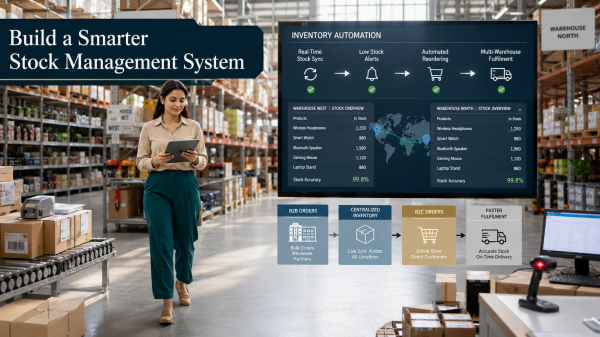
Unified Inventory Across All Warehouses
Shopaccino gives brands a centralized dashboard where they can:
- Manage stock for every warehouse
- Track inventory in real time
- Allocate stock automatically
- Prevent overselling
- Manage variants across locations
This eliminates fragmentation and ensures accuracy across channels. Explore Shopaccino's Multi-Warehouse Management feature to see the dashboard in action.
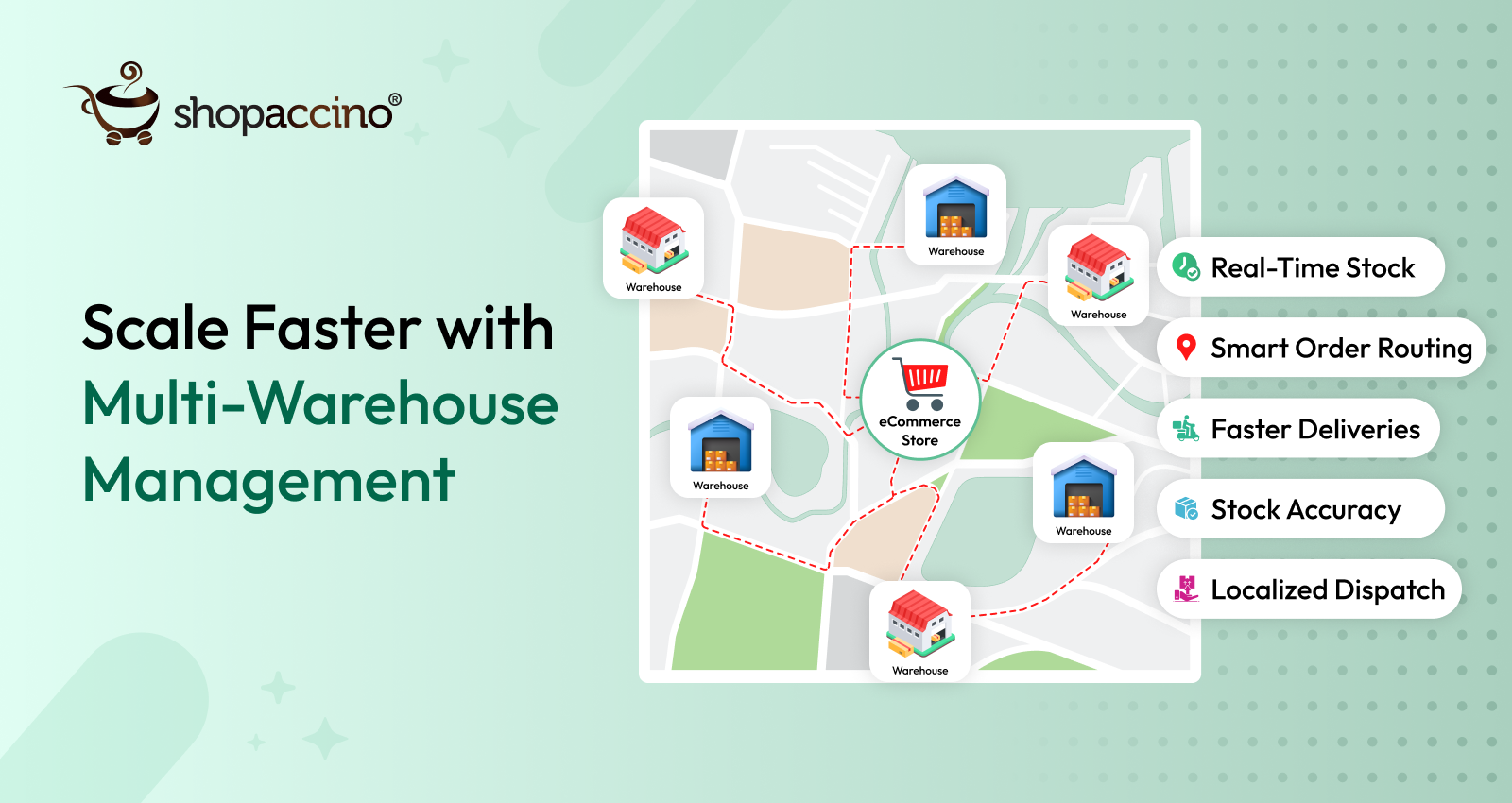
Automated Order Routing to the Right Warehouse
When a customer places an order, the system intelligently assigns:
- The nearest warehouse
- Or the warehouse with available stock
- Or as per your custom rules
This reduces shipping time and cost dramatically.
Zone-Based and Warehouse-Based Delivery Management
Brands can define:
- Delivery zones
- Warehouse service areas
- Pin code restrictions
- Region-based availability
This ensures customers only see products deliverable to them. Learn more about how Multi-Warehouse Locations mapping works.
Centralized Control with Decentralized Operations
Brands can allow warehouses to:
- Receive their own orders
- Manage their own stock
- Update status independently
- Handle returns locally
Meanwhile, the brand still controls everything centrally.
This balance is essential for scalability.
Efficient Stock Transfers and Replenishment
Shopaccino helps businesses:
- Move stock between warehouses
- Monitor fast-moving SKUs
- Prevent stock imbalances
- Reduce wastage and dead inventory
Balanced warehouses boost profitability.
Integrated Courier and Delivery Systems
The platform supports:
- Bulk label generation
- Shipment tracking
- Courier assignment
- Order grouping
- Multi-parcel shipping
This makes fulfillment smooth for every warehouse.
Warehouse-Wise Reporting and Analytics
Businesses can analyze:
- Warehouse performance
- Region-wise sales
- Fulfillment speed
- Order accuracy
- Stock movement
- Demand forecasting
These insights allow data-driven warehouse expansion.
The right ecommerce system—like Shopaccino—makes multi-warehouse management not just possible, but efficient and scalable.
How to Implement Multi-Warehouse Management – Step-by-Step Guide
Here is a simple, practical roadmap for brands ready to scale.
Step 1: Evaluate Your Geography and Customer Demand
Before expanding warehouses, analyze:
- Where orders are coming from
- Delivery times
- Shipping cost patterns
- Demand clusters
- Regional trends
This helps identify your ideal warehouse locations.
Step 2: Set Up Warehouses in Your Ecommerce System
Inside Shopaccino:
- Add warehouse names
- Assign addresses
- Set pin-code coverage
- Map delivery zones
- Define warehouse roles
This forms the backbone of your multi-warehouse structure.
Step 3: Allocate Inventory Intelligently
Distribute inventory by:
- Regional demand
Warehouse capacity - Product popularity
- Seasonal patterns
Avoid overloading any one location.
Step 4: Automate Order Routing Rules
Enable rules based on:
- Nearest warehouse
- First available stock
- Warehouse priority order
Automation reduces manual decisions and speeds up dispatch.
Step 5: Define Warehouse-Level Permissions
Assign responsibilities such as:
- Stock updates
- Order picking
- Packing
- Dispatch
- Return processing
This ensures each warehouse operates independently but within a controlled framework.
Step 6: Integrate Delivery Partners
Connect your couriers through:
- API integrations
- Pickup scheduling
- Label generation
Multi-warehouse shipping becomes smoother with automation.
Step 7: Optimize Replenishment and Transfers
Use sales data to:
- Move inventory proactively
- Reduce slow-moving stock
- Increase availability in high-demand regions
Balanced warehouses ensure customer satisfaction.
Step 8: Monitor Performance and Refine the System
Review:
- Delivery speed
- Return rates
- Inventory turnover
- Regional sales patterns
Continuous improvement is key to scaling.
Benefits of Multi-Warehouse Management for eCommerce Brands
Implementing this model brings powerful advantages.
Faster Delivery and Better Customer Satisfaction
Shipping from the nearest warehouse provides:
- Quick delivery
- Lower delays
- Better customer experience
Faster fulfillment directly boosts repeat sales.
Reduced Shipping Costs
Shorter delivery distances mean:
- Cheaper courier charges
- Lower operational cost
- Higher margins
This improves overall profitability.
Better Inventory Control
Multiple warehouses allow:
- Efficient stock distribution
- Higher availability
- Lower stockouts
- Optimized procurement
Inventory becomes a strategic advantage.
Support for Regional Market Expansion
Brands can serve new regions without heavy investment in physical stores.
A warehouse serving multiple states becomes a growth engine.
Improved Operational Efficiency
Warehouse-level autonomy reduces bottlenecks and spreads workload evenly.
Automation ensures smooth execution.
Lower Return Rates
Faster, accurate deliveries lead to fewer RTOs and exchange issues.
A Future-Ready eCommerce Infrastructure
Multi-warehouse capability helps brands scale from:
- Local seller → Regional seller → Nationwide brand
It creates a stable operational foundation for long-term success.
Conclusion
Multi-warehouse management is no longer reserved for enterprise-level companies. With the right ecommerce platform—such as Shopaccino—even MSMEs, D2C brands, and growing retailers can operate multiple warehouses with ease, precision, and automation.
This model empowers brands to deliver faster, expand regionally, reduce costs, optimize stock, and build customer loyalty at scale. In a world where customer expectations are rising and competition is intensifying, multi-warehouse fulfillment is the smart, future-ready way to run a modern ecommerce business.
Brands that adopt this model early gain a long-term competitive edge.
Those who delay risk slow deliveries, higher costs, and lower customer satisfaction.
The path to scalable ecommerce starts with intelligent warehouse management.
FAQs
No. Platforms like Shopaccino let you manage everything without coding.
Analyze your order geography, delivery times, and shipping cost patterns.
Yes. Staff can manage picking, packing, and returns while the system syncs centrally.
Absolutely. Dispatching from the closest warehouse lowers courier charges.
Yes. You can set warehouse-wise product availability and pin-code serviceability.
Order routing rules automatically assign the nearest or best-stocked warehouse.
Yes. You can view region-wise sales, stock health, and fulfillment speed.