Quick Commerce vs Sustainable Grocery Delivery: What Most Startups Get Wrong
Over the last few years, grocery delivery in India has been reshaped by one powerful idea: speed. The promise of getting groceries in 10 or 15 minutes has captured consumer attention and attracted massive funding. For many new grocery startups, this model looks like the only way forward. If fast delivery works for big players, it must work for everyone—at least, that’s the assumption.
But behind the marketing headlines and app notifications lies a much harsher reality. While quick commerce platforms may win on speed, they often lose on sustainability. Extremely high operating costs, rider shortages, delivery failures during peak hours, and wafer-thin margins make this model difficult to sustain—especially for MSMEs, local grocers, and regional brands.
Yet, many grocery startups continue to copy the quick commerce playbook without questioning whether it fits their scale, geography, or economics. In doing so, they confuse growth with survival.
This blog explores the real difference between speed-focused grocery models and profit-focused, sustainable delivery models. It explains why ultra-fast delivery is not practical for most grocery businesses, what operational challenges are often ignored, and how a slot-based, planned delivery approach creates healthier margins and long-term growth.
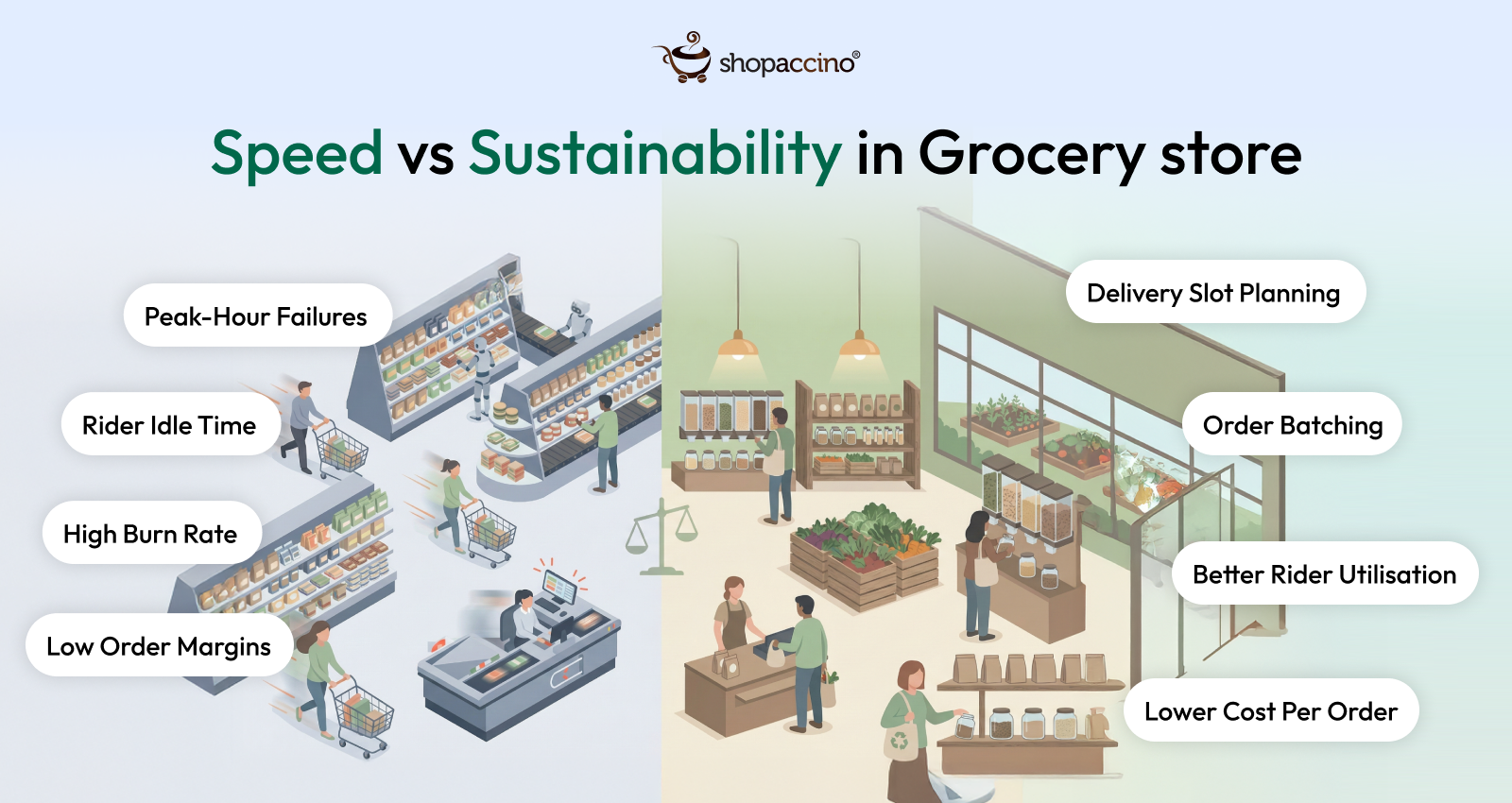
Challenging Area: Why Most Grocery Startups Struggle With the Quick-Commerce Model
At first glance, quick commerce seems attractive. Faster delivery promises higher customer satisfaction and more frequent orders. But when implemented at ground level, cracks begin to show very quickly.
Extremely High Burn Rate
Quick commerce requires:
- Dense dark store networks
- A large pool of delivery riders
- Heavy discounts to drive adoption
- Continuous marketing spend
For startups, this creates a constant cash drain. Every order costs more to deliver than it earns, forcing businesses to rely on funding instead of profits.
Rider Inefficiency and Idle Time
To promise 10–15 minute delivery, riders must be available at all times—even when there are no orders. During off-peak hours, riders remain idle but still add to operational costs. During peak hours, rider demand exceeds supply, leading to delays and cancellations.
Failed Deliveries During Peak Hours
Peak grocery demand usually happens:
- Early mornings
- Evenings after work
- Weekends
Ironically, these are the exact times when quick commerce systems struggle the most. Order surges overwhelm rider availability, stores run out of stock, and delivery promises are missed—damaging customer trust.
Low Margins Despite High Order Volume
Groceries already operate on thin margins. Add express delivery costs, rider incentives, and returns, and profitability becomes nearly impossible. Even with high order volume, net margins remain low or negative.
Operational Complexity Increases Rapidly
Managing inventory, riders, and real-time order routing in a quick commerce setup requires advanced systems and large teams. For most startups, this complexity grows faster than revenue.
Their Customer Challenging Area: What Grocery Buyers Actually Want
While startups focus on speed, grocery buyers think differently. Their expectations are shaped by daily habits, not urgency.
Customers Want Reliability Over Speed
Most customers are not in a real emergency when ordering groceries. They prefer knowing exactly when their order will arrive rather than gambling on ultra-fast delivery.
Customers Want Fewer Cancellations and Substitutions
Nothing frustrates customers more than missing items or last-minute substitutions. Accuracy matters more than speed.
Customers Want Predictable Delivery Windows
Customers plan their day around delivery. Being available during a chosen time slot is easier than waiting indefinitely.
Customers Want Stable Pricing
Constant discounts followed by price hikes reduce trust. Customers prefer fair, predictable pricing over flash offers.
Customers Value Consistency
If a grocery store delivers on time, every time, customers return—even if delivery takes a few hours or a day.
Solution: How Sustainable Grocery Delivery Models Solve These Issues
A sustainable grocery delivery model does not compete on minutes. It competes on planning, predictability, and operational efficiency.
Instead of promising instant delivery, this model allows customers to choose delivery dates and time slots during checkout. Orders are planned, batched, and delivered efficiently.
Platforms like Shopaccino enable this approach by supporting delivery slot–based grocery ecommerce, helping businesses grow profitably rather than burning cash for speed.
Smart Delivery Date & Time Slot Selection
Customers select a preferred delivery slot—same day, next day, or scheduled. This simple choice transforms delivery planning.
Order Batching Improves Efficiency
Orders within the same area and time slot are grouped together, reducing travel distance and fuel cost.
Better Rider Utilization
Riders are assigned planned routes instead of rushed, individual deliveries. This increases productivity and reduces idle time.
Lower Cost Per Order
With fewer failed deliveries, less rider churn, and optimised routes, delivery costs drop significantly.
Improved Inventory Planning
Since orders are scheduled, inventory can be managed more accurately, reducing stockouts and wastage.
How to Implement a Sustainable Grocery Delivery Model
Step 1: Move Away From Instant Delivery Promises
Set realistic expectations. Communicate delivery slots clearly instead of speed guarantees.
Step 2: Enable Delivery Slot Selection at Checkout
Allow customers to choose when they want their groceries delivered.
Step 3: Batch Orders by Area and Slot
Group deliveries are logical to minimize travel and delays.
Step 4: Plan Rider Routes in Advance
Assign riders fixed routes for each slot instead of reacting to real-time chaos.
Step 5: Optimize Inventory Based on Slot Demand
Prepare stock in advance for scheduled orders.
Step 6: Track Performance and Adjust Slots
Analyze which slots perform best and optimize capacity accordingly.
Benefits of Sustainable Grocery Delivery Over Quick Commerce
Significantly Lower Burn Rate
Reduced rider costs, fewer discounts, and better planning improve unit economics.
Higher Delivery Success Rate
Scheduled slots reduce missed deliveries and customer complaints.
Better Rider Productivity
Planned routes improve rider satisfaction and retention.
Stronger Customer Trust
Consistency builds loyalty more effectively than speed. That's the same reason repeat orders ecommerce should be a bigger priority than acquiring new users.
Healthier Margins
Lower delivery costs directly improve profitability.
Scalable Growth Model
Businesses can grow region by region without operational breakdown.
Conclusion
Quick commerce has reshaped expectations, but it is not a one-size-fits-all solution. For most grocery startups, copying the 10–15 minute delivery model leads to high burn, operational stress, and fragile margins.
Sustainable grocery delivery focuses on planning instead of panic. By offering delivery slots, batching orders, and optimising rider utilisation, businesses can deliver reliably while protecting profitability.
With platforms like Shopaccino, grocery brands can build ecommerce systems designed for long-term growth—not just short-term speed. In the grocery business, the winners are not always the fastest. They are the ones who last.
FAQs
Because high delivery costs, rider inefficiency, and low margins make profitability difficult.
Yes. Most customers prefer predictable delivery over rushed delivery.
Yes. Planning improves accuracy and success rates.
Absolutely. It works especially well for MSMEs and regional brands.
Yes, through selected slots instead of instant delivery.
Yes. Planning replaces chaos with control.