Reducing Abandoned Cart: 7 Proven Checkout Optimization Tips
very online store works hard to attract visitors—running ads, creating campaigns, building product pages, and investing in content. But the real measure of success is not traffic; it is conversions. Yet, most businesses experience a painful reality: a large percentage of customers place products in their cart but never complete the purchase.
This phenomenon, known as Abandoned cart, is not just a minor metric—it directly impacts revenue. Every abandoned cart represents lost revenue, wasted marketing spend, and a customer who was interested but not convinced enough to buy. Today’s online shoppers abandon carts for many reasons: unexpected costs, slow checkout, limited payment options, lack of trust signals, delivery uncertainty, or simply distraction.
The good news? Abandoned cart is preventable when brands create a frictionless checkout experience that balances convenience, transparency, and personalization. Platforms like Shopaccino enable brands to implement these optimizations without coding, helping businesses convert more customers while enhancing their digital experience.
This guide explores the challenges businesses face, what customers expect, how an integrated platform solves issues, and seven proven strategies to reduce drop-offs and boost conversions.
Challenging Area – Why Businesses Struggle With Checkout Conversions
Many ecommerce brands focus heavily on attracting visitors but spend less time optimizing checkout workflows. As a result, customers drop off at the final step, where purchase intent is highest.
Here are the common challenges brands face:
Complex Checkout with Too Many Steps
Customers lose interest when they encounter:
- Multiple pages
- Unnecessary fields
- Forced account creation
Long routes from cart to payment discourage buyers, especially on mobile.
Limited Payment Choices
In India, shoppers expect flexibility. If a store does not support UPI, cards, wallets, or COD, the customer may leave—even if the product is perfect.
Hidden Charges and Unclear Pricing
Extra delivery fees, taxes, or packing charges revealed at the last step cause customers to feel misled, leading to immediate abandonment.
Slow Loading and Poor Mobile Experience
If a site takes more than a few seconds to load or redirects between pages, customers drop off—especially on mobile networks.
Lack of Trust and Security Indicators
Customers hesitate when checkout pages lack credibility markers like SSL, secure payment badges, clear return policies, or brand reassurance.
No Guest Checkout Option
Not everyone wants to create an account just to buy once. Forced signups increase bounce rates significantly.
Their Customer Challenging Area – What Buyers Expect During Checkout
Modern shoppers want a checkout experience that mirrors their daily digital interactions—fast, familiar, and frustration-free.
Their expectations are shaped by ecommerce giants offering seamless flows, saved payment methods, and instant payments.
Here’s what buyers want:
Fast Payments and One-Click Checkout
Customers prefer storing addresses, saved cards, and instant digital payments. Any inconvenience feels unnecessary.
Clear Pricing Transparency
They want a breakdown of:
- Product price
- Shipping
- Taxes
- Offers applied
No surprises, no hidden fees.
Secure and Credible Payment Flow
Customers look for verified gateways, recognizable payment partners, and visible security assurances.
Multiple Delivery and Payment Choices
They expect flexibility—same-day delivery, scheduled delivery, COD, UPI, and wallet payments—all based on convenience.
Smooth Mobile Experience
Since most online purchases happen on mobile, pages must load fast, display clearly, and offer intuitive navigation.
A checkout journey designed around these expectations dramatically increases conversion rates.
Solution – How an Integrated Platform Improves Checkout Performance
Fixing checkout is not only about UI changes—it requires a platform that handles payments, UI speed, cart logic, discounts, and delivery settings seamlessly.
This is where Shopaccino supports brands by offering:
Fast, Mobile-Optimized Checkout Pages
A structured checkout flow that reduces clicks and loads quickly, especially on mobile.
Multiple Payment Gateway Integrations
UPI, wallets, cards, net banking, and COD—configured within minutes.
Automated Pricing and Tax Visibility
All pricing breakdowns appear upfront, reducing customer frustration.
Built-In Security and Encryption
Secure payment routing and SSL ensure trust across transactions.
Customizable Checkout Layouts
Brands can tailor fields, enable guest checkout, or remove unnecessary steps to create frictionless journeys.
A platform that combines speed, transparency, and automation can significantly reduce drop-offs and lift conversion rates.
How to Implement – 7 Proven Checkout Optimization Tips
Below are strategies to reduce abandoned cart with a balance of short actionable bullets and long descriptive explanations.
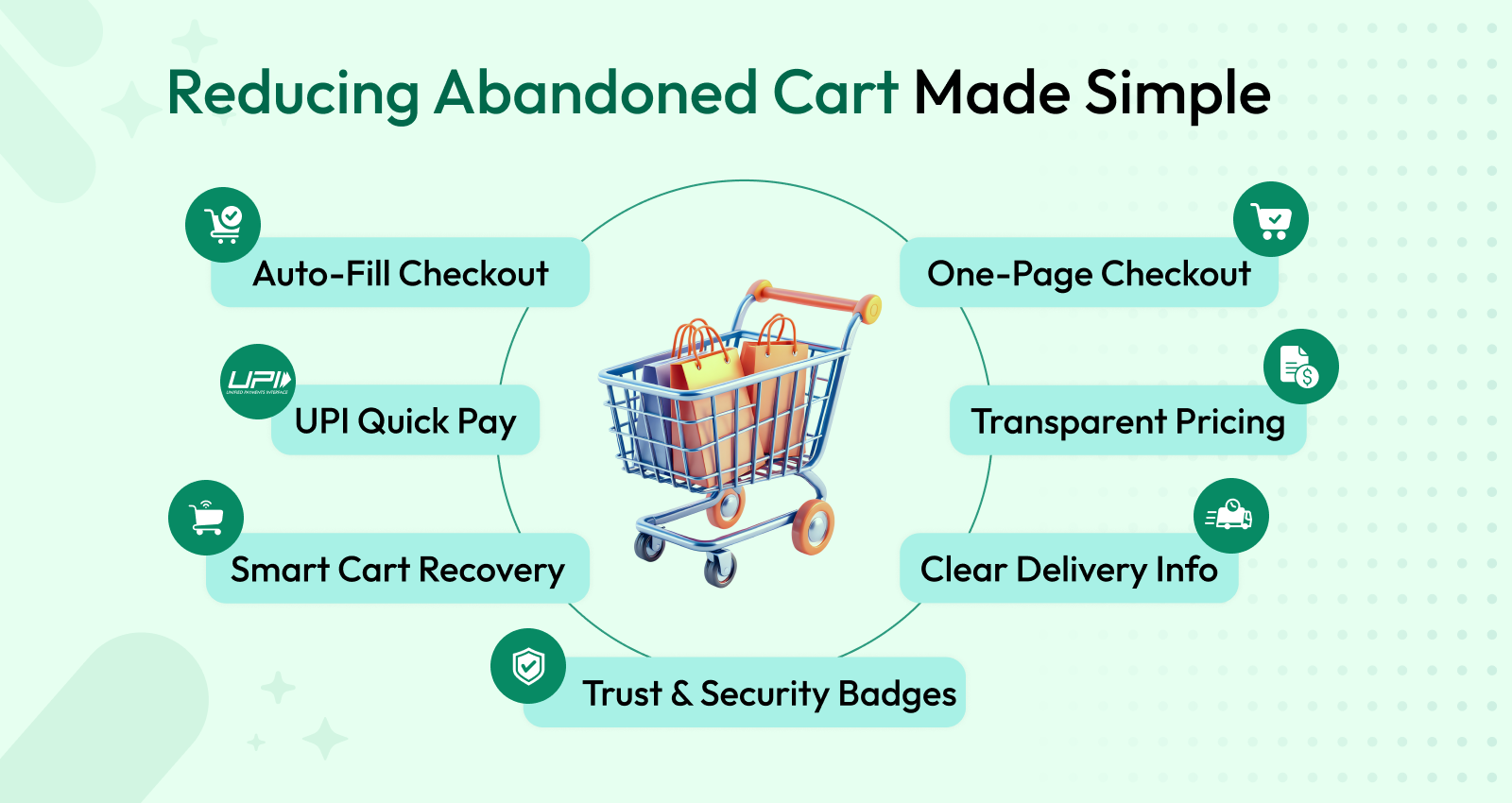
Tip 1: Offer a Fast, One-Page Checkout Experience
- Reduce steps required to complete purchase
- Minimize form fields
- Allow auto-fill for addresses and profile details
A single-page checkout removes friction and keeps buyers focused. When customers don’t have to navigate multiple screens, they complete payments faster. This especially helps mobile users and first-time shoppers who value simplicity over detailed workflows.
Tip 2: Enable Guest Checkout for First-Time Buyers
- Don’t force account creation
- Ask for login only after payment
- Offer signup benefits later
Guest checkout reduces resistance and respects buyer intent. Once the order is placed, brands can invite users to create accounts through email, rather than forcing it upfront.
Tip 3: Provide Multiple, Localized Payment Options
- UPI and wallets for quick payments
- COD for trust-building
- Cards and net banking for flexibility
Customers have different comfort levels with payment modes. Offering diverse options ensures no one drops off simply because a preferred method isn’t available.
Tip 4: Make Pricing Transparent Before Checkout
- Display shipping charges early
- Show taxes upfront
- Avoid last-minute cost surprises
When customers trust pricing from the beginning, they are more likely to complete the purchase. Surprise fees at checkout are one of the top causes of abandonment.
Tip 5: Speed Up Page Loading and Optimize for Mobile
- Compress images
- Reduce scripts
- Use lightweight UI
Mobile-first performance is key. Faster checkout keeps buyers engaged and reduces bounce rates.
Tip 6: Strengthen Trust with Security and Policy Visibility
- Display SSL badges
- Add secure payment icons
- Highlight easy-return policies
Validation builds confidence. Buyers feel reassured when platforms clearly communicate safety and fairness.
Tip 7: Send Smart Recovery Reminders for Abandoned Carts
- Automated emails
- SMS nudges
- Personalized offers
Rather than losing customers forever, businesses can bring them back with systematic reminders. Platforms like Shopaccino provide built-in automation tools that help recover lost sales.
Benefits of Optimizing Checkout
Improving checkout drives measurable business impact that compounds over time.
Higher Conversion Rates
Reducing friction leads directly to more completed orders.
Reduced Dependency on Paid Ads
Higher conversions mean each customer costs less to acquire.
Better Customer Satisfaction
Smooth experiences create trust and repeat purchases.
Faster, Data-Driven Decisions
A refined checkout process provides insights into customer behavior and drop-off points.
Improved Profitability
With fewer abandoned carts, revenue increases without increasing traffic.
Conclusion
Abandoned cart is not just a technical issue—it’s a business challenge rooted in customer behavior, digital convenience, and trust. Brands that refine their checkout flow unlock immediate growth, better ROI from marketing spend, and stronger customer loyalty.
With integrated tools, automated cart recovery, secure payment options, and mobile-first design, platforms like Shopaccino empower MSMEs and D2C brands to turn abandoned carts into completed orders—without hiring developers or building custom workflows.
A seamless checkout is not merely a feature; it is a competitive advantage. The brands that fix this will sell more, retain more, and scale faster.
FAQs
Common reasons include complicated checkout, limited payment options, hidden charges, and slow page load.
Yes. Reduced steps lead to higher completion rates, especially on mobile.
Yes—especially in India, where COD builds trust for new customers.
Enable guest checkout and simplify onboarding.
Yes. Apps store data, offer faster checkout, and send timely reminders.
They re-engage customers using personalized nudges and offers.
In most cases, yes—fewer steps = higher conversions.