
The Power of Real-Time Inventory Sync Across Warehouses
In the world of modern ecommerce, the promise of instant availability and fast delivery has become more than a competitive advantage—it is an expectation. As businesses expand, diversify product lines, and serve customers across cities or even countries, the complexity behind inventory management grows exponentially. What used to be a small storeroom operation evolves into a multi-warehouse ecosystem where accuracy, speed, and forecasting determine whether a brand thrives or struggles.
Yet, many businesses still manage inventory with spreadsheets, manual updates, or disconnected tools. The consequences are predictable: stock mismatches, delayed shipments, unhappy customers, and operational chaos. This is precisely where real-time inventory sync comes into focus, redefining how brands operate and scale.
Today, integrated ecommerce platforms like Shopaccino empower businesses with seamless, multi-warehouse synchronization—ensuring each order reflects accurate stock, delivery timelines remain trustworthy, and operations never fall out of rhythm.
Challenging Area: Business Challenges Without Real-Time Inventory Sync
Managing inventory across multiple warehouses is one of the most complex operational challenges for growing ecommerce brands. Without real-time synchronization, businesses face significant friction at every step.
Frequent Stockouts and Overselling
When inventory is updated manually or delayed, the website often shows products available even when they are sold out. Overselling leads to customer dissatisfaction, refund requests, and brand distrust.
High Operational Load
Teams often spend hours reconciling warehouse data, verifying physical counts, and updating systems. This increases dependency on manpower and slows down order processing.
Inefficient Order Routing
Without automated warehouse assignment, orders may get routed to the wrong location, increasing shipping costs and delivery time.
Poor Forecasting
Without unified visibility across warehouses, brands cannot understand real demand patterns across regions, leading to either excess stock or poorly stocked locations.
Scaling Barriers for Different Business Models
- Established D2C Brands struggle to maintain consistency across regions.
- Exporters deal with multi-region demand fluctuations.
- Manufacturers face difficulty syncing production cycles with real sales data.
- Wholesalers need accurate stock for bulk orders.
- Distributors require real-time inventory at each location to keep supply chains running smoothly.
When systems don’t speak to each other, business growth becomes limited—not because of lack of demand, but because of operational inefficiencies.
Their Customer Challenging Area: What Today’s Buyers Expect
Customer expectations have evolved dramatically, especially after the rise of same-day delivery, real-time tracking, and hyperlocal fulfillment.
Buyers now expect:
Immediate Stock Visibility
Customers want to know instantly whether a product is available—and whether the delivery promise is reliable.
Faster Delivery Options
Customers naturally pick the brand that can deliver faster. Multi-warehouse infrastructure works only if inventory sync is accurate and real-time.
No Order Cancellations
One of the biggest frustrations for online buyers is receiving cancellation notifications due to inventory errors.
Consistent Experience Across Channels
Whether they shop from the website, app, or marketplace, they expect the same product availability and delivery timelines.
Region-Specific Availability
For bulky items like furniture or limited-supply items like jewelry, customers rely heavily on geo-specific availability and faster dispatch.
Real-time inventory sync isn’t just a backend feature; it’s a customer-experience essential.
Solution: How an Integrated Ecommerce Platform Solves These Issues
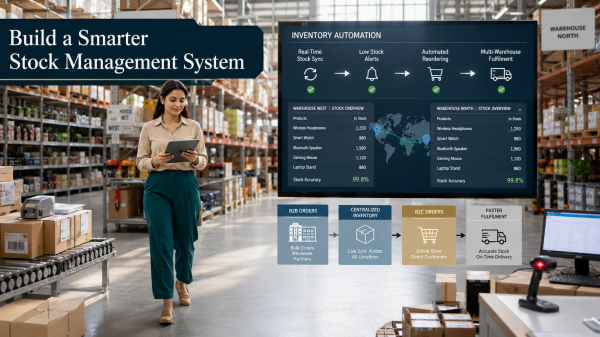
The solution lies in implementing a unified ecommerce platform that offers real-time, multi-warehouse inventory synchronization. Instead of managing different systems or manually updating stock, businesses rely on automatic syncing that updates inventory the moment an order is placed, returned, canceled, or transferred.
Platforms like Shopaccino allow businesses to:
- Sync inventory across all warehouses instantly
- Assign orders automatically to the nearest warehouse
- Maintain variant-level and batch-level accuracy
- Consolidate stock across local, national, and international locations
- Offer dynamic, region-specific availability
- Integrate marketplaces, POS, and ERPs for unified visibility
With real-time sync, every action—order placement, cancellation, restock, or transfer—updates instantly. This reduces errors, eliminates manual dependencies, and keeps the entire supply chain in perfect rhythm.
The Power Behind Real-Time Inventory Sync Across Warehouses
Operational Efficiency
Real-time sync allows teams to work on accurate numbers, eliminating redundant communication and manual reconciliation. Orders move faster, stock levels remain reliable, and warehouse teams can prioritize fulfillment efficiently.
Lower Logistic Costs
By automatically routing orders to the nearest warehouse, businesses reduce last-mile cost, fuel usage, and delivery time.
Higher Conversion Rates
When customers see transparent stock availability and faster delivery, they are far more likely to complete their purchase.
Reduced Returns and Cancellations
Accurate stock equals fewer errors. Fewer errors equal happier customers.
Scalable Growth
Regional warehouses can be added without interrupting operations. The system adapts automatically, supporting expansion into new markets.
Multi-warehouse syncing becomes the backbone of a high-performing ecommerce business—not a feature but a transformative operational foundation.
How to Implement Real-Time Inventory Sync Across Warehouses
Implementing real-time inventory sync requires clarity, planning, and the right platform. Below is a simple, step-by-step roadmap businesses can follow.
Step 1: Map Your Warehousing Structure
Identify all your storage locations—main warehouse, local hubs, vendor warehouses, dark stores, or fulfillment partners.
Step 2: Select an Integrated Platform
Explore Shopaccino's Multi-Warehouse Management feature to see this in action.
Step 3: Define Inventory Logic
Set rules for:
- Safety stock
- Region-wise availability
- Warehouse priority
- Automatic routing logic
- Made-to-order vs in-stock items
Step 4: Connect ERPs, POS, and Marketplaces
Ensure your platform integrates seamlessly with your existing business tools to maintain unified visibility.
Step 5: Enable Pincode-Based Serviceability
This works seamlessly with Shopaccino's Multi-Warehouse Locations mapping.
Step 6: Test the System
Place dummy orders, map inventory deductions, and run dispatch simulations.
Step 7: Train Your Warehouse Teams
Make sure every team member understands:
- How real-time sync works
- How to manage inbound and outbound stock
- How to process internal transfers
Step 8: Review & Optimize Regularly
Use analytics to identify:
- Regions with high demand
- Warehouse performance
- Stock turnover
- Optimal replenishment cycles
With the right implementation, real-time sync becomes the core mechanism powering fulfillment, forecasting, and future expansion.
Benefits of Real-Time Inventory Sync Across Warehouses
The advantages go beyond operational ease. Real-time inventory syncing impacts the entire business ecosystem.
Consistent Stock Accuracy
Every product, variant, and location reflects real-time status, reducing overselling significantly.
Improved Delivery Speeds
By shipping from the nearest warehouse, delivery times drop, and customer satisfaction grows.
Better Demand Forecasting
Unified stock visibility helps businesses analyze region-wise demand, making replenishment smarter.
Lower Operational Costs
Automation cuts manual workload and reduces mistakes—saving both time and money.
Enhanced Scalability
New warehouses or vendors can be added effortlessly without disturbing ongoing operations.
Higher Conversion & Retention
When customers trust availability and delivery, they keep choosing the brand over competitors.
Real-time inventory syncing becomes a silent engine driving growth, efficiency, and customer trust.
Conclusion
As ecommerce evolves, brands that manage inventory intelligently will stay ahead. Real-time inventory sync across multiple warehouses is not a luxury—it is a business essential. It impacts everything: delivery speed, customer experience, operational accuracy, and long-term scalability.
By adopting integrated platforms like Shopaccino, businesses gain access to advanced multi-warehouse capabilities without technical complexity. Whether you’re an Established D2C Brand, Exporter, Manufacturer, Wholesaler, or Distributor, real-time syncing ensures your entire operation moves as one cohesive, responsive system.
The brands that master inventory synchronization will be the brands that scale faster, reduce operational friction, and deliver exceptional customer experiences across every touchpoint.
FAQs
It is the automatic updating of product stock across all warehouses, channels, and systems the moment any change occurs—orders, cancellations, returns, or transfers.
It prevents overselling, improves delivery speed, and ensures customers see accurate product availability.
Yes. When orders are routed to the nearest warehouse, last-mile cost and delivery timelines significantly improve
Absolutely. It brings region-wise visibility, helping businesses understand demand patterns and replenish intelligently.
Yes. Wholesalers, distributors, and manufacturers benefit from accurate bulk order management and warehouse-level stock tracking.
Not if you use an integrated platform like Shopaccino, where syncing is automated and user-friendly.
Fashion, furniture, grocery, jewelry, footwear, and home decor businesses—essentially any vertical with variants, multiple locations, or large catalog sizes.