
Why Manufacturers Need B2B eCommerce in a Digital-First World
Manufacturing has always been an industry driven by precision, scale, and long-term relationships. But in the digital-first world of 2026, one major shift has transformed how manufacturers reach buyers, manage orders, and expand into new markets—B2B ecommerce.
What was once handled through phone calls, emails, offline catalogues, trade shows, and manual processes is now moving online. Buyers want the same ease, transparency, and speed they experience in B2C shopping—but tailored for bulk quantities, negotiated pricing, flexible payment terms, and repeat ordering.
For manufacturers across India and global markets, B2B ecommerce is no longer a “nice-to-have.” It has become the foundation for operational efficiency, customer satisfaction, and scalable growth. Whether a manufacturer supplies retailers, wholesalers, distributors, exporters, or institutional buyers, online ordering brings order accuracy, cost reduction, and a significantly better buyer experience.
This blog explains why B2B ecommerce is essential for manufacturers in a digital-first world, what challenges they face today, what customers expect, and how an integrated platform helps them transform operations without huge teams or long setup cycles.
Challenging Area: Why Traditional B2B Selling Holds Manufacturers Back
While manufacturers are experts in production, the commercial side of the business often struggles because traditional selling relies heavily on manual coordination. These challenges grow bigger as order volumes and customer bases expand.
Manual Order Processing Leads to Errors
Manufacturers receive orders through email, WhatsApp, spreadsheets, PDF catalogues, or phone calls.
This leads to:
- Wrong quantities
- Missed items
- Wrong variants
- Errors in pricing
Every correction means more back-and-forth and delays.
No Centralised Catalog or Real-Time Stock Visibility
Buyers rely on outdated product sheets that do not reflect:
- Updated designs
- Current stock levels
- Price changes
- New variants
This results in order confusion, cancellations, and poor buyer experience.
Slow Quotations and Approvals
Creating quotations manually takes time, especially for manufacturers dealing with:
- Size sets
- Material choices
- MOQ-based pricing
- Tiered discounts
- Customizations
Delays directly impact sales.
Inefficient Repeat Ordering Process
Manufacturers depend heavily on physical follow-ups, WhatsApp reminders, and repeat manual order entries. There is no automated system to support frequent bulk buyers.
Limited Visibility Across Distributors, Wholesalers, and Resellers
Tracking what is sold, what is pending, or what stock needs replenishment becomes nearly impossible without a systematic B2B platform.
Lack of Data for Forecasting and Production Planning
Since orders come from scattered sources, it becomes difficult to identify:
- Best-selling products
- High-volume customers
- Demand patterns
- Seasonal spikes
Manufacturers end up overproducing or under-producing.
In a digital-first market, these gaps make it harder for manufacturers to match speed, accuracy, and expectations.
Their Customer Challenging Area: What B2B Buyers Expect Today
Manufacturers are not the only ones facing friction—B2B buyers have their own challenges, and their expectations have changed dramatically.
Transparent, Real-Time Information
Buyers expect instant access to:
- Updated stock
- Available variants
- Correct pricing
- Order eligibility
- Shipping timelines
They no longer want to rely on messages or calls.
Quick Ordering Without Waiting for Sales Reps
B2B buyers want a self-serve portal where they can place orders anytime—whether late at night, during field visits, or on shop floors.
Easy Access to Order History & Reordering
Wholesale customers frequently reorder. They want:
- One-click reorder
- Saved lists
- Past invoices
- Accurate status updates
Manual processes slow them down.
Digital Payments & Flexible Options
Buyers expect payment choices such as:
- Net banking
- Cards
- Wallets
- UPI
- Credit terms
A smooth digital checkout increases trust and reduces payment delays.
Faster Turnaround and Fewer Mistakes
If orders are wrong or delayed, retailers lose their own customers. Accuracy is non-negotiable.
A Professional Brand Experience
Distributors and retailers prefer manufacturers who offer modern, streamlined processes—it gives them confidence in long-term partnerships.
Solution: How an Integrated B2B Ecommerce Platform Solves These Challenges
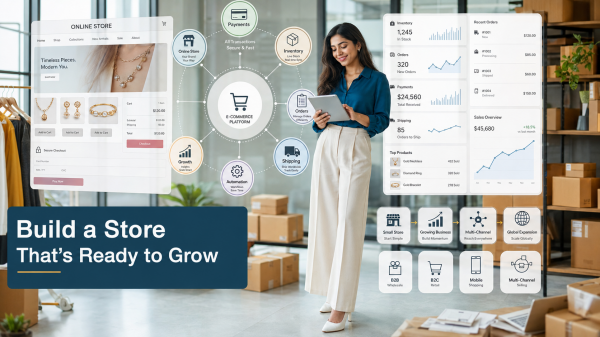
A robust B2B ecommerce system bridges the gap between manufacturers and their customers by digitising the entire workflow—from catalog browsing to payment to fulfilment.
Here’s how a platform like Shopaccino supports manufacturers:
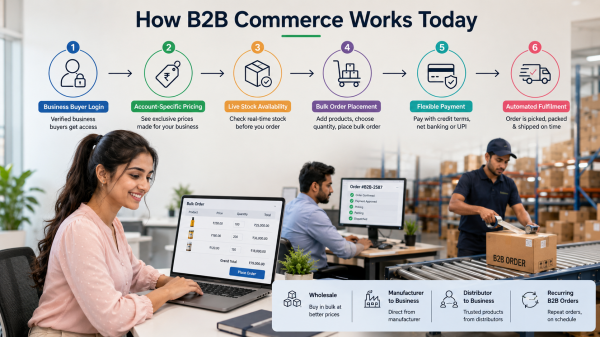
A Self-Serve B2B Ordering Portal
Buyers can log in, view prices assigned to them, check available stock, and place orders 24/7. No manual intervention required.
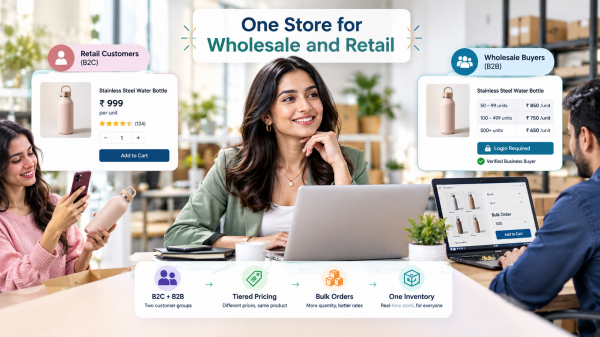
Customer-Specific Pricing and Discounts
Manufacturers can assign:
- Tiered discounts
- Volume-based pricing
- Region-wise pricing
- MOQ-based pricing
This ensures transparency and accuracy for every buyer.
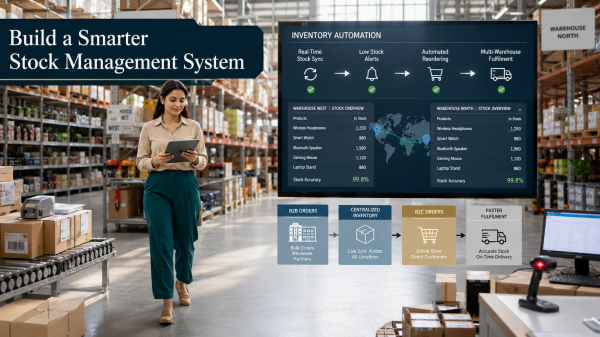
Real-Time Inventory Sync
The platform updates stock automatically whenever orders are placed, cancelled, edited, or returned.
Manufacturers avoid overselling or miscommunication.
Digital Catalogue with Variants and Large Product Lists
Whether manufacturers deal in apparel, furniture, electronics, accessories, or industrial supplies, they can create detailed listings for:
- Sizes
- Colours
- Materials
- Custom options
Buyers get complete clarity.
Automated Order Validation System
A B2B platform automatically verifies each order for:
- Stock availability
- Correct variants
- MOQ compliance
- Accurate pricing
This eliminates manual checking and ensures every bulk order enters production or dispatch without errors.
Simplified Multi-Warehouse Operations
If stock is placed across multiple warehouses, an integrated platform like Shopaccino allocates orders automatically to the right location.
Automated Invoices, Payments, and Notifications
The system generates:
- GST invoices
- Payment updates
- Order confirmations
- Shipment notifications
This builds trust and reduces errors.
How to Implement B2B Ecommerce for Manufacturing: A Step-by-Step Approach
Even first-time digital manufacturers can adopt B2B ecommerce smoothly by following a structured process.
Step 1: Define Your B2B Customer Groups
Manufacturers generally sell to:
- Wholesalers
- Distributors
- Retailers
- Exporters
- Institutional buyers
Each segment may require different pricing, order minimums, and access levels.
Step 2: Create a Digital Product Catalogue
Upload:
- Product images
- Variants
- Specifications
- Packaging details
- MOQ rules
This eliminates confusion during ordering.
Step 3: Set Up Price Lists and Volume Discounts
Assign:
- Distributor prices
- Bulk pricing
- Tier-based discounts
Customer-specific pricing builds stronger, scalable relationships.
Step 4: Enable Buyer Login and Permissions
Allow your buyers to:
- Log in
- Browse assigned pricing
- Place orders
- View order history
Permission-based access keeps your catalogue secure.
Step 5: Connect Inventory and Warehouses
Manufacturers can manage:
- Raw material stock
- Finished goods stock
- Warehouse-wise quantities
Real-time visibility improves production planning.
Step 6: Digitise Quotation & Approval Flow
Buyers can request quotes and manufacturers can instantly share digital approvals—speeding up the sales cycle.
Step 7: Integrate Payments and Invoicing
Manufacturers can generate GST invoices automatically and allow buyers to pay using secure payment options.
Benefits of B2B Ecommerce for Manufacturers
B2B ecommerce delivers both long-term and immediate advantages:
More Accurate Orders with Fewer Errors
Digital ordering eliminates manual miscommunication and reduces errors dramatically.
Faster Sales Cycle
Quotations, approvals, and ordering all happen instantly online.
Higher Buyer Satisfaction
Customers get full control, transparency, and smooth ordering experiences.
Lower Operational Costs
Less manual work means fewer sales reps needed for routine tasks.
Better Production & Demand Forecasting
Real-time data helps manufacturers plan production with more confidence.
Expansion into New Markets
A professional B2B portal helps manufacturers sell nationwide or globally without adding new teams.
Easy Scalability for Large Catalogues
Big manufacturers dealing with hundreds or thousands of SKUs can manage everything systematically.
Conclusion
In a digital-first world, manufacturers cannot rely on phone calls, spreadsheets, or manual communication to run large-scale B2B operations. Buyers expect the speed, transparency, and convenience of modern ecommerce—but customised for wholesale purchasing.
B2B ecommerce gives manufacturers the tools they need to:
- Operate efficiently
- Reduce errors
- Serve buyers better
- Expand into new markets
- Build stronger commercial relationships
With platforms like Shopaccino, manufacturers can digitise their catalogues, automate orders, centralise stock, streamline warehouses, and improve overall fulfillment—without requiring large teams or complex infrastructure.
The future of manufacturing is digital. And the businesses that adopt B2B ecommerce today will be the ones leading the market tomorrow.
FAQs
It centralises catalogues, digitises ordering, manages warehouses, processes invoices, and simplifies the entire B2B workflow.
It helps manufacturers reduce errors, speed up ordering, improve buyer satisfaction, and manage bulk purchasing efficiently through automation.
Yes. Buyers want transparent pricing, quick ordering, and access to their order history without waiting for sales reps.
Yes. A B2B platform allows manufacturers to assign discounts, tiered prices, and wholesale rates to different buyer groups.
Absolutely. Buyers can reorder instantly using saved lists, past orders, and quick-buy tools.
Yes. Manufacturers can offer MOQs, size sets, custom options, and bulk pricing digitally.
Yes. Even small factories benefit from faster ordering, accurate inventory, and automation.