Why Exporters Struggle to Manage Large Product Catalogs for Global Buyer
Exporting products to global markets sounds exciting. More buyers, bigger reach, and better business opportunities. But for many exporters, growth brings an unexpected problem: managing a large product catalog that international buyers can actually understand and use.
As exporters add more products, variations, specifications, packaging types, and regional pricing, their catalogs slowly turn confusing. What started as a small list becomes hundreds or thousands of items. Buyers struggle to find the right product. Sellers struggle to keep everything organized. Orders slow down. Enquiries increase. Conversions drop.
This is not a product quality issue. It is a catalog management issue.
Global buyers today expect clarity, speed, and confidence when browsing products online. When they don’t find what they need easily, they move on. This blog explains why exporters struggle with large product catalogs, what buyers expect instead, and how a well-structured ecommerce platform can solve this challenge step by step.
Challenging Area: Business Problems Exporters Face
Managing a large export catalog is not just about uploading more products. It is about structure, logic, and buyer usability.
Many exporters rely on spreadsheets, PDFs, or basic websites to list products. As the catalog grows, these systems break down.
Catalog Overload Without Structure
Exporters often add products quickly but without a clear structure. Categories become too broad. Subcategories are missing. Similar products are scattered across pages. This makes internal management difficult and buyer navigation frustrating.
A buyer looking for one specific product ends up scrolling endlessly or sending enquiry emails instead.
Too Many Variations, Too Little Clarity
Export products often have variations like size, grade, material, packaging, MOQ, or compliance type. When these variations are not organized properly, buyers get confused.
Instead of helping buyers choose, the catalog creates doubt.
Manual Updates Create Errors
Large catalogs need frequent updates. Prices change. Availability changes. Compliance documents change. When updates are done manually, errors are common.
Outdated information reduces trust and leads to order cancellations.
Search Does Not Work Properly
Many exporter websites have basic or poorly implemented search. Buyers type product names but see irrelevant results or nothing at all.
When search fails, buyers leave.
Their Customer Challenging Area: Global Buyer Expectations
To understand the real problem, exporters must look at it from the buyer’s side.
Global buyers do not browse like local buyers. They compare, filter, and shortlist quickly. Their expectations are shaped by modern ecommerce experiences.
Buyers Want Fast Discovery
International buyers want to find the right product within seconds. They expect clear categories, filters, and logical grouping.
If they cannot narrow down products quickly, they assume the supplier is not organized.
Buyers Need Confidence Before Contact
Unlike local buyers, global buyers cannot easily visit a warehouse or factory. The catalog itself becomes the first proof of credibility.
Clear product presentation builds trust. Confusing catalogs raise red flags.
Buyers Prefer Self-Service
Modern buyers do not want to email for every detail. They want specifications, certifications, packaging options, and variations available upfront.
A catalog that answers questions without human support converts better.
Buyers Expect Consistency Across Regions
Buyers from different countries expect the same structured experience, even if pricing or availability differs. A scattered catalog makes global selling feel unreliable.
Solution: How an Integrated Ecommerce Platform Solves These Issues
The real solution is not adding more staff or replying to more emails. The solution lies in organizing the catalog digitally in a buyer-friendly way.
A modern ecommerce platform designed for exporters helps structure, present, and scale large catalogs without confusion.
Structured Categories and Subcategories
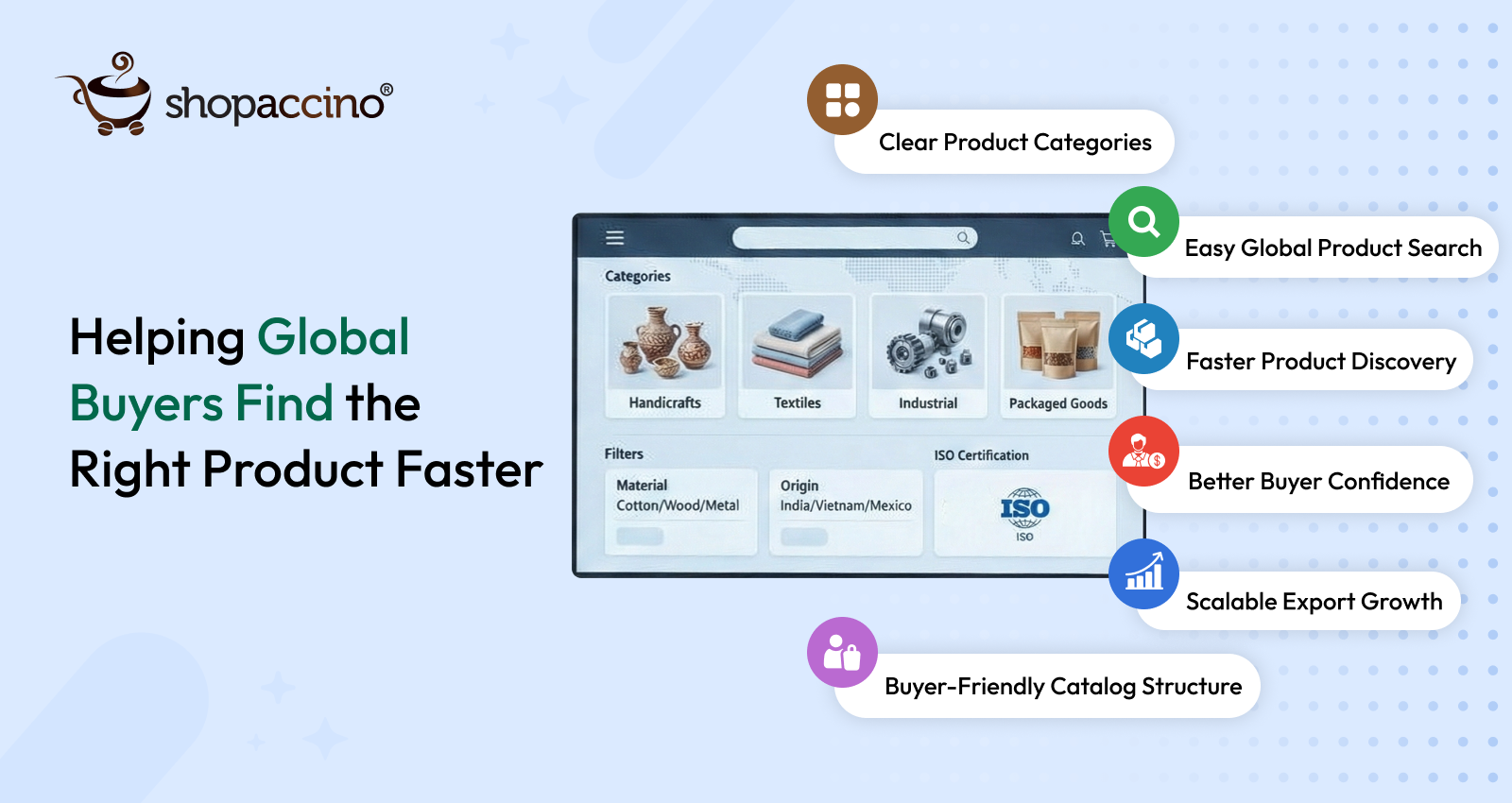
Instead of long product lists, products are grouped logically. Main categories, subcategories, and product types guide buyers naturally.
This improves navigation and reduces buyer drop-off.
Smart Filters and Search
Buyers can filter products by specifications, size, material, usage, or region. Search becomes meaningful instead of frustrating.
This dramatically improves global ecommerce catalog management and buyer satisfaction.
Centralized Product Information
All product data lives in one system. When something changes, it updates everywhere. This reduces errors and improves trust.
Platforms like Shopaccino allow exporters to manage large catalogs from a single dashboard without chaos.
Scalable for Growth
As new products are added, the structure remains intact. The catalog grows, but clarity remains.
This is how exporters can support international buyers online without overwhelming them.
How to Implement: Step-by-Step Guidance
Managing a large export catalog does not require complex technology knowledge. It requires the right approach.
Step 1: Group Products by Buyer Thinking
Organize products based on how buyers search, not how factories manufacture. Use use-case, application, or industry-based categories.
Step 2: Define Clear Product Variations
Instead of separate listings, use structured variations for size, grade, or packaging. This keeps catalogs clean and readable.
Step 3: Enable Strong Search and Filters
Make sure buyers can search by keywords and refine results easily. This supports product discovery for global buyers.
Step 4: Maintain Centralized Updates
Use one system to manage product data. Avoid multiple spreadsheets and duplicate files.
Step 5: Test the Buyer Journey
Browse your catalog like a buyer. If it feels confusing, it probably is.
Benefits of a Well-Organized Export Catalog
When exporters fix catalog structure, the impact is immediate.
- Buyers find products faster and contact sellers with confidence
- Enquiry quality improves and unnecessary emails reduce
- Trust increases without heavy marketing
- Conversion rates improve naturally
- Catalog management becomes easier for internal teams
Most importantly, exporters stop losing buyers due to confusion, not competition.
Conclusion
Exporters do not struggle because they have too many products. They struggle because their products are not organized in a way global buyers understand.
In international trade, clarity equals trust. A well-structured catalog speaks before any sales conversation begins.
By using an integrated ecommerce platform, exporters can turn large catalogs from a burden into a growth advantage. Instead of overwhelming buyers, the catalog guides them. Instead of creating doubt, it builds confidence.
This is how exporters scale globally without losing control.
FAQs
Global buyers leave when they cannot quickly find or understand products. Confusing categories, missing filters, and unclear specifications reduce confidence and increase bounce rates.
A clear catalog helps buyers discover products easily, compare options, and make decisions faster. Poor structure creates hesitation and delays purchase intent.
Yes. Modern ecommerce platforms are designed for business users, allowing easy catalog management without technical skills.
Search helps buyers quickly locate products in large catalogs. Weak search forces buyers to browse manually, which often leads to abandonment.
Yes. Clear presentation signals professionalism and reliability, which is critical when buyers cannot physically verify products.