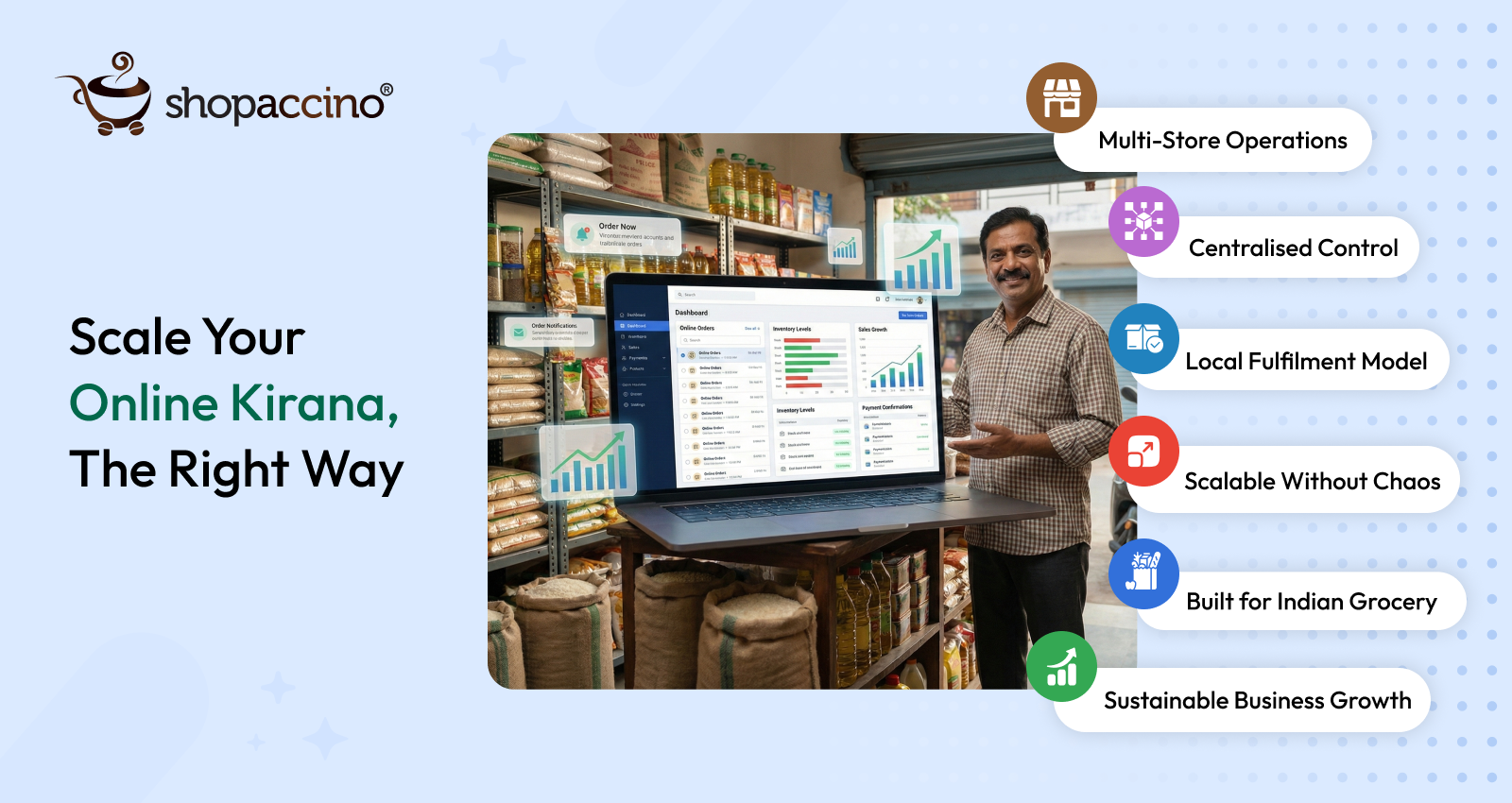
How to Scale a Kirana Store into a Multi-Store Grocery Brand in India
Scaling a kirana store into a multi-location grocery brand comes down to one shift: replacing single-store, manual systems with a central ecommerce platform that manages products, pricing, and inventory in one place while letting each outlet fulfil orders locally. This guide covers why kiranas stall at one store, what Indian grocery operations actually need, and the step-by-step tech stack to grow from one store to many.
Every successful grocery brand in India starts small. A single kirana store. A trusted neighbourhood name. Familiar faces, handwritten bills, phone orders, and loyal customers who return because of trust, not technology. For decades, this model worked beautifully. But as customer behaviour shifts and digital ordering becomes normal, many kiranas find themselves at a crossroads.
Every successful grocery brand in India starts small. A single kirana store. A trusted neighbourhood name. Familiar faces, handwritten bills, phone orders, and loyal customers who return because of trust, not technology. For decades, this model worked beautifully. But as customer behaviour shifts and digital ordering becomes normal, many kiranas find themselves at a crossroads.
The ambition is clear: open another outlet, serve more areas, accept online orders, maybe even build a recognizable local brand. The challenge is that what works for one store breaks completely at scale.
Most kiranas that try to grow face the same reality. Systems are built for one counter, one godown, one team. Operations remain manual. There is no central view of stock, orders, or performance. As soon as a second or third store is added, confusion replaces control.
This is not a lack of effort or intent. It is a technology mismatch.
This blog explains why most kiranas struggle to scale, why basic ecommerce tools are not designed for Indian grocery realities, and what kind of tech stack actually supports growth—from one store to many—without turning operations into chaos.
Challenging Area: Why Scaling a Kirana Is Harder Than It Looks
Scaling a grocery business is not just about opening more stores. It is about managing complexity without losing control.
Single-Store Systems Don’t Extend
Most kiranas rely on systems that assume everything happens in one place. Inventory is managed locally. Orders are written manually or tracked on WhatsApp. Billing happens at the counter. These systems have no concept of multiple locations.
When a second store opens, data gets duplicated. When a third opens, it gets lost.
Manual Operations Don’t Multiply
Manual processes work only because the owner oversees everything. Once orders, suppliers, staff, and deliveries increase, manual coordination becomes the bottleneck. Owners spend more time resolving mistakes than growing the business.
No Centralised Control
Without a central dashboard, there is no way to answer basic questions:
- Which store is selling more?
- Where is stock running out?
- Which area generates repeat orders?
- Which store is overstaffed or underperforming?
Growth without visibility creates stress, not success.
Fragmented Online Ordering Attempts
Many kiranas experiment with basic ecommerce tools or marketplace listings. These often operate independently from store operations. Orders come in online, inventory is updated offline, and mismatches become common.
India’s Grocery Complexity Is Ignored
Indian grocery is not uniform. Prices vary by area. Delivery costs change by distance. Demand patterns differ by locality. Generic tools do not account for this, forcing kiranas to manage complexity outside the system.
This is where most growth attempts stall.
Their Customer Challenging Area: What Indian Grocery Buyers Expect
As kiranas scale, customer expectations evolve alongside them.
Customers Want Consistency Across Locations
When a brand opens multiple stores, customers expect the same experience everywhere—product availability, pricing logic, delivery reliability, and communication.
Convenience Is Now Assumed
Customers no longer see online ordering as a bonus. They expect it to work smoothly, reflect local availability, and offer accurate delivery timelines.
Local Fulfilment Still Matters
Even in a digital world, grocery remains local. Customers want orders fulfilled from nearby stores for freshness and speed. Central warehouses are not always practical.
Transparency Builds Trust
Buyers expect clear pricing, order updates, and predictable delivery windows. Confusion erodes trust faster than delays.
Repeat Experience Must Be Simple
As brands grow, customers want easier reordering, saved preferences, and familiarity—without needing to explain themselves every time.
A scalable grocery brand must meet these expectations consistently, across all locations.
Solution: A Tech Stack Designed for Indian Grocery Scale
Scaling a kirana is not about adopting more tools. It is about adopting the right architecture—one that centralises control while keeping fulfilment local.
Multi-Store, Multi-Location Ecommerce Setup
Instead of one store trying to handle everything, a scalable system treats each outlet as a fulfilment point while maintaining a unified brand presence. Customers interact with one platform. Orders route automatically to the nearest or assigned store.
Central Dashboard With Local Execution
The heart of scalability is central visibility. Owners and managers can monitor all stores from one dashboard—orders, inventory, performance, and demand trends—while each store focuses on fulfilment.
Unified Product & Pricing Control
Products, categories, and pricing rules are managed centrally but applied intelligently across locations. This avoids duplication and inconsistency.
Inventory Sync Without Manual Intervention
Stock updates happen automatically as orders are placed and fulfilled. This reduces overselling, cancellations, and customer frustration.
Location-Aware Ordering & Delivery Logic
Delivery areas, time slots, and costs can be defined per location. This reflects real operational constraints instead of forcing uniform rules everywhere.
Platforms like Shopaccino are built around this philosophy—helping Indian grocery businesses scale operations without adding layers of complexity.
How to Build a Scalable Grocery Tech Stack (Step-by-Step)
Scaling becomes manageable when broken into clear stages.
Step 1: Centralise Your Digital Foundation
Start with one ecommerce platform that represents your brand—not individual stores. All customers interact with the same storefront or app.
Step 2: Add Stores as Fulfilment Locations
Treat each kirana outlet as a fulfilment node. Assign service areas, stock levels, and delivery capacity to each location.
Step 3: Standardise Product Data
Create one master product catalogue. Control names, categories, images, and pricing centrally to avoid inconsistency.
Step 4: Enable Local Inventory Visibility
Allow the system to display availability based on the customer’s location. This prevents orders being placed for out-of-stock items.
Step 5: Route Orders Intelligently
Orders should automatically reach the right store—based on location, stock, or workload—without manual assignment.
Step 6: Monitor Performance Centrally
Track which stores perform best, which areas reorder more, and where operations need improvement. Data replaces guesswork.
Step 7: Scale Gradually, Not Aggressively
Add locations one by one. The same tech stack should support 2 stores or 20 without needing reinvention.
Benefits of the Right Tech Stack for Grocery Scaling
Growth Without Losing Control
Central visibility ensures owners stay in control as operations expand.
Reduced Operational Stress
Automation replaces constant coordination and follow-ups.
Better Customer Experience
Consistent pricing, availability, and delivery improve trust and loyalty.
Faster Expansion With Lower Risk
New locations can be added confidently without disrupting existing operations.
Improved Profitability
Smarter inventory and delivery management protect margins.
Long-Term Brand Building
A scalable foundation allows kiranas to evolve into recognisable regional grocery brands.
Conclusion
Scaling a grocery business in India is not about copying quick-commerce giants or stitching together random tools. It is about respecting local operations while building central control. Kiranas fail to scale not because they lack demand, but because their systems were never designed for growth.
A tech stack that understands Indian grocery realities—multi-store operations, local fulfilment, variable delivery economics, and habit-based buying—makes the difference between struggling expansion and sustainable success.
With platforms like Shopaccino, kiranas can move beyond survival mode and build grocery brands that grow steadily, operate smoothly, and serve customers consistently across locations.
The future of Indian grocery belongs to businesses that scale smart—not fast.
FAQs
Because their systems are built for single-store operations. Manual processes and lack of central control create chaos as soon as multiple locations are added.
Yes. A dedicated ecommerce setup allows kiranas to own customer relationships while scaling operations independently.
Most tools are designed for single warehouses and uniform pricing. Indian grocery requires location-aware inventory, delivery, and pricing logic.
Not when using a platform designed for scale. Centralised systems reduce long-term costs by preventing operational inefficiencies.
Extremely important. Without a central dashboard, decision-making becomes reactive and growth becomes risky.
Yes. With the right tech foundation, even small kiranas can expand gradually and sustainably.