Gold Prices Keep Changing? How Jewelry Stores Handle It Smoothly
If you sell jewellery online, daily gold price changes are one of the biggest sources of customer hesitation, cart abandonment, and post-order disputes, and the fix is structural, not just operational. Gold rates can change multiple times a day depending on international markets; most Indian retailers update prices once or twice daily. When customers walk into a physical jewelry store, they accept that gold prices change daily. The salesperson explains the rate of the day, the weight, the making charges, and the final amount with calm confidence. The buyer feels guided, reassured, and informed.
Online, that same comfort is harder to recreate.
Gold prices move constantly. Sometimes they change more than once in a single day. When customers see one price in the morning and a different price by evening, confusion begins. Hesitation follows. Questions multiply. And very often, the purchase stops right there.
For jewelry brands selling online, this creates a delicate challenge. They must remain transparent, accurate, and fair—while also maintaining the personal attention and confidence that customers expect from a showroom experience.
This blog explains why fluctuating gold prices create friction online, how customers experience that confusion, and how jewelry stores handle price changes smoothly using structured ecommerce systems—without disputes, delays, or loss of trust.
Challenging Area: Why Changing Gold Prices Disrupt Online Jewelry Sales
Gold pricing is not static. It depends on global markets, currency movement, and local taxes. Jewelry brands understand this reality well. Customers, however, experience it emotionally.
When prices are updated manually, several problems appear.
First, pricing inconsistencies creep in. The displayed product price may not reflect the current gold rate. Sales teams hesitate to commit. Orders are paused for confirmation. Even a small mismatch creates doubt.
Second, disputes arise after checkout. A customer places an order believing the price is locked. Later, they receive a call explaining that the rate has changed. Even if the increase is valid, it feels unfair.
Third, internal teams feel pressure. Every enquiry turns into a calculation exercise—gold rate of the moment, weight, wastage, making charges, taxes. Repeating this manually increases the chance of mistakes.
Over time, brands realize that fluctuating gold prices are not just a pricing issue. They are a trust and experience issue.
Read Also : Increase Your Ecommerce Conversion Rate by 30%
Their Customer Challenging Area: What Jewelry Buyers Expect Online
Jewelry buyers behave cautiously online. Unlike fashion or electronics, gold purchases involve emotion, savings, and long-term value.
Customers expect:
- Clear Explanation of Gold Price Used
- Confidence That Price Will Not Change After Order
- Visibility Into Weight, Purity, And Charges
- Fairness That Matches In-Store Experience
When prices keep changing without explanation, customers feel uneasy. They worry about overpaying. They delay decisions. They contact support repeatedly.
Most importantly, they miss the reassurance they receive in physical stores—where pricing logic is explained patiently and clearly.
If an online store cannot recreate that sense of clarity, customers prefer to wait or walk into a showroom instead.
Read Also : Your Inventory Can Make or Break Your Ecommerce Sales
Solution: How Integrated Ecommerce Platforms Handle Gold Price Changes
The key to handling changing gold prices smoothly is automation with transparency.
Modern ecommerce platforms allow jewelry brands to separate gold value from design value. Instead of showing a fixed product price, the system calculates pricing dynamically based on live or regularly updated gold rates.
This creates a calmer experience for both buyers and sellers.
When a customer selects a product, the platform calculates:
- Gold Weight × Current Gold Rate
- Making Charges Based on Design
- Taxes and Additional Costs Clearly
The final price feels logical, not arbitrary.
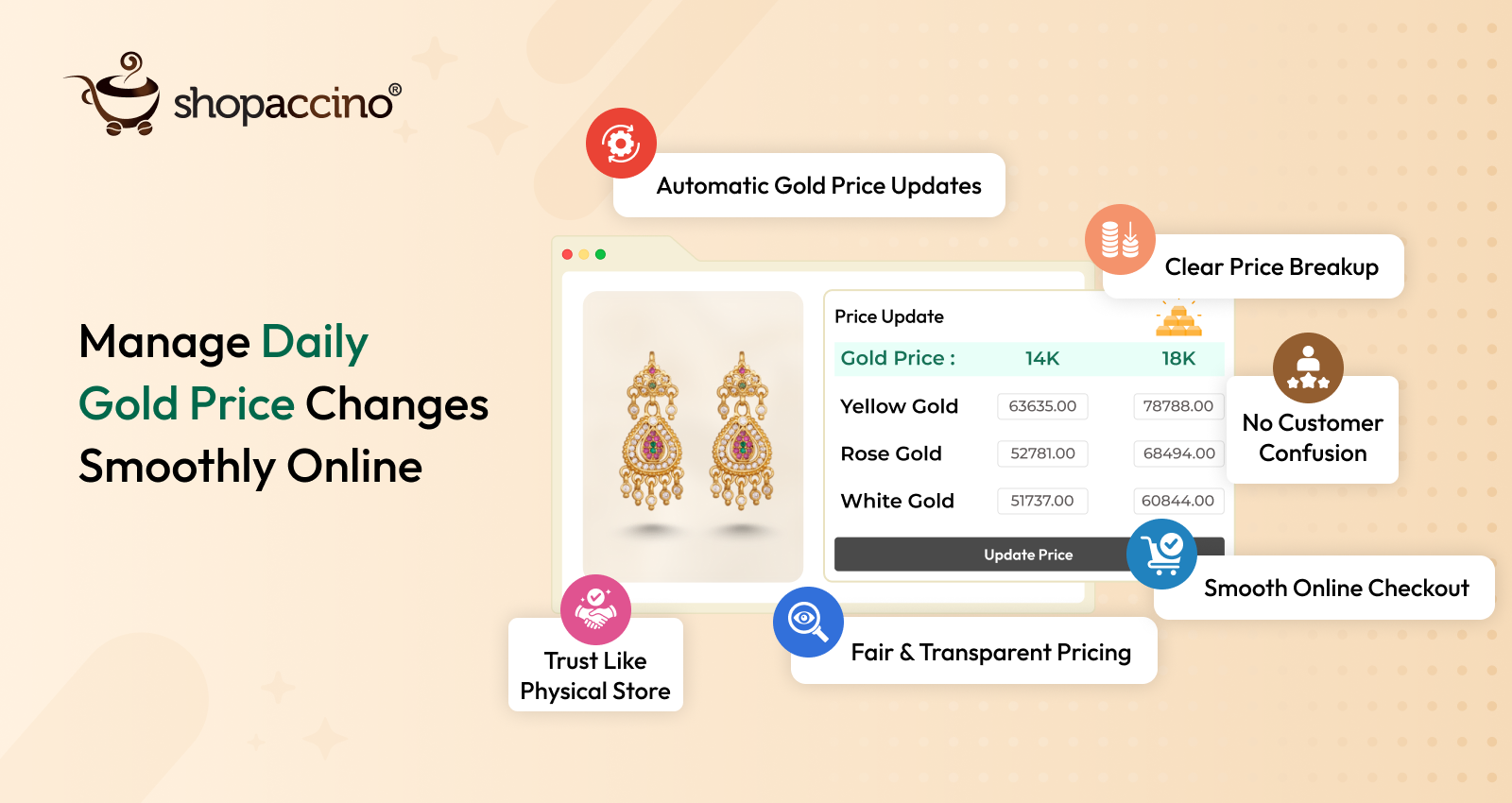
Platforms like Shopaccino help jewelry stores define this logic once, so pricing updates automatically without manual intervention. Customers see updated prices instantly, and brands avoid disputes caused by outdated information.
More importantly, the system communicates clearly why a price is what it is.
See how JewelFlex automates gold rate updates across 24K–14K
How Jewelry Stores Recreate In-Store Trust Online
Handling gold price changes is not only about calculations. It is about communication.
Successful jewelry stores focus on three principles.
Price Transparency Over Price Stability
Instead of trying to freeze prices unrealistically, stores explain that gold prices fluctuate. When customers understand the reason, they accept the change.
Clear Price Breakups
Showing gold value, making charges, and taxes separately reduces suspicion. Customers feel informed rather than surprised.
Controlled Price Locking
Some stores lock prices for a limited time—during checkout or payment window. This mirrors the in-store practice of holding the rate while billing happens.
These practices turn price fluctuation into a normal part of the buying journey instead of a roadblock.
How to Implement: Step-by-Step Guidance for Jewelry Brands
Handling changing gold prices smoothly requires structure, not complexity.
Step 1: Separate Gold Rate from Product Price
Do not treat jewelry as a fixed-price product. Configure the system to calculate gold value dynamically based on weight and purity.
Step 2: Update Gold Rates at Defined Intervals
Rates can be updated daily or multiple times a day depending on business policy. Consistency matters more than frequency.
Step 3: Display Clear Price Breakups
Show customers how the final price is formed. This reduces confusion and post-order questions.
Step 4: Set Price Lock Rules
Decide when prices are locked—during checkout, payment, or order confirmation—and communicate it clearly.
Step 5: Train Support Teams to Explain Pricing Calmly
When systems are structured, explanations become easier. Support teams can focus on reassurance instead of recalculation.
This approach replaces uncertainty with clarity.
Benefits of Managing Gold Price Changes Properly
Jewelry brands that handle price fluctuations well experience tangible improvements.
Key benefits include:
- Higher Customer Confidence During Checkout
- Fewer Pricing Disputes After Orders
- Reduced Manual Price Calculations
- Faster Order Confirmations
- Stronger Trust Compared to Marketplaces
Instead of fearing price changes, brands begin to treat them as a normal, well-managed process.
Read Also : How to Automatically Update Gold and Silver Prices
Handling Different Gold Purities (14K, 18K, 22K, 24K) in Daily Pricing
Different markets prefer different purities. 22K dominates in India, 21K is the standard across most of the GCC, 18K is common in Europe and high-end Western markets, and 14K is widely used in North America. 24K is mostly reserved for coins and investment bars rather than worn jewellery.
Each purity needs its own daily rate, but stores don't have to update four separate rates every morning. With Shopaccino's dynamic gold pricing add-on, JewelFlex, the admin sets the gold rates as per purities , and every product price across the entire website updates automatically — across 24K, 22K, 18K, and 14K. No manual recalculation, no per-product editing, and no risk of one purity tier showing yesterday's price while another shows today's..
This keeps a single source of truth for the day's rate while ensuring every product across every karat updates correctly, without manual recalculation.
Conclusion
Gold prices will always change. That reality cannot be controlled. What jewelry brands can control is how those changes are communicated and managed.
When pricing feels transparent, structured, and fair, customers remain confident—even if the rate moves slightly. The goal of ecommerce software is not to hide fluctuations, but to explain them clearly and handle them consistently.
Jewelry stores that succeed online are not the ones with the lowest prices. They are the ones that make customers feel just as informed and reassured as they would in a physical showroom
FAQs
The international gold price moves continuously during global trading hours, but most jewellery retailers don't re-tag products hourly. Stores typically lock a daily rate once or twice a day — usually a morning rate, and sometimes an evening update — based on the local bullion association.
Yes. The gold-content portion of every jewellery item is recalculated daily based on the prevailing bullion rate. Making charges, wastage, and stone value normally stay fixed, while only the metal value moves with the market.
This is exactly how JewelFlx on Shopaccino is designed to work. The admin defines gold weight, purity, making charges, and stone value separately for each product. When the daily gold rate is updated, only the metal value recalculates automatically — making charges and stone value stay locked. The result is a transparent, fair price that mirrors how billing already works in physical jewellery showrooms.
The operational impact is similar across countries — daily metal value updates, billing recalculations, and online price syncing — but the rate source differs. Indian stores follow IBJA, UAE stores follow the Dubai gold rate, and UK and Canada stores follow LBMA-linked local rates.
Shopaccino supports jewellery brands across all these markets through JewelFlex. Whether your reference is IBJA, Dubai gold, or LBMA-based, the workflow is identical: enter the day's rate once, and the entire online catalogue stays current. Multi-currency, multi-region jewellery brands can manage this from a single Shopaccino admin without separate systems for each country.
The cleanest way is to use a jewellery-specific ecommerce platform with a built-in dynamic pricing engine.
Shopaccino's JewelFlex add-on is built exactly for this. The admin enters the day's gold rate once, and every product price across the entire website — across all purities (24K, 22K, 21K, 18K, 14K) — updates automatically based on each product's defined weight and purity. There's no need to edit products one by one,
Trust in online gold purchases depends on hallmark verification — the official BIS hallmark in India, or equivalent assay marks in other markets — which certifies the actual purity of the gold used. Reputable jewellery stores display hallmark information alongside the daily-rate-based price so customers can verify they're paying the correct rate for the correct purity.
Shopaccino lets jewellery brands display hallmark certificates, purity badges, and assay details directly on each product page. Combined with JewelFlex automatic per-purity pricing, customers see both the verified purity and the live-calculated price together — exactly the same transparency they'd get at a physical showroom counter.