Selling Jewelry Online: Challenges & Proven Strategies for Growth
Jewelry has always been a deeply emotional product category—rooted in culture, identity, celebration, and personal taste. Whether it's fine gold and diamond jewelry, handcrafted silver ornaments, fashion accessories, or gemstone collections, customers don’t just buy jewelry for utility; they buy to express something about themselves. This emotional value combined with high order value creates immense opportunity for online jewelry brands.
Digital-first jewelry brands are now growing faster than traditional retail, thanks to social discovery, influencer-driven demand, and direct-to-consumer (D2C) selling. Buyers increasingly research online, compare styles, check reviews, and place orders directly from mobile devices. Even traditional jewellers are shifting to ecommerce to reach new markets, offer catalog browsing, and handle inquiries digitally.
But selling jewelry online is not the same as selling apparel or home goods. The category demands high trust, detailed product representation, quality assurance, secure order handling, and well-managed post-purchase experience. Platforms like Shopaccino help jewelry brands operate unified online stores with catalog control, order workflows, multiple payment options, and customer engagement systems—allowing them to scale digitally with confidence.
To succeed in this category, brands must address unique challenges and adopt strategies tailored to jewelry buying behaviour.
Challenging Area – Why Selling Jewelry Online Is Difficult
Jewelry ecommerce is complex because products are high value, sensitive to perception, and vary widely across materials and craftsmanship. Even small gaps in communication can create hesitation.
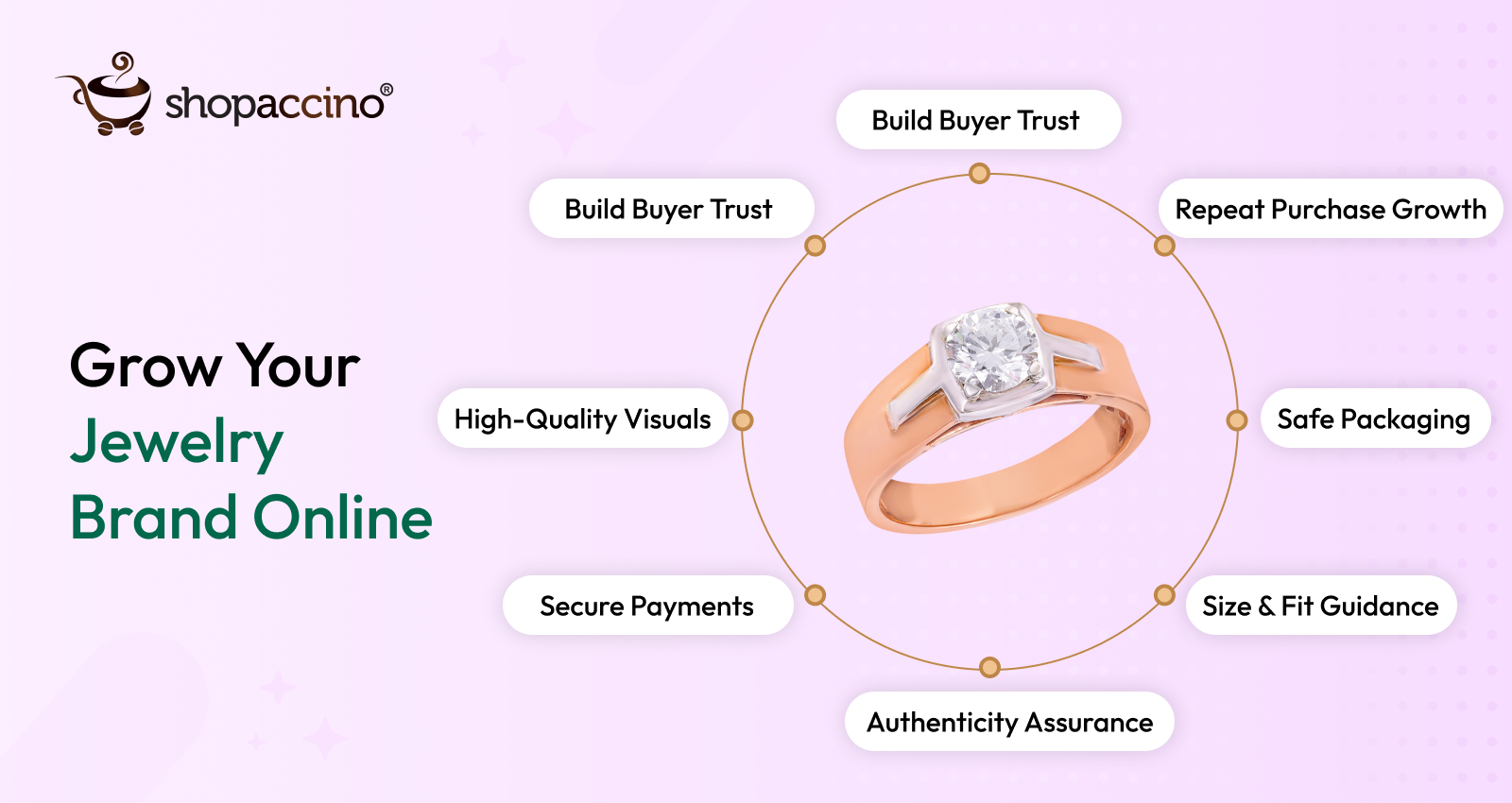
One struggle is product trust and authenticity. Buyers want assurance on purity, origin, craftsmanship, and metal type. If brands fail to communicate clearly, customers assume risk and hesitate.
Another challenge is visual representation. Jewelry requires close-up product clarity—detailing of finish, stone cut, clasp quality, and dimensions. Low-quality images make products appear misrepresented and trigger returns.
Size and fit concerns also emerge, especially for rings, bangles, and necklaces. Without correct measurement guidance, customers worry about selecting the wrong size and avoiding returns.
Operationally, the category demands safe packaging, insured delivery, secure payment flows, and careful stock control. For handcrafted and made-to-order products, fulfilment complexity rises further.
While demand exists, growth depends on solving these structural issues holistically.
Their Customer Challenging Area – What Jewelry Buyers Expect Online
Jewelry buyers value emotion, aesthetics, assurance, and transparency. Their expectations often differ from regular ecommerce customers.
They Expect Complete Product Transparency
Buyers want clarity on materials, weight categories, metal purity, finishing details, stone type, and craftsmanship notes.
They Want Visual Confidence
They need images, videos, close-up views, and styling references to visualize how pieces look when worn.
They Want Clarity on Care, Storage & Durability
Handcrafted and delicate jewelry needs usage instructions to prevent damage or disappointment.
They Want Ease of Purchase & Clear Policies
Clear returns/exchange rules, payment options, and delivery timelines reduce hesitation.
They Want Trust Before Purchase
Customers evaluate brand credibility through reviews, packaging, policies, and presentation—especially for high-value items.
These expectations shape the buying journey long before checkout.
Solution – How Integrated Platforms Support Jewelry eCommerce
Digital commerce tools help brands build trust, manage catalog details, and streamline post-purchase handling.
Platforms like Shopaccino enable jewelry brands to:
Showcase Products With Rich Catalog Structure
Multiple images, variant attributes, materials, style categories, and detailed descriptions in one structured system.
Offer Smooth Checkout & Payments
Multiple payment methods, secure workflows, and seamless mobile experience help convert hesitant buyers.
Manage Orders Centrally
Tracking, notifications, and dispatch workflows help manage high-value shipments with precision.
Maintain Customer Profiles for Repeat Sales
Buyers of jewelry often return for gifting, festivals, and collection expansion—data-driven communication strengthens retention.
Handle Policies Clearly
Platforms allow brands to publish transparent return terms and guidelines, helping set correct expectations.
These capabilities help smaller brands operate professionally without building custom systems.
How to Implement – A Step-by-Step Strategy for Growth
Step 1: Build a Detailed Product Catalog
Categorize jewelry thoughtfully: by material, style, occasion, collection, and theme. Add detailed specifications such as size dimensions, closure type, plating, and finish. Rich product pages increase trust and reduce returns.
Step 2: Invest in Better Visual Presentation
High-resolution images, lifestyle shots, close-up details, scale references, and model images help buyers visualize the product accurately. For delicate pieces, show zoom-level clarity.
Step 3: Create Clear Return and Exchange Policies
Define eligibility, packaging conditions, time limits, and non-returnable categories (e.g., hygiene-sensitive items). Transparency reduces disputes and improves experience.
Step 4: Use Data to Understand Buyer Intent
Track:
- Most viewed products
- Repeat purchase trends
- Cart-abandoned SKUs
- Festival-driven demand
This helps refine product launches and promotions.
Step 5: Streamline Packaging and Fulfilment
Jewelry requires secure packaging, scratch protection, and tamper-proof handling. Use systematic workflows to avoid manual errors.
Benefits of Selling Jewelry Online With Structured Systems
A well-built digital presence helps brands grow faster and operate confidently.
Higher Trust & Brand Credibility
Clear presentation, secure payments, and professional workflows build long-term trust.
Lower Return Rates
Detailed catalog information reduces incorrect purchases.
More Repeat Purchases
Strong retention strategies keep customers returning for new collections.
Better Operational Efficiency
Centralized orders and catalog management reduce reliance on manual tracking.
Stronger Market Reach
Brands expand beyond local demand and reach wider customers digitally.
When process and storytelling align, jewelry ecommerce becomes both scalable and profitable.
Conclusion
Selling jewelry online is an opportunity to create emotional relationships at scale—but it requires careful alignment between product representation, trust-building, and operational systems. Buyers expect transparency, precise information, secure delivery, and reliable post-purchase service. The brands that succeed are those that invest in accurate catalog data, strong visual storytelling, clear policies, and streamlined fulfilment.
Platforms like Shopaccino help jewelry brands manage catalog variants, orders, payments, secure workflows, and customer engagement under a unified system—supporting growth without heavy technical development.
Jewelry ecommerce isn’t just about selling products—it’s about creating confidence.
FAQs
High-value items require trust, clarity, and reliable presentation to convert buyers.
By providing detailed sizing, material descriptions, finishing notes, and usage guidance.
Not initially—accurate catalogs and structured operations matter more than advanced tech.
Online expands reach, but many brands benefit from a hybrid online + offline strategy.
Extremely—visual clarity directly impacts conversion and customer trust.
Yes—platforms allow professional operations without building custom systems.
Returns reduce significantly when sizing, material details, and policies are clear.