How Distributors Can Use a B2B Portal to Receive Orders Faster & More Accurately
For distributors, order management is not just a task—it is the heartbeat of the business. Every day brings a new mix of phone calls, WhatsApp messages, email threads, spreadsheets, and handwritten notes from retailers, wholesalers, and field agents. While demand is growing and brands are expanding their regional networks, the process of receiving and validating orders still remains shockingly manual for many distribution-driven businesses.
In today’s digital-first supply chain, delays and errors are no longer seen as normal business challenges. Buyers want instant updates, accurate stock availability, shorter delivery cycles, and clear communication at every step. A single mismatch in order quantity, a price misunderstanding, or a product availability issue can shake their confidence.
This is exactly why more distributors are shifting to a B2B ecommerce portal—a central, self-serve digital platform that simplifies how orders are captured, validated, and processed. Platforms like Shopaccino bring everything together—catalogues, pricing, inventory, and order tracking—so distributors can receive orders faster, reduce mistakes, and operate with far greater accuracy.
This blog explains why a B2B portal is becoming essential, what challenges it solves, how distributors can implement it step-by-step, and the transformation it creates in daily operations.
Challenging Area: Business Challenges Faced by Distributors
Running a distribution business means managing chaos that looks normal from the outside but is extremely complex internally. Some of the biggest operational pain points include:
Order Overload Across Multiple Channels
Most distributors receive orders from:
- Phone calls
- WhatsApp screenshots
- Personal visits
- Sales representatives
- Email chains
The lack of a single structured channel results in:
- Missing orders
- Duplicate entries
- Wrong quantity dispatch
- Miscommunication during peak hours
Human-Made Errors During Manual Entry
When orders are typed manually into software or registers, accuracy drops.
Incorrect product selection, wrong pricing, missed variants, or typing errors often lead to return requests, delays, and rising fulfilment costs.
Difficulty Managing Customer-Wise Pricing
Different retailers often have different negotiated prices, discounts, and minimum order quantities.
Keeping track manually creates confusion and inconsistency.
Inventory Mismatch & Stock Uncertainty
Distributors cannot update buyers instantly about:
- Low-stock items
- Out-of-stock products
- New arrivals
- This results in incomplete orders, rework, and frustrated customers.
Slow Order Processing and Low Efficiency
With manual operations, teams spend more time collecting and correcting orders than focusing on sales growth, service quality, or route optimisation.
Their Customer Challenging Area: What Buyers Expect Today
Retailers, wholesalers, and business customers have evolved. Their expectations are shaped by modern ecommerce experiences.
They Want Ordering to Be Quick
Buyers want a simple tap-and-add flow, not a long chat or call.
They Expect Real-Time Accuracy
They want to see:
- Correct prices
- Valid offers
- Updated inventory
- Order status instantly
They Need 24×7 Ordering Flexibility
Traditional working hours no longer define purchase cycles.
Buyers prefer placing orders late at night, early morning, or even on holidays without depending on a sales rep.
They Prefer Transparency Over Negotiation
Customers trust systems where:
- Prices are visible
- Discounts are clear
- Stock is updated
- Delivery timelines are predictable
They Expect Zero Mistakes
Accuracy in product, quantity, and billing has become a non-negotiable expectation—especially for established retail chains.
Solution: How a B2B Ecommerce Platform Solves These Issues
A modern B2B ecommerce portal centralises your catalogue, pricing, inventory, and order workflows in one place. Distributors using platforms like Shopaccino can transform how orders come in and how fast they are processed.
Centralised Order Capture
All orders—whether from retailers, agents, or field reps—come through a single structured portal.
This eliminates duplicate entries and consolidates every request in one dashboard.
Real-Time Inventory Visibility
Buyers can instantly see:
- Available stock
- Variant-wise quantity
- New arrivals
- This single change drastically reduces return orders and incomplete dispatches.
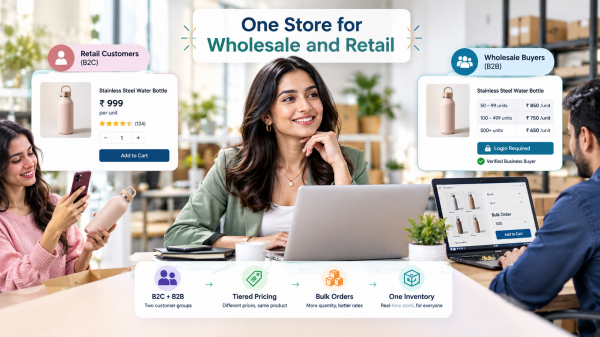
Customer-Wise Pricing & Discount Automation
The portal applies:
- Customer-specific price lists
- Exclusive discounts
- Bulk rates
- Minimum order rules
Sales teams no longer need to calculate manually or recheck old records.
Zero-Error Digital Ordering
Because buyers select items themselves:
- Product selection becomes accurate
- Quantity mismatches reduce
- Variant-wise selection becomes clear
Faster Order Processing & Approval
Orders come structured with:
- Exact SKUs
- Customer notes
- Payment instructions
- Delivery preferences
Distributors simply verify and dispatch—cutting processing time significantly.
Instant Communication & Status Updates
Automated updates keep customers informed about:
- Order confirmation
- Invoice generation
- Dispatch details
- Delivery timelines
Communication becomes smooth and transparent.
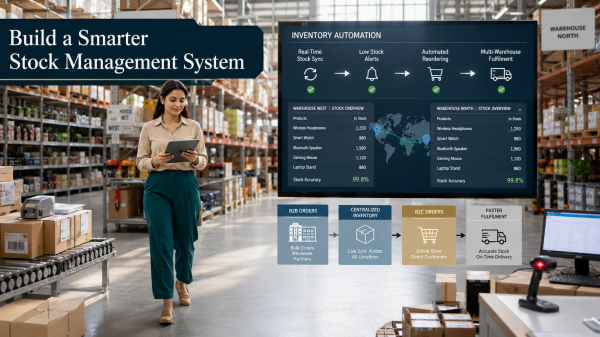
Seamless Multi-Warehouse Support
Modern portals support multiple locations, allowing distributors to assign orders to the nearest warehouse automatically—ensuring speed and cost optimisation. For a deeper look at handling large-volume orders and multi-warehouse stock specifically, see our guide on bulk order and multi-warehouse inventory management for B2B distributors
How to Implement a B2B Portal: Step-by-Step Guidance
Implementing a B2B ecommerce portal is easier than most distributors imagine.
Here is a simple breakdown:
Step 1: Digitise Your Product Catalogue
Upload:
- Product names
- Images
- Variants
- Packaging sizes
- Minimum order quantities
- Category and brand information
A clean catalogue ensures a clean ordering experience.
Step 2: Set Up Customer Segments and Price Lists
Distributors usually deal with multiple customer types.
Define price lists for:
- Retailers
- Wholesalers
- Superstockists
- Chains or key accounts
Set automated discounts so you never need manual negotiation.
Step 3: Update Warehouse-Wise Inventory
Sync real-time stock levels for each warehouse or location.
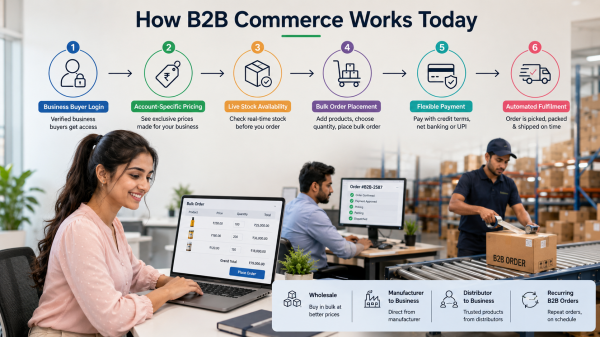
Step 4: Give Portal Access to Buyers
Customers receive secure login access where they can:
- Browse catalogue
- Check inventory
- View pricing
- Place orders instantly
Step 5: Train Your Team and Sales Representatives
Ensure your team understands:
- Order approval
- Dispatch workflow
- Customer communication
- Pricing rules
Step 6: Automate Notifications and Updates
Set up automated emails, SMS, or WhatsApp alerts for:
- Order confirmation
- Dispatch updates
- Payment reminders
- Back-in-stock notifications
Step 7: Monitor, Analyse, Improve
Use portal analytics to understand:
- Top selling products
- High-value customers
- Order frequency
- Revenue trends
This helps in forecasting and planning stock efficiently.
Benefits: What Distributors Gain from a B2B Portal
A well-implemented B2B portal transforms the way distributors operate, elevating speed, accuracy, and service quality.
Faster Order Receiving
Customers order directly on the portal, cutting down 60–80% of manual communication time.
Fewer Errors and Higher Accuracy
Digital order placement eliminates wrong entries, unclear messages, and mismatches.
Higher Reorder Frequency
Because buyers find it easy to place orders, the overall frequency improves.
Lower Operational Costs
Less manpower is needed for order collection, data entry, and coordination.
Higher Customer Satisfaction
Buyers appreciate transparency in pricing, availability, and status updates.
Better Sales Forecasting
Analytics help distributors plan stock and avoid dead inventory or shortages.
Better Control Over Pricing and Margins
Customer-specific pricing ensures consistency across sales channels.
Stronger Multi-Warehouse Efficiency
Orders auto-assigned to the right warehouse improve delivery timelines.
Conclusion
The distribution ecosystem is changing faster than ever. Buyers expect simplicity, accuracy, transparency, and speed—all at once. Traditional manual order-taking methods are no longer sustainable in a world where competition is growing and customer patience is shrinking.
A B2B ecommerce portal helps distributors cut through operational clutter and run their business the way modern buyers want. It brings order accuracy, real-time visibility, and predictable workflows to a space that has historically been dominated by manual processes.
Platforms like Shopaccino enable distributors to simplify order capturing, reduce errors, automate pricing, and build a smoother path for growth. Distributors who adopt a digital-first approach are able to deepen customer trust, improve operational control, and accelerate fulfilment—ultimately outperforming those who still rely on outdated processes.
FAQs
A B2B portal removes guesswork, reduces errors, centralises all orders, and gives buyers real-time visibility of stock, pricing, and status—something WhatsApp or calls cannot manage accurately.
Even small distributors benefit because it reduces workload, increases accuracy, and makes customers more self-dependent, helping the business scale smoothly.
Customers select exact products, variants, and quantities themselves, reducing human error and ensuring the order arrives exactly as they intended.
Most buyers adapt quickly because the experience is similar to placing an online order, and they prefer clarity over back-and-forth communication.
It allows each warehouse to manage its inventory separately and automatically assigns orders to the nearest location for faster delivery.
Yes, price lists and discount rules can be customised for each customer segment to ensure consistent, error-free pricing.
Yes, by removing manual tasks like order entry, price checking, and repeated communication, overall operational effort reduces significantly.