How Furniture Brands Can Sell Faster Without Manual Quotations
For many furniture brands, selling is not the hardest part—closing the sale quickly is. Customers walk in with clear intent: a sofa in a specific size, a dining table in a particular finish, or a bulk order for a project. Yet, instead of instant confirmation, they are told, “We’ll share the quotation shortly.” Hours turn into days. Follow-ups pile up. Interest fades. Sales quietly slip away.
Manual quotations have been part of the furniture business for decades. They once felt necessary because furniture is rarely standard. Sizes vary, materials change, finishes differ, and bulk pricing depends on volume. But what worked in an offline-first world now creates friction in a digital buying journey. Customers today expect speed, clarity, and confidence—especially when they are ready to buy.
This blog explores why manual quotations slow down furniture sales, how they frustrate buyers, and how modern ecommerce software helps furniture brands sell faster without compromising on customization or pricing accuracy.
Challenging Area: Why Manual Quotations Slow Furniture Sales
Furniture brands rely on manual quotations because their products are complex. A single item can have multiple dimensions, materials, finishes, and add-ons. But this dependence creates hidden operational problems.
Sales teams spend hours calculating prices for each enquiry. Designers check feasibility. Managers approve margins. Each quotation becomes a mini-project. When multiple enquiries arrive in parallel, response time stretches even further.
Another challenge is inconsistency. Two sales executives might quote different prices for similar configurations. Discounts vary based on urgency or negotiation skills. Over time, brands lose control over standardized pricing, which directly affects profitability.
Manual quotations also break momentum. A customer who is emotionally ready to buy is forced to wait. During that waiting period, doubts creep in. They explore competitors. They postpone decisions. Speed, not intent, becomes the deciding factor.
Their Customer Challenging Area: What Buyers Expect Today
Furniture buyers today behave very differently from the past. Even when purchasing high-value items, they expect digital clarity.
Customers want to:
- See Prices Instantly for selected sizes and materials
- Understand Delivery Timelines before committing
- Compare Options without talking to sales teams
- Get Confidence that pricing is final and transparent
When customers submit a quotation request, they are not browsing—they are evaluating seriousness. Delayed responses signal complexity, uncertainty, or lack of readiness. For B2B buyers, architects, and project managers, slow quotations can disrupt entire planning schedules.
From the buyer’s perspective, manual quotations feel outdated. They introduce unnecessary conversations, follow-ups, and waiting. The expectation is simple: “If I can configure it, I should be able to see the price and place the order.”
Solution: How Integrated Ecommerce Software Changes the Game
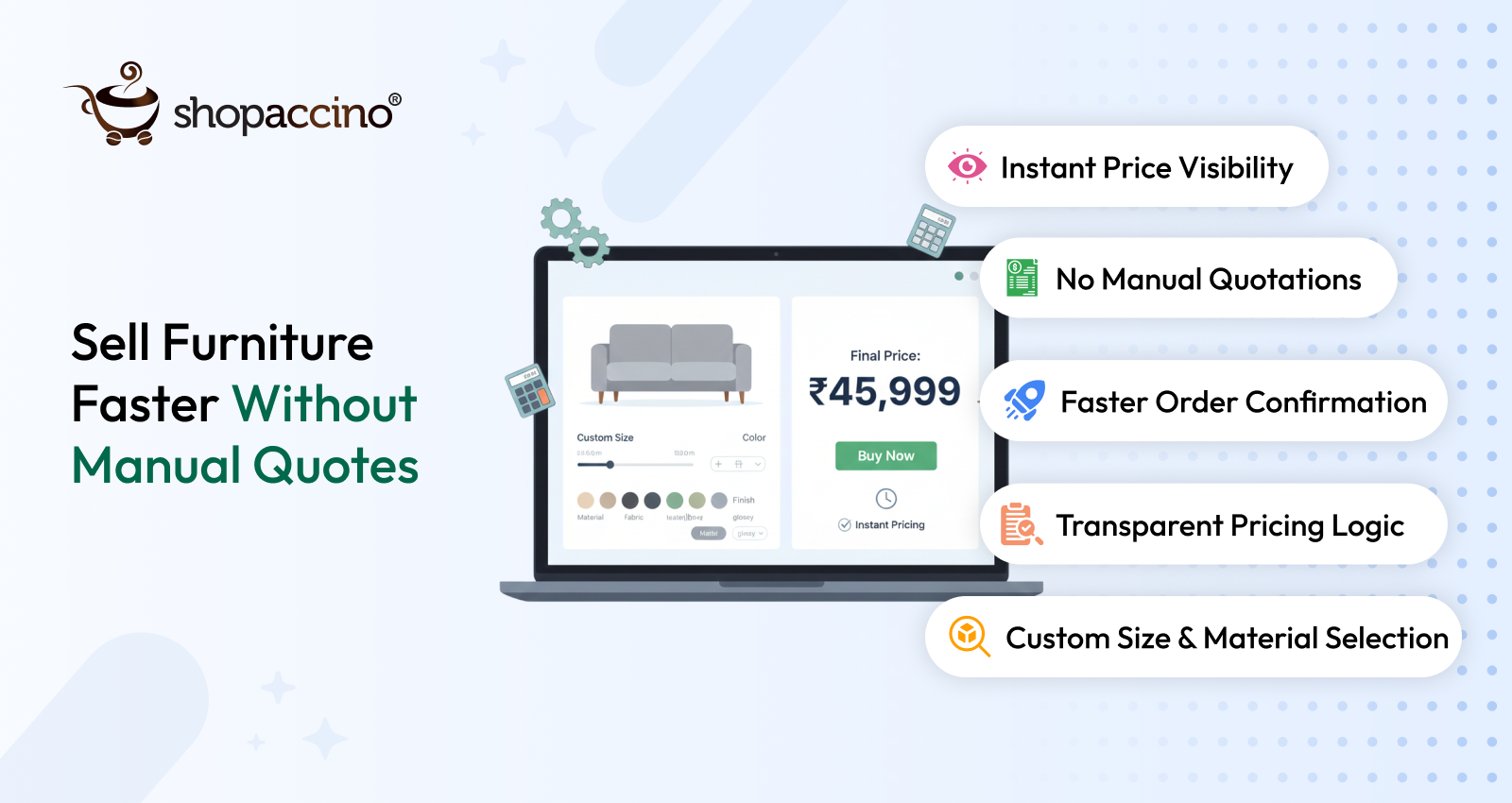
Modern ecommerce software allows furniture brands to move pricing logic from spreadsheets into systems. Instead of calculating every enquiry manually, brands can define rules once and let the platform handle the rest.
Product configurations—such as size, material, finish, and add-ons—can be structured digitally. Each selection automatically adjusts pricing in real time. Bulk pricing slabs can be predefined. Delivery rules can be mapped by location or order value.
This approach does not remove customization; it standardizes it. Sales teams shift from calculators to consultants. Customers move from waiting to ordering.
Platforms like Shopaccino help furniture brands centralize this logic so pricing remains consistent across website, sales teams, and repeat orders. The goal is not automation for its own sake, but speed with accuracy.
What changes when pricing goes online
- Customers See Prices Immediately without waiting for callbacks
- Sales Teams Focus on Closing instead of calculating
- Pricing Remains Consistent across channels
- Orders Get Confirmed Faster with fewer clarifications
This shift directly impacts conversion speed and customer trust.
How to Implement: Step-by-Step Guidance for Furniture Brands
Moving away from manual quotations does not require a complete overhaul. It requires thoughtful structuring.
Step 1: Standardize Product Configuration Logic
Start by identifying repeatable variables—sizes, materials, finishes, and add-ons. These form the foundation of digital configuration.
Step 2: Define Pricing Rules Clearly
Instead of per-order decisions, set rules for base pricing, material premiums, size increments, and bulk discounts. This ensures fairness and margin control.
Step 3: Enable Real-Time Price Calculation
Use ecommerce software that updates pricing instantly when customers change configurations. This replaces back-and-forth communication.
Step 4: Set Approval Thresholds (Where Needed)
For high-value or custom-heavy orders, allow conditional approvals rather than manual quotations for everything.
Step 5: Integrate Order Confirmation and Payment
Once pricing is visible, customers should be able to confirm orders, make partial or full payments, and receive timelines immediately.
This structured approach removes friction without removing flexibility.
Benefits of Eliminating Manual Quotations
The impact of moving away from manual quotations goes beyond speed. It reshapes the entire sales experience.
Furniture brands experience:
- Faster Sales Cycles from enquiry to confirmation
- Fewer Follow-Ups because pricing is self-explanatory
- Higher Conversion Rates due to reduced drop-offs
- Better Margin Control through standardized pricing
- Improved Buyer Confidence with transparent pricing
Customers experience clarity. Sales teams experience relief. Management experiences predictability.
Conclusion
Manual quotations were once unavoidable in furniture selling. Today, they are optional—and often costly. In a market where buyers value speed as much as craftsmanship, delaying price visibility delays decisions.
By using ecommerce software to standardize pricing logic and product configurations, furniture brands can sell faster without sacrificing customization. The result is not just efficiency, but trust—built through clarity, consistency, and confidence.
The brands that grow tomorrow will not be the ones that quote faster manually, but the ones that remove the need for quotations altogether.
FAQs
Manual quotations add waiting time, internal approvals, and follow-ups. This breaks buyer momentum and often leads customers to explore faster alternatives before receiving a response.
Yes. While designs vary, pricing rules for size, material, and quantity can be structured digitally, ensuring consistency while still allowing customization.
Customers trust pricing more when it is transparent, consistent, and instantly visible. Automated pricing removes ambiguity and negotiation fatigue.
Absolutely. Custom furniture benefits most from structured configurations that calculate pricing accurately instead of relying on ad-hoc estimates.
No. It changes their role from calculators to advisors, helping customers choose better instead of waiting for quotes.