How Manufacturers Can Simplify B2B Payment Collections With Online Options
For manufacturers, business does not end when an order is placed or dispatched. In reality, the most stressful part of the cycle often begins after the goods leave the warehouse—collecting payments. In B2B trade, payments are rarely instant. They are spread across credit terms, partial payments, reminders, reconciliations, and long follow-ups.
For decades, this was considered normal. Manufacturers accepted delayed payments as part of doing business. Sales teams chased cheques. Accounts teams tracked bank statements manually. Buyers paid when convenient. Everyone adjusted.
But the business environment in 2026 is very different. Manufacturing margins are tighter. Competition is higher. Cash flow matters more than ever. A delay of even a few days can affect raw material purchases, production schedules, and supplier payments. At the same time, B2B buyers are becoming more digital. They expect clarity, convenience, and flexibility—without friction.
This is where online payment options, integrated directly into B2B ecommerce systems, are changing the way manufacturers collect money. Not by forcing buyers, but by making payments easier, clearer, and faster for everyone involved.
This blog explains why traditional B2B payment collection is such a challenge, what buyers expect today, and how manufacturers can simplify collections using digital payment options—without damaging relationships or control.
Challenging Area: Why Payment Collection Is a Major Pain Point for Manufacturers
Payment issues do not usually come from bad intent. They come from broken processes.
Payments Rely on Personal Follow-Ups
In many manufacturing businesses, payment collection depends on people, not systems. Sales representatives remind dealers. Accounts teams call buyers. WhatsApp messages are sent repeatedly. If one person is busy, travelling, or unavailable, follow-ups stop.
This makes cash flow unpredictable and dependent on human effort.
No Single Source of Truth for Payments
Payments come through many channels:
- Bank transfers
- Cheques
- Advance payments
- Partial settlements
Without a central system, matching payments to invoices becomes a daily struggle. Small mismatches lead to big confusion.
Delayed Payments Hurt Production Planning
Manufacturers need steady cash flow to:
- Purchase raw materials
- Pay labour
- Maintain production schedules
When payments are delayed, production decisions are postponed or compromised.
Sales Teams Are Distracted From Growth
Instead of opening new markets or strengthening dealer relationships, sales teams spend time chasing payments. This affects morale and productivity.
Disputes Arise Due to Poor Records
Buyers and sellers often disagree on:
- What was paid
- What is pending
- Which invoice the payment applies to
Without digital records, resolving disputes takes time and damages trust. Many of these disputes actually start with pricing confusion — learn how manufacturers can maintain different pricing across dealer networks to prevent it at the source.
Their Customer Challenging Area: How B2B Buyers Experience Payment Friction
B2B buyers are not intentionally delaying payments. They face their own operational pressures.
Buyers Want Flexibility, Not Rigidity
Their cash flow depends on their own sales cycles. Buyers prefer payment options that fit their situation, not fixed processes.
Buyers Want Clarity on Outstanding Dues
They want to know exactly:
- Which invoices are unpaid
- How much is due
- When payment is expected
Calling suppliers for this information wastes time.
Buyers Prefer Secure, Digital Payments
Handling cheques or manual transfers feels outdated and risky, especially for large amounts.
Buyers Want Immediate Payment Confirmation
Delayed confirmation creates uncertainty and follow-ups from both sides.
Buyers Value Professional Payment Systems
Clear invoices, digital receipts, and transparent records make buyers feel confident dealing with the supplier long term.
Solution: How an Integrated Ecommerce Platform Simplifies B2B Payment Collections
An integrated ecommerce platform does not just sell products—it connects ordering, invoicing, and payments into one smooth flow.
Platforms like Shopaccino allow manufacturers to embed online payment options directly into the B2B buying experience, turning payment from a painful task into a simple step.
Multiple Online Payment Options in One Place
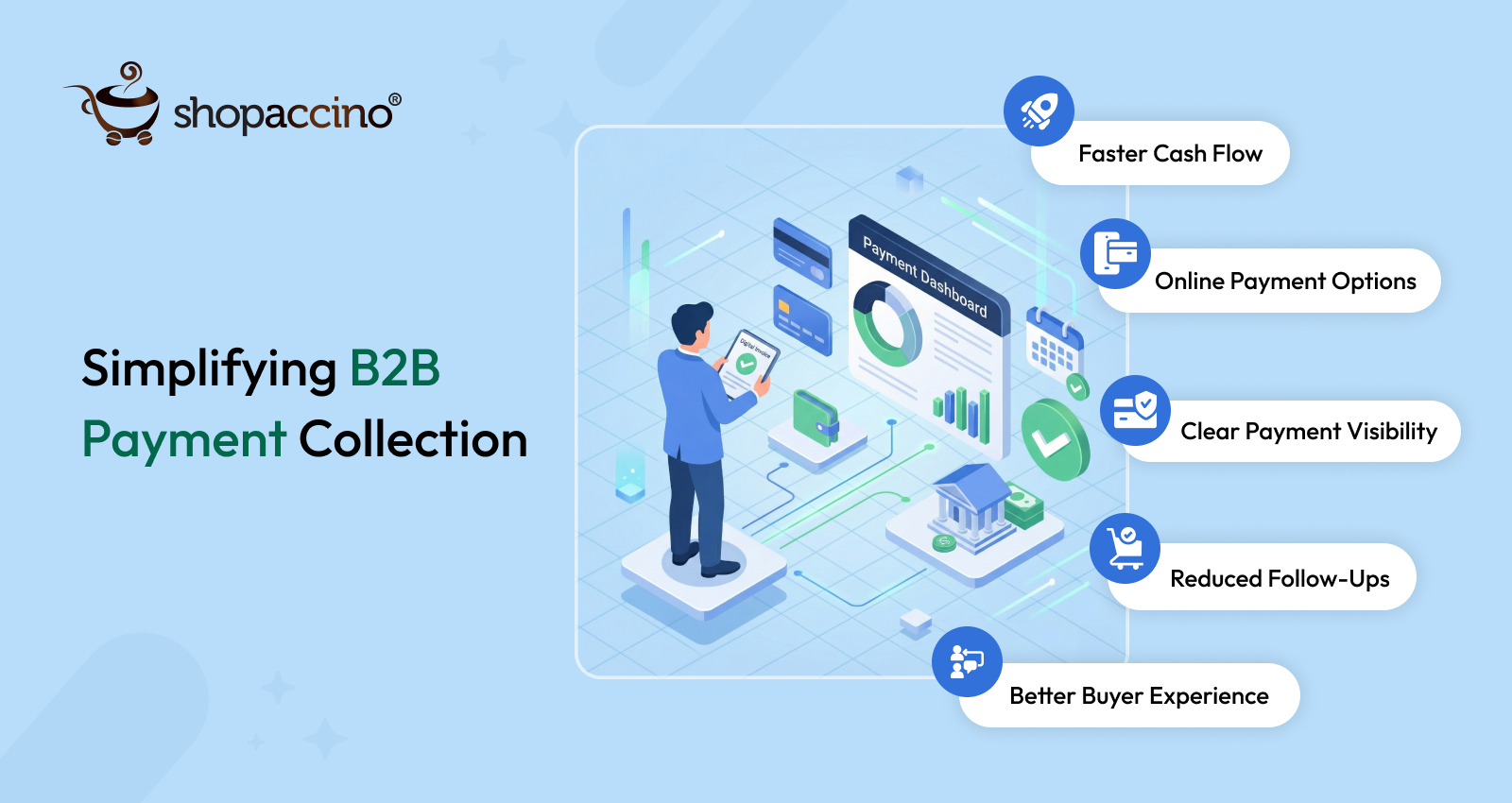
Manufacturers can offer buyers the freedom to pay using:
- Net banking
- UPI
- Cards
- Direct bank transfers
This removes friction and excuses.
Automatic Invoice and Payment Linking
Payments are automatically matched with invoices. No manual reconciliation is required.
Real-Time Payment Visibility
Finance teams instantly see which invoices are paid, pending, or overdue.
Automated Reminders Replace Manual Chasing
System-generated reminders are professional, consistent, and less uncomfortable than personal follow-ups.
How to Implement Online B2B Payment Collection Step by Step
Step 1: Digitize Every Invoice
Ensure invoices are created digitally and stored in one system.
Step 2: Integrate Secure Payment Gateways
Choose payment options suitable for high-value B2B transactions.
Step 3: Link Payments to Orders Automatically
Ensure payments update order and invoice status instantly.
Step 4: Provide Buyer Login Dashboards
Buyers should see their invoices, payments, and dues clearly.
Step 5: Define Payment Rules Clearly
Set due dates, advance payment rules, or partial payment conditions transparently.
Step 6: Automate Notifications
Send confirmations and reminders automatically.
Step 7: Analyse Payment Behaviour
Track delays, payment cycles, and buyer patterns to improve strategy.
Customer Segmentation
Online payment collection is valuable across all B2B segments:
- Manufacturers collecting from dealer networks
- Wholesalers handling frequent transactions
- Distributors managing multiple retail accounts
- Exporters dealing with long payment cycles
- Established D2C Brands running B2B supply chains
Benefits of Simplified B2B Payment Collection
Faster Cash Flow
Money reaches the business sooner, improving stability.
Reduced Payment Delays
Easy payment options remove friction.
Better Financial Control
Clear records improve accounting accuracy.
Stronger Buyer Relationships
Professional systems reduce awkward follow-ups.
Higher Team Productivity
Sales and accounts teams focus on growth, not chasing.
Scalable Payment Operations
Systems grow smoothly as business expands.
Conclusion
In modern manufacturing, collecting payments should not be harder than fulfilling orders. As B2B commerce becomes more digital, manual payment collection methods are no longer sustainable.
Online payment options integrated with ecommerce platforms simplify collections for manufacturers and buyers alike. With solutions like Shopaccino, manufacturers gain clarity, speed, and control—without sacrificing flexibility or relationships.
In 2026, manufacturers who simplify payment collection will not just improve cash flow—they will build healthier, more scalable businesses.
FAQs
Because they depend on manual follow-ups and unclear processes.
Yes, modern gateways support high-value transactions.
Yes, modern gateways support high-value transactions
Yes, digital records improve clarity and trust.
Absolutely. It reduces workload and improves cash flow.
Yes, when handled through verified gateways.