How Shopaccino’s Multi-Warehouse System Simplifies Operations
As ecommerce matures, the ability to deliver products quickly and accurately defines a brand’s success more than any marketing campaign ever could. The days when businesses operated from a single storage unit are long gone. Today’s landscape demands multi-location fulfillment, regional distribution centers, vendor-managed inventory, and hyperlocal delivery capabilities. For growing MSMEs, scaling this level of complexity often becomes overwhelming—especially when inventory, warehouse teams, order routing, and logistics operate in silos.
This is precisely where Shopaccino’s multi-warehouse system becomes a transformational pillar for ecommerce operations. It provides the structure, automation, and real-time visibility needed to manage distributed inventory without friction. Instead of navigating endless spreadsheets or reconciling mismatched stock records, businesses operate with clarity, accuracy, and speed.
In this blog, we explore how such a system simplifies operations for different business models, enhances the customer experience, and supports scaling without increasing complexity.
Challenging Area: The Real Operational Barriers Businesses Face
Running multi-warehouse operations is inherently challenging, especially for MSMEs transitioning from single-location setups. As order flow increases, the lack of systemized processes begins to surface in very noticeable ways.
No visibility across locations
When stock resides in different warehouses, vendor locations, or retail stores, businesses often lose real-time visibility across the entire network. This results in:
- Duplicate orders
- Slow dispatch
- Operational confusion
Higher delivery time and cost
Without automated order routing, warehouses ship orders inefficiently—often from farther locations, increasing shipping expenses and slowing down delivery.
Mismanaged stock movement
Internal transfers, vendor restocks, returns, and damaged stock tracking become difficult to handle without centralized control.
Order delays and cancellations
When inventory isn’t synchronized, businesses frequently oversell products or commit to delivery timelines that warehouses cannot meet.
Complicated logistics for diverse business types
Different customer segments struggle differently:
- Established D2C Brands suffer from split inventory and inconsistent delivery experiences.
- Exporters need stringent control over stock levels and availability timelines.
- Manufacturers require coordination between production units, warehouses, and fulfillment hubs.
- Wholesalers need visibility for bulk orders across cities.
- Distributors require centralized control to avoid supply imbalances between retail points.
These challenges are not caused by lack of demand—they are caused by lack of unified systems.
Their Customer Challenging Area: What Buyers Expect Today
Modern consumers don’t just buy products—they buy convenience, speed, and reliability. Their expectations are shaped by global marketplaces and large D2C brands that offer precision in every step of the shopping experience.
Buyers today expect:
Real-time stock accuracy
Customers instantly abandon the purchase if a product that appears “in stock” suddenly becomes unavailable at checkout.
Faster, region-based delivery
Shoppers prefer brands that deliver from a nearby warehouse instead of waiting days for intercity fulfillment.
Transparent availability
Customers expect stores to correctly indicate whether a product is deliverable to their pin code or region.
Dependable post-purchase experience
Order tracking, promised delivery dates, and warehouse accuracy deeply influence retention.
Consistent experience across channels
Whether buying from the website, mobile app, or social storefront, stock and delivery timelines must stay consistent.
Without a multi-warehouse system that syncs inventory in real time, it becomes nearly impossible to meet these expectations consistently.
Solution: How an Integrated Ecommerce Platform Resolves These Issues
An integrated multi-warehouse ecommerce system connects product inventory, order routing, warehouse operations, and delivery logistics into a single, synchronized engine. Instead of managing each location independently, businesses operate through a centralized dashboard that updates stock and order status instantly.
With Shopaccino’s multi-warehouse system, businesses gain:
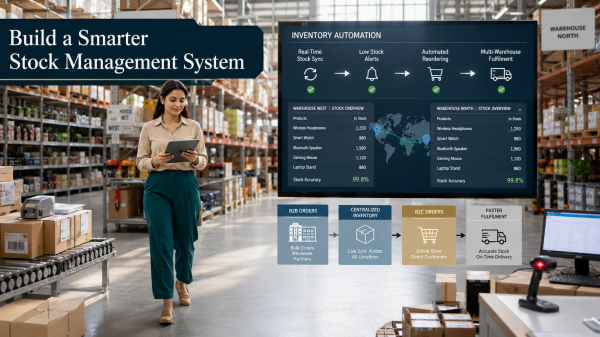
- Real-time inventory sync across all warehouses
- Automated warehouse assignment based on pin code, location, or predefined rules
- Accurate stock tracking at variant level
- Smooth internal stock transfers
- Vendor warehouse support
- Unified order and delivery management
- Region-wise availability and pricing control
This level of integration removes dependency on manual coordination and dramatically increases fulfillment accuracy.
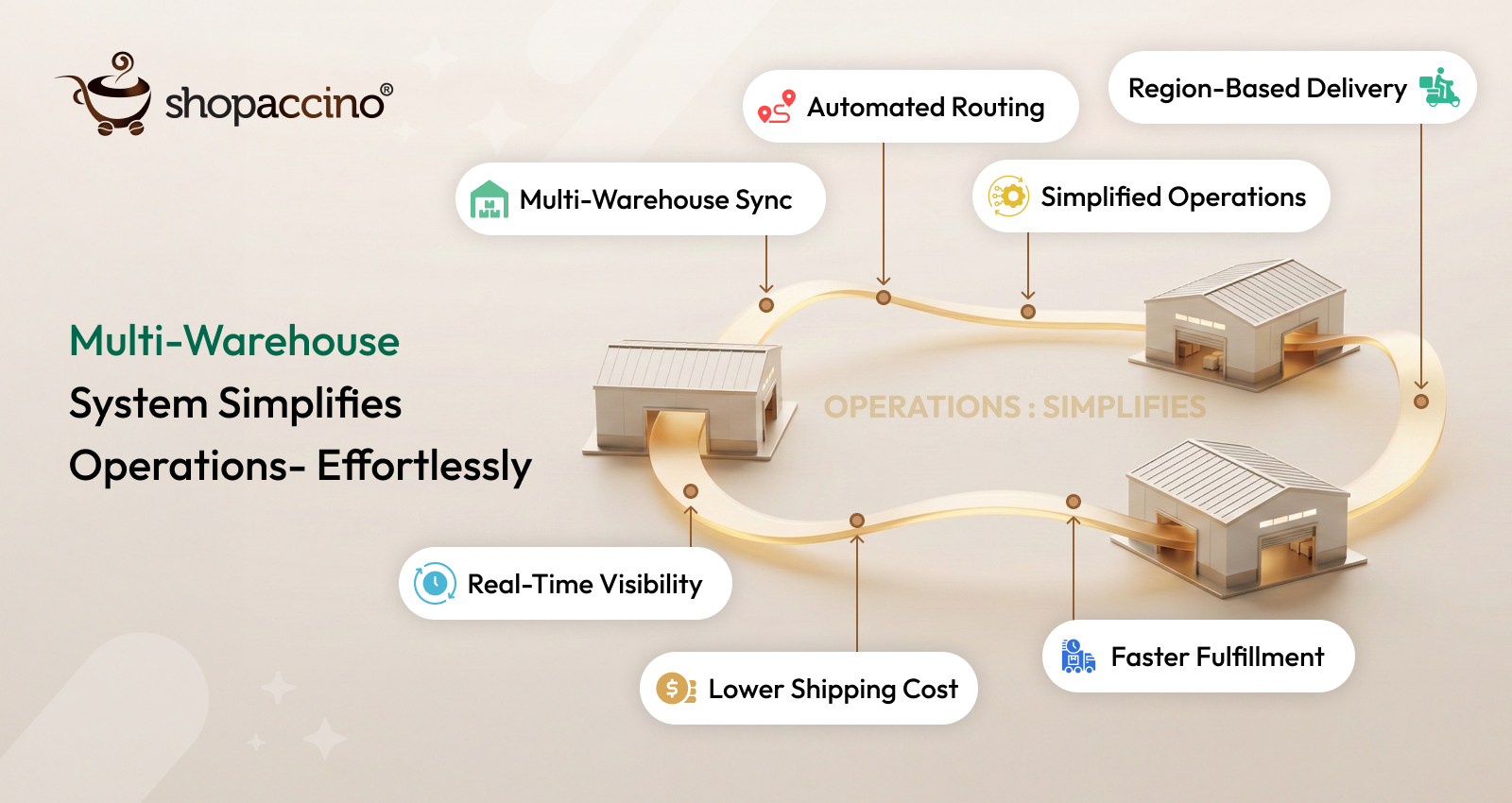
How Shopaccino’s Multi-Warehouse System Simplifies Operations
Real-Time Inventory Visibility Across All Locations
At the heart of a high-performing ecommerce business is accurate stock visibility. Shopaccino updates inventory instantly whenever an order is:
- Placed
- Returned
- Canceled
- Restocked
- Transferred internally
This eliminates gaps that typically lead to overselling and customer dissatisfaction. In industries like fashion, jewelry, footwear, furniture, and groceries, this accuracy is essential because variants often sell differently across regions.
Automated Order Routing to the Best Warehouse
Instead of manually checking which warehouse should fulfill an order, Shopaccino automatically routes orders based on multiple factors such as:
- Customer location
- Stock availability
- Warehouse priority settings
- Serviceable pin codes
This ensures faster delivery at lower shipping cost—an essential requirement for improving conversion rates and repeat purchases.
Efficient Handling of Internal Stock Transfers
Multi-warehouse businesses frequently require stock shuffling across locations. Shopaccino simplifies this through a structured workflow:
- Raise transfer request
- Approve and dispatch from origin warehouse
- Update status in real time
- Update stock at destination automatically
This brings transparency and eliminates manual reconciliation efforts.
Support for Vendor Warehouses and Dropshipping
Businesses working with multiple vendors can assign inventory to vendor warehouses within the system. When orders come in, the vendor receives fulfillment instructions, ensuring smooth multi-source distribution.
This is especially beneficial for:
- Manufacturers
- Wholesalers
- Distributors
- Niche category sellers
- Brands working with outsourced production units
Region-Based Availability and Pricing
Shopaccino allows brands to show products only in regions where they can deliver profitably or maintain stock.
This solves a major challenge for bulky products like furniture or region-sensitive products like groceries.
Brands can also manage region-specific pricing strategies when needed.
How to Implement a Multi-Warehouse System (Step-by-Step)
Identify Your Warehousing Needs
Map out your physical, vendor, and virtual warehouse locations. Define their roles—fulfillment, stocking, vendor dropship, or dark stores.
Set Up Stock Allocation Rules
Configure each warehouse with:
- Lead time
- Priority order
- Serviceable regions
- Product restrictions
This ensures the system routes orders intelligently.
Import Inventory or Sync Existing Systems
Upload stock levels or connect existing systems (ERP, POS, marketplaces) to ensure all data stays unified.
Assign Teams and Access Permissions
Shopaccino enables granular access control so each warehouse team manages only what is relevant to their operations.
Enable Pincode-Based Delivery Checks
Define serviceable regions for each warehouse. This helps customers see accurate availability instantly.
Test Order Workflows
Before going live, place test orders from different regions to ensure routing, tracking, and inventory deduction work seamlessly.
Monitor Warehouse Performance
Review data regularly:
- Dispatch times
- Inventory turnover
- Regional demand
- Vendor fulfillment speed
This helps refine stock distribution strategies.
Benefits of a Multi-Warehouse System
Faster Delivery Times
Routing orders to the closest warehouse ensures hyper-efficient shipping and strengthens customer satisfaction.
Lower Shipping Costs
Optimized order routing reduces fuel charges, courier fees, and return shipping overhead.
Higher Stock Accuracy
Real-time syncing maintains accuracy at product and variant levels—reducing order cancellations drastically.
Seamless Scalability
Brands can add new warehouses, expand to new cities, or integrate vendor hubs without disrupting the system.
Better Customer Experience
Regional availability, faster delivery, and reliable stock display contribute to stronger brand trust and higher retention.
Improved Inventory Planning
Businesses can forecast demand by analyzing region-specific performance and adjust stock distribution accordingly.
Conclusion
A multi-warehouse system is no longer a function reserved for large enterprises—it is now a necessity for every ecommerce brand aiming for scalability, operational precision, and customer satisfaction. Managing distributed stock without a unified system introduces inefficiencies that slow down growth.
With a deeply integrated system like Shopaccino, MSMEs gain access to real-time inventory visibility, automation, accurate order routing, and transparent stock control—empowering them to operate with the sophistication of much larger brands. Whether you’re an Established D2C Brand, an Exporter expanding into international markets, a Manufacturer balancing production and distribution, a Wholesaler handling bulk orders, or a Distributor coordinating supply chains, multi-warehouse sync becomes the backbone of a scalable ecommerce operation.
As customer expectations rise and competition intensifies, brands that adopt intelligent warehouse systems will gain a decisive edge—delivering faster, operating smarter, and growing sustainably.
FAQs
It is a centralized system that manages inventory, stock movement, and order routing across multiple warehouses with real-time synchronization.
It reduces delivery time, improves stock accuracy, lowers shipping cost, and enables regional fulfillment.
Yes. Automation eliminates manual stock updates, minimizes coordination, and accelerates fulfillment.
Absolutely. Manufacturers, wholesalers, and distributors gain accurate visibility for bulk fulfillment.
Yes, Shopaccino provides a fully integrated multi-warehouse system with automated routing, real-time sync, and seamless stock transfers.
Yes. Vendor-managed inventory and dropshipping workflows are supported.
Yes. Faster shipping, accurate stock display, and reliable delivery timelines significantly enhance customer satisfaction.