How to Choose the Best E-commerce Platform in 2026: Pros, Cons, & Comparison Guide
Ecommerce in 2026 is very different from what it was just a few years ago. Online selling is no longer limited to listing products and accepting payments. Today’s ecommerce businesses deal with rising customer expectations, intense competition, multiple sales channels, and the need for personalization.
Customers now expect:
- Fast-loading websites
- Seamless mobile experiences
- Flexible product options
- Secure and smooth checkout
- Consistent experience across devices
Why E-commerce Platform Selection Is a Long-Term Decision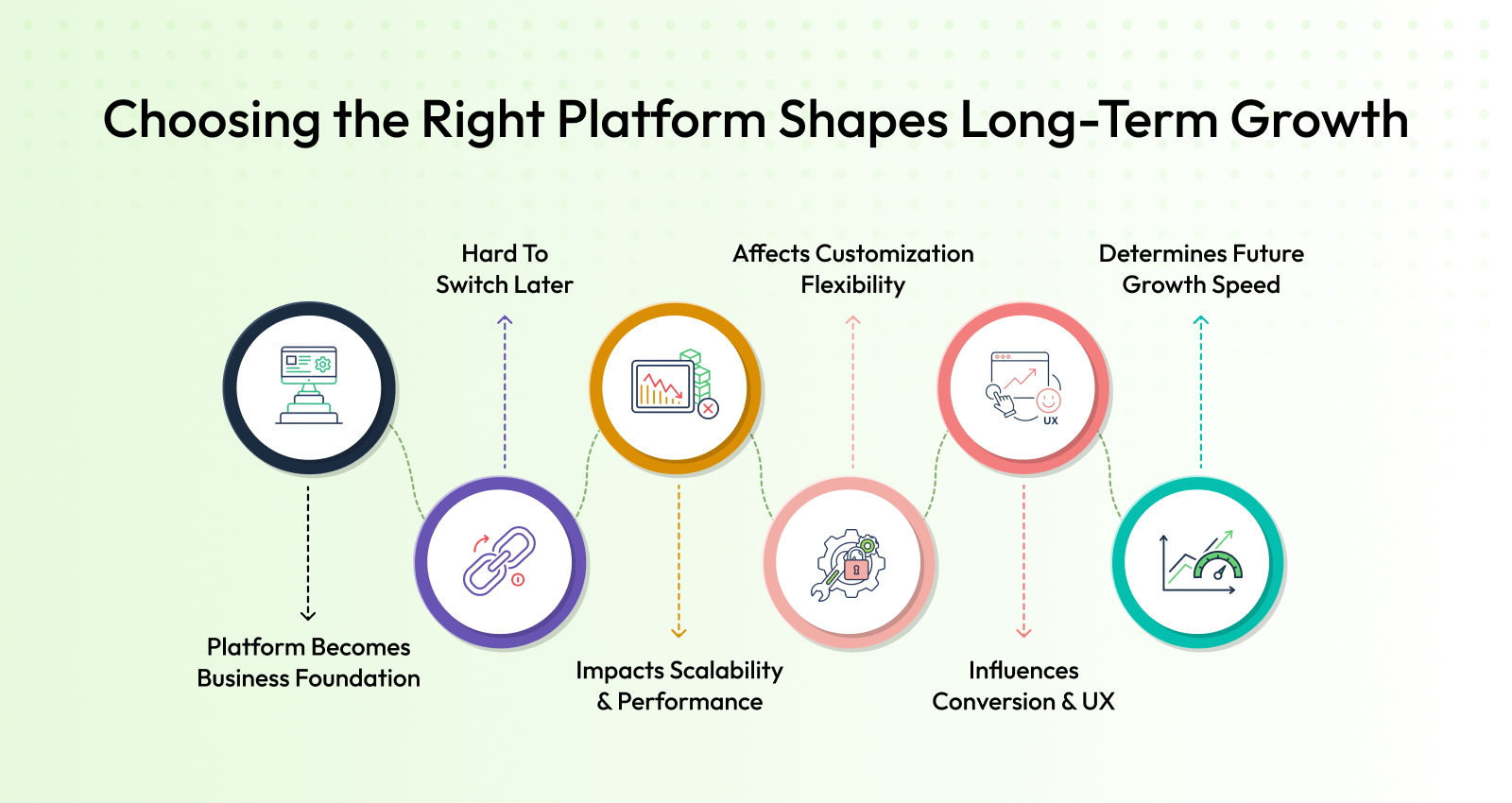
Many businesses make the mistake of choosing a platform based only on price, popularity, or ease of setup. While these factors matter in the early stages, they often create limitations as the business grows.
An e-commerce platform becomes the foundation of your online business. Once you build on it, switching platforms later can be expensive, time-consuming, and risky for SEO and operations.
This makes it essential to evaluate platforms not just for today’s needs, but for where your business will be in the next 2–5 years.
What an E-commerce Platform Really Does (Beyond Selling Products)
To choose the best e-commerce platform, it’s important to understand what a platform actually handles behind the scenes.
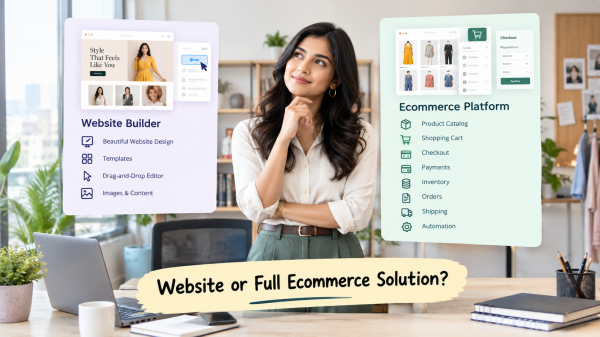
A modern e-commerce platform manages:
- Product catalogs and variations
- Website performance and security
- Checkout and payments
- Order and inventory management
- Integrations with marketing and logistics tools
- Scalability during traffic spikes
If any of these areas are weak, your business growth will eventually slow down.
The Hidden Cost of Choosing the Wrong Platform
Choosing the wrong platform often doesn’t hurt immediately. The problems appear later—when growth starts happening.
Common issues businesses face include:
- Website slowing down as traffic increases
- Limited customization options
- Poor support for custom product requirements
- Difficulty scaling during sales or campaigns
- Costly migrations when the platform is outgrown
These challenges are why businesses increasingly compare e-commerce platforms carefully before committing.
Why “Best Ecommerce Platform” Means Different Things for Different Businesses
There is no single platform that is best for everyone. The “best” platform depends on your business model, product complexity, growth plans, and technical requirements.
For example:
- A small D2C brand may prioritize ease of use and speed
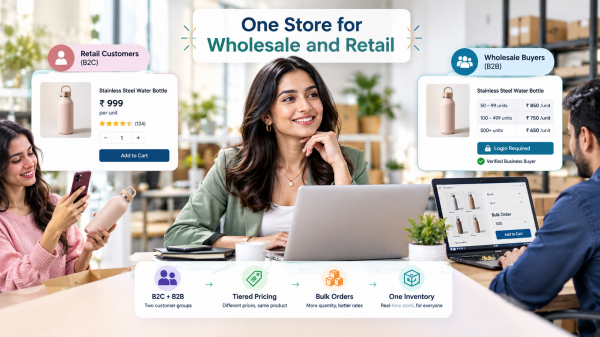
- A B2B business may need complex pricing and workflows
- A growing brand may need a scalable e-commerce platform
- A customization-heavy business may need a custom e-commerce platform
Understanding your specific needs is the first step toward making the right choice.
Key Factors to Consider Before You Compare Ecommerce Platforms
Before diving into platform comparisons, it’s important to define what matters most for your business.
Business Size and Growth Plans
Ask yourself:
- Are you just starting, or already scaling?
- Do you expect rapid growth in traffic or orders?
- Will you expand into new categories or regions?
Platforms that work well for small stores may struggle under high traffic or complex operations.
In this environment, the ecommerce platform you choose plays a critical role in how well your business performs. It directly impacts speed, scalability, customization, and long-term growth.
That’s why choosing the right ecommerce platform is no longer a technical decision—it’s a strategic business decision.
Why E-commerce Platform Selection Is a Long-Term Decision
Many businesses make the mistake of choosing a platform based only on price, popularity, or ease of setup. While these factors matter in the early stages, they often create limitations as the business grows.
An e-commerce platform becomes the foundation of your online business. Once you build on it, switching platforms later can be expensive, time-consuming, and risky for SEO and operations.
This makes it essential to evaluate platforms not just for today’s needs, but for where your business will be in the next 2–5 years.
What an E-commerce Platform Really Does (Beyond Selling Products)
To choose the best e-commerce platform, it’s important to understand what a platform actually handles behind the scenes.
A modern e-commerce platform manages:
- Product catalogs and variations
- Website performance and security
- Checkout and payments
- Order and inventory management
- Integrations with marketing and logistics tools
- Scalability during traffic spikes
If any of these areas are weak, your business growth will eventually slow down.
The Hidden Cost of Choosing the Wrong Platform
Choosing the wrong platform often doesn’t hurt immediately. The problems appear later—when growth starts happening.
Common issues businesses face include:
- Website slowing down as traffic increases
- Limited customization options
- Poor support for custom product requirements
- Difficulty scaling during sales or campaigns
- Costly migrations when the platform is outgrown
These challenges are why businesses increasingly compare e-commerce platforms carefully before committing.
Why “Best Ecommerce Platform” Means Different Things for Different Businesses
There is no single platform that is best for everyone. The “best” platform depends on your business model, product complexity, growth plans, and technical requirements.
For example:
- A small D2C brand may prioritize ease of use and speed
- A B2B business may need complex pricing and workflows
- A growing brand may need a scalable e-commerce platform
- A customization-heavy business may need a custom e-commerce platform
Understanding your specific needs is the first step toward making the right choice.
Key Factors to Consider Before You Compare Ecommerce Platforms
Before diving into platform comparisons, it’s important to define what matters most for your business.
Business Size and Growth Plans
Ask yourself:
- Are you just starting, or already scaling?
- Do you expect rapid growth in traffic or orders?
- Will you expand into new categories or regions?
Platforms that work well for small stores may struggle under high traffic or complex operations.
Product Complexity and Customization Needs
If your products require:
- Multiple variations
- Custom configurations
- Add-ons or personalization
Then a platform that supports the best ecommerce platform for custom products becomes essential.
Some platforms handle simple products well but struggle with advanced customization.
Scalability and Performance Requirements
A scalable ecommerce platform should be able to:
- Handle traffic spikes during campaigns
- Maintain fast load times
- Support growing catalogs and order volumes
Performance issues directly impact conversion rates and customer trust.
Flexibility vs Control
Some platforms prioritize simplicity, while others prioritize flexibility.
- Simpler platforms are easier to use but limit customization
- Flexible platforms allow deeper control but require more planning
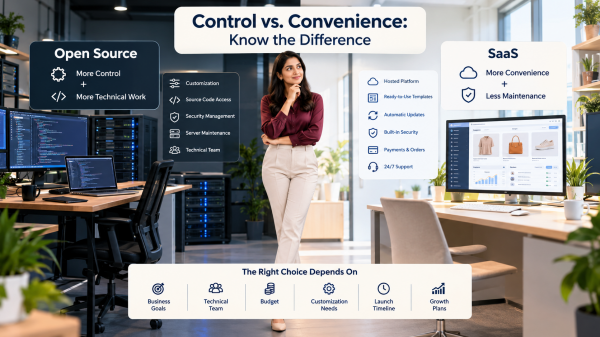
This is where businesses often choose between hosted solutions and more customizable or custom ecommerce platforms.
Custom E-commerce Platform vs Ready-Made Solutions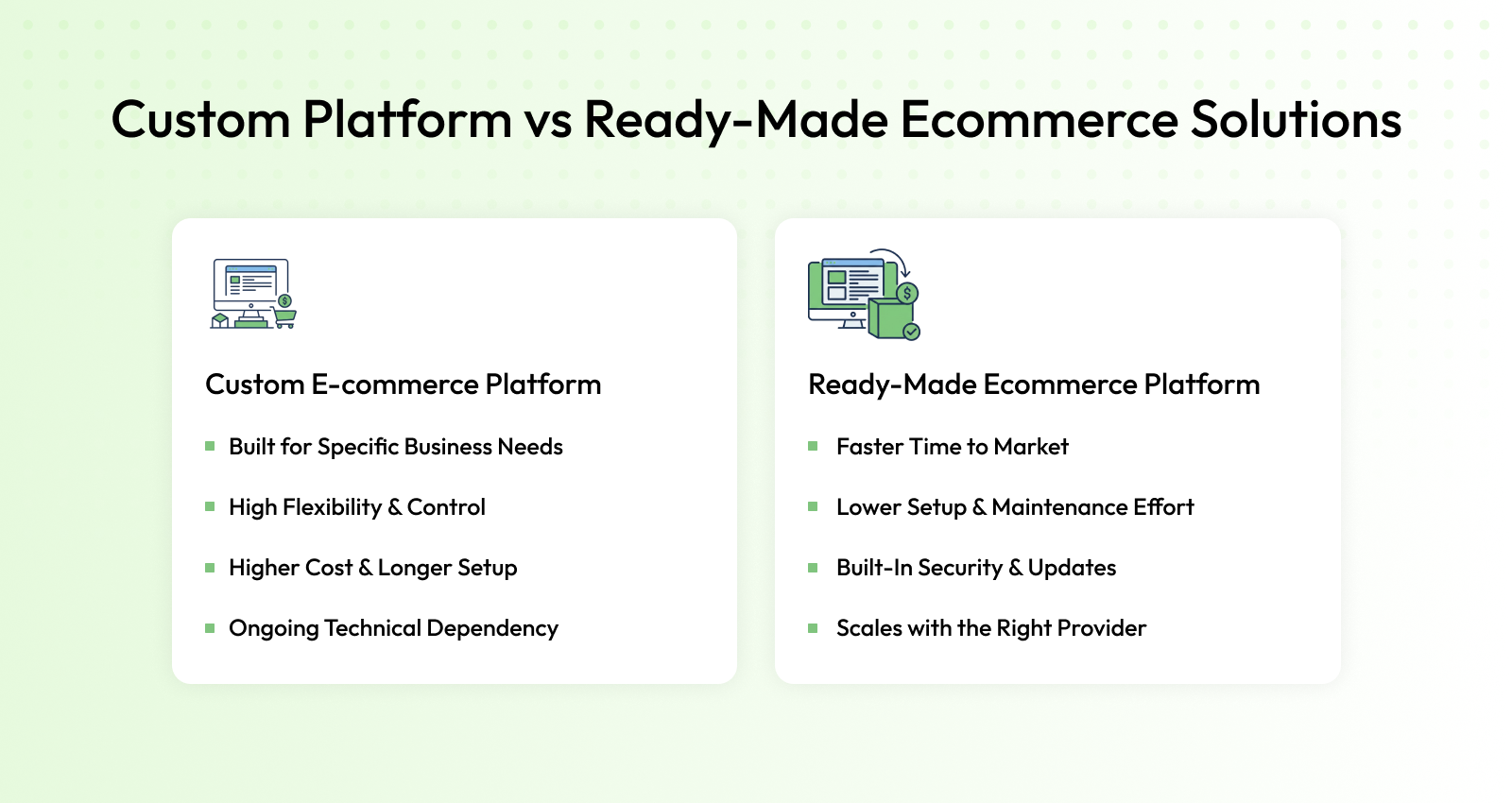
One of the most common decisions businesses face is whether to choose a ready-made platform or invest in a custom ecommerce platform.
When a Custom Ecommerce Platform Makes Sense
A custom ecommerce platform may be suitable when:
- Your business has highly specific workflows
- You need deep integrations with internal systems
- Standard platforms cannot support your requirements
However, custom platforms often come with higher development costs and maintenance responsibilities.
When Ready-Made Platforms Are a Better Choice
Ready-made platforms are often ideal when:
- You want faster time-to-market
- You prefer managed infrastructure
- You need ongoing platform updates and security
Many modern platforms offer customization flexibility without the cost and complexity of fully custom builds.
Why Platform Comparison Is Essential in 2026
In 2026, platform comparison is no longer optional. With so many choices available, businesses must compare ecommerce platforms based on real-world performance, not marketing claims.
Key comparison areas include:
- Scalability
- Customization capabilities
- Performance and speed
- Cost structure
- Support and reliability
A structured comparison helps avoid future roadblocks and unexpected limitations.
Comparing Ecommerce Platforms Based on Real Business Needs
Before you compare ecommerce platforms feature by feature, it’s important to understand the main categories platforms fall into. In 2026, most ecommerce solutions can be grouped into three broad types, each serving different business needs.
Some platforms focus on simplicity and speed, others prioritize flexibility and scalability, while a few are built specifically for businesses with advanced customization requirements.
Choosing the right type is often more important than choosing a specific brand.
Hosted Ecommerce Platforms: Pros and Limitations
Hosted ecommerce platforms are solutions where the technology infrastructure, security, and updates are managed by the platform provider. Businesses focus on selling while the platform handles the backend.
Where Hosted Platforms Work Well
Hosted platforms are a good fit when businesses want:
- Quick store launch
- Minimal technical involvement
- Built-in hosting, security, and updates
- Predictable operational setup
For many growing brands, hosted platforms like Shopaccino offer a balanced approach—combining ease of use with strong scalability and control over branding, products, and checkout experience.
Limitations to Be Aware Of
While hosted platforms simplify operations, not all of them are built equally. Some may:
- Limit deep customization
- Restrict complex product configurations
- Increase costs as the business scales
This is why it’s important to evaluate how scalable and flexible a hosted platform really is, not just how easy it is to start.
Open-Source and Custom Ecommerce Platforms: Control vs Complexity
At the other end of the spectrum are open-source and fully custom ecommerce platforms. These give businesses complete control over functionality, design, and integrations.
When a Custom Ecommerce Platform Makes Sense
A custom ecommerce platform may be suitable if:
- Your business has highly specific workflows
- You sell complex or configurable products
- You need deep system integrations
- You have an in-house technical team
For businesses selling custom or configurable products, evaluating the best e-commerce platform for custom products becomes critical, as not all platforms handle advanced configurations efficiently.
The Trade-Offs of Custom Platforms
While custom platforms offer flexibility, they also come with challenges:
- Higher development and maintenance costs
- Longer launch timelines
- Ongoing technical dependency
- Responsibility for security and performance
For many businesses, these trade-offs outweigh the benefits unless customization is absolutely essential.
Scalability: The Most Important Factor in 2026
In 2026, scalability is no longer optional—it’s expected.
A scalable ecommerce platform should be able to:
- Handle sudden traffic spikes
- Support increasing product catalogs
- Process high order volumes reliably
- Maintain fast load times under pressure
Platforms that struggle with performance during growth phases directly impact conversion rates and customer trust.
This is where businesses must look beyond pricing and templates and focus on real-world scalability.
Customization Needs vs Speed to Market
One of the most common mistakes businesses make is choosing a platform that either:
- Is too rigid for future needs
- Or too complex for current operations
The right platform strikes a balance between customization and speed.
Modern ecommerce platforms like Shopaccino are designed to support customization—such as flexible product options, checkout optimization, and branding control—without the overhead of building everything from scratch.
This makes them suitable for businesses that want control without complexity.
Comparing Ecommerce Platforms the Right Way
When businesses compare ecommerce platforms, they often focus on surface-level features. In reality, deeper factors matter more.
Key comparison criteria should include:
- How well the platform scales with growth
- Support for custom and configurable products
- Checkout and conversion optimization flexibility
- Platform stability during high-traffic events
- Quality of support and ecosystem
A structured comparison helps businesses avoid short-term decisions that lead to long-term limitations.
Why Platform Choice Impacts Revenue, Not Just Operations
The ecommerce platform you choose affects more than operations—it directly impacts revenue.
A well-chosen platform helps:
- Improve site performance
- Reduce checkout friction
- Support better user experience
- Enable faster experimentation
All of these factors contribute to higher conversion rates and long-term growth.
This is why selecting the right platform is a strategic investment, not just a technical setup step.
A Practical Framework to Choose the Right Ecommerce Platform in 2026
After understanding platform types, scalability, and customization trade-offs, the final step is decision-making. In 2026, choosing the best ecommerce platform requires a structured approach rather than feature comparison alone.
A good platform decision balances current needs with future growth, not just ease of launch.
Step 1: Define Your Business Model Clearly
Before comparing platforms, be clear about how your business operates.
Ask yourself:
- Are you B2C, D2C, B2B, or hybrid?
- Do you sell standard or configurable products?
- Will you scale product range or order volume rapidly?
- Do you plan to expand into new regions or channels?
Your answers determine whether you need a simple hosted solution, a scalable ecommerce platform, or support for custom workflows.
Step 2: Evaluate Product Complexity Early
Product structure plays a major role in platform selection.
If your business involves:
- Multiple product variants
- Bundles or add-ons
- Personalized or made-to-order items
Then you must evaluate the best ecommerce platform for custom products, not just general ecommerce functionality.
Many platforms handle basic products well but struggle with advanced configurations at scale.
Step 3: Assess Scalability Beyond Traffic Numbers
Scalability is not only about handling more visitors. A truly scalable ecommerce platform should support growth across operations.
Look for a platform that can:
- Maintain speed during traffic spikes
- Handle increasing order volumes
- Support larger catalogs
- Scale checkout and payment processing smoothly
Platforms that fail here often force businesses into costly migrations later.
Step 4: Compare Ecommerce Platforms on Conversion Impact
In 2026, platform choice directly affects revenue.
When you compare ecommerce platforms, go beyond backend features and ask:
- How flexible is checkout optimization?
- Can you customize product pages easily?
- Does the platform support mobile-first experiences?
- Can you experiment with pricing, offers, and layouts?
Platforms that support faster experimentation and better UX give businesses a competitive edge.
Step 5: Understand the True Cost of Ownership
The cost of an ecommerce platform is not just the monthly fee.
Consider:
- Setup and development costs
- Maintenance and upgrades
- Transaction or scaling charges
- Support and downtime risks
Sometimes, a platform that appears cheaper initially becomes expensive as the business grows.
Why Many Businesses Outgrow Their First E-commerce Platform
A common mistake businesses make is choosing a platform that works only for the launch phase.
As growth accelerates, limitations appear:
- Restricted customization
- Performance bottlenecks
- Poor support for complex products
- Limited control over checkout and UX
This is why selecting a platform with long-term scalability matters more than choosing the fastest option to go live.
Where Shopaccino Fits in the 2026 E-commerce Landscape
For businesses looking for balance—between simplicity, scalability, and control—platforms like Shopaccino are designed to meet modern ecommerce requirements.
Shopaccino supports:
- Scalable infrastructure for growing brands
- Flexible product and checkout customization
- Mobile-optimized ecommerce experiences
- Strong performance without heavy technical overhead
- Control over branding, data, and conversions
This makes it suitable for businesses that want growth flexibility without the complexity of a fully custom e-commerce platform.
Common Mistakes to Avoid When Choosing an E-commerce Platform
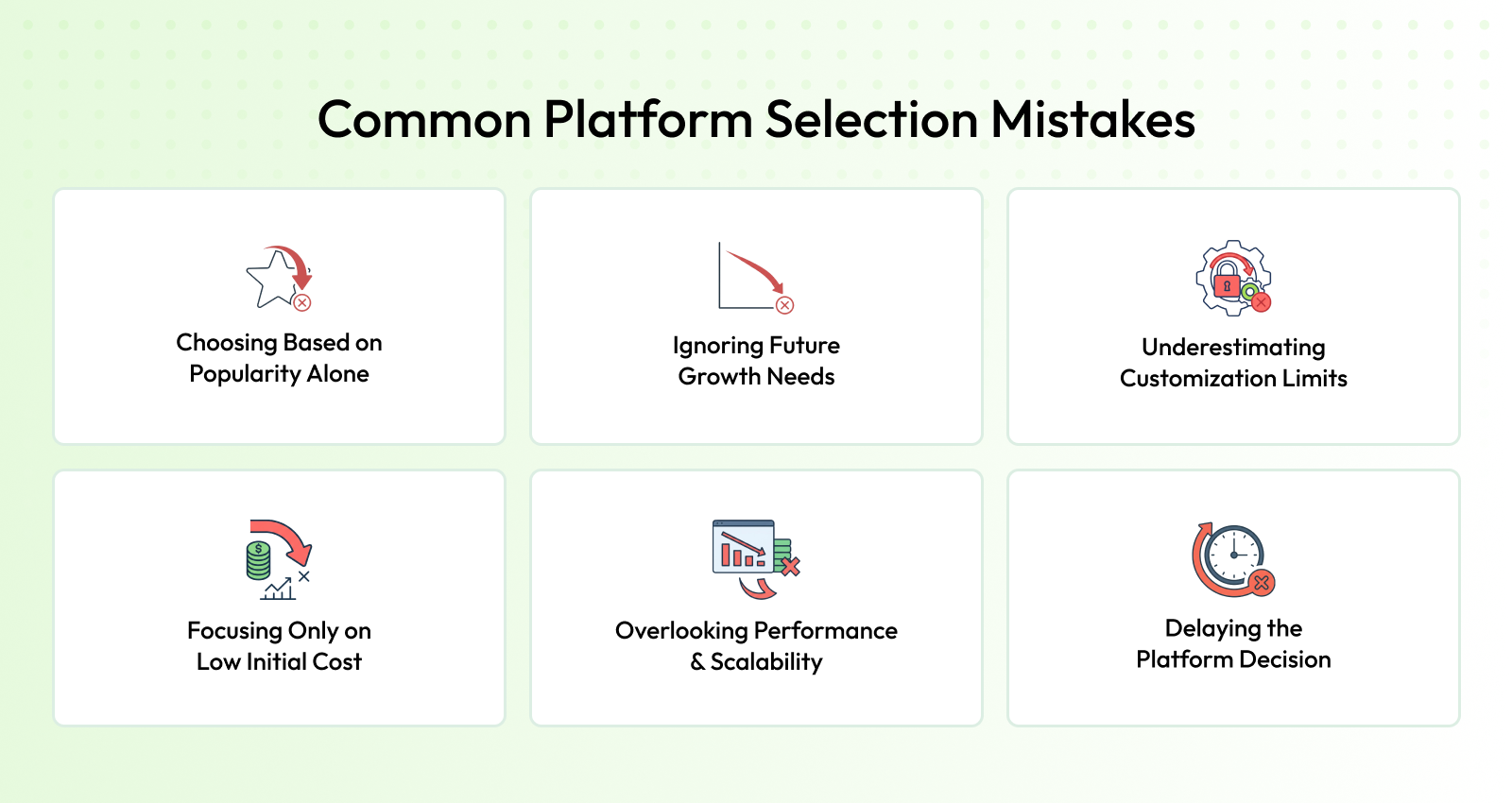
Even experienced businesses make avoidable mistakes during platform selection.
Choosing Based Only on Popularity
What works for another business may not work for yours.
Ignoring Future Growth
Platforms that cannot scale will slow down revenue and operations.
Underestimating Customization Needs
Lack of flexibility becomes a serious issue as products and marketing evolve.
Delaying Platform Decisions
Frequent platform changes damage SEO, operations, and customer experience.
Avoiding these mistakes saves time, money, and growth momentum.
Final Checklist Before Making a Decision
Before finalizing your platform choice, confirm that it:
- Supports your business model
- Handles your product complexity
- Scales with traffic and orders
- Enables conversion optimization
- Offers reliable support
- Aligns with long-term goals
If a platform meets these criteria, it is far more likely to support sustainable growth.
Final Verdict: What Makes the Best Ecommerce Platform in 2026
The best ecommerce platform in 2026 is not defined by the longest feature list or the lowest price.
It is defined by:
- Scalability without performance loss
- Flexibility without complexity
- Customization without heavy development
- Stability during growth phases
Businesses that choose platforms aligned with their future needs grow faster, operate smoother, and avoid expensive rebuilds.
FAQs
A scalable ecommerce platform should handle traffic spikes, growing product catalogs, and higher order volumes without slowing down. It should also support future features like new payment methods, channels, and integrations without requiring a rebuild.
Hosted platforms manage hosting, security, and updates for you, while custom ecommerce platforms offer full control but require ongoing development and maintenance. The right choice depends on your budget, technical resources, and customization needs.
In 2026, customer expectations for speed, mobile experience, and personalization are much higher. Choosing the wrong platform can limit performance, hurt conversions, and make scaling expensive as competition increases.
Instead of comparing only features, businesses should evaluate platforms based on scalability, customization flexibility, performance under load, checkout optimization, and long-term cost of ownership.
Yes. Businesses with configurable, personalized, or made-to-order products should choose a platform that supports advanced product options and workflows. Not all ecommerce platforms handle complex product structures efficiently.
While switching platforms is possible, it often involves high costs, SEO risks, and operational disruption. That’s why choosing the right platform early is important to avoid migrations as the business grows
An ecommerce platform impacts page speed, mobile usability, checkout flexibility, and overall user experience. These factors directly influence how easily customers complete purchases and how well the store converts traffic into sales.
Not necessarily. Lower-cost platforms may lack scalability, customization, or performance features. Over time, these limitations can increase costs through lost sales, add-ons, or forced platform changes.
Growing businesses should prioritize scalability, flexibility, reliable support, and the ability to optimize conversion journeys. A platform that supports long-term growth is more valuable than one focused only on quick setup.