
How to Choose the Right eCommerce Platform for Your Business 2026
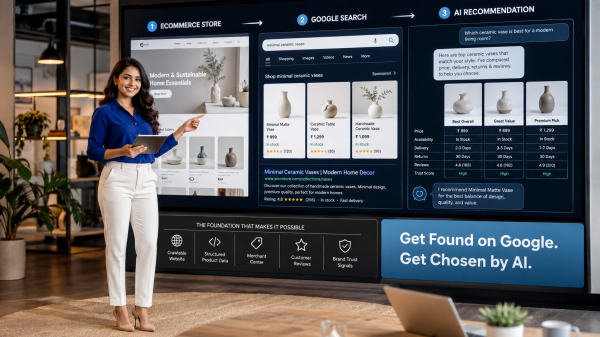
Choosing an ecommerce platform is no longer just about launching an online store; it’s about choosing the foundation on which a brand will grow over the next decade. The digital commerce landscape in 2026 is far more competitive, experience-driven, and omni-channel than when most businesses first stepped online. Consumer expectations are faster, technology cycles are shorter, and brands are now expected to operate with the sophistication of large retail systems from day one.
For businesses, the challenge is no longer whether they need an online presence—it is deciding which platform can support their scale, operations, and evolving business model without requiring frequent migrations or massive development cycles. A platform that works at 100 orders per month may collapse at 10,000. A store designed for single-location fulfillment may struggle when demand expands across regions. And a basic website builder may fail when the brand transitions toward subscriptions, wholesale, B2B selling, or global payments.
In this environment, choosing the right ecommerce platform becomes a strategic business investment, not a design decision. The right platform determines how efficiently operations run, how fast a brand adapts to change, how well customers convert—and ultimately how profitable the business becomes as it grows. Once you've picked a platform, follow our guide to set up an ecommerce store to get selling quickly.
Common Mistakes When Choosing an Ecommerce Platform
Most businesses evaluate ecommerce platforms based on surface-level requirements—theme design, pricing, and basic catalog features. These considerations matter, but they don’t address long-term sustainability.
The first major challenge is scalability. Platforms that work well at launch often struggle when product lines expand, order volumes rise, or fulfillment models evolve. Businesses end up rebuilding technology and migrating platforms, which results in lost time, broken SEO, disrupted customer experience, and increased cost.
Another common issue is fragmentation. Many brands rely on plugins and third-party tools for essential functions—shipping, marketing automation, CRM, loyalty, payments, analytics. As the stack grows, compatibility issues emerge, updates break workflows, and performance slows down. Scaling becomes operationally expensive instead of efficient.
Budget misalignment is another challenge. Cheap platforms often require high spending later on integrations, development, maintenance, and custom features, resulting in hidden costs that exceed what a unified platform would have cost initially.
Finally, some platforms are too rigid. They lock businesses into fixed workflows, limited APIs, or restricted customization, making future evolution difficult. Brands must choose platforms that support not just how they sell today, but how they plan to sell tomorrow.
What Customers Expect From an Online Store in 2026
The platform a business chooses directly influences customer experience. Consumers in 2026 are not patient—they expect seamless digital journeys across devices and channels.
Customers expect fast, frictionless checkout with multiple payment options, including UPI, cards, wallets, and increasingly, BNPL and subscription billing.
They expect real-time stock accuracy, clarity on product variants, fast search, and smooth filters—especially for large catalogs.
They also expect highly personalized experiences: tailored recommendations, saved preferences, seamless login, and contextual engagement. Platforms that don’t support customer data segmentation or automated communication cannot deliver retention.
Finally, delivery expectations are rising. Customers want region-wise speed, slot-based scheduling, and transparent tracking. Without inventory and logistics integration, brands cannot compete on delivery experience.
The platform a business chooses must therefore support end-to-end customer journeys—not just checkout pages.
Key Features to Look for in an Ecommerce Platform
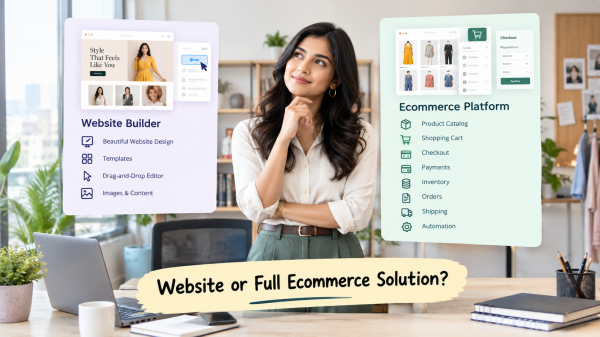
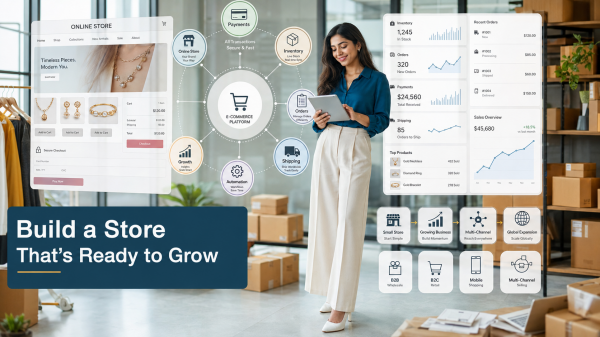
Instead of simply offering website-building capabilities, modern ecommerce platforms must help brands operate and scale like end-to-end commerce systems. This means providing unified tools for storefront, inventory, logistics, payments, CRM, and analytics—without requiring custom development or multiple software vendors.
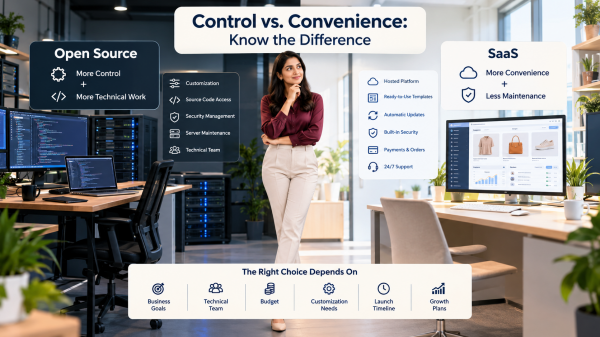
For WordPress-based ecommerce businesses that want centralized control over site operations, performance, and scalability, tools like WP Managify can play a crucial role by simplifying ongoing management as order volumes and technical complexity grow.
Platforms like Shopaccino follow this integrated approach. Rather than offering standalone storefront tools, they combine essential ecommerce operations into one system so businesses can scale without rebuilding infrastructure.
| Factor | What to Check | Why It Matters |
|---|---|---|
| Scalability | Handles traffic & catalog growth | Avoids costly replatforming later |
| Integrations | Payments, shipping, marketing tools | Smooth operations |
| Total cost | Setup + transaction + add-on fees | Protects margins |
| Ease of use | No-code store management | Faster launch |
| Ownership & control | Own your data & storefront | Long-term brand asset |
| Support | 24/7 help & onboarding | Less downtime |
A future-ready platform should include:
Unified Inventory & Order Management
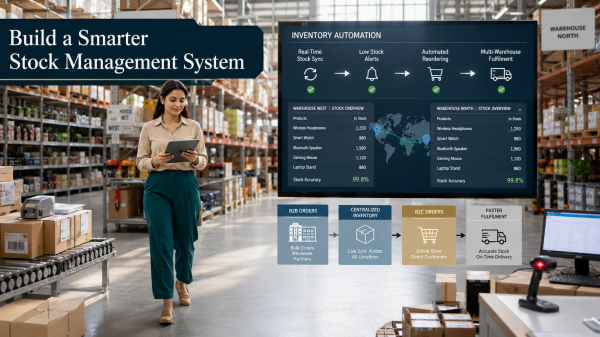
Real-time stock across warehouses, stores, and channels reduces manual coordination and improves delivery accuracy.
Integrated Marketing & Engagement Tools
Segmentation, automation, retention workflows, and reports help brands convert existing customers, not just new traffic.
Flexible Catalog & Pricing Structure
Support for variants, bundles, dynamic pricing, bulk models, and different product categories ensures businesses don’t outgrow the system.
Multi-Channel Selling Support
The platform should allow expansion into apps, offline POS, marketplaces, and B2B portals without separate setups.
Built-In Logistics Ecosystem
Courier integrations, shipping rules, and dispatch workflows streamline fulfillment.This integrated approach reduces technical cost and operational friction while enabling long-term growth.
How to Evaluate and Choose the Right Platform: Step-by-Step
Selecting a platform should follow a structured evaluation rather than preference or pricing alone.
Start with Business Model Mapping
Define whether your business is:
- D2C retail
- Manufacturer turning digital
- Subscription-based
- Marketplace model
- Regional + warehouse-based
- Hybrid offline + online
This determines required platform capabilities.
Evaluate Platform Architecture, Not Just Themes
Businesses should assess:
- Database scalability
- Inventory workflows
- API flexibility
- Support for multiple fulfillment models
This prevents platform limitations later.
Check Operational Fit
Ask whether the platform manages:
- Catalog uploads efficiently
- Multiple shipping partners
- Multi-location stock
- Channel expansion
- Customer segmentation
Operational flexibility is more important than UI aesthetics.
4. Validate Ownership and Control
Brands should own:
- Customer data
- Marketing channels
- Store branding
- Product visibility
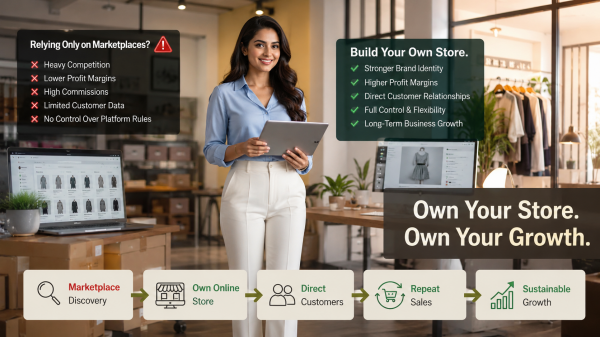
Platforms like Shopaccino support business-owned growth rather than dependency on marketplaces.
Plan Total Cost Over 5 Years
Instead of comparing subscription fees, calculate:
- Integrations
- Development
- Maintenance
- Migrations
- Transaction tools
- Marketing tech
An all-in-one system often costs less over time.
How to Choose a B2B Ecommerce Platform
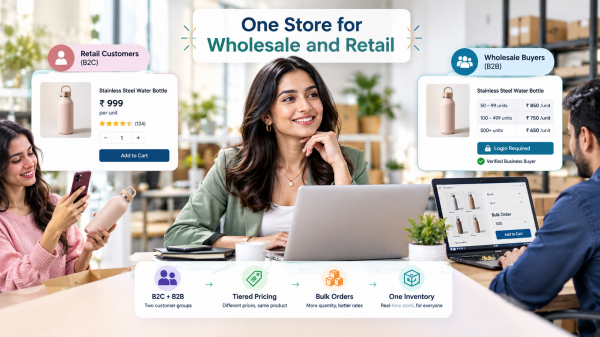
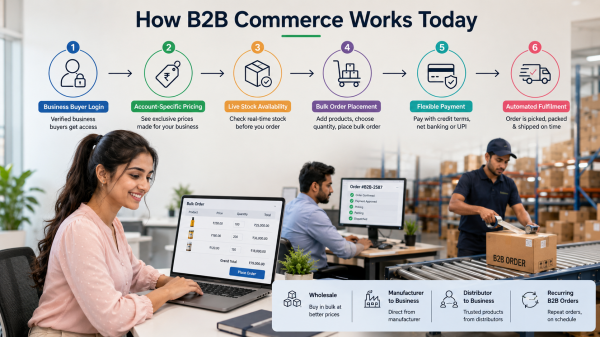
Choosing a B2B ecommerce platform involves a few extra considerations beyond a standard online store. B2B buyers expect features like customer-specific pricing, bulk and wholesale ordering, minimum order quantities, quote requests, credit terms, and GST-compliant invoicing. When evaluating a platform for B2B, check whether it supports tiered price lists for different customer groups, gated catalogs where only approved buyers can see products and prices, and easy reordering for repeat wholesale customers.
You should also confirm the platform can handle larger catalogs, integrate with your ERP or accounting system, and manage both B2B and B2C selling from a single dashboard if you sell to both. Prioritising these B2B-specific capabilities from the start ensures the platform can support complex wholesale workflows as your business grows.
Benefits of Choosing the Right Ecommerce Platform
Choosing the right platform is a long-term investment that shapes profitability.
Lower Migration Costs
Avoid rebuilding systems when demand scales.
Higher Customer Lifetime Value
Better engagement tools improve retention.
Better Delivery & Fulfillment Accuracy
Integrated workflows reduce errors and delays.
Data-Driven Decision Making
Analytics guide product and marketing strategy.
Faster Time-to-Market for New Models
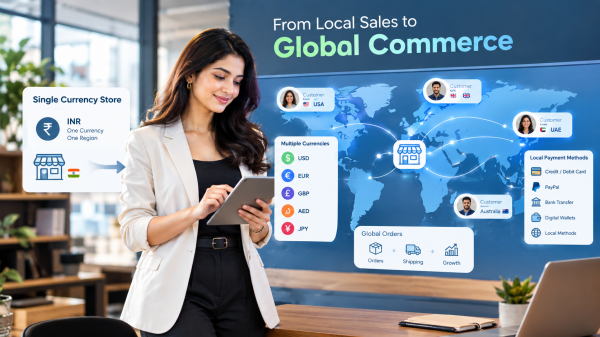
Subscriptions, apps, multi-warehouse, or global selling can be enabled without technical rebuilds.
Conclusion
By 2026, ecommerce success will not depend on who launches first—it will depend on who scales efficiently. The platform a business chooses determines its ability to adapt to customer expectations, deliver fast experiences, and manage operations without unnecessary complexity.
Businesses should not select platforms based solely on cost or design features. They should evaluate long-term scalability, operational integration, ownership, and flexibility to expand across warehouses, channels, and product categories. Solutions like Shopaccino help brands build mature ecommerce operations from day one, offering a unified system that grows with the business instead of limiting it.
A well-chosen platform is not just software—it is the backbone of digital commerce. Make the choice strategically, and growth becomes a planned outcome, not a challenge.
FAQs
Evaluate scalability, integrations, fulfillment workflows, and ownership over data—not just pricing.
Yes, choosing scale-ready platforms reduces future migration costs.
No. Marketplaces help with reach, but owning your storefront protects profit and customer relationships.
Choose platforms that support integrated stock and order routing.
Both matter, but backend operations determine long-term success.
Yes, but migrations can be costly and disrupt SEO and performance—better to choose long-term platforms initially.
Platforms like Shopaccino reduce dependency on custom development through built-in tools.