How Wholesalers Can Reduce Order Errors With a Self-Serve B2B Portal
In the wholesale industry, accuracy is everything. A single mistake—wrong quantity, missing item, incorrect variant, delayed confirmation—can disrupt an entire supply chain. When buyers depend on large quantities for resale, manufacturing, or distribution, even a minor order error becomes costly. It affects trust, delays production, and creates friction that weakens long-term business relationships.
As the B2B landscape becomes more digital, wholesalers are realizing that traditional order-taking methods—WhatsApp messages, handwritten notes, phone calls, and manual spreadsheets—are no longer reliable. They leave too much room for miscommunication and miscalculations. A self-serve B2B portal, however, removes these risks by letting buyers place orders directly, accurately, and systematically without depending on sales reps or backend teams.
This blog explains why wholesalers face frequent order errors, how buyer expectations have evolved, and how an integrated B2B ecommerce platform like Shopaccino helps eliminate these challenges with automation and real-time workflows.
Challenging Area: Why Wholesalers Struggle With Order Errors
For many wholesalers, order handling is not the problem—order accuracy is.
As businesses scale, the cracks in manual order processing become more visible.
Orders Come From Too Many Channels
Buyers send their requirements through multiple touchpoints—calls, emails, WhatsApp chats, and sometimes even PDF sheets. With scattered communication:
- Orders get missed
- Multiple versions of the same order are created
- Staff enter details manually, increasing chances of mistakes
This fragmented workflow becomes unmanageable as volumes increase.
Manual Entry Leads to Human Errors
Whether it’s typing quantities, variants, or item codes, manual entry always carries risk. Wholesale orders often involve large quantities and multiple SKUs—perfect conditions for mistakes.
No Real-time Stock Visibility
Many wholesalers still confirm orders without knowing exact stock availability. This results in:
- Partial shipments
- Rejected items
- Last-minute shortages
- Customer frustration
Without real-time inventory sync, order errors are unavoidable.
Sales Teams Face Overload
As the buyer base grows, sales teams struggle to keep up with order intake. Instead of focusing on relationship building and large deals, they remain busy copying details, editing spreadsheets, and clarifying order mistakes.
Price Lists Are Not Standardized
Buyers often get different pricing or outdated rate sheets. Even small discrepancies cause re-negotiations and delays.
High Dependency on Follow-Ups
Since orders aren’t placed through a structured portal:
- Buyers keep asking for confirmation
- Teams manually verify every line item
- Changes are made repeatedly
This results in unnecessary communication loops.
These challenges point to one root issue—the system relies too heavily on humans, not technology.
Their Customer Challenging Area: What Modern B2B Buyers Expect
Wholesale buyers today behave very differently from ten years ago. They want speed, clarity, and autonomy—similar to how they shop online personally.
24×7 Order Placement
Buyers don’t want to wait for sales teams to respond. They want a portal where they can log in and place orders anytime.
Correct and Real-Time Stock View
They expect clarity on:
- What is available
- What is out of stock
- What is coming soon
Anything less leads to disappointment.
Transparent Pricing
No buyer wants to negotiate every time they place an order. They want agreed-upon pricing visible automatically inside their account.
Zero Confusion
Product images, variants, and quantity options should be clear to avoid miscommunication.
Faster Confirmations
Buyers want instant order confirmations—not long, back-and-forth messaging.
These expectations cannot be met through traditional offline workflows.
Solution: How a Self-Serve B2B Portal Eliminates Order Errors
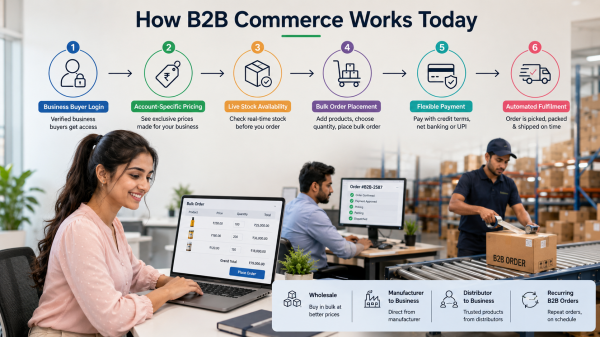
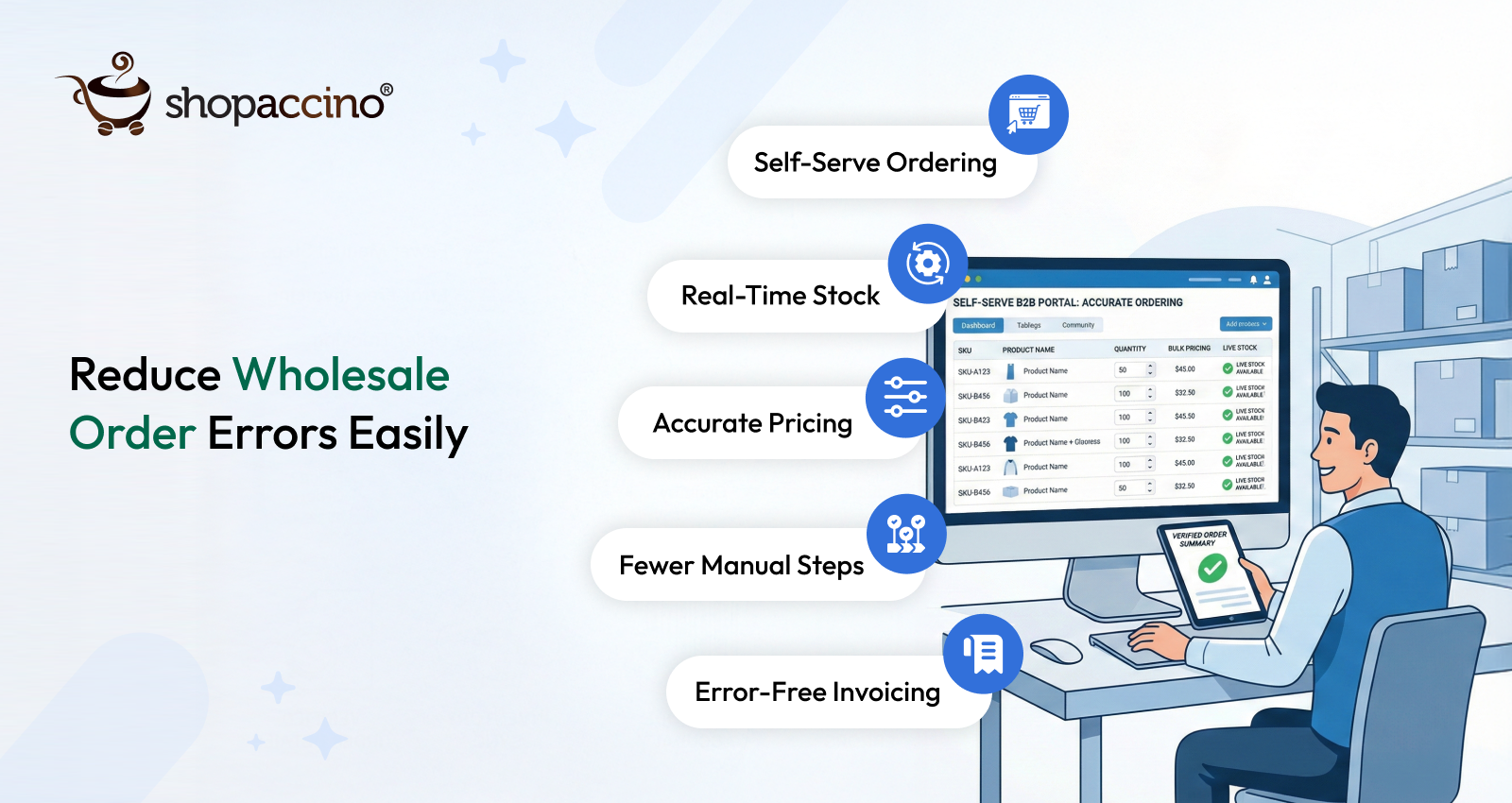
A self-serve B2B portal solves the root problems wholesale businesses face by giving buyers a structured digital environment to order in. And when powered by an integrated platform like Shopaccino, the entire process becomes automated, predictable, and error-free.
Buyers Place Orders Directly, Not Through Sales Reps
This removes manual data entry entirely. Buyers can log in, see products, select variants, view their assigned pricing, and place orders digitally.
Real-Time Stock Visibility Prevents Wrong Orders
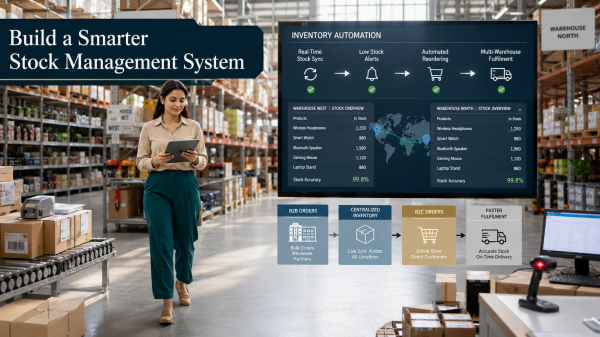
A self-serve system syncs inventory instantly:
- If stock reduces, customers see it
- If a product is unavailable, it shows clearly
- No more accidental overselling
Custom Pricing Rules Are Applied Automatically
Different buyers can have different:
- Price lists
- Order-level discounts
- Minimum order quantities
- Tax structures
Shopaccino automatically applies these rules whenever the buyer logs in.
Clear Product Catalog Reduces Confusion
With product images, descriptions, and variants shown clearly, buyers understand exactly what they are ordering—reducing mistakes.
Automated Confirmation and Workflow Updates
The system handles:
- Order acknowledgment
- Status updates
- Payment requests
- Dispatch stage notifications
No follow-ups required.
Repeat Orders Become Effortless
Buyers can reorder from:
- Past orders
- Frequently purchased items
- Saved lists
This reduces time and improves order accuracy.
This shift from manual processing to buyer-driven ordering brings accuracy, speed, and structure.
How to Implement a Self-Serve B2B Portal (Step-by-Step Guide)
Below is a simple, beginner-friendly implementation process that any wholesaler can follow.
Step 1: Digitize Your Catalog
Upload all product details into your platform:
- Product names
- Images
- Variants
- Units
- Minimum order quantities
When buyers see clear information, they make accurate decisions.
Step 2: Create Buyer-Specific Pricing Rules
Wholesalers often have tiered pricing. A good B2B portal allows assigning:
- Custom price lists
- Bulk discounts
- Region-wise pricing
- Tax configurations
Once configured, pricing is shown automatically every time the buyer logs in.
Step 3: Give Each Buyer a Dedicated Login
Buyers should access:
- Their catalog
- Their pricing
- Their past orders
- Their credit limits (if applicable)
This personalizes the experience and eliminates confusion.
Step 4: Sync Inventory in Real Time
Ensure your system automatically updates stock whenever:
- An order is placed
- A return is approved
- Inventory arrives in the warehouse
This reduces stock errors drastically.
Step 5: Automate Order Confirmation
Instead of manual approvals:
- The system sends instant confirmation
- Buyers get automated emails or portal notifications
- Admins see the order in their dashboard immediately
This increases efficiency for both sides.
Step 6: Integrate Shipping and Dispatch
With integrated workflows like Shopaccino offers:
- Waybills are generated automatically
- Tracking information updates instantly
- Buyers can check dispatch status without calling
This creates transparency and reliability.
Step 7: Track Order Patterns Using Analytics
Analytics help identify:
- Fast-moving items
- Seasonal purchasing trends
- Buyer-level behaviour
- Product-level accuracy issues
This helps wholesalers plan better and deliver consistently.
Benefits of Using a Self-Serve B2B Ordering Portal
Zero Order Errors
Since buyers place orders themselves, the risk of miscommunication disappears.
Faster Order Processing
Orders enter the system instantly and move straight to fulfillment.
Increased Buyer Satisfaction
Clear visibility, real-time updates, and predictable workflows make the purchase journey smooth.
Reduced Workload for Sales Teams
Instead of copying order details, sales teams can focus on business growth and wholesale partnerships.
Better Inventory and Pricing Control
Everything is updated centrally, making operations more organized.
Higher Retention and Repeat Orders
A convenient, accurate ordering experience keeps buyers loyal.
Scalable B2B Operations
Whether you serve 50 buyers or 5,000, the workflow remains consistent.
Conclusion
Order errors are not just operational problems—they are relationship problems. In wholesale, where trust and long-term partnerships matter, accuracy is the foundation of success. A self-serve B2B portal removes human dependency, reduces friction, and gives buyers the clarity and control they need.
By adopting a digital portal through platforms like Shopaccino, wholesalers gain automation, real-time accuracy, structured ordering, and smoother buyer interactions. As the B2B world shifts toward digital-first operations, the wholesalers who simplify ordering will be the ones who scale fastest.
FAQs
It eliminates manual entry, offers real-time stock visibility, and lets buyers place orders directly—reducing miscommunication.
Yes. A self-serve portal allows individual pricing rules, discounts, and tax structures.
Absolutely. Buyers can repeat previous orders, reorder frequently purchased items, or upload bulk requirements.
Yes. Since orders come directly from buyers, sales teams can focus on negotiations and expansion instead of data entry.
With an integrated system, waybills, tracking information, and order updates are automated.
Yes. Even with a small buyer base, it helps eliminate errors and saves significant time.
Platforms like Shopaccino support multiple warehouse structures with real-time syncing.