
Shipping Internationally? Here’s How to Handle Duties and Returns
Expanding into international markets is one of the most powerful ways for online stores to scale—yet it’s also one of the most misunderstood. Many MSMEs launch cross-border sales only to find themselves overwhelmed by duties, taxes, unexpected surcharges and, more importantly, the complicated process of managing international returns.
Global buyers expect transparency, predictable delivery timelines and a return experience that feels as smooth as buying locally. For digital-first businesses, that means building strong operational foundations before activating global traffic.
Whether you’re a growing D2C brand, an exporter shipping globally, or a manufacturer exploring cross-border opportunities, understanding how duties and returns truly work can help you save money, avoid compliance issues and deliver a world-class customer experience. If you are still planning your launch, start with how to set up international selling end to end.
The Growing Complexity of International Shipping
Selling internationally isn’t as simple as printing a label and sending a parcel overseas. Every country has its own import duties, de minimis thresholds, tax laws and customs protocols. Something as small as incorrect documentation can cause your shipment to be held, delayed or returned to origin—at the merchant’s cost.
Businesses also underestimate how much complexity grows once volumes increase. What starts as a handful of orders can quickly turn into dozens of daily shipments, each requiring clarity on product value, HS codes, tariffs and carrier-based regulatory rules.
International logistics becomes even more challenging when return requests are involved. Unlike domestic returns where a courier simply picks up the parcel, cross-border returns must pass through customs, re-enter your warehouse system and be assessed for refurbish, resell or discard.
For many online sellers, this is where the real friction begins.
What Today’s Global Customers Expect
Modern buyers—especially international ones—want reassurance before they commit to a purchase. Their expectations have evolved significantly:
Full Transparency on Duties & Taxes
Customers want to know:
- Whether duties are included or excluded
- What the estimated amount will be
- Who will pay at the time of delivery
Hidden charges at the doorstep remain one of the biggest reasons for cart abandonment.
Clear Return Policies
Buyers expect:
- Refund timelines
- Whether return shipping is paid or chargeable
- Instructions for packaging and documentation
A vague or complicated return policy almost guarantees lost sales.
Multi-currency Pricing
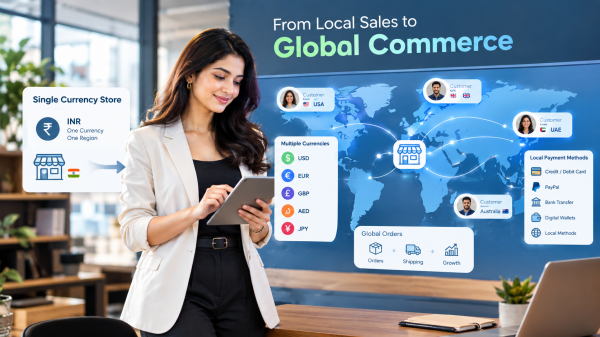
A customer in France does not want to convert INR to EUR. They want prices shown in their currency, with accurate and live conversion.
Delivery Estimates Based on Country
International customers compare you with global brands. If your delivery promise is not clear, they simply won’t buy.
Hassle-free Return Workflow
For buyers, returns should feel:
- Predictable
- Trackable
- Fast
- Transparent
This is where platforms like Shopaccino help with structured Return Management, Return Waybill, and Global Commerce tools that simplify the process for both merchants and customers.
The Real Solution: Integrated Global Commerce Infrastructure
Managing duties and international returns manually becomes unmanageable as you scale. What online sellers truly need is an integrated ecosystem that manages:
- Country-based pricing
- Multi-currency checkout
- Shipping rules based on destination
- Return waybills
- Automated notifications
- Documentation-ready shipping labels
- Warehouse-level workflows
This shift—from manual oversight to system-driven operations—is what makes cross-border commerce scalable, predictable and cost-efficient.
Shopaccino supports this through structured tools like Global Commerce, country-based shipping charges, multi-currency checkout, and automated return workflows, helping MSMEs manage international operations without complex third-party dependencies.
How to Implement Duties & Return Management: A Practical Roadmap
This is where most stores get stuck, not because the process is overly complicated, but because it requires accuracy and consistency. Here is a clear step-by-step approach.
Step 1: Understand Duty Models (DDP vs. DDU)
International shipments generally use two models:
DDP (Delivered Duty Paid)
You collect duties at checkout and pay them on behalf of the buyer.
This improves conversion because the customer has no surprise charges.
DDU / DAP (Delivered Duty Unpaid / Delivered At Place)
The buyer pays duties at delivery.
Lower merchant cost, but often leads to high return rates.
Choose based on:
- Product category
- Destination country
- Customer sensitivity
- Margins
Step 2: Map Accurate HS Codes
The Harmonized System (HS) assigns each product a global classification code that determines applicable duties.
Incorrect HS codes can lead to penalties or shipment holds.
Step 3: Configure Multi-Currency Checkout
Customers should see:
- Prices in their local currency
- Accurate conversion
- No manual calculations
Shopaccino’s multi-currency checkout helps ensure accuracy and boosts international conversion rates, one of the highest-impact keywords for global commerce.
Step 4: Set Country-Based Shipping Rules
This is essential when:
- Some countries have strict import restrictions
- Shipping costs differ drastically
- Products cannot be delivered everywhere
With Shopaccino, you can set:
- Country-wise delivery availability
- Country-wise shipping charges
- Country-wise estimated delivery days
This clarity dramatically reduces complaints and refunds.
Step 5: Prepare Documents Automatically
Documentation should include:
- Commercial invoice
- Tax ID / EORI where required
- HS codes
- Value declaration
- Return instructions
Using system-generated waybills and labels prevents errors.
Shopaccino’s shipping waybill generation helps reduce manual work and avoid customs rejection.
Step 6: Build a Clear Cross-Border Return Policy
Your policy must address:
- Who pays the return shipping
- Which countries are eligible for returns
- Estimated refund processing timelines
- Condition requirements
For complex markets, many stores allow:
- Return-to-warehouse
- Return-to-consolidator
- Return-on-refund-only for high-value items
If your tool supports Return Management and Return Waybill, you can automate requests, generate documents and keep customers informed.
Step 7: Automate Customer Notifications
Cross-border logistics require more updates than domestic shipments.
Automate notifications for:
- Order confirmation
- Shipment dispatch
- Customs clearance
- Delivery
- Return received
- Refund processed
This dramatically reduces customer service tickets and builds trust.
Benefits of a Structured Duties & Returns System
Once your system is in place, the advantages become immediately visible.
Higher Conversion Rates
When duties, shipping charges and return policies are transparent, customers are more confident buying from a foreign brand.
Clear visibility influences their final purchase decision.
Predictable Shipping Costs
Instead of absorbing unexpected carrier surcharges, you can forecast your logistics expenses accurately.
Reduced Return Losses
By automating return workflows, you:
- Reduce manual errors
- Shorten processing time
- Get products back in circulation faster
Fewer Customer Complaints
Most complaints come from:
- Unknown duties
- Delivery delays
- Confusing return process
- Unexpected costs
A structured system eliminates these issues entirely.
Scalability for Global Expansion
Whether selling to 5 countries or 50, your process remains consistent.
Tools like Shopaccino’s Global Commerce and return automation help MSMEs expand without operational chaos.
Conclusion
International ecommerce is not difficult—it’s just procedural. The businesses that succeed globally aren’t the ones that ship the most; they’re the ones that manage documentation, duties and returns with discipline and clarity.
With the right operational foundation and the right ecommerce tools, even a small MSME can deliver a customer experience that rivals global brands. Duties, taxes and returns become manageable, predictable and scalable—not roadblocks.
Once your international workflow is automated, cross-border growth becomes one of the most profitable and exciting phases of your ecommerce journey.
FAQs
The most common challenge is the lack of transparency around duties, taxes and return charges. When customers face unexpected fees, they refuse delivery or request refunds.
This depends on your strategy. DDP improves conversions, while DDU lowers merchant cost. Your margins and destination country will influence the decision.
Platforms like Shopaccino enable Return Management, Return Waybill and automated notifications to simplify cross-border returns.
Because parcels must pass through customs again, require documentation, and sometimes incur reverse duties depending on the country’s regulations.
Show:
- Transparent duties
- Country-based shipping
- Estimated delivery timeline
- Clear return policy
This builds trust and reduces hesitation.
Yes. With tools like multi-currency checkout, automated shipping rules and return processing, MSMEs can scale internationally without needing a large operations team.
No. Some brands sell as final sale for specific countries. However, offering returns increases trust and conversion rates.