WhatsApp vs B2B Portal: Which Is Better for Wholesale Order Management in 2026?
Wholesale order management has changed more in the past few years. What once relied on
long phone calls, handwritten notes, and informal coordination has now shifted to digital channels. In this shift, WhatsApp emerged as the simplest tool. Distributors, wholesalers, retailers, sales representatives, and even manufacturers began using it as a convenient bridge for sharing order lists, sending product photos, and confirming quantities. The speed and familiarity of WhatsApp made it feel like the perfect solution.
But as we move into 2026, the wholesale ecosystem is no longer the same. Order volumes are larger, product assortments are broader, customer segments are more demanding, and businesses have expanded across regions. With growth comes complexity—and complexity needs structure. This is where a B2B ecommerce portal brings a more organised, scalable, and error-free framework for managing wholesale operations.
Both tools—WhatsApp and a B2B Portal—play important roles. But which one truly supports long-term efficiency, accuracy, and customer experience?
This blog dives into the comparison in a clear, descriptive way to help wholesale-first businesses, including Established D2C Brands, Exporters, Manufacturers, Wholesalers, and Distributors, decide the right direction for 2026.
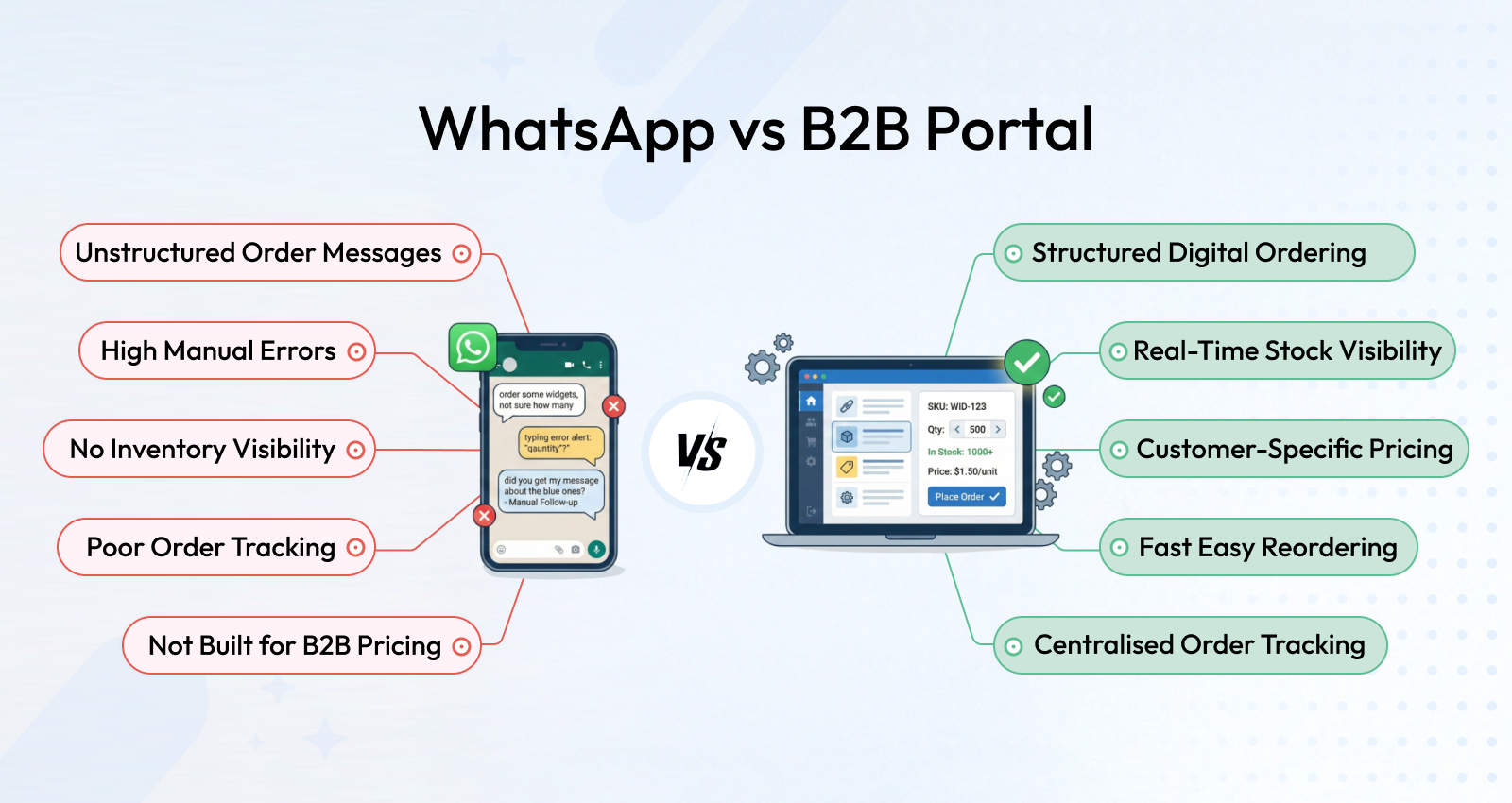
Challenging Area: Business Challenges When Using WhatsApp for Wholesale Orders
WhatsApp made communication effortless. But when used for wholesale order management, the experience begins to crack as business scales.
Many MSMEs initially feel WhatsApp is enough, but as product lines grow and customer bases expand, the real challenges surface.
Unstructured Order Flow
Orders come as:
- Screenshots
- Text messages
- Voice notes
- Excel files
The format is different every time, so teams spend hours decoding information, rechecking messages, and entering data manually.
High Risk of Human Errors
Because data is retyped manually, mistakes become common:
- Incorrect variants
- Wrong quantities
- Pricing mismatches
- Missed line items
These errors directly affect fulfilment accuracy.
Difficult to Track Order History
WhatsApp threads become long and cluttered.
Even basic tasks like finding a previous order, checking a dispute, or identifying a pricing conversation require scrolling through hundreds of messages.
Multiple Team Members Cannot Access the Same Data
Only the person carrying the phone sees the conversation.
If they are unavailable or leave the company, the order flow breaks.
No Real-Time Inventory Visibility
WhatsApp cannot show:
- Available stock
- Warehouse-wise inventory
- Product variants
- Out-of-stock items
So customers place orders blindly, which leads to incomplete or delayed fulfilment.
Not Built for Complex B2B Pricing
Customer-wise pricing, bulk discounts, case-pack rates, and region-specific rules are nearly impossible to manage manually on WhatsApp.
Their Customer Challenging Area: What Wholesale Buyers Expect in 2026
B2B buyers’ expectations now mirror those of modern ecommerce users.
Retailers, distributors, and corporate clients expect digital clarity, not manual guesswork.
They Expect Speed Without Dependence
Buyers want to place orders at any time—night, weekend, or peak season—without waiting for a sales representative to respond.
They Want Real-Time Accuracy
Customers want clarity on:
- Stock availability
- Pricing
- Schemes
- Order status
WhatsApp can’t provide these instantly.
They Want Transparency in Every Step
A clear record of orders, invoices, dispatches, and deliveries is essential for planning.
They Hate Repeating Orders
If a buyer orders the same product every week, they expect a “repeat order” option—not typing product names again.
They Want Zero Mistakes
A wrong product or missing item disrupts their sales cycle and affects their own customers.
The gap between WhatsApp’s simplicity and the professional expectations of B2B buyers becomes more visible as operations scale.
Solution: Why a B2B Portal Is Better for Wholesale Order Management in 2026
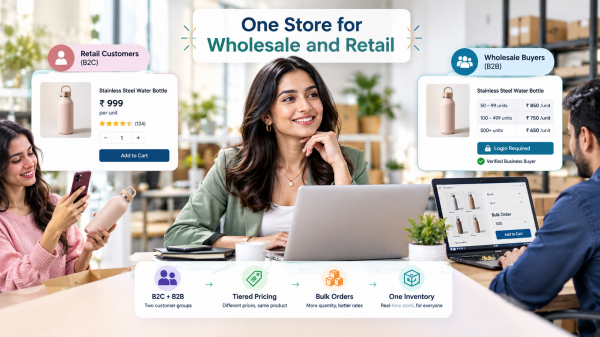
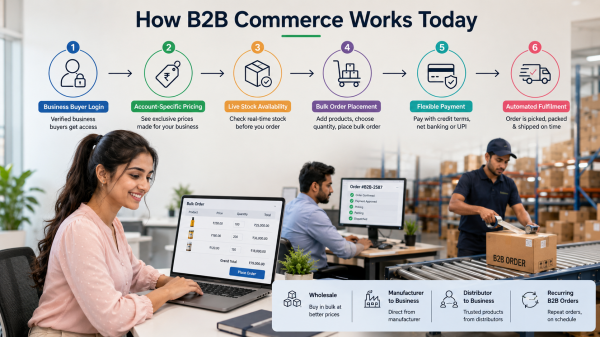
A B2B ecommerce portal is designed specifically for wholesale processes. While WhatsApp is a communication tool, a B2B Portal is an ordering ecosystem that gives structure, accuracy, visibility, and control.
Platforms like Shopaccino allow wholesalers and distributors to overcome operational challenges by providing a centralised, always-available ordering system.
Structured Digital Order Placement
Buyers select products directly from the catalog—not from memory or text.
This ensures:
- Correct variants
- Correct quantities
- Correct pack sizes
- Zero confusion
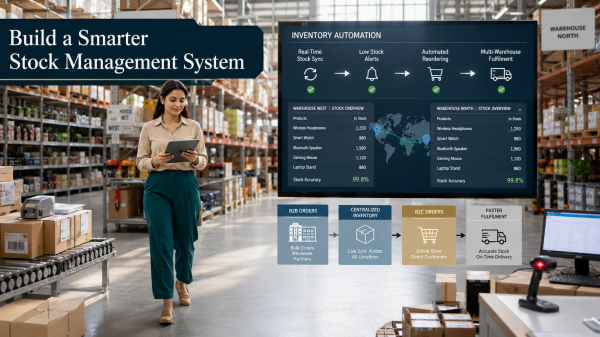
Real-Time Inventory Management
The portal shows:
- Stock in each warehouse
- Low-stock alerts
- Out-of-stock updates
- Variant-wise availability
This prevents incomplete dispatches.
Customer-Specific Pricing Automation
The portal automatically applies:
- Segment-wise pricing
- Bulk discounts
- Special wholesale rates
- Region-based rules
No more manual negotiation or confusion.
Fast Reordering Options
Customers can:
- Repeat previous orders
- Save frequent orders
- Create wishlists
- Access personalised catalogues
This reduces ordering time drastically.
Centralised Order History
Every order, invoice, and status update stays in one place—easy to search, easy to verify.
Multi-Warehouse Routing
The system automatically routes the order to the warehouse closest to the buyer.
This cuts delivery time and reduces logistics costs.
Reliable Communication and Tracking
Buyers receive automated updates for:
- Order confirmation
- Dispatch
- Delivery status
No follow-ups, no confusion.
How to Implement a B2B Portal: Step-by-Step in Simple Language
Many wholesalers believe shifting from WhatsApp to a portal is difficult, but the process is actually simple when done in a structured way.
Step 1: Digitise Your Product Catalogue
Prepare your catalog with:
- Product names
- Images
- Variants
- Price lists
- Minimum order quantities
A clean catalog helps buyers order easily.
Step 2: Set Customer Groups and Pricing
Create groups such as:
- Retailers
- Wholesalers
- Distributors
- Bulk buyers
Then set customised pricing for each segment.
Step 3: Add Warehouse-Wise Inventory
Upload stock quantities for every warehouse so the portal can show real-time availability.
Step 4: Invite Your Buyers
Send secure login access to all your customers.
They can now:
- Browse
- Add products to cart
- Place orders independently
Step 5: Train Internal Teams
Teach your staff how to:
- Process orders
- Check inventory
- Handle dispatch
- Manage returns
This ensures smooth operations.
Step 6: Enable Automated Notifications
Set alerts for:
- Order updates
- Payment reminders
- Dispatch notifications
This reduces manual communication.
Step 7: Use Analytics to Improve Efficiency
Track:
- Bestselling products
- Regular customers
- Seasonal demand
- Stock movement
This helps plan better for the future.
Benefits: Why B2B Portals Outperform WhatsApp for Wholesale Orders
A B2B Portal brings long-term efficiency, while WhatsApp provides only temporary convenience.
Accurate, Error-Free Orders
Buyers choose from a digital catalog, eliminating confusion.
Faster Order Processing
No more screenshot decoding or voice-note interpretation.
Real-Time Inventory Visibility
Buyers know exactly what is available before placing an order.
Customer-Specific Pricing Automation
Every customer sees the correct rate automatically.
Reduced Manual Workload
Teams spend less time on coordination and more time on fulfilment.
Higher Buyer Satisfaction
Customers enjoy clarity, speed, and transparency.
Scalable for Multi-Warehouse and Multi-Region Networks
Perfect for fast-growing B2B brands.
Better Data and Decision-Making
The portal tracks orders, returns, product performance, and customer behaviour.
Conclusion
WhatsApp is excellent for quick communication, but it is not built for the depth and structure wholesale order management requires. As we move into 2026, B2B buyers expect professional clarity, real-time visibility, accurate pricing, and a frictionless ordering experience. A B2B ecommerce portal fulfils all these expectations by creating a structured, self-serve environment where buyers can order efficiently without depending on a sales representative.Tools like Shopaccino help MSME wholesalers, manufacturers, and distributors make this transition smoothly—giving them a complete system that supports growth, reduces errors, and strengthens customer relationships. The brands that shift to a B2B Portal in 2026 will operate faster, deliver more accurately, and build stronger trust with their wholesale partners.
FAQs
Yes, WhatsApp is great for communication, quick queries, and relationship building. But it is not a complete solution for structured wholesale order management.
A B2B portal gives real-time inventory, structured order placement, pricing automation, and order history, while WhatsApp relies on manual messaging and data entry.
Most buyers adapt quickly because it saves time and provides clarity. Repeat orders, inventory visibility, and accurate pricing make adoption smooth.
Absolutely. Even small wholesalers benefit because it eliminates manual errors and helps them manage more customers with the same team.
Yes, it can route orders automatically to the nearest warehouse and show warehouse-specific inventory to buyers.
Yes, because messages are unstructured, data is typed manually, and there is no real-time visibility—leading to frequent mistakes.