Why Online Grocery Orders Get Cancelled and How to Fix It
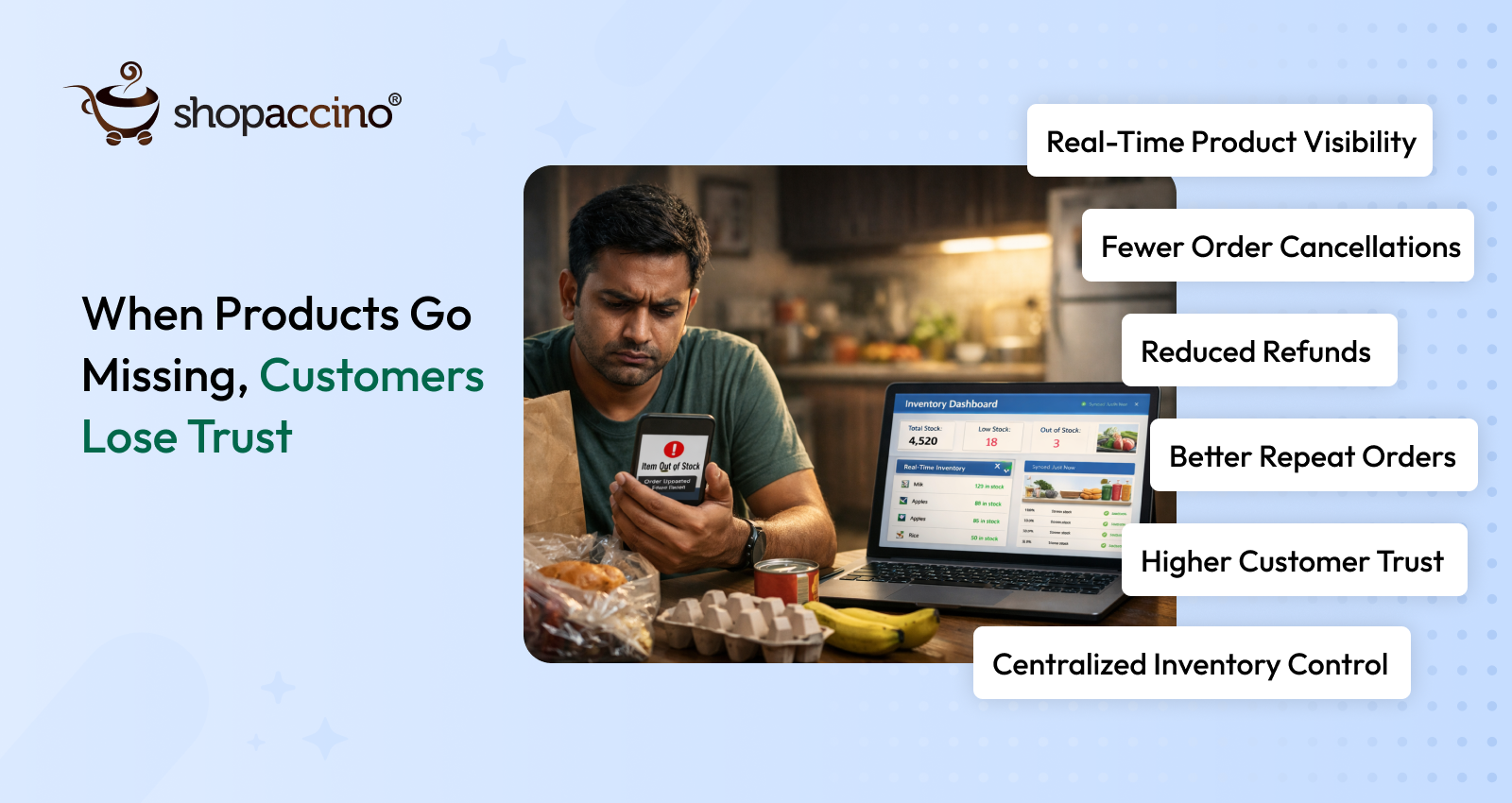
For grocery businesses moving online, nothing damages customer trust faster than a simple message: “This item is unavailable.”
It usually arrives after the order is placed, sometimes after payment, and often at the last possible moment—when the customer is already planning meals around that delivery.
In physical grocery stores, customers adjust instantly when a shelf is empty. Online, the expectation is very different. Customers believe what they see on the screen is real, current, and reliable. When an online grocery store repeatedly shows products that cannot be fulfilled, the problem goes deeper than stock—it becomes a credibility issue.
Many grocery businesses struggle with consistent product availability online not because demand is unpredictable, but because their systems are disconnected. Offline stock, warehouse reality, supplier timing, and online listings rarely speak to each other in real time. The result is cancelled items, partial orders, refunds, and frustrated customers who quietly stop returning.
This blog explains why grocery stores face this challenge so often, what customers actually expect when they shop online, and how a centralized, availability-aware ecommerce system helps stores display accurate products, reduce last-minute changes, and rebuild trust.
Why Grocery Businesses Face Availability Gaps Online
Maintaining accurate product availability in grocery ecommerce is uniquely difficult. Unlike durable goods, groceries move fast, expire fast, and change daily.
Offline and Online Stock Are Often Disconnected
Many grocery stores still manage stock manually at the store level. When orders start coming in online, the same inventory is used, but without real-time synchronization. The website shows yesterday’s stock, while the store operates on today’s reality.
High Velocity of Daily Sales
Staple items like milk, bread, vegetables, and packaged snacks can sell out multiple times a day. Without continuous updates, availability becomes outdated within hours, sometimes minutes.
Supplier Dependence and Variable Restocking
Grocery stores depend heavily on distributors and local suppliers. Delayed deliveries or short supplies directly affect availability, but these changes are rarely reflected online immediately.
Multiple Sources of Orders
Orders may come from:
- Walk-in customers
- Phone or WhatsApp orders
- Online website or app
When all channels pull from the same stock without a centralized system, availability errors multiply.
Manual Updates Are Not Sustainable
Some stores try to manually enable or disable products online. This works for small catalogs but becomes impossible as the number of SKUs grows. Human updates cannot match grocery speed.
What Online Grocery Buyers Expect
Customers shopping for groceries online think very differently from in-store shoppers.
They Expect Accuracy, Not Approximation
Customers assume that if a product is visible online, it is available for delivery. Any mismatch feels like a broken promise.
They Expect Certainty Before Checkout
Buyers want to know:
- What is available now
- What quantity can be ordered
- Whether substitutes will be needed
Surprises after checkout create anxiety and dissatisfaction.
They Expect Fewer Calls, Not More
Customers do not want follow-up calls asking them to replace items. Online shopping is chosen for convenience, not negotiation.
They Expect Consistency Across Orders
If the same item appears unavailable repeatedly, customers stop trusting the platform—even if other items are fulfilled correctly.
They Expect Transparency Over Perfection
Customers understand that grocery availability changes. What they do not accept is unclear or misleading availability.
How a Centralized Ecommerce Platform Solves Availability Issues
Platforms like Shopaccino enable grocery stores to manage their online product availability from a centralized dashboard, ensuring customers only see what can actually be fulfilled.The key to consistent product availability online is centralization—one system controlling what is shown, sold, and fulfilled.
Single Source of Truth for Products
A centralized platform maintains one master product list that reflects real inventory status. Products are shown online only when they are actually available.
Real-Time Availability Status
Instead of static listings, grocery platforms update availability dynamically based on stock movement, reducing false visibility.
Controlled Product Visibility
Stores can:
- Hide out-of-stock items
- Limit quantities per order
- Temporarily disable products
This prevents over-promising and under-delivering.
Channel-Aware Inventory Management
Online orders automatically reduce available stock, ensuring offline sales do not consume inventory already sold online.
Clear Customer Communication
Accurate availability removes the need for apology calls, refunds, and last-minute changes—replacing confusion with confidence.
Platforms like Shopaccino enable grocery stores to manage their online product availability from a centralized dashboard, ensuring customers only see what can actually be fulfilled.
How to Implement Consistent Product Availability (Step-by-Step)
Grocery businesses can improve availability accuracy without overhauling operations overnight.
Step 1: Centralize Product Listings
Create one unified product catalog used across all online channels.
Step 2: Define Stock Rules Clearly
Set minimum stock thresholds, quantity limits, and rules for when products should be hidden or restricted.
Step 3: Sync Inventory Frequently
Ensure inventory updates reflect real sales activity, especially during peak hours.
Step 4: Separate Available vs Temporarily Unavailable Items
Instead of deleting products, mark them unavailable so customers understand the situation clearly.
Step 5: Avoid Manual Overrides During Peak Times
Rely on system logic rather than manual updates when order volume is high.
Step 6: Monitor High-Turnover Items Closely
Staples and daily essentials should be reviewed more frequently than slow-moving products.
Step 7: Communicate Availability Clearly on the Storefront
Use clear labels like “Out of stock” or “Available tomorrow” to set expectations.
Benefits of Maintaining Accurate Product Availability Online
Fewer Order Cancellations
When customers order only what is available, cancellations drop significantly.
Reduced Refunds and Support Effort
Accurate listings reduce the need for refunds and customer service intervention.
Higher Customer Trust
Customers return to stores that consistently deliver what they promise.
Better Operational Efficiency
Staff spend less time handling substitutions and complaints.
Improved Repeat Purchases
Trust leads to habit, and habit drives repeat grocery orders.
Stronger Brand Reputation
Reliability becomes a competitive advantage in grocery ecommerce.
Conclusion
In grocery ecommerce, availability is not a backend detail—it is the foundation of customer trust. When customers repeatedly see items go missing after checkout, they do not complain loudly. They simply stop ordering.
The struggle to maintain consistent product availability online is rarely due to demand. It is caused by disconnected systems, manual updates, and lack of centralized control. Grocery businesses that continue to rely on fragmented tools will keep facing cancellations, refunds, and lost loyalty.
A centralized ecommerce platform allows grocery stores to show accurate products, manage stock transparently, and deliver on promises consistently. With systems like Shopaccino, stores gain visibility and control over what customers see and buy—reducing last-minute surprises and building confidence order after order.
In online grocery, showing less but delivering accurately is far more powerful than showing everything and disappointing customers.
FAQs
This usually happens when online listings are not synced with real-time stock, causing customers to order items that are already sold offline.
Yes. Hiding or clearly marking unavailable items prevents false expectations and reduces cancellations.
Yes. With centralized systems, even small stores can control listings and stock visibility effectively.
Customers return to platforms they trust. Repeated unavailability breaks that trust quickly.
Absolutely. Fewer complaints, calls, and refunds mean less operational stress.
Yes. That’s why systems must update frequently rather than relying on static listings.
Connect both to a single inventory source rather than updating each system separately. When your point of sale and your online storefront read from the same stock record, a sale in the shop immediately reduces what the website shows. Shopaccino handles this from one dashboard, so there is no manual reconciliation at the end of the day.
Almost always a delay between systems. Stock is counted in the store or warehouse, then pushed to the website on a schedule instead of in real time. Anything sold in that gap still appears available online. Fast-moving items like milk, bread and fresh produce are affected most because they can sell out several times in one day.
Look for real-time stock updates, channel-aware inventory that deducts online and offline sales from the same pool, per-order quantity limits, and the ability to hide or disable products automatically when stock hits zero. A platform built for grocery should treat availability as a live status, not a field someone updates by hand.