B2B Ecommerce Software for Distributors: 2026 Buying Guide
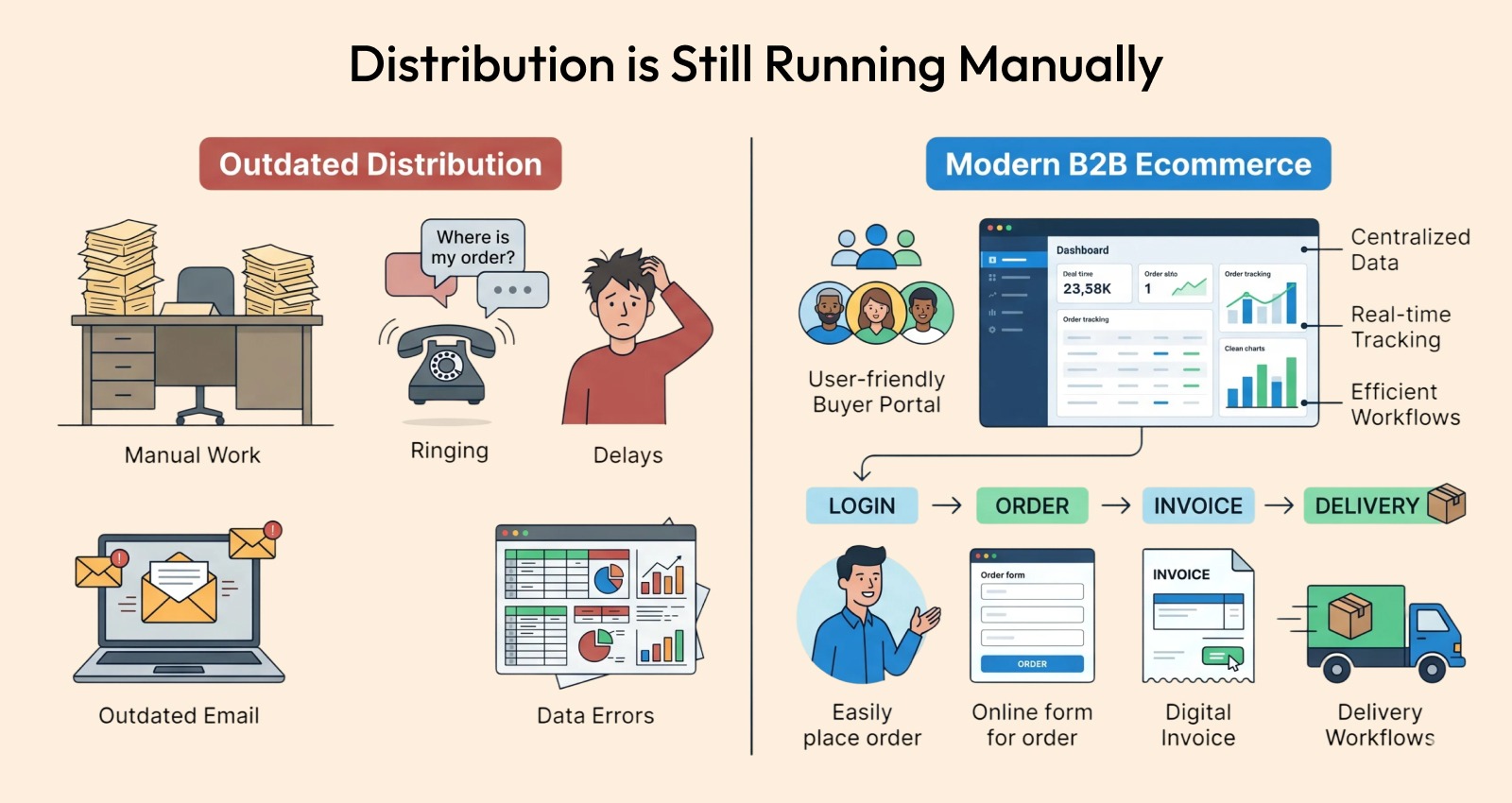
Ask most distributors how they currently manage wholesale orders and the answer is usually some version of the same thing — phone calls, emails, PDFs, and a salesperson who knows every account by name. It works until it doesn't. And in 2026, for most distribution businesses, it has stopped working. Buyers expect more. The competition has moved online. And the distributors still running on manual processes are slowly becoming harder to do business with.
The right B2B ecommerce software doesn't just move your orders online. It rebuilds how your distribution business operates — making it faster to serve existing accounts, easier to reach new ones, and possible to scale without adding headcount proportionally to order volume. This guide covers what distributors actually need from B2B software in 2026, what separates the right platforms from the rest, and how to make a decision you won't regret twelve months in.
The question for distributors in 2026 is no longer whether to sell online. It's how quickly you can build
the infrastructure before the buyers who want to order online find a supplier who has already done
it.
Why Distribution Is the Industry Most Overdue for B2B Ecommerce
Manufacturing and retail both moved online years ago. Distribution has been slower — partly because the relationships feel too complex to digitise, and partly because the technology to do it properly did not exist at accessible price points until recently. Both of those reasons no longer hold.
The typical distribution operation involves dozens or hundreds of active accounts, each with different pricing, different order patterns, and different payment arrangements. A retailer in one city has negotiated terms that differ from a dealer in another. A long-term account orders weekly on a 45-day invoice. A new account is still on an upfront payment until trust is established. Managing this manually is not just inefficient — it is error-prone. Wrong prices get quoted. Orders get missed. Invoice terms get misapplied. Each of these errors costs money and erodes the buyer relationship.
B2B ecommerce software designed for distribution solves this at the source. Each account has its own pricing profile, its own payment terms, and its own order history — all managed automatically by the platform. The buyer logs in and sees exactly what applies to them. They place an order. It flows to your fulfillment team without a single manual step. And your sales team is freed from processing routine reorders to focus on the work that actually requires a human.
What Distributors Need vs. What Most Platforms Offer
The B2B ecommerce software market is large but confusing. Many platforms market themselves as B2B-ready when they are fundamentally retail tools with a few wholesale features bolted on. Here is an honest comparison of what distribution businesses actually need versus what most standard platforms deliver. Businesses can also use Techimply to compare and evaluate B2B ecommerce software solutions based on features, pricing, and business requirements.
|
Feature Distributors Need |
Retail-First Platforms |
Purpose-Built B2B Platforms |
|---|---|---|
|
Account-based pricing |
Limited / app required |
Native, per-account control |
|
Credit terms & invoice payment |
Not supported natively |
Built-in, automated |
|
Minimum order quantities |
Plugin required |
Built-in at the product level |
|
Order approval workflows |
Not available |
Standard feature |
|
Multi-warehouse fulfillment |
Complex workaround |
Automated routing |
|
Buyer self-service portal |
Basic or absent |
Full portal with history |
|
ERP / accounting integration |
Limited, expensive |
Native or direct API |
This table is not a criticism of retail platforms — they do what they are designed to do. The problem arises when a distribution business tries to force a retail tool into a wholesale workflow. The gaps create manual work, and manual work is exactly what you are trying to eliminate.
The Core Features Every Distributor Needs in B2B Software
Before evaluating any specific platform, it helps to know precisely what you are looking for. These are the features that separate genuinely capable B2B ecommerce software from platforms that will create more work than they save.
Account-Based Pricing That Runs Automatically
In distribution, there is no such thing as a single price. Your pricing matrix is a map of relationships — different rates for different account types, volume tiers that unlock better pricing, and individual deals negotiated with specific clients. The right platform manages all of this automatically. Each buyer logs in and sees their pricing and only their pricing. No manual quote sheets. No risk of quoting the wrong rate. No sales team involvement for routine reorders. This is the single most important feature for any distribution business and the one that most standard retail platforms handle worst.
Credit Terms and Invoice-Based Payment
Trade credit is the default in distribution. Most of your accounts will not pay at checkout — they pay on net-30,
net-60, or whatever terms apply to their account. A platform that requires payment at the point of purchase is
structurally incompatible with how distribution works. Your B2B ecommerce solution provider must support invoice
generation, deferred payment, and a clear view of outstanding amounts across all accounts. When this runs
automatically, your finance team stops chasing invoices manually and starts managing exceptions
instead.
Note: We can set credit limit and outstanding amount is only shown when the order is
cod or partial cod
Minimum Order Quantities and Bulk Order Entry
Distributors sell in volume, and the economics of distribution depend on it. If a buyer can order a single unit at your distributor price, your margin structure breaks. The platform must support minimum order quantities at the product level, and ideally at the account level so different buyer tiers have different minimums. Bulk order entry — where a buyer can enter quantities across a large SKU list at once rather than navigating product pages individually — is equally important. Procurement buyers handling large catalogs will not use a system that slows them down.
Approval Workflows for Large Accounts
Many distribution accounts are companies, not individuals. Within those companies, purchasing decisions go through a process — a buyer submits an order, a manager approves it before it goes to your warehouse. Without approval workflow support in your platform, large accounts either avoid your online channel or create workarounds that cause confusion on both sides. Built-in approval workflows handle this automatically: the order sits in a pending state, the right person is notified, and the order is released to your fulfillment team only after approval. This is standard in serious B2B operations and should be standard in your software.
Multi-Warehouse Management
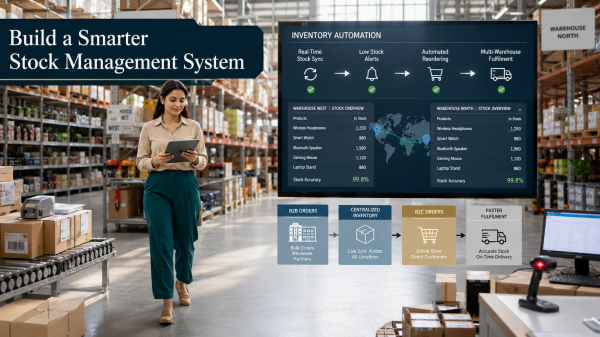
Distributors operating from multiple locations need more than a single inventory pool. When an order comes in from a buyer, the platform should route it to the closest or most appropriately stocked warehouse automatically, not require manual assignment by your operations team. Multi-warehouse support reduces delivery times, cuts shipping costs, and removes the coordination overhead that slows down large-volume fulfillment. It is particularly critical for distributors serving geographically spread buyer networks.
A distributor with the right B2B software and three warehouses can serve a national buyer network faster and cheaper than a competitor with five warehouses and a manual routing process.
The Self-Service Buyer Portal: Your Most Profitable Feature
If you asked most distributors what their sales team spends the majority of its time doing, the honest answer would be: processing reorders that the buyer could place themselves, answering stock availability questions, and chasing invoices that should be visible to the buyer in their account. These are not high-value activities. They are administrative tasks that consume skilled people and add cost without adding value.
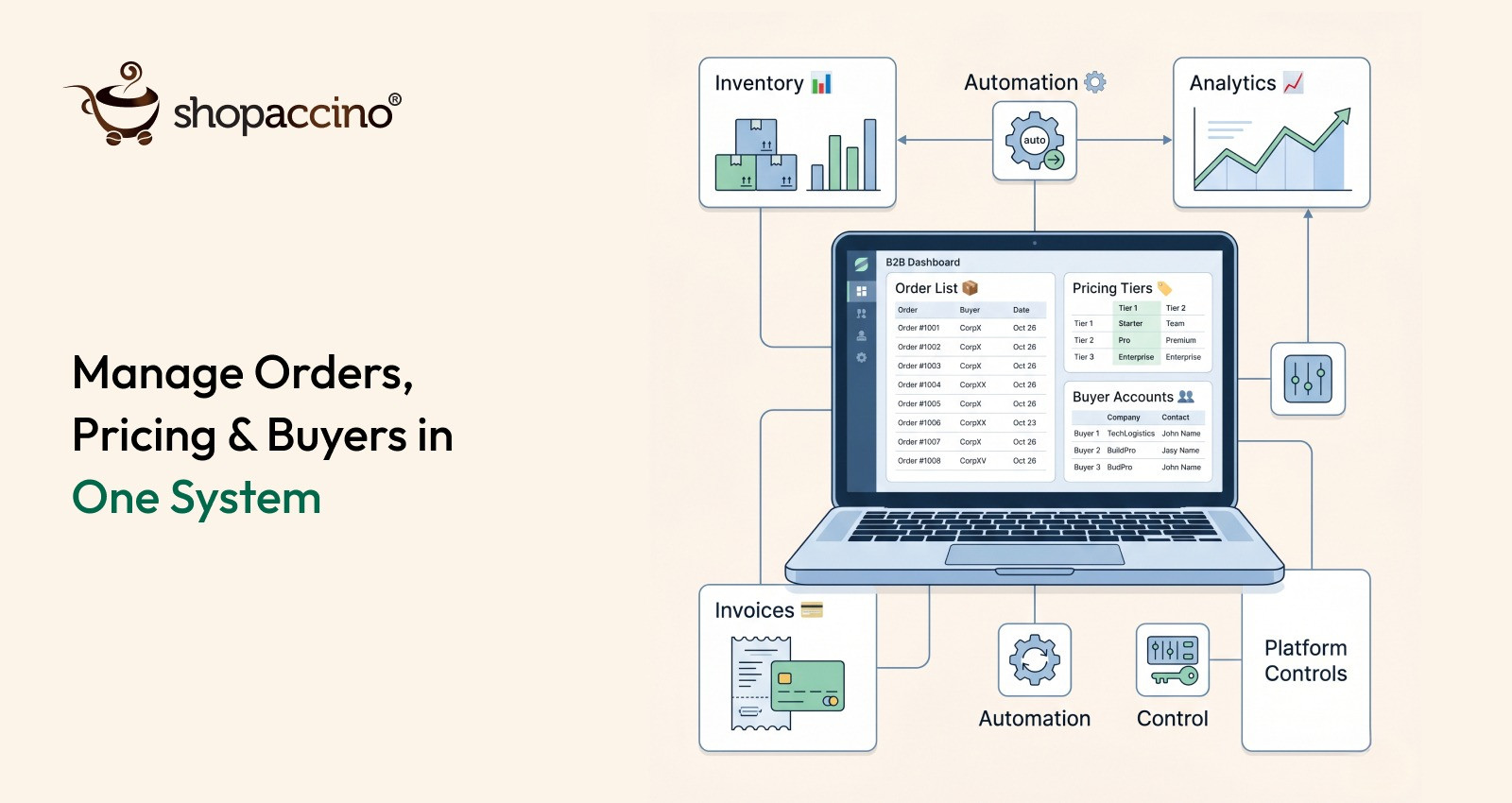
A proper buyer portal built into your ecommerce platform for B2B eliminates all three. Buyers log in and see their account-specific pricing, their order history, current stock levels, outstanding invoices, and shipment tracking — all without contacting your team. Their finance department can download invoices directly from their order history.
The commercial impact is significant. Every order placed through the portal is one your sales team did not process. Every invoice downloaded directly is one your finance team did not manually send. Every stock query answered by the portal is one your customer service team did not handle. As order volumes grow, this self-service capacity is what allows your business to scale without a linear increase in headcount.
The buyer portal is not a convenience feature. It is the mechanism that allows your distribution business to handle 3x the order volume with the same team size.
B2B Ecommerce Website Builder vs Custom Development: What Distributors Should Know
When distributors first explore going online, many initially consider building a custom solution. The reasoning is understandable — the pricing structure is complex, the workflow is specific, and no off-the-shelf tool seems to fit perfectly on first look. So they contact an agency and begin scoping a build.
What usually follows is a long development timeline, a large invoice, and a platform that works for the business as it exists at launch — but requires developer involvement every time something changes. A new pricing tier, a new buyer category, a new payment term, a new warehouse location. Each change becomes a project, and the cost of maintaining a custom platform consistently exceeds what distributors expected.
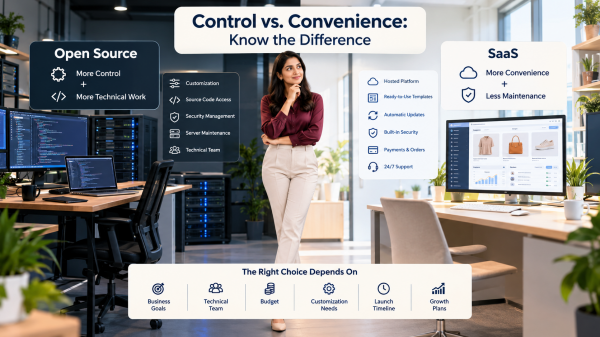
A purpose-built B2B ecommerce website builder solves this differently. The hard problems — pricing logic, approval workflows, buyer account management, bulk ordering, credit terms — are already built, tested, and maintained by the platform. You configure the system to match your business rather than building that logic from scratch. This means faster time to launch, lower ongoing costs, and the ability to update your setup as your business evolves without going back to a developer for every change.
The critical question to ask any platform is: how much can I configure without a developer? If adding a new buyer tier or updating a pricing rule requires a technical ticket, that platform will cost significantly more over time than its subscription fee suggests. A good B2B ecommerce website builder puts that control in your hands, not in an agency's queue.
Integrations That Make Your B2B Software Actually Work
The best B2B ecommerce software does not operate as a standalone tool. For distributors, it needs to connect cleanly with the systems that run the rest of the business. The quality of those integrations often determines whether the software delivers on its promise or creates a new layer of manual data management.
ERP Integration
If your inventory, logistics, and financial reporting run through an ERP system, your ecommerce platform must sync with it in real time. When a buyer places an order, your inventory count should update immediately. When a new account is created, their pricing terms should flow from the ERP to the store automatically. Without this, you maintain two separate data environments that drift apart over time, causing pricing errors and fulfillment mistakes that damage buyer relationships.
Accounting and Finance
Credit-term orders create financial obligations the moment they are placed. Your finance team needs to see them immediately, issue invoices on schedule, and track payment against terms without manually entering data from a separate system. Platforms like Shopaccino support accounting tool integrations that keep order data and financial records automatically in sync, so your finance team is always working from the same picture as your operations team without a manual reconciliation process between them.
Shipping and Logistics
For distributors fulfilling from multiple locations and shipping to buyers across geographies, logistics integration is not optional — it is infrastructure. Your platform should connect with your freight and courier partners, calculate accurate shipping costs based on order weight and destination, auto-select the correct carrier based on the account's requirements, and generate shipping documentation automatically. Every step that requires manual intervention adds time and introduces the possibility of error.
How to Evaluate a B2B Ecommerce Solution Provider Without Getting It Wrong
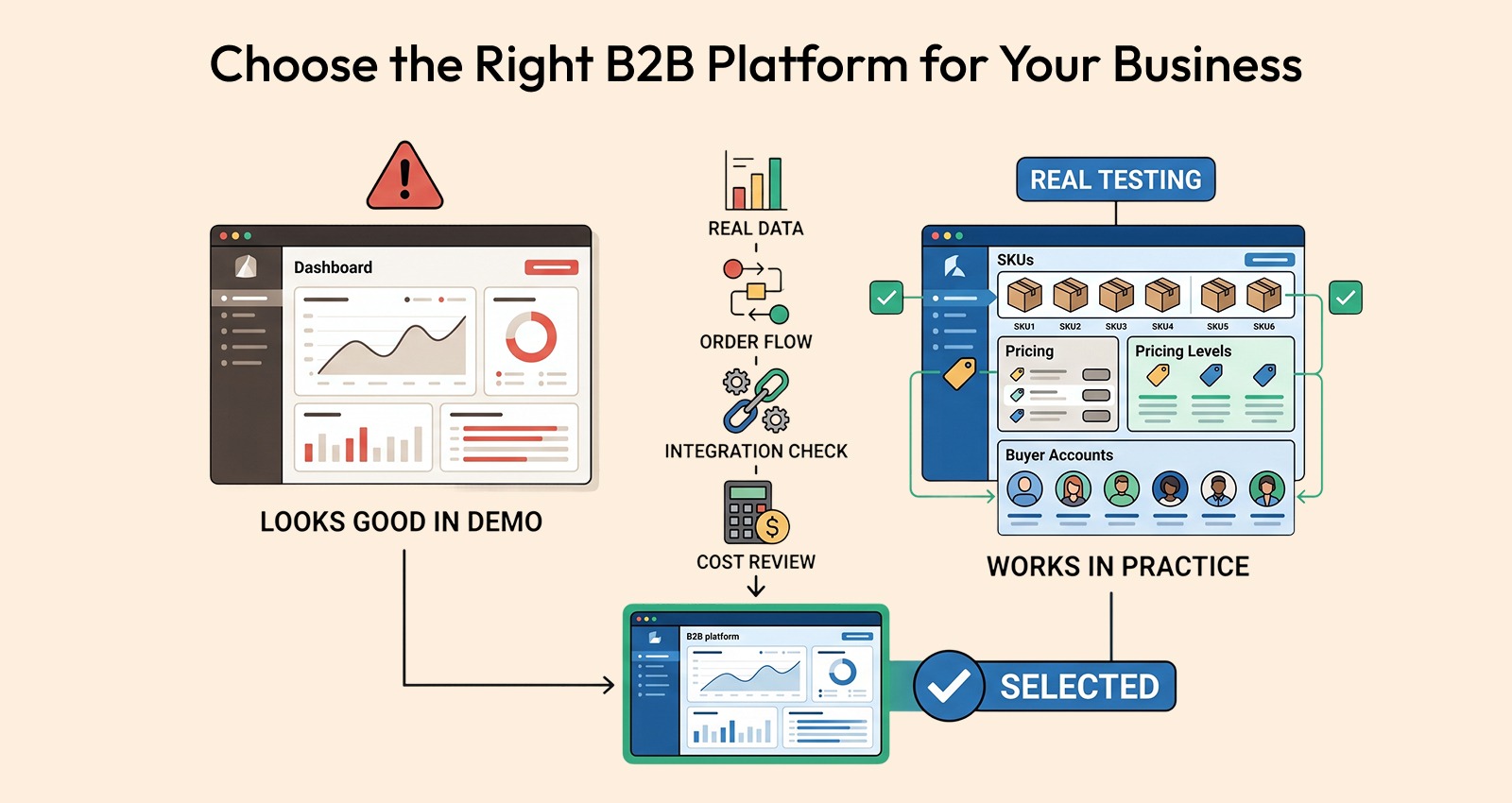
Choosing a B2B ecommerce solution provider is a decision that is difficult and expensive to reverse once you
are live. Here is how to evaluate options in a way that surfaces real capability rather than demo-stage
appearances.
Load your real data, not demo data. Ask for a trial environment and set it up with your actual product catalog, your real pricing tiers, and your typical account structures. A 30-product demo with uniform pricing hides problems that a 2,000-SKU catalog with eight buyer tiers and three currency markets will expose immediately. If the platform struggles with your real complexity during evaluation, it will struggle in production.
Test the buyer experience end-to-end. Log in as one of your typical buyers. Try to place a bulk order. Check how pricing displays for that account. Submit an order for approval. Look at the order history view. Download an invoice. If any of these steps are clunky or confusing, your buyers will revert to calling your sales team — and the platform will not deliver the operational efficiency you are paying for.
Calculate the real total cost. The subscription fee is never the full picture. Add any apps or plugins needed to fill feature gaps, the development cost of customisation, transaction fees on every order, and the ongoing support cost. Platforms that include B2B features natively — pricing, approval workflows, buyer portals, credit terms — are consistently cheaper in practice than retail-first platforms that require expensive add-ons to achieve equivalent functionality.
Ask for references from distribution businesses specifically. A platform that works well for fashion retail may not handle the complexity of industrial distribution, chemical supply, or food and beverage wholesale. The nuances differ significantly. Speaking to an existing customer with a similar business model will tell you more than any sales presentation.
What Good Looks Like: A Distribution Business Running on the Right Platform
It is worth painting a clear picture of what a well-implemented B2B ecommerce operation actually looks like for a distributor, because the gap between the manual status quo and the digital alternative is larger than most people expect until they see it working.
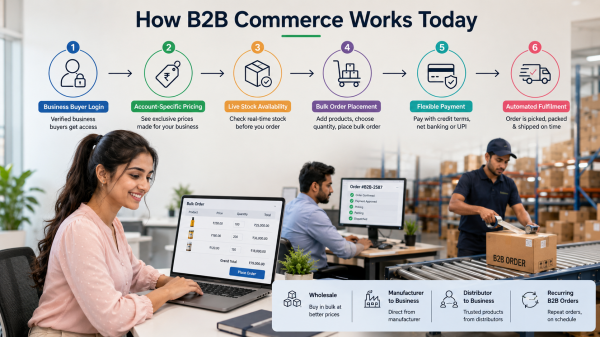
A buyer at a retail chain logs into the distributor's portal at 8 PM. They see their account-specific pricing, check current stock levels across the product lines they carry, and place a bulk order for next week's delivery. The order is automatically routed to the correct warehouse based on the buyer's location and stock availability. A manager at the retail chain receives a notification to approve the order, clicks approve, and the order is released to the distributor's fulfillment team. An invoice is generated and sent to the buyer's finance department automatically. The buyer receives shipping confirmation and tracking information the following morning. No calls. No emails. No manual data entry. No human involvement until the warehouse team picks and packs the order.
That scenario is not a vision of 2030. It is what distributors running the right B2B ecommerce software are already delivering to their accounts today. The technology exists. The question is whether your business is using it.
The distributors winning new accounts in 2026 are not winning on price. They are winning because they are the easiest supplier to work with — and digital self-service is what's making them easy.
The Window to Move Is Now
Distribution is a relationship business, and it will always be one. But the nature of those relationships is changing. Buyers who can order from a competitor's portal at 10 PM without picking up the phone are choosing convenience as much as they are choosing a supplier. The distributors building that convenience now are establishing habits in their buyers that are difficult to displace once formed.
The right B2B ecommerce software for your distribution business is the one that fits how your accounts actually operate — your pricing structures, your payment terms, your fulfillment model, and your buyer relationship depth. It exists. It is accessible at price points that make sense for businesses of all sizes. And in 2026, for any distributor serious about growth, implementing it is no longer a competitive advantage. It is a competitive necessity.
FAQs
B2B ecommerce software is a platform designed for businesses that sell to other businesses rather than individual consumers. For distributors, it manages account-based pricing, credit terms, bulk ordering, approval workflows, and multi-warehouse fulfillment — all the complexity that retail platforms cannot handle. It allows buyers to self-serve, reduces manual order processing, and scales wholesale operations without proportional headcount growth.
The essential features for distributors are account-based pricing, invoice-based payment with credit terms, minimum order quantities, order approval workflows, a buyer self-service portal with order history and invoice access, multi-warehouse routing, and ERP or accounting integration. Platforms that include these natively are significantly more effective than those requiring third-party apps to fill these gaps.
A B2B ecommerce solution provider is a platform or company that delivers the complete software infrastructure for wholesale and trade selling online. This includes the storefront, pricing engine, order management, buyer portal, payment terms, and integrations with accounting and logistics tools. A good provider handles the technical complexity so the distribution business can focus on operations and buyer relationships rather than software maintenance.
A B2B ecommerce website builder provides pre-built B2B functionality — pricing logic, approval workflows, buyer accounts, bulk ordering — that you configure rather than build from scratch. Custom development builds all of this from zero, taking longer and costing more, with ongoing developer dependency for every change. Purpose-built B2B website builders let non-technical teams update their setup without going back to a development agency for every modification.
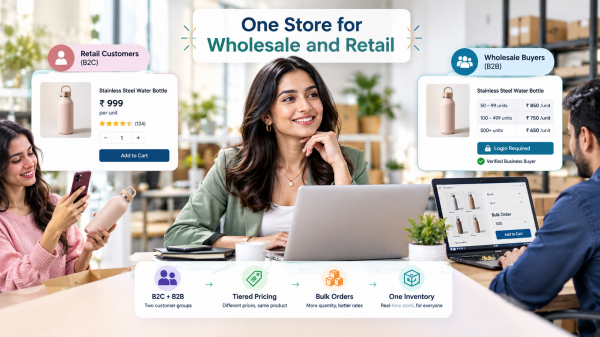
A B2C ecommerce platform is built around a single price, a single buyer, and card payment at checkout. A B2B ecommerce platform handles variable pricing per account, multi-user buyer accounts, bulk orders, credit terms, approval workflows, and minimum order quantities. These are not add-on features — they are architectural differences. Using a B2C platform for B2B distribution creates continuous workarounds that increase manual work and limit scalability.
Yes. Purpose-built B2B ecommerce software for distributors includes multi-warehouse management that automatically routes orders to the correct fulfillment location based on buyer destination, product availability, and account-level preferences. This reduces delivery times and shipping costs while removing the manual routing decisions that slow down operations teams. Without this, high-volume distributors end up manually assigning orders to warehouses, which does not scale.