B2B Order Management Systems for Distributors: The Complete Guide
Picture this. It's a Tuesday morning and your warehouse team is already behind. Three buyers have called asking where their orders are. Your sales manager is manually updating a spreadsheet with this week's purchase orders. Two invoices went out with the wrong pricing because someone pulled last month's price list. And a new account you worked three months to acquire just placed their first order — but nobody has acknowledged it yet.
This is not a bad day. For most distributors without a proper B2B order management system, this is a normal day. The chaos is so familiar it stops feeling like a problem and starts feeling like the job.
It is not the job. It is the cost of running distribution without the right infrastructure. And in 2026, that cost — in time, in errors, in buyer frustration, and in the accounts quietly moving to competitors who have their ordering experience sorted — is higher than most businesses realise until they actually measure it.
What Is a B2B Order Management System?
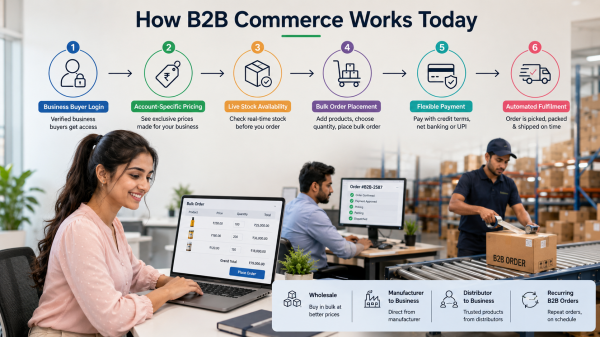
A B2B order management system is the software that manages every step of an order from the moment a business buyer places it to the moment the payment is reconciled. In distribution, this covers a chain of events that is considerably more complex than consumer ecommerce: the order may involve multiple product lines, account-specific pricing, minimum quantity requirements, credit term verification, multi-warehouse allocation, partial fulfillment, and invoice generation on different payment schedules.
Where a consumer places one order for one delivery to one address and pays immediately, a wholesale buyer might place a recurring bulk order, split across two warehouses, to three delivery addresses, on a 45-day invoice, with a 5% volume discount that kicks in above a threshold they just crossed. A system that handles the consumer transaction does not handle the wholesale one.
The core functions of a B2B OMS for distributors include:
- Receiving and processing purchase orders from multiple channels — online portal, EDI, email, sales rep entry
- Verifying pricing against account-specific price lists and active promotions
- Checking credit terms and outstanding balances before order confirmation
- Allocating inventory across single or multiple warehouses
- Managing partial shipments and backorder notifications
- Generating invoices automatically on the agreed schedule
- Tracking payment against open invoices and flagging overdue accounts
- Providing real-time order status to buyers through a self-service portal
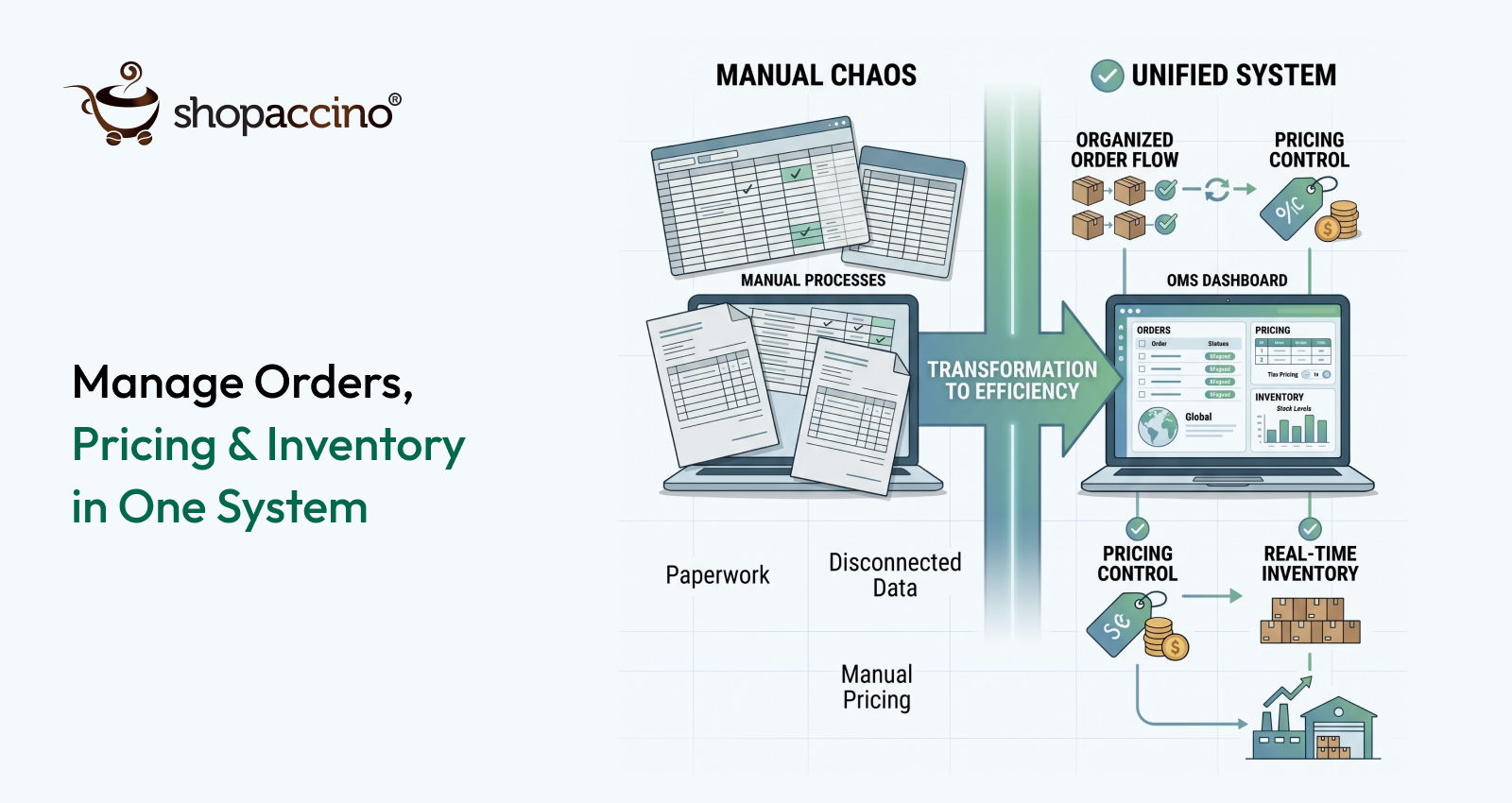
An OMS does not replace your warehouse operations or your ERP. It is the connective layer that ensures an order placed at any point enters the right workflow, at the right price, for the right account, every time.
Why Do Distributors Specifically Need B2B Order Management Systems?
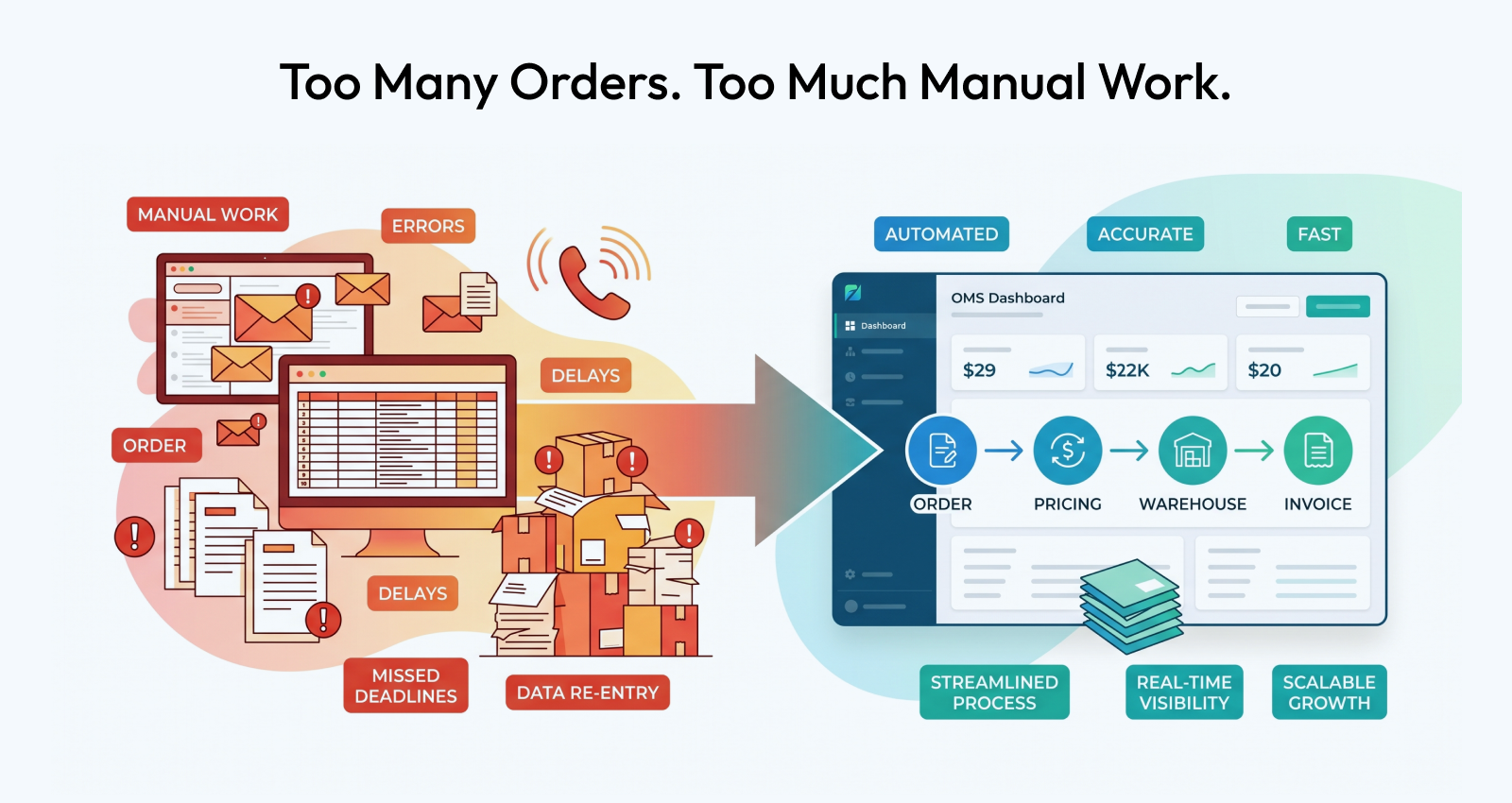
Manufacturers and retail businesses have their own OMS challenges, but distribution sits at a uniquely complex intersection. Distributors buy from multiple suppliers, sell to multiple buyer types, move high SKU volumes, and operate on tight margins where operational errors translate directly into profit loss.
Let's look at what happens without a proper system. A mid-sized distributor handling 200 active accounts might process 500 orders a week. Without automated order management, each order requires:
- Manual price verification against the correct account tier
- Credit check against outstanding invoices
- Manual warehouse assignment based on stock levels
- Manual invoice creation and dispatch
- Follow-up emails when stock is unavailable
- Manual status updates when buyers ask “where is my order”
A study by McKinsey found that B2B companies that digitise their order management processes reduce their cost to serve by up to 40% and see significant improvement in customer retention. That is not a small efficiency gain — it is the difference between a distribution business that can grow profitably and one that cannot scale without proportionally increasing headcount.
The buyer experience argument is equally compelling. Research from Forrester consistently shows that B2B buyers expect the same self-service capabilities in their supplier relationships that they have as consumers. A buyer who can check order status, download invoices, and reorder from purchase history in under two minutes is a buyer who stays. One who has to call your office for every update is a buyer who is already browsing your competitor's catalog.
Distributors that automate order management report fewer pricing errors, faster order cycles, and significantly lower customer service overhead — all of which compound into measurable margin improvement.
How Does a B2B Order Management System Work for Distributors?
Understanding the flow of an order through a properly configured OMS helps clarify where the value is created and where manual processes break down without one.
Step 1: Order Receipt
Orders arrive through multiple channels. A buyer logs into the wholesale portal and places an order directly. A sales rep enters an order on behalf of a client. An EDI connection transmits a purchase order automatically from the buyer's procurement system. An email order is manually entered. A properly integrated B2B order management system receives all of these through a single processing pipeline, regardless of the source channel, so your operations team is not managing four separate inboxes.
Step 2: Validation and Pricing Check
The moment an order is received, the OMS validates it against the buyer's account profile. Is the pricing correct for this account tier? Does the order meet the minimum quantity requirement? Is the buyer within their credit limit? If any of these checks fail, the order is flagged automatically for review rather than proceeding into fulfillment with incorrect parameters. This single step eliminates the most common and expensive class of distributor errors: orders fulfilled at the wrong price or for accounts with outstanding overdue balances.
Step 3: Inventory Allocation and Warehouse Routing
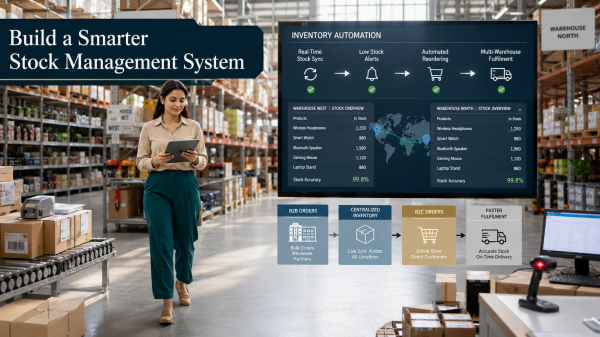
Once validated, the OMS allocates inventory and determines which warehouse or warehouses will fulfill the order. For distributors with multiple storage locations, this routing can be based on proximity to the delivery address, current stock levels, or account-level preferences. The system updates inventory counts in real time so the same stock cannot be allocated to two orders simultaneously — the root cause of most overselling incidents in manual operations.
Step 4: Fulfillment Coordination
The warehouse team receives a pick list, packing instructions, and shipping requirements directly in their workflow system. If a product is out of stock, the OMS automatically generates a backorder record, notifies the buyer, and creates a fulfillment task for when stock is replenished. Partial shipments are tracked separately from the remaining balance, with the buyer receiving status updates for each shipment independently.
Step 5: Invoicing and Payment Tracking
On shipment confirmation, the OMS generates and dispatches the invoice automatically, with payment terms applied according to the buyer's account configuration. Net-30 accounts receive invoices dated 30 days out. Prepayment accounts receive invoices on order confirmation. The finance team gets a real-time view of all open invoices, upcoming due dates, and overdue amounts across the entire account base — with automated reminders reducing the manual chasing that occupies most accounts receivable functions in traditional distribution.
What Features Should a B2B Order Management System Have for Distributors?
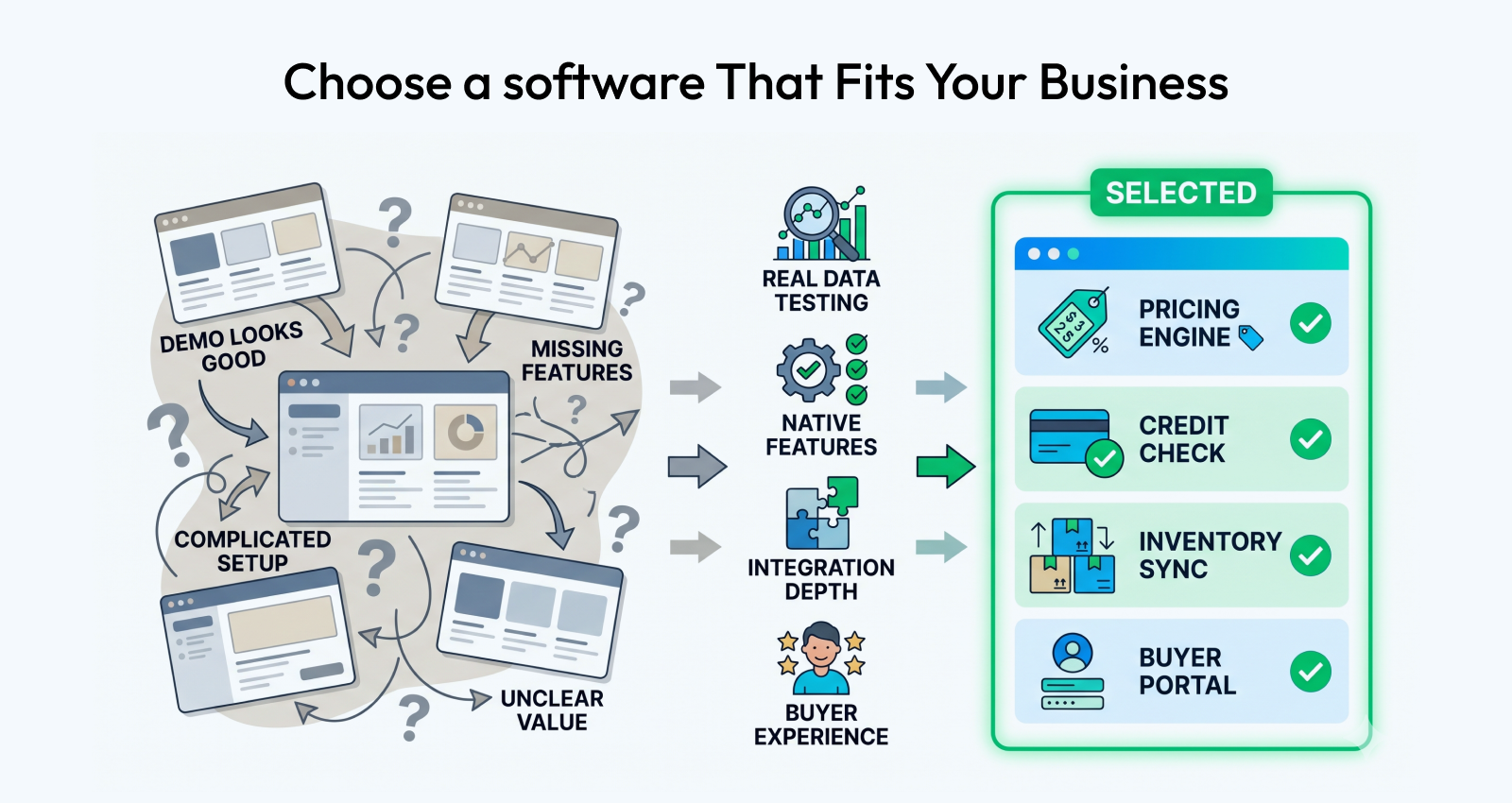
Not all order management systems are built for the complexity of distribution. Here is what genuinely matters when evaluating options.
The table below compares essential OMS features against the operational problem each one solves.
OMS Feature | Operational Problem It Solves |
|---|---|
Account-based pricing engine | Eliminates manual price verification and wrong-price fulfillment |
Credit limit management | Prevents orders from overdue or over-limit accounts entering fulfillment |
Multi-warehouse routing | Automatically assigns orders to the correct location, reducing delivery time |
Real-time inventory sync | Prevents overselling and double-allocation across simultaneous orders |
Backorder management | Tracks unfulfilled quantities and auto-fulfills when stock arrives |
Approval workflow engine | Holds large or new-account orders for internal sign-off before processing |
Automated invoice generation | Removes manual invoice creation, reducing delay and human error |
Buyer self-service portal | Reduces inbound order status queries and reorder friction for buyers |
ERP and accounting integration | Keeps financial and operational data in sync without manual reconciliation |
EDI support | Receives purchase orders automatically from buyers' procurement systems |
How Do B2B Order Management Systems Integrate With Ecommerce Platforms?
For distributors who sell through an online wholesale store, the OMS and the ecommerce platform need to work as a single system rather than two separate tools that occasionally share data. When they are properly integrated, every order placed through the buyer portal flows automatically into the OMS workflow without manual re-entry. Inventory levels displayed in the portal reflect what is actually available in real time. Account pricing shown at checkout matches what the OMS would apply. Invoices generated by the OMS appear immediately in the buyer's portal account.
Platforms like Shopaccino are designed with this integration in mind. The order management functionality is built into the same platform as the ecommerce storefront, the buyer portal, and the pricing engine — so for distributors using a unified platform, the OMS is not a separate integration project but a native capability. This architecture eliminates the synchronisation failures, data latency, and maintenance overhead that come from connecting separate OMS and ecommerce systems through third-party connectors.
For distributors using standalone ERP systems like SAP, Microsoft Dynamics, or Oracle, OMS integration is typically handled through API connections or EDI protocols. The key requirement is that the integration is bidirectional and real-time: inventory changes in the ERP update the OMS immediately, and orders processed through the OMS flow back to the ERP without batch delays. Any lag between the two systems creates the conditions for overselling, pricing mismatches, and fulfillment errors.
Internal link suggestion: See also — ‘B2B Ecommerce Software for Distributors in 2026' and ‘B2B Ecommerce Platform for Manufacturers' for related guidance on building your wholesale digital infrastructure.
What Are the Most Common Challenges Distributors Face Without an OMS?
Understanding the specific pain points that an OMS resolves makes it easier to assess whether your current setup is genuinely working or just appearing to work while hiding costs you have not yet measured.
Pricing Errors at Scale
In a manual pricing environment, the risk of a wrong price reaching an order is a function of volume. With 10 orders a day, a pricing error once a month is manageable. With 200 orders a day across 150 account tiers, without an automated pricing engine, pricing errors are not occasional — they are structural. Each error either costs you the margin difference when you honour it or costs you the buyer relationship when you correct it after the fact.
Inventory Overselling
Without real-time inventory allocation, the same stock can be committed to multiple orders simultaneously. This is particularly acute for distributors where popular SKUs have tight availability. An OMS with a live inventory lock — where stock is reserved the moment an order enters the system — eliminates this entirely. Without it, overselling incidents are a cost of doing business rather than a solvable operational problem.
Order Visibility Gaps
Buyers who cannot see the status of their orders in real time contact your customer service team. Every status query that reaches a human costs approximately five to fifteen minutes of staff time when you factor in the context-switching, the lookup, and the response. At scale, this represents a significant and largely invisible overhead. A self-service buyer portal with real-time status visibility eliminates most of this category of contact entirely.
Credit Management Breakdowns
Manual credit management in distribution typically means a finance team member checking a spreadsheet before approving orders for specific accounts. This process fails in both directions: sometimes orders are approved for accounts that have crossed their limit because the check was not run, and sometimes legitimate orders are held up because the approval process has a queue. An OMS with automated credit verification removes both failure modes.
Fulfillment Bottlenecks
When warehouse teams receive pick lists through email, shared folders, or verbal instruction, the risk of lost, duplicated, or incorrectly prioritised orders is high. An OMS that routes fulfillment tasks directly to warehouse workflow systems eliminates the manual handoff and its associated errors, and gives operations managers real-time visibility into where each order is in the fulfillment process.
How to Choose the Right B2B Order Management System for Your Distribution Business
The market for OMS software is wide and the marketing language is often indistinguishable between platforms that genuinely handle distribution complexity and those that do not. Here is a practical approach to evaluating your options.
Evaluate Against Your Real Complexity, Not a Demo
Ask any vendor to let you test their system with your actual account structure, your real pricing tiers, and your typical order patterns. Load 50 accounts with different pricing, run 20 simultaneous orders, trigger a credit limit alert, and process a partial fulfillment. Platforms that handle this without workarounds are genuinely capable for distribution. Those that struggle with your real data during evaluation will create problems in production.
Prioritise Native B2B Features Over Plugins
An OMS that handles account pricing, credit terms, approval workflows, and EDI through native functionality is significantly more reliable than one that requires third-party plugins for each capability. Plugins break on updates, introduce latency, and add ongoing maintenance cost. The total cost of a platform with gaps filled by plugins is almost always higher than it appears from the subscription price alone.
Verify Integration Depth, Not Just Integration Existence
Most OMS vendors claim ERP integration. The relevant question is the depth of that integration: Is it real-time or batch? Is it bidirectional or one-way? Does it cover pricing data, inventory levels, and customer account information, or just order records? A shallow integration that syncs once a day is not adequate for a distribution operation where inventory moves continuously and pricing changes affect live orders.
Consider the Buyer Experience, Not Just the Internal Workflow
The best B2B order management systems for distributors are evaluated from both sides — the internal operational experience for your team and the external buying experience for your accounts. Log in as one of your buyers. Place a bulk order. Check order status. Download an invoice. Request a reorder. If any of these steps require your team's involvement, the buyer-facing capability of the system has gaps that will translate into support overhead and account friction.
Reference: Forrester's ‘The State of B2B eCommerce' report documents that 74% of B2B buyers research and evaluate suppliers online before contacting sales — reinforcing why digital order management is a buyer acquisition tool, not just an operational efficiency tool.
What Is the ROI of Implementing a B2B Order Management System?
The return on investment from a properly implemented OMS comes from four distinct sources, each measurable independently.
Reduction in order processing cost. Manual order entry, price verification, credit checking, and invoice creation typically cost between £4 and £12 per order in staff time, depending on complexity and volume. An OMS that automates these steps reduces this to the cost of exception handling — typically 10–15% of the original volume. At 300 orders per week, the saving is material.
Reduction in pricing and fulfillment errors. Each pricing error costs the margin difference when corrected or the buyer relationship when disputed. Fulfillment errors cost return shipping, re-fulfillment, and the less quantifiable cost of buyer trust. Distributors typically report a 60–80% reduction in order errors after OMS implementation.
Improvement in accounts receivable. Automated invoicing and payment reminders consistently reduce the average days sales outstanding (DSO) for distribution businesses. A reduction of 7–10 days in DSO across a £2M monthly invoice volume represents significant working capital improvement.
Increase in buyer retention and order frequency. Buyers who experience smooth, self-service ordering reorder more frequently and with higher average order values than those navigating friction-heavy manual processes. This is the least visible but often the largest component of OMS ROI, because it shows up in revenue growth rather than cost reduction.
Conclusion: The Distributor That Controls Its Orders Controls Its Growth
The operational chaos of manual order management in distribution is not inevitable. It is a choice — made by default when the right systems are not in place, and reversed deliberately when a proper B2B order management system takes its place.
The distributors growing confidently in 2026 are not necessarily the largest, the best capitalised, or the ones with the widest product range. They are the ones that have made the buying experience easiest for their accounts — accurate pricing automatically applied, orders confirmed without delays, invoices arriving on schedule, and status visible without a phone call. That experience, at scale and delivered consistently, is what retains accounts and attracts new ones.
The technology to deliver this is not new, and it is not expensive relative to the cost of the manual processes it replaces. What it requires is the decision to implement it properly — with real data, real buyer structures, and the commitment to migrate your operation rather than running two systems in parallel indefinitely.
If you are still manually verifying prices before each order, manually generating invoices, or relying on your sales team to field status queries from buyers, the question is not whether a B2B order management system would improve your business. The question is how much the current approach is already costing you in errors, staff time, and accounts that quietly move on.
The best time to implement an OMS was when your distribution business first felt the friction. The second best time is before your next high-volume week.
FAQs
A B2B order management system is software that automates the complete order lifecycle for wholesale businesses — from order receipt and pricing validation through inventory allocation, fulfillment, invoicing, and payment tracking. It handles the complexity of account-specific pricing, credit terms, minimum order quantities, and multi-warehouse operations that standard retail ecommerce tools cannot manage natively.
B2C order management handles a single price, a single buyer, and immediate payment. B2B order management must handle account-specific pricing tiers, credit limits and invoice payment terms, minimum order quantities, multi-stakeholder approval workflows, EDI purchase order ingestion, and complex fulfillment logic across multiple warehouses. The commercial and operational complexity of wholesale trade requires fundamentally different software architecture.
Yes, and often earlier than they expect. The manual processes that work for 20 orders a week create serious problems at 100. Pricing errors become structural rather than occasional. Credit management fails under volume. Staff time consumed by order processing crowds out growth activities. A properly configured OMS scales with the business, so the right time to implement is before the manual approach breaks — not after.
Integration can be native (when OMS and ecommerce platform are the same system) or through API or EDI connections. Native integration, as offered by platforms like Shopaccino, is simpler and more reliable because data flows within a single system without synchronisation lag or connector maintenance. API integration with standalone ERP systems requires bidirectional, real-time connectivity to avoid inventory and pricing discrepancies between systems.
For most distributors, the biggest immediate benefit is the elimination of pricing errors and the reduction in order processing staff time. Longer term, the most commercially significant benefit is improvement in buyer retention — buyers who experience fast, accurate, self-service ordering reorder more frequently and with higher average values than those navigating manual processes. This revenue retention effect typically exceeds the cost savings from operational efficiency.