How Manufacturers Can Sell Directly to Retailers Online
Quick Answer: B2B ecommerce for manufacturers means building a direct digital sales channel to retailers, wholesalers, and trade buyers — without relying on distributors as the intermediary. With the right platform, manufacturers can offer account-specific pricing, MOQs, trade credit terms, and a self-service ordering portal that lets retailers buy at any time without a sales call.
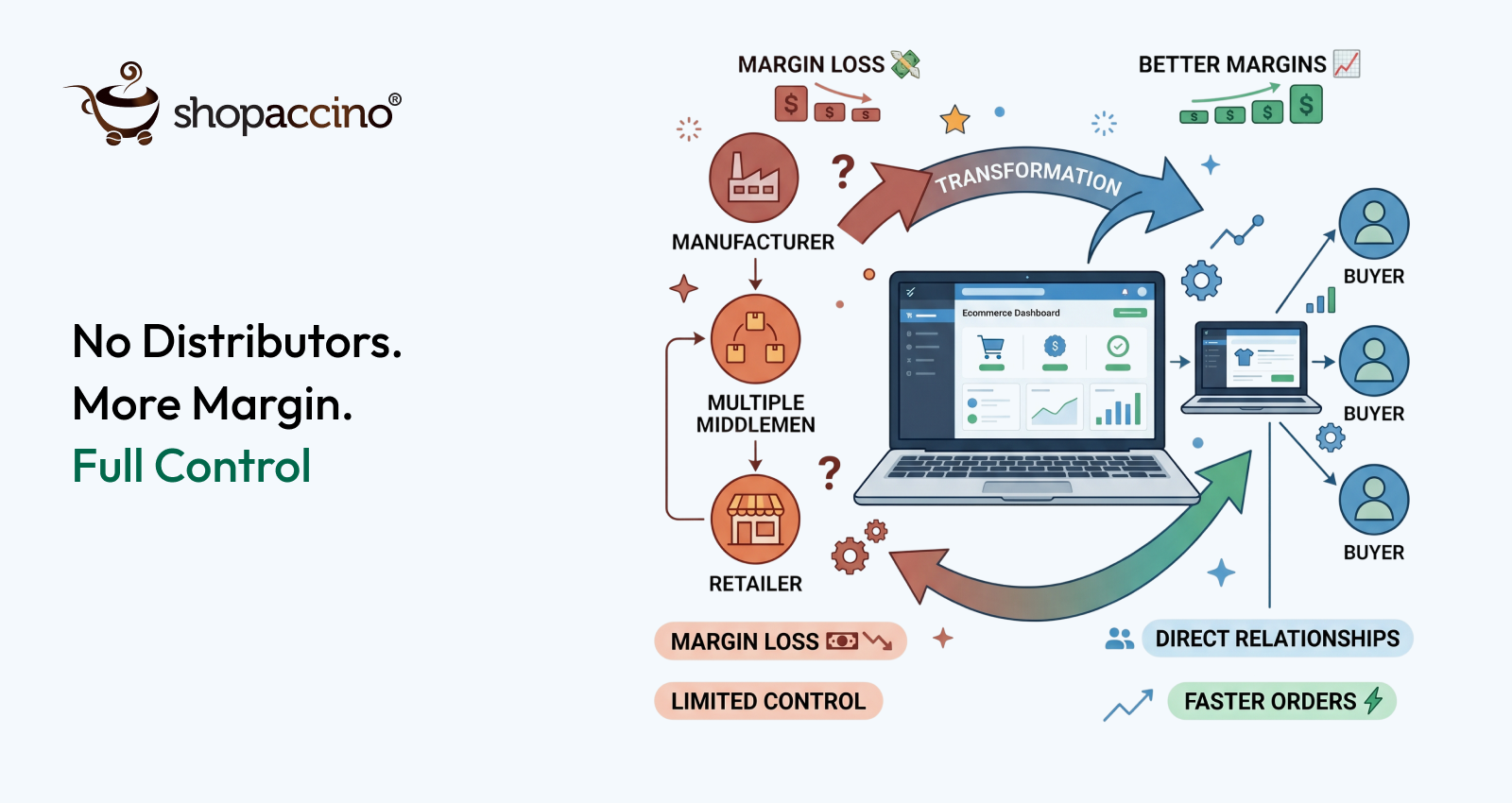
You spent years building your manufacturing operation — your processes, your quality, your capacity. But when it comes to selling, you hand control to someone else. A distributor takes your product, adds their margin, and owns the relationship with the retailer. You get the order. They get the buyer.
That arrangement made sense when the only way to reach retailers was through a sales force that distributors had already built. It makes less sense now. B2B ecommerce for manufacturers has changed the equation. A manufacturer with the right digital infrastructure can reach retailers directly, offer trade pricing automatically, and process wholesale orders without a distribution intermediary eating into the margin.
This guide covers exactly how that works — the model, the technology, the common mistakes, and the practical steps to move from relying on intermediaries to owning your retail relationships directly.
Why Are More Manufacturers Moving to Direct B2B Ecommerce?
The traditional distribution model was built around access. Distributors had the reach, the relationships, and the logistics infrastructure that manufacturers could not replicate alone. Paying a distribution margin was the price of reaching the market.
Digital infrastructure has fundamentally changed what a manufacturer can build independently. A properly configured B2B ecommerce platform gives a manufacturer the ability to:
- Display their full catalog to trade buyers with account-specific pricing
- Accept and process bulk orders automatically
- Issue invoices on credit terms without manual intervention
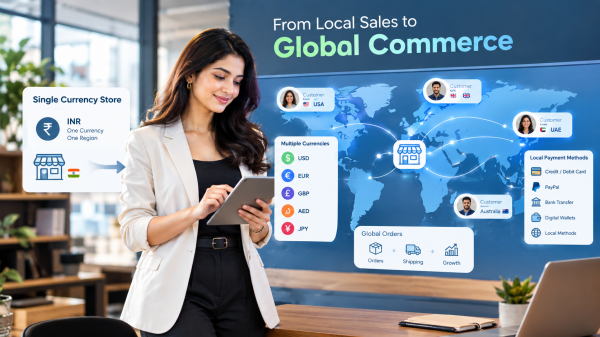
- Reach international retailers without a local agent or distributor
- Collect and own data on buyer behaviour, reorder patterns, and account health
A 2023 report by McKinsey found that B2B companies with strong digital sales channels grew revenue 5x faster than those relying predominantly on traditional sales forces. For manufacturers, the implication is direct: the access that distributors once exclusively provided is now replicable through digital means, and the margin difference is substantial.
This does not mean every manufacturer should abandon distribution. It means every manufacturer should evaluate whether they are over-reliant on intermediaries for relationships they could own directly — and what that dependency costs them in margin, buyer data, and commercial agility.
Every retailer your distributor serves is a relationship you do not own. B2B ecommerce for manufacturers changes that — gradually or rapidly, depending on how you build it.
What Is B2B Ecommerce for Manufacturers, Specifically?
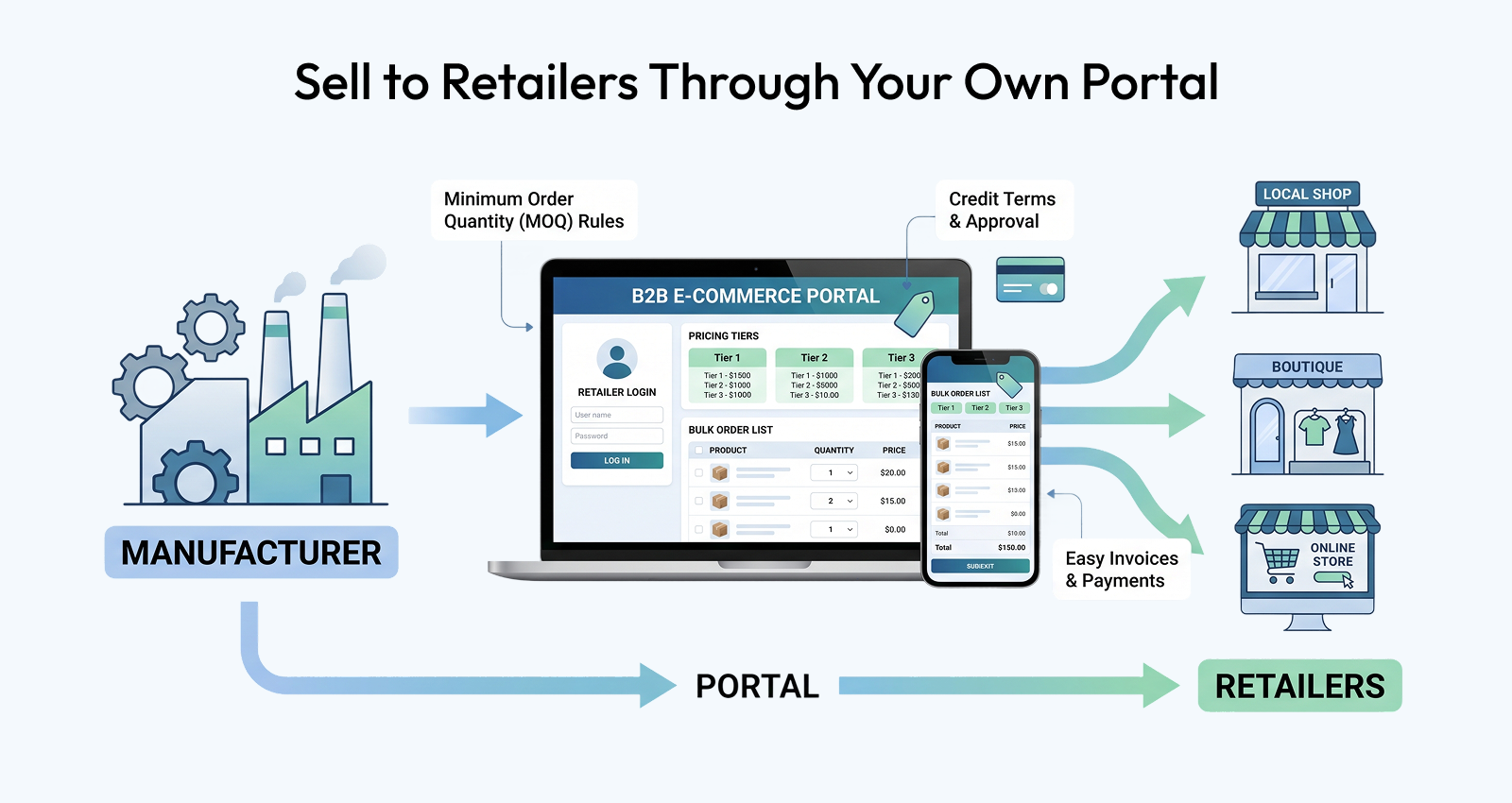
B2B ecommerce for manufacturers is the practice of selling products directly to retailers, wholesale buyers, or trade accounts through a digital ordering system, rather than through distributors or sales reps as the primary channel.
This is distinct from DTC (direct-to-consumer) ecommerce, where the end buyer is an individual. In manufacturer-to-retailer ecommerce, the buyer is a business — a retail chain, a boutique, an online store, or a trade account — with its own pricing arrangement, minimum order requirements, and payment terms.
The key difference from a standard ecommerce setup is the commercial complexity involved. Retailers buying from manufacturers expect:
- Pricing specific to their account or buyer tier, not a published retail price
- Minimum order quantities that reflect manufacturing economics
- The ability to pay on credit terms rather than at checkout
- Order approval processes for large or new accounts
- Access to a catalog that may differ from the consumer-facing product range
A platform that handles all of this natively — rather than through workarounds and plugins — is what separates manufacturers who successfully run direct wholesale channels from those who attempt it and revert to distributor dependence within months.
How Does Direct Manufacturer-to-Retailer Ecommerce Actually Work?
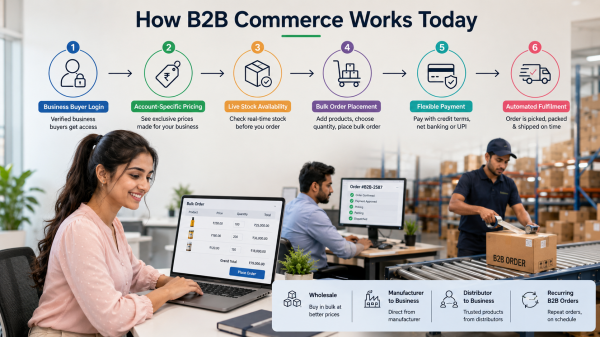
The mechanics are more straightforward than most manufacturers expect. Here is the typical flow of a direct B2B order between a manufacturer and a retailer on a properly configured platform.
Step 1: Retailer Discovery and Account Setup
A retailer finds the manufacturer's wholesale portal — through Google search, a trade directory listing, a referral, or a trade show follow-up. They apply for a trade account. The manufacturer's team reviews the application, approves it, and assigns the retailer to the appropriate pricing tier. From this point, every time the retailer logs into the portal, they see their own prices automatically.
Step 2: Self-Service Ordering
The retailer browses the manufacturer's trade catalog, selects products, and builds their order. Minimum order quantities are enforced automatically — the system prevents the order from being placed below the commercial threshold without requiring a manual check. The retailer sees their trade pricing throughout the browsing experience, so there are no surprises at checkout.
Step 3: Order Approval and Confirmation
For new accounts or orders above a certain value, the order may enter an approval workflow before being confirmed. This protects the manufacturer from fraudulent or non-qualifying orders and gives the sales team visibility into large transactions before they enter fulfillment. Once approved, the retailer receives an order confirmation automatically.
Step 4: Fulfillment and Shipment
The order flows to the manufacturer's warehouse or production team. If the platform is integrated with logistics partners, shipping is booked automatically. The retailer receives tracking information through the portal without needing to contact anyone. For made-to-order products, the system can communicate lead times and production status.
Step 5: Invoice and Payment
An invoice is generated automatically on the agreed terms — immediately for prepayment accounts, or on the net-30/net-60 schedule for credit accounts. The retailer can view and download the invoice from their portal account. Your finance team has a real-time view of all outstanding invoices across all retail accounts without manual tracking.
The entire flow above — from account setup to invoice payment — can run with minimal human involvement on the manufacturer's side for standard orders. Human attention is reserved for exceptions, new relationships, and strategic accounts.
What Features Do Manufacturers Need for Successful B2B Ecommerce?
The features that make direct-to-retailer ecommerce work for manufacturers are materially different from what a standard consumer store provides. Here is what matters and why.
|
Feature |
Why Manufacturers Need It |
What Happens Without It |
|---|---|---|
|
Account-based pricing |
Different retailers pay different rates |
Manual quotes for every order |
|
Trade account approval |
Verify buyers before granting access |
Non-qualifying buyers see trade prices |
|
Minimum order quantities |
Protect manufacturing economics |
Small orders erode margins |
|
Credit terms and invoicing |
Retailers buy on standard trade terms |
Buyers require workarounds to avoid upfront payment |
|
Order approval workflow |
Review large or new-account orders |
Fraud risk and unvetted large commitments |
|
Wholesale catalog control |
Show trade range separate from consumer catalog |
Retail pricing or consumer products visible to trade |
|
Self-service buyer portal |
Retailers order and track without sales team |
High support overhead per order |
|
Mobile ordering |
Buyers order at trade shows and on the go |
Lost orders that happen outside office hours |
Why Should Manufacturers Sell Directly Rather Than Through Distributors?
This is the question most manufacturers actually wrestle with. The honest answer is not that distributors are bad partners — they often provide genuine value in markets where reach and logistics are complex. The question is whether the margin and data you give up in every transaction is proportionate to the value they provide in your specific situation.
The Margin Argument
A distributor typically takes a margin of 20–40% on the manufacturer's price before selling to the retailer. For a product priced at £100 wholesale, the retailer might pay £130–£140 to the distributor, who paid £100 to you. If you sell directly to that retailer at £115, you earn more margin per unit while offering the retailer a better price. Both parties benefit. The distributor's margin becomes shared value.
Across a base of 50 active retail accounts ordering monthly, the margin difference compounds into material annual revenue. For a manufacturer with a £1M annual wholesale revenue through distributors, moving 30% of that volume to direct channels at a 15-point margin improvement generates £45,000 in additional gross profit from the same underlying orders.
The Data Argument
When a distributor manages your retail relationships, you receive order volumes but not insight. You do not know which retailers are growing, which are at risk, which products are performing in which regions, or when the next reorder from any account is due. This is commercially valuable information that you currently pay a distribution margin to keep out of your hands.
A direct B2B ecommerce platform captures everything: which products each retailer views, how often they order, their average basket composition, and when their ordering pattern indicates a churn risk. This data becomes the foundation of a proactive commercial strategy rather than a reactive one.
The Relationship Argument
The retailer who buys from your distributor has a relationship with your distributor, not with you. If the distributor drops your line, introduces a competing product, or simply deprioritises you, the retailer follows the distributor's recommendation. When you own the relationship directly — through a branded portal, direct communication, and a commercial arrangement that connects the retailer to your brand — the relationship is yours to develop and protect.
A manufacturer with 200 direct retail accounts has a commercial asset that cannot be taken away. A manufacturer with 200 accounts managed through a single distributor has a commercial dependency.
How Do You Build a Direct-to-Retailer B2B Ecommerce Channel Without Alienating Distributors?
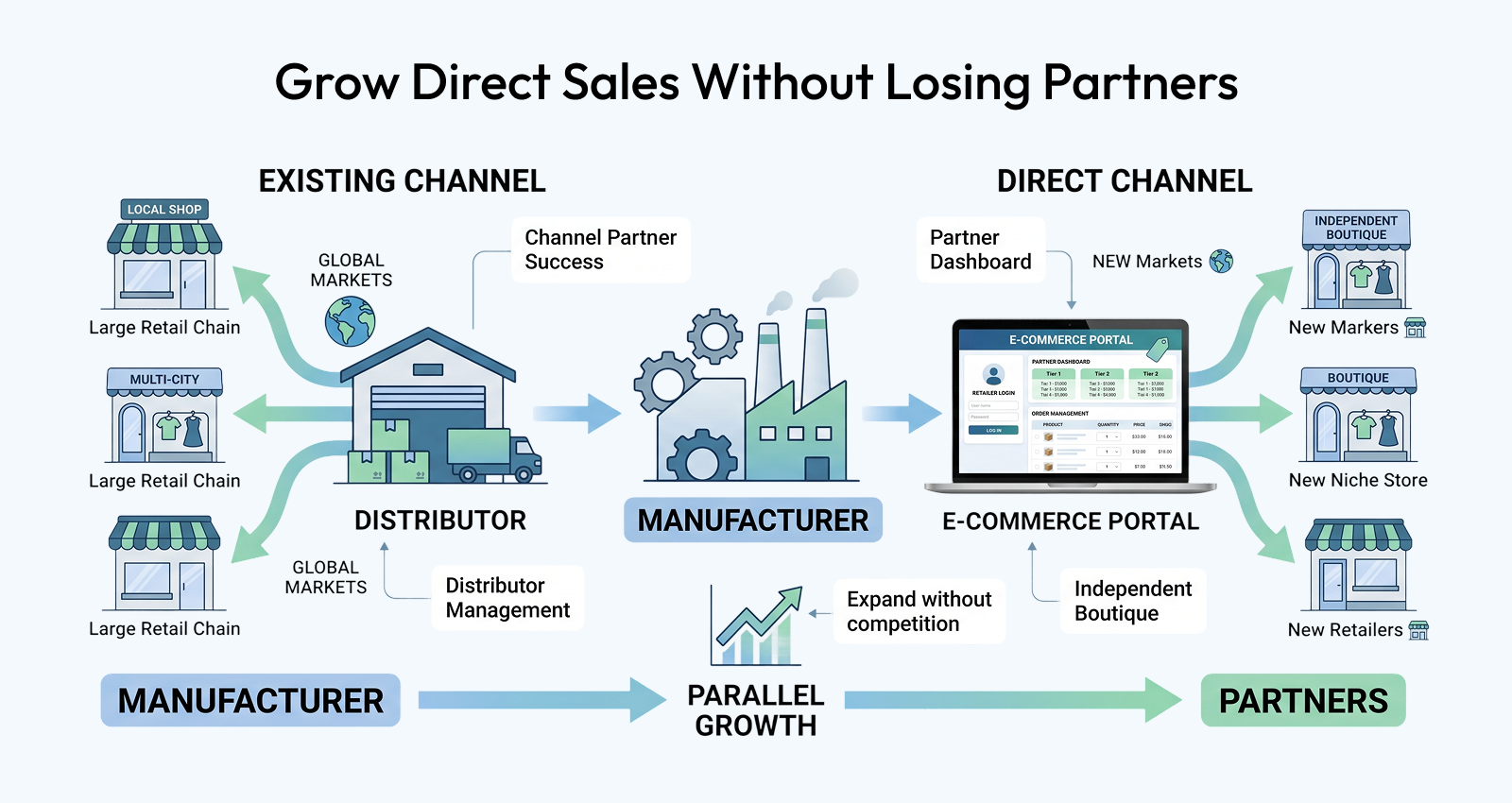
This is the practical challenge that stops many manufacturers from moving. They have existing distributor relationships they depend on, contractual arrangements in some markets, and a legitimate concern that going direct will damage those relationships.
The approach that works best is segmentation by geography or retailer type:
- Build your direct channel for markets or buyer segments where you do not yet have distributor coverage
- Use the direct channel to serve smaller accounts that distributors typically deprioritise
- Position the direct channel as a complement to distributor relationships, not a replacement — initially
- As the direct channel matures, gradually expand its scope where it makes commercial sense
Many manufacturers find that their distributor partners are less threatened than expected, particularly when the direct channel serves a different segment or geography. The more common reaction from distributors is acknowledgment that digital infrastructure is now a competitive requirement, and that manufacturers who invest in it are easier to work with, not harder.
It is also worth noting that direct ecommerce and distribution are not mutually exclusive long term. The most commercially sophisticated manufacturers use both — maintaining distributor relationships where the distributor genuinely adds value (logistics, regional sales force, market access) while building direct relationships with high-value accounts that merit the investment.
Which Platform Should Manufacturers Use for B2B Ecommerce?
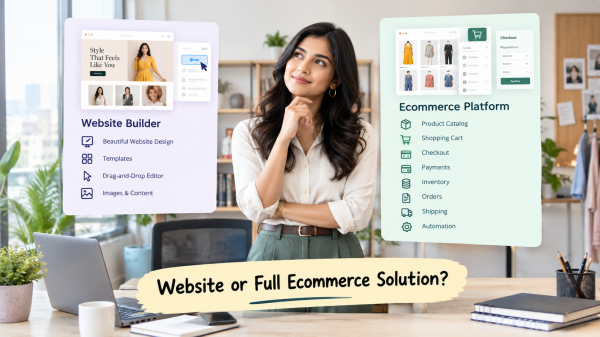
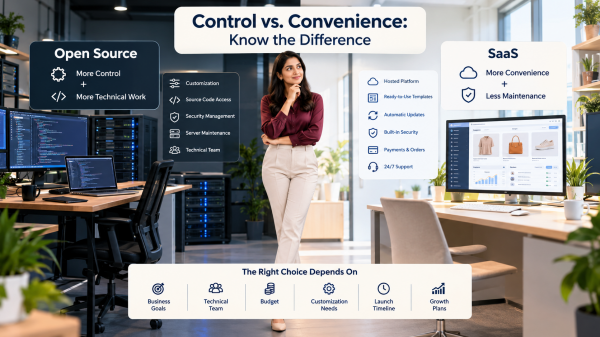
The platform question is where many manufacturers make their most expensive mistake — choosing a consumer ecommerce tool and trying to adapt it for trade selling. The workarounds required are significant, the buyer experience is poor, and the operational overhead of maintaining those workarounds grows with volume rather than shrinking.
The criteria that matter for manufacturers specifically are:
- Native B2B pricing: Account-specific pricing that works automatically, not through discount codes or manual price list maintenance
- Trade account management: The ability to approve buyers, assign pricing tiers, and manage credit limits per account
- MOQ enforcement: Minimum order quantities that prevent below-threshold orders from entering the system
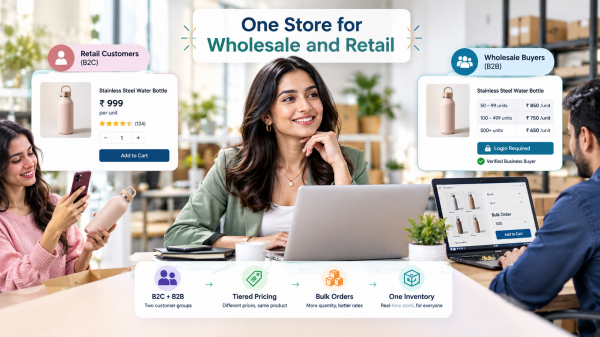
- Dual channel support: The ability to run a consumer storefront and a trade portal from the same platform with separate pricing and catalog rules
- Mobile-first ordering: Trade buyers order from phones at trade shows and warehouses, not just from office desktops
Platforms like Shopaccino are built to handle exactly this complexity — supporting B2B and B2C selling from the same system, with account-based pricing, wholesale buyer portals, and the logistics integrations that manufacturers need, without requiring a development team to configure the basics. For manufacturers who need to run consumer and trade channels simultaneously, a unified platform eliminates the data reconciliation problems that come from maintaining two separate systems.
Whatever platform you evaluate, test it with your real data. Set up three account tiers with different pricing, place a test order that falls below MOQ, and check how the invoice is generated. Platforms that handle your real complexity clearly during evaluation will handle it reliably in production.
Internal link suggestion: See also — ‘B2B Ecommerce Platform for Manufacturers' and ‘Wholesale Ecommerce: Complete Guide for Manufacturers and Distributors' on the Shopaccino blog.
What Are the Most Common Mistakes Manufacturers Make With B2B Ecommerce?
Launching With Incomplete Pricing Structures
The most common and costly early mistake is going live before the pricing logic is properly configured. Retailers who log in and see the wrong price — or worse, the consumer price — lose trust in the system immediately and revert to phone ordering. Price accuracy from day one is not optional. It is the entire value proposition of a self-service ordering channel.
Ignoring the Mobile Experience
Trade shows are still one of the primary contexts where retail buyers decide to add a new manufacturer to their range. A buyer who scans a QR code at a stand and finds your wholesale portal loads slowly or is hard to navigate on a phone has already disengaged. Mobile-first design for trade ordering is as important as it is for consumer ecommerce — possibly more, because the context of use is often less controlled.
Treating It as an IT Project Rather Than a Commercial One
The platform is infrastructure. What actually drives the direct channel's growth is how you market it to retailers, how you onboard new accounts, and how your sales team uses the data the platform generates to deepen relationships. Manufacturers who invest in the technology but not in the commercial motion around it consistently underperform compared to those who treat the launch as a sales channel initiative with a technology component, not the other way around.
Underestimating Retailer Onboarding
Even retailers who want to order digitally need support making the transition. A structured onboarding sequence — a welcome email with login details, a short walkthrough of the portal, a first-order incentive — significantly increases the proportion of approved accounts that become active ordering accounts. Without it, a large portion of approved trade accounts never places a first order through the portal.
The Case for B2B Ecommerce for Manufacturers Has Never Been Clearer
Selling directly to retailers is not a new idea. What is new is how accessible and manageable that direct channel has become through B2B ecommerce for manufacturers platforms built specifically for the complexity of wholesale trade.
The manufacturers winning in 2026 are not just the ones with the best products. They are the ones with the strongest direct retail relationships — owned, not rented through a distributor. They are the ones who know which retailers are growing, which are at risk, and which products are performing where. They are the ones their retail accounts prefer to order from because the experience is fast, accurate, and entirely self-sufficient.
Building that capability does not require a large technology team or a significant budget. It requires choosing the right platform, configuring your pricing and account structure correctly, and making the commercial investment in onboarding the retailers who matter most to your business.
The retailers who will be your highest-value accounts in five years are already ordering from someone. The question is whether that someone is you directly, or a distributor who owns the relationship on your behalf.
The best time to build a direct retail channel was when your distributor first started growing faster than you. The second best time is now, before they become the only route to market you have.
FAQs
B2B ecommerce for manufacturers is selling products directly to retailers, wholesalers, or trade buyers through a digital platform — without requiring a distributor as the intermediary. The platform handles account-specific pricing, trade credit terms, minimum order quantities, and self-service ordering, allowing manufacturers to build and own direct commercial relationships with their retail accounts.
Yes. With the right B2B ecommerce platform, manufacturers can build a wholesale portal where retailers apply for trade accounts, log in to see their negotiated pricing, and place bulk orders independently. The platform manages pricing tiers, credit terms, invoice generation, and order status visibility — replicating what a distributor once managed, but with the manufacturer owning the relationship and the margin.
Through account-based pricing, which assigns each trade account to a pricing tier or a custom price list. When a retailer logs into the wholesale portal, the platform automatically applies their pricing to every product they view. This removes the need for manual quotes and ensures pricing accuracy at scale across hundreds of accounts with different commercial arrangements.
DTC (direct-to-consumer) ecommerce sells products directly to individual buyers at retail prices. B2B ecommerce for manufacturers sells to business buyers — retailers, distributors, trade accounts — at wholesale prices with minimum order quantities, credit terms, and bulk ordering tools. The buyer is a business, the order sizes are larger, and the commercial terms are fundamentally different from consumer transactions.
By enabling manufacturers to build direct ordering relationships with retail accounts, a B2B ecommerce platform reduces reliance on distributors as the only route to market. Manufacturers gain margin on direct orders, access buyer data they previously could not see, and build retailer relationships they own independently. The platform becomes a direct sales channel that compounds over time as more accounts move to self-service ordering.