How to Sell Products Online Internationally
The world is your marketplace — and that's not just a motivational phrase. Today, a small fashion brand, a home decor business, or a B2B wholesaler can reach customers across continents without a single physical storefront abroad. Cross-border ecommerce is growing rapidly, and businesses that act on this opportunity early are the ones building lasting competitive advantages.
But selling internationally isn't simply about flipping a switch and shipping worldwide. It requires the right strategy, the right tools, and a clear understanding of what global customers actually expect. This guide walks you through everything — from setting up your store to handling currencies, logistics, and marketing across borders — so you can sell products online to a truly global audience with confidence. Before you go global, make sure you've covered the 6 essential requirements to start an ecommerce store.
Why Selling Internationally Is Worth the Effort
Before diving into the how, it's worth understanding the why. Domestic markets have natural ceilings. If you're selling home decor, beauty products, or electronics, there are only so many local customers you can reach. International markets multiply your potential customer base dramatically.
Beyond reach, international selling also provides resilience. When one market slows down — due to seasonal shifts, economic changes, or local competition — your revenue from other regions keeps the business stable. Many successful ecommerce brands describe going global as one of the most important decisions they ever made, not because it was easy, but because it fundamentally changed how they thought about growth.
The key is approaching it systematically rather than haphazardly. Selling to customers in different countries introduces complexities around language, currency, payment preferences, shipping, and compliance — but each of these is solvable with the right preparation.
Step 1 — Research Your Target Markets Before Anything Else

Successful international expansion begins with research, not with logistics. The first question to ask is: where is the genuine demand for what you sell?
If you're in the marble and stone industry, your strongest international markets might be construction-heavy economies in Europe or the Middle East. If you sell fashion, Southeast Asia and Western Europe may present more opportunity than other regions. If you're in beauty or skincare, markets like the UK, Australia, and the UAE have well-established online shopping cultures with high average order values.
Look at your existing website analytics. Are visitors already coming from other countries? Which countries are they from, and are they bouncing or actually spending time on your product pages? This data often reveals international demand that already exists but isn't yet being captured.
Also research local competition. Understanding who is already serving your target market — and at what price point — helps you position your brand intelligently rather than entering a market blindly. Official trade data is a good starting point for demand and tariff research, and the International Trade Administration publishes country-level market guides.
Step 2 — Choose the Right Platform to Build Your International Store
Your technology foundation determines how easily you can manage products, currencies, languages, and shipping across markets. This is where your choice of online selling platforms becomes critically important.
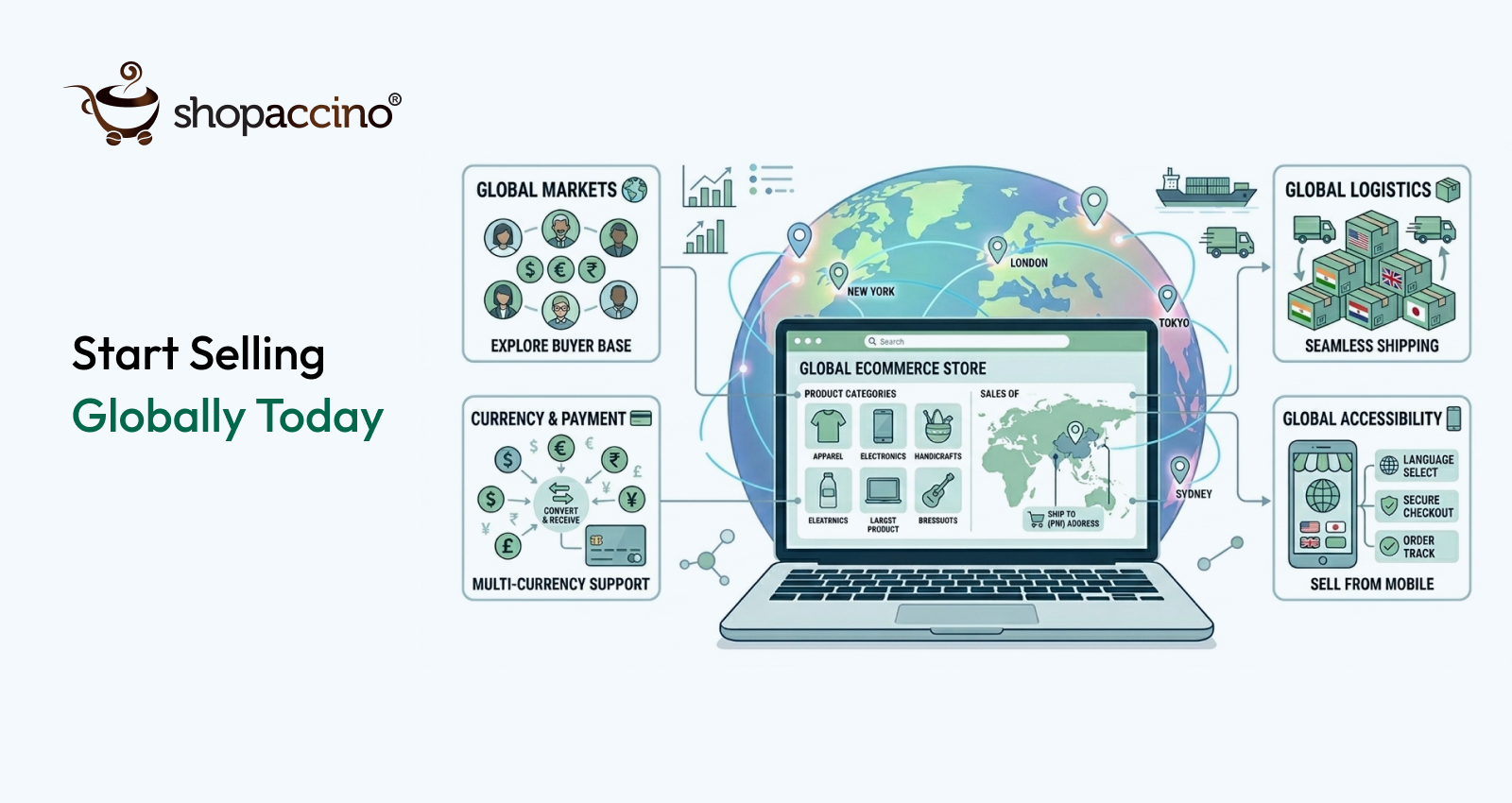
A platform built specifically for ecommerce will serve you far better than a general website builder when you're selling internationally. You need native support for multi-currency pricing, international shipping integrations, tax handling for different jurisdictions, and localized checkout experiences. Without these, you'll spend enormous time patching together workarounds that slow you down and frustrate customers.
When you decide to make your own website to sell items internationally, look for these specific capabilities in a platform: the ability to display prices in local currencies, support for international payment methods, customizable shipping rules by region, and the flexibility to adapt your storefront content for different audiences.
Platforms like Shopaccino are designed with these requirements in mind, offering ecommerce businesses the tools to manage international operations without needing a dedicated tech team — which matters enormously for small businesses and growing D2C brands managing multiple markets simultaneously.
The alternative — using a marketplace like Amazon or eBay for international sales — offers quick access to existing audiences but comes with significant trade-offs: high fees, limited brand control, and dependency on a platform that can change its rules at any time. Many successful international sellers use a combination: their own branded store as the primary channel and marketplaces as supplementary discovery platforms. Exporters selling in bulk have additional needs around catalogs, quotations and buyer accounts, which is covered in our guide to cross-border ecommerce software.
Step 3 — Set Up Multi-Currency and Localized Pricing
One of the fastest ways to lose an international customer is to show them prices in a currency they don't recognize or use. When a shopper in Germany sees prices only in US dollars, they have to mentally calculate the conversion — and most won't bother. They'll simply leave.
Multi-currency support means your store automatically detects where a visitor is browsing from and displays prices in their local currency. This single feature can meaningfully increase conversion rates in international markets.
Beyond just displaying local currency, consider whether your pricing strategy makes sense for each market. A product priced at $49 in the United States might need to be positioned differently in a market where purchasing power is different, or where your competitors are priced lower. Localized pricing — setting specific prices per market rather than just converting a base price — gives you more strategic control.
Also account for VAT and tax requirements. Many countries require you to collect and remit taxes on sales to their residents. As your international volume grows, this becomes a compliance issue you cannot ignore. Most modern ecommerce platforms either handle this automatically or integrate with tax services that do. For a deeper walkthrough of both areas, see how to set up a multi-currency checkout and our guide to managing taxes and currencies for international orders.
Step 4 — Build Trust With International Customers
Here's a challenge many sellers underestimate: international customers are naturally more cautious about buying from an unfamiliar brand. When they can't walk into a store, can't easily return something, and are dealing with potential shipping delays and customs, they need stronger reassurance before handing over their credit card details.
Trust signals are not optional for international ecommerce — they're essential.
Start with a professional, credible-looking store. A poorly designed website signals risk to a cautious shopper. High-quality product photography, clear and detailed product descriptions, and a polished design communicate legitimacy before a word is read.
Customer reviews and testimonials carry enormous weight, especially from buyers in the same region. If you already have satisfied customers internationally, feature their feedback prominently. A review from a verified buyer in the UK means more to a UK shopper than a dozen reviews from buyers elsewhere.
Be explicit about your shipping times and return policy. International customers worry about: how long will delivery take, what happens if the product arrives damaged, and can I return it easily? Address these questions proactively on your product pages, FAQ section, and at checkout. Vague or missing policy information is a conversion killer.
Offering secure, recognizable payment methods also matters significantly. PayPal, Stripe, and local alternatives like RazorPay increase trust because customers are using payment tools they already know and trust. Two things make the biggest difference here: localized checkout experiences that match local habits, and PayPal integration for global buyers, which many international shoppers look for before they commit.
Step 5 — Get International Shipping Right
Shipping is where many international ecommerce ambitions run into real-world friction. Products get delayed at customs, shipping costs erode margins, and delivery time expectations vary wildly between markets.
The foundation of a solid international shipping strategy is working with carriers that have reliable international networks. DHL, FedEx, UPS, and regional carriers each have strengths depending on your product category, destination markets, and average order weight. Compare their rates, delivery time commitments, and tracking capabilities before committing.
Customs and duties are the part most new international sellers get wrong. Depending on the product category and destination country, your customers may face import duties or customs fees on delivery. If this isn't communicated clearly at checkout, you'll face chargebacks, negative reviews, and lost customers. Be transparent: either include duties in your pricing (Delivered Duty Paid / DDP model) or clearly explain that customers may face additional charges on delivery.
Packaging matters too. Products shipped internationally undergo more handling than domestic shipments. Invest in packaging that protects your products through longer journeys and multiple transfers. Damage in transit is expensive to your reputation, not just your bottom line.
For high-volume international sellers, consider regional fulfillment centers. Storing inventory closer to your largest international markets dramatically reduces shipping times and costs. This isn't necessary on day one, but it's a model worth planning toward as your volume grows. If you are setting up carriers and zones for the first time, our guide to managing cross-border logistics covers the practical setup in detail. Product classification determines the duty your customer pays, and the World Customs Organization maintains the HS code system used worldwide. Delivery standards between postal operators are set by the Universal Postal Union.
Step 6 — Localize Your Marketing, Not Just Your Store
There's a difference between translating your content and truly localizing it. Translation is converting words from one language to another. Localization is adapting your messaging, imagery, tone, and offers to genuinely resonate with a specific cultural audience.
Consider an example: a beauty brand selling in Japan versus France. Both are sophisticated markets, but their aesthetic preferences, buying behaviors, and values around beauty are quite different. A campaign that resonates deeply in France may feel tone-deaf or irrelevant to a Japanese consumer. Localizing means understanding these nuances and adapting accordingly.
At a minimum, localize your top-performing product pages, your homepage, and your most important marketing communications into the primary language of your target market. Machine translation tools have improved significantly and can provide a starting point, but always have a native speaker review customer-facing content before it goes live.
For paid advertising internationally, platforms like Meta Ads and Google Ads allow you to create region-specific campaigns with localized creative and messaging. Start with a modest budget to test which messages and product angles resonate in each market before scaling spend.
Email marketing remains one of the highest-ROI channels for international ecommerce. Build segmented lists by country, and tailor your campaigns to include local events, seasonal moments, and culturally relevant hooks. A summer sale campaign sent to customers in Australia needs to be timed for their summer (December–January), not the Northern Hemisphere's.
Step 7 — Manage International Returns Professionally
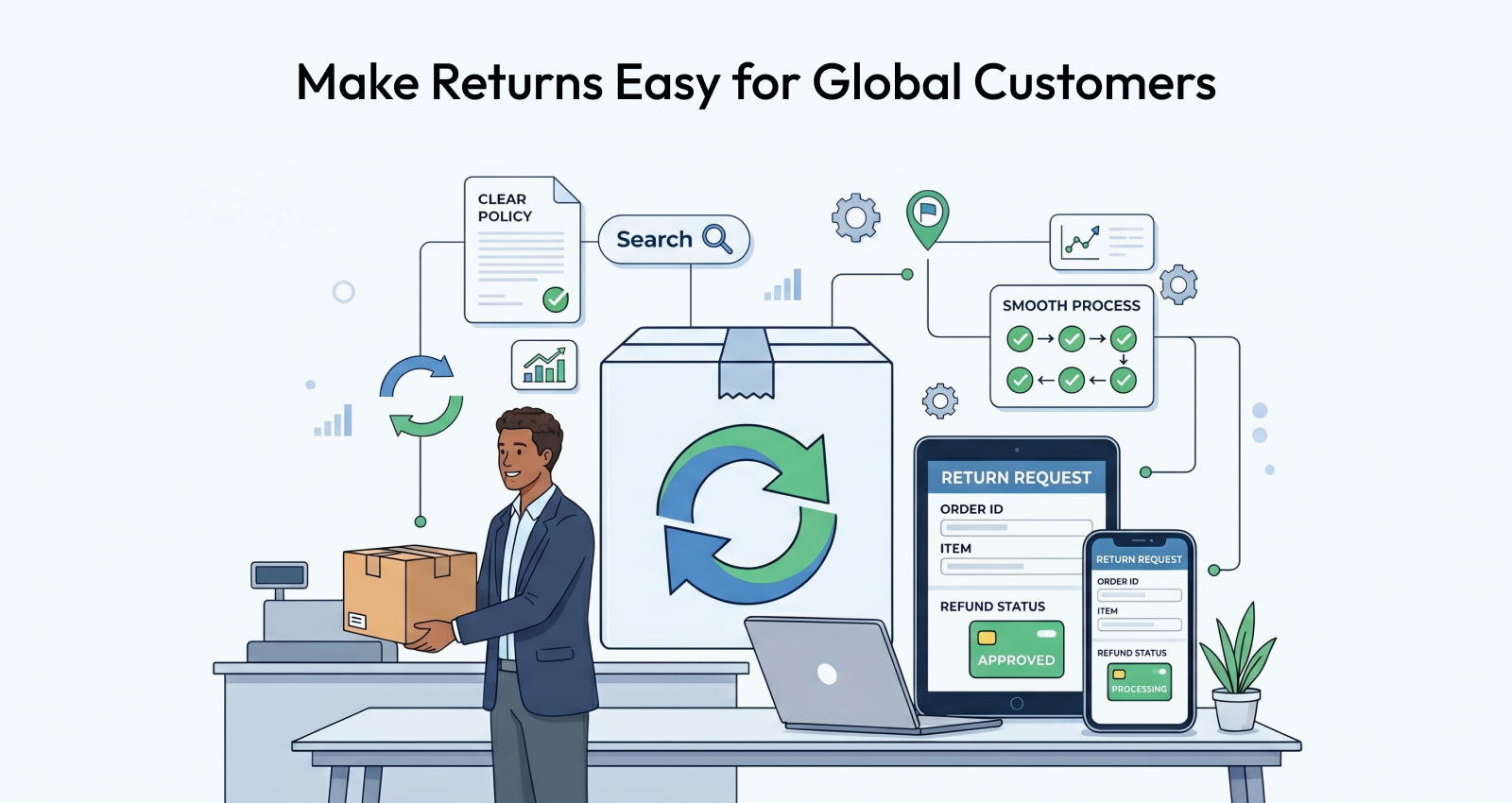
Returns are an unavoidable part of ecommerce. Internationally, they're more complicated — and how you handle them directly affects whether a customer buys from you again.
The most important thing is to have a clear, written international returns policy that customers can find easily before they buy. Ambiguity around who pays return shipping, what the returns window is, and how refunds are processed creates anxiety and deters purchases.
Some international sellers choose a no-returns policy for cross-border orders to manage logistics costs — but this needs to be extremely clearly communicated, and it often increases hesitation at checkout. A better approach for most growing brands is to offer returns but set a longer returns window (60–90 days) to account for international shipping times, and to build return shipping costs into your pricing model so it doesn't erode margins.
High-quality product photography, accurate sizing guides, and detailed product descriptions reduce return rates significantly by helping customers make more confident purchase decisions in the first place. Duties and taxes complicate returns more than most sellers expect, so it is worth reading how to handle duties and returns before you publish your policy. Return rights are set by law in many regions, not by your policy. In the EU, for example, buyers have a statutory withdrawal period explained by the European Commission.
Step 8 — Measure, Learn, and Expand Strategically
Once you're actively selling internationally, the work shifts from setup to optimization. The sellers who scale successfully across borders are those who track performance rigorously and double down on what's working.
Monitor your conversion rates by country. A high traffic volume from a particular market with a low conversion rate signals something — perhaps a language barrier, a currency friction, a payment method gap, or a pricing issue. Investigate before assuming the market simply isn't interested.
Track your average order value and customer acquisition cost by region. Some markets may have lower conversion rates but much higher average order values, making them more profitable than higher-volume markets on pure revenue metrics. This nuance is easy to miss if you're only looking at top-line numbers.
Expand into new markets one at a time rather than trying to be everywhere at once. Entering a new country requires attention — to local regulations, customer expectations, competitive dynamics, and marketing channels. Spreading yourself too thin across too many markets simultaneously is a common reason international ecommerce strategies stall.
When you find a market that responds well — where customers are buying, returning, and leaving positive reviews — that's your signal to invest more: localize further, build dedicated marketing, and explore whether regional fulfillment makes economic sense.
Selling Internationally From India: What Is Different
The eight steps above apply anywhere. If you are exporting from India, four additional pieces need to be in place before your first international order ships.
What Export Documentation Do You Need?
Every export shipment needs an Importer Exporter Code, issued by the Directorate General of Foreign Trade. Alongside it you will prepare a shipping bill, a commercial invoice, and a packing list for each consignment. Courier partners handling low-value ecommerce shipments often file much of this for you, but the IEC has to be in your business name before you start.
How Are Taxes Handled on Exports?
Exports are treated as zero-rated supplies under GST, so you do not charge Indian GST to an overseas buyer. You have two routes: pay IGST upfront and claim a refund, or file a Letter of Undertaking and export without paying it. Most regular exporters choose the LUT route because it avoids blocking working capital in refund cycles.
How Do You Receive Foreign Payments?
Foreign currency receipts have to come through banking channels that generate proof of inward remittance, since your bank and your GST filings both need it. Check that your payment gateway supports export receipts and issues the required documentation before you rely on it, because not every domestic gateway does.
Own Website or Amazon Global Selling and eBay Export?
Marketplaces give you immediate access to buyers, which is genuinely valuable at the start. The trade-off is commission on every order, no control over how your brand appears, and no access to your customer's contact details, which makes repeat purchases difficult to build.
Your own store reverses that: you keep the margin, the branding and the customer relationship, but you have to generate the traffic yourself. Most established exporters end up running both, using marketplaces for discovery and their own store for repeat buyers. Shopaccino supports multi-currency pricing, international payment gateways and region-based shipping rules so the second channel does not need separate development work.
The Opportunity Is Real — Start With a Solid Foundation
International ecommerce isn't reserved for large enterprises with offices around the world. Thousands of small businesses and independent brands successfully sell products online to global customers every day, starting with nothing more than a well-built store, a reliable shipping partner, and a clear understanding of what their international customers need.
The technology available through modern online selling platforms has democratized global commerce in a way that simply wasn't possible a decade ago. The brands that move decisively — building their international presence before competitors in their category do — are the ones that will look back on this period as the decision that changed everything.
Start with research, build on a platform designed for growth, and commit to treating international customers with the same care and attention as your domestic ones. The rest follows from there.
FAQs
Start by researching which markets have demand for your products, then choose an ecommerce platform that supports multi-currency, international shipping, and localized checkout. Set up clear policies for shipping times and returns, and test with one or two target markets before expanding further.
The best online selling platforms for international selling are those with built-in multi-currency support, flexible shipping rules, tax management, and localized checkout. Dedicated ecommerce platforms outperform general website builders for cross-border selling because they're built specifically for these requirements.
No, you don't need a separate website per country. A well-configured single ecommerce store can display local currencies, adapt content for different regions, and handle international shipping rules — all from one platform. Some larger brands use region-specific subdomains, but this isn't necessary when starting out.
Work with established international carriers like DHL, FedEx, or UPS. Clearly communicate customs duties at checkout — either include them in your pricing (DDP) or inform customers they may face additional charges on delivery. Transparent communication prevents disputes and builds customer trust across borders.
To make your own website to sell items internationally, choose a dedicated ecommerce platform that supports multi-currency, global payment gateways, and international shipping integrations. Focus on professional design, localized content, clear policies, and a frictionless checkout experience for international visitors.
Offer a mix of globally recognized and locally preferred payment methods. PayPal and Stripe work across most markets. For regional coverage, consider Klarna in Europe, Afterpay in Australia and the UK. Offering familiar payment options significantly reduces checkout abandonment.
Register for an Importer Exporter Code with the DGFT, file a Letter of Undertaking so you can export without paying IGST upfront, set up a payment gateway that supports foreign currency receipts, and choose between marketplaces and your own store. From there the eight steps in this guide apply as normal.
If you are exporting from India, yes. The Importer Exporter Code is required for commercial export shipments and must be issued in your business name before you ship. It is a one-time registration with no renewal requirement.