
B2B Order Management System Explained: From Inquiry to Invoice
In the world of B2B commerce, nothing moves without structure. Every sale begins long before an order is placed and continues long after products leave the warehouse. Unlike B2C, where shoppers checkout instantly, the B2B buying cycle involves negotiation, bulk pricing, approvals, quotations, dispatch planning, and sometimes multiple delivery milestones. Managing this cycle manually—through emails, spreadsheets, and phone calls—creates delays that can slow down growth and damage relationships.
As brands scale across markets, the complexity increases: more inquiries, more quotations, more shipments, more invoices, and more teams involved in the process. The need for precision becomes non-negotiable. A B2B order management system becomes the backbone of this entire workflow, connecting every step from inquiry to invoice into a single streamlined journey.
This blog breaks down that journey, explains each stage in detail, and demonstrates how an integrated ecommerce platform like Shopaccino helps MSMEs manage B2B operations with enterprise-level control.
Challenging Area: Why B2B Order Management Becomes Complicated
B2B businesses rarely face challenges because of low demand.The real friction comes from mismanaged workflows, disconnected tools, and the rigid nature of traditional processes.
High dependency on manual coordination
Sales teams, warehouse teams, finance teams, and distributors often operate in silos. This leads to miscommunication and slower processing of every request.
Custom pricing requirements
Every buyer may need a different negotiated price, discount structure, or MOQ. Manual handling invites errors and inconsistencies.
Inaccurate stock availability
When real-time inventory is missing, businesses commit to orders they cannot fulfill on time—damaging trust and delaying subsequent cycles.
Approvals that slow down timelines
Many B2B orders require internal approvals or customer approvals before they can move forward. Without automation, this becomes a bottleneck.
Partial payments, credit cycles, and multi-step invoicing
B2B commerce rarely follows a simple “pay now, deliver now” model.
Payment terms vary across:
- Manufacturers
- Exporters
- Wholesalers
- Distributors
- Large retail chains
Managing all these manually increases the risk of financial discrepancies.
Bulk orders with multiple SKUs
B2B orders often contain large quantities, multiple categories, and custom product configurations. Handling these without a system leads to delays in production, packaging, and dispatch.
In short, complexity—not lack of opportunity—is what holds B2B brands back.
Their Customer Challenging Area: What B2B Buyers Expect Today
Your customers—whether they are retailers, institutional buyers, sourcing agents, or distributors—operate under tight deadlines and procurement targets. They expect an ordering experience that mirrors modern digital standards.
Transparent and real-time pricing
Buyers expect clarity. They want to see negotiated prices, bulk discounts, and taxes upfront.
Faster quotation and approval cycles
Long waiting times push buyers toward competitors who respond quickly.
Accurate inventory visibility
Retailers place orders based on demand forecasts. Incorrect stock information affects their entire supply chain.
Multi-channel ordering
B2B customers want the flexibility to order from:
- A portal
- A mobile app
- A sales representative interface
Timely dispatch and documentation
B2B logistics include:
- Part shipments
- Consolidated invoices
- GST-compliant documentation
- Export documentation for cross-border sellers
Mistakes in these areas create legal and operational challenges.
Reliable communication at every step
Buyers expect updates when:
- Quotation is ready
- Order is confirmed
- Shipment is dispatched
- Invoice is generated
Modern buyers no longer tolerate uncertainty.
Solution: How an Integrated B2B Ecommerce Platform Solves These Issues
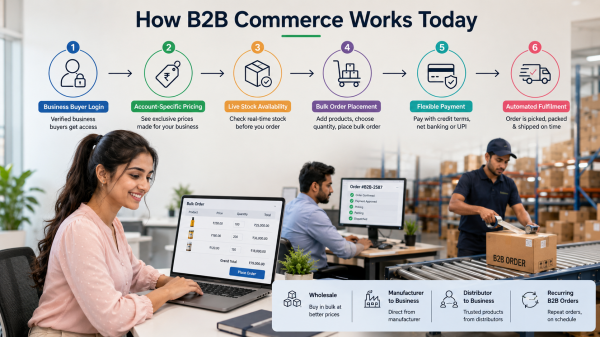
A modern B2B order management system synchronizes every stage—from the first inquiry to the final invoice—into a unified workflow. It eliminates manual follow-ups and adds automation where accuracy is essential.
With an integrated system like Shopaccino, businesses can manage:
- B2B catalog with role-based access
- Customer-specific pricing
- Quotations
- Approval workflows
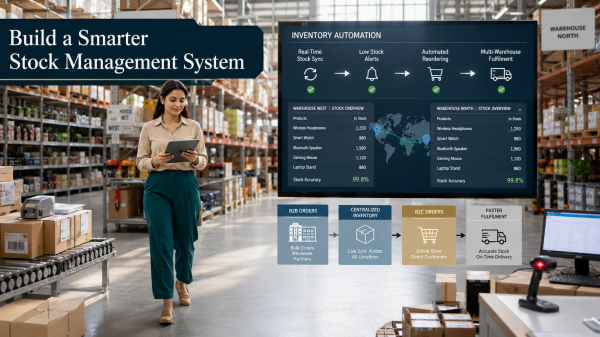
- Real-time inventory sync
- Bulk order processing
- Order routing to warehouses
- Part shipments
- Credit and payment terms
- GST-compliant invoices
Instead of scattered communication, everything happens in one connected environment.
B2B Order Management System Explained: From Inquiry to Invoice
Inquiry or Lead Generation
The B2B cycle begins when a buyer expresses interest—via website form, sales call, email, or distributor outreach.
A structured system helps capture:
- Buyer details
- Business category
- Requirement summary
- Urgency or order timeline
This is where the brand determines whether the buyer belongs to:
- Established D2C Brands
- Exporters
- Manufacturers
- Wholesalers
- Distributors
The categorization helps assign pricing tiers and order handling rules later.
Product Selection and Custom Pricing
After the inquiry is registered, the buyer or sales team navigates through a restricted-access catalog designed for B2B buyers.
The system allows:
- Customer-specific pricing
- MOQ-based pricing
- Bulk discounts
- Tiered pricing
- Custom tax and shipping rules
This is where a B2B product catalog differs from regular ecommerce—every buyer sees the version curated specifically for them.
Quotation Generation (RFQ to Quote)
The next major step is generating a quotation.
A strong B2B OMS handles:
- Multiple SKUs
- Quantity-based pricing
- Validity period
- Tax calculation
- Custom shipping charges
- Additional notes or terms
In a traditional setup, this stage alone takes days. With automation, quotations can be generated within minutes.
Approval Workflows
Once the quotation is shared, approvals may be required on both sides.
- Buyer’s internal team may need management approval.
- Seller’s internal team may need credit approval or stock verification.
The system keeps progress visible, eliminates back-and-forth communication, and avoids misinterpretation.
Order Confirmation
When the buyer approves the quotation, it seamlessly converts into an order.
The system handles:
- PO number
- Advance payment (if applicable)
- Credit terms
- Delivery preferences
- Warehouse assignment
For large exporters and manufacturers, this is the most crucial stage, as it triggers production or stock allocation.
Warehouse Processing and Fulfillment
Once the order is confirmed, warehouse teams receive structured picking lists.
A system-driven approach ensures:
- Part shipments
- Batch-wise stock management
- QC verification
- Packaging instructions
- Multi-warehouse routing
Brands with multiple warehouses benefit from automated warehouse assignment, reducing lead time and minimizing shipping costs.
Dispatch and Tracking
After fulfillment, the system generates:
- Shipping labels
- Waybills
- Consignment notes
- Packing slips
Tracking details are shared automatically with buyers, ensuring transparency.
Invoice Generation
The final stage is invoice creation.
B2B invoices require:
- GST compliance
- HSN codes
- Dynamic tax calculation
- Partial or consolidated invoicing
- Export invoice formats
An integrated system generates accurate invoices instantly, reducing errors and speeding up the payment cycle.
This completes the journey—from inquiry to invoice—with every stage streamlined.
How to Implement a B2B Order Management Workflow (Step-by-Step)
Map your current B2B workflow
Document your existing steps: inquiry → quotation → confirmation → dispatch → invoice.
Define your customer segments
Segment buyers into categories such as:
- Established D2C Brands
- Exporters
- Manufacturers
- Wholesalers
- Distributors
This helps set pricing logic and ordering rules.
Create your B2B catalog
Upload products with:
- Customized prices
- MOQ requirements
- Bulk discounts
- Variant-level specifications
Set up quotation templates
Configure fields for:
- Validity
- Taxes
- Shipping rules
- Approval settings
Connect your inventory
Enable real-time inventory sync so every buyer interacts with accurate stock data.
Enable approval workflows
Define internal and external approvals required at each stage.
Automate warehouse routing
Assign rules based on:
- Location
- Customer type
- Order size
Implement invoicing and documentation tools
Ensure compliance and automation for:
- GST invoices
- Export invoices
- Credit terms
With the right setup, the system runs smoothly with minimal human intervention.
Benefits of a B2B Order Management System
Faster Sales Cycles
Automation shortens the inquiry-to-order timeline significantly.
Reduced Manual Errors
From pricing to invoicing, the system eliminates inconsistencies.
Improved Customer Trust
Accurate stock, transparent pricing, and timely communication build long-term relationships.
Operational Efficiency
Warehouse teams, sales teams, and finance teams operate in sync.
Scalability
Whether adding new distributors or selling internationally, the process remains consistent.
Higher Repeat Orders
B2B buyers are more likely to reorder when the experience is smooth and predictable.
Conclusion
In B2B commerce, operational excellence matters as much as product quality. The journey from inquiry to invoice has multiple moving parts, and without a systemized process, delays and miscommunication become inevitable. A reliable B2B order management system introduces structure where it is needed the most—simplifying negotiations, improving transparency, and eliminating manual errors.
With the right platform, MSMEs gain the operational strength of large enterprises. Shopaccino helps businesses streamline quotations, automate approvals, manage large orders, handle multi-warehouse workflows, and generate compliant invoices effortlessly.
Whether you’re an Established D2C Brand, Manufacturer, Exporter, Wholesaler, or Distributor, an integrated B2B order management workflow becomes your competitive advantage—reducing inefficiencies and accelerating growth in a rapidly evolving global marketplace.
FAQs
It is a structured system that manages the entire B2B buying cycle—from inquiry, quotation, and approval to fulfillment and invoicing.
B2B involves bulk orders, custom pricing, negotiated terms, and approval cycles, which require a more advanced workflow.
Yes. A modern OMS supports tiered pricing, MOQ-based pricing, and negotiated structures.
Yes. Orders can be automatically routed to the right warehouse based on rules.
Yes. The system generates GST-compliant and export-ready invoices.
Shopaccino includes powerful B2B features such as quotations, custom pricing, approval flows, and multi-warehouse routing.
Absolutely. Automation cuts manual coordination, speeds up order cycles, and improves accuracy.