Ecommerce SEO Checklist 2026: Step-by-Step Guide to Rank Higher & Get Free Organic Traffic
Ecommerce in 2026 is more competitive than ever. Customers no longer shop only through marketplaces - they search on Google, browse social media, ask questions on voice assistants like Alexa or Google Assistant, and even rely on AI-powered platforms. If your ecommerce store does not appear where customers are searching, you risk losing both visibility and sales.
Paid advertising alone is no longer sustainable. Ad costs continue to rise, competition has intensified, and customers trust organic results more than ads. This is where Ecommerce SEO (Search Engine Optimization) becomes the most powerful growth channel - helping you attract free, long-term, high-intent organic traffic without constant spending.
This comprehensive Ecommerce SEO Checklist 2026 is written for business owners, ecommerce founders, D2C brands, wholesalers, and marketers - even if you do not understand technical SEO. Everything is explained in simple, human language so you can confidently implement it for your store.
Why Ecommerce SEO Matters More Than Ever in 2026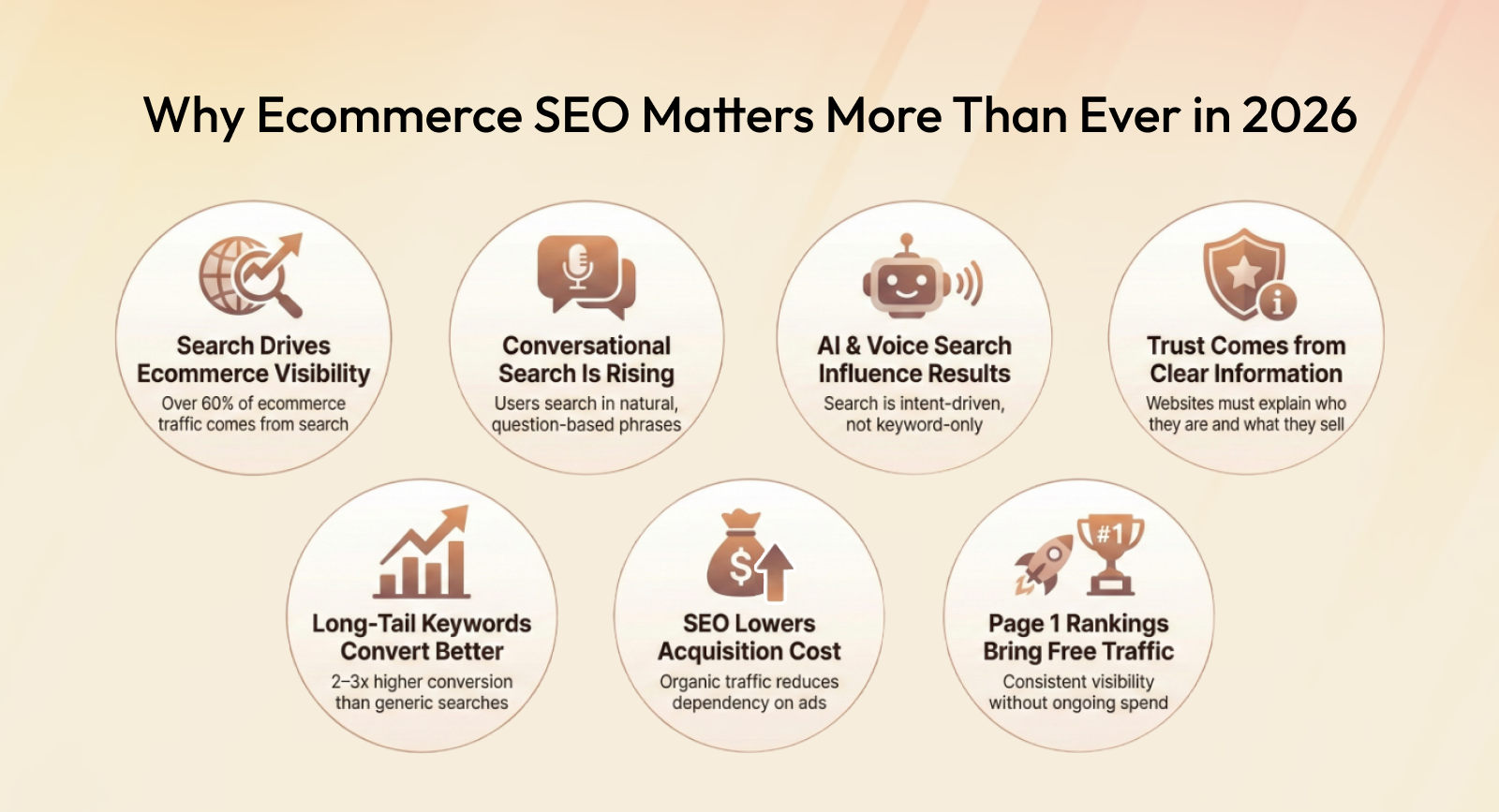
Ecommerce success now depends on visibility, trust, and experience. Customers search differently than before. Instead of short keywords such as “running shoes,” they use natural, conversational searches like:
- best lightweight running shoes under 3000
- Which organic shampoo is safest for babies
- gold jewellery designs with hallmark certification
Search is no longer keyword-only. It is intent-driven, voice-driven, and experience-driven - supported by AI understanding. That means your ecommerce website must clearly explain who you are, what you sell, and why customers should trust you.
Key Ecommerce SEO Insights
- Over 60% of ecommerce traffic comes from search engines
- Long-tail keywords convert 2–3x higher than generic phrases
- SEO reduces Customer Acquisition Cost (CAC) significantly
- Websites ranking on Page 1 enjoy consistent free traffic
- Voice & AI-driven search is rapidly growing
Conclusion:
In 2026, SEO is not just a marketing tactic -
It is the foundation of ecommerce growth, trust, and profitability.
Ecommerce SEO Checklist 2026
To make SEO simple, we will break the process into clear sections:
- Website Technical SEO
- Keyword Research
- On-Page Content SEO
- Post-Publishing SEO
- Category Page SEO
- Product Page SEO
- Voice Search & AEO Optimization
- Practical SEO Tips for Ecommerce Success
Each step is written in simple, easy-to-understand language.
Website Technical SEO
Technical SEO ensures your website is search-friendly, fast, secure, and properly indexed. Without technical SEO, even the best content will struggle to rank.
These actions create the foundation for long-term organic success.
Set Up Google Search Console
Registering your ecommerce website on Google Search Console is one of the most important first steps in SEO. This free tool helps you communicate directly with Google. When you verify your site, Google officially recognises you as the site owner and allows you to track how your website appears in search results. You can see which pages are indexed, what keywords people use to find your site, how much traffic your pages receive, and whether Google is facing any issues while crawling your website.
This tool also alerts you to technical problems such as slow loading pages, mobile usability issues, and indexing errors. Without Search Console, you would be completely unaware of how Google views your site. For ecommerce stores, this is critical because you constantly add and update product and category pages. Search Console ensures Google can see and understand these pages correctly.
Key Stats:
• Allows Google to recognise and monitor your website
• Helps detect indexing and technical SEO issues
• Provides keyword and search performance insights
Impact:
Ensures your products appear in Google search results sooner and remain visible.
Optimise and Submit an XML Sitemap
An XML sitemap is like a directory of your website pages that you share with search engines. It lists your product pages, categories, blog articles, and important sections so search engines can easily discover and index them. Without a sitemap, search engines may miss some pages - especially deep product URLs or newly added listings.
Submitting your sitemap through Search Console and Bing Webmaster Tools ensures faster and more accurate indexing. For ecommerce, this is essential because product pages frequently change or get added. The sitemap keeps search engines updated with your latest content.
Most ecommerce platforms generate sitemaps automatically, but you should still confirm it works correctly and includes relevant pages. A clean sitemap improves crawl efficiency and helps your site structure remain organised.
Think of it as giving search engines a roadmap to your store instead of letting them explore blindly.
Key Stats:
• Ensures search engines discover important pages
• Helps new and updated pages get indexed faster
• Improves crawl efficiency and site structure
Impact:
New products get discovered and indexed much sooner.
Set Up Google Analytics
Google Analytics allows you to track and understand how visitors interact with your ecommerce website. It tells you where your traffic comes from, which pages users visit, how long they stay, and whether they make purchases. This information is critical for improving SEO, including international SEO services, marketing, user experience, and conversion rates.
Analytics helps you measure which traffic sources perform best - such as search, social media, email, or ads. You can also identify slow-loading pages, pages with high bounce rates, and areas where customers drop off before completing purchases.
For ecommerce stores, data-driven decisions significantly improve growth. Instead of guessing what works, you can clearly see real user behaviour. Over time, this allows you to optimise content, fix weak pages, improve navigation, and refine product strategy.
Analytics turns website performance into measurable insights - making SEO and marketing more strategic and effective.
Key Stats:
• Tracks user behaviour and purchase journeys
• Helps identify high-performing content and traffic sources
• Enables data-driven decision-making for SEO and growth
Impact:
You make decisions based on real customer behaviour - not guesswork.
Improve Website Speed (Including Core Web Vitals)
Website speed is one of the most important ranking and user-experience factors in ecommerce SEO. A fast online store loads quickly, responds instantly, and feels smooth to browse. Slow websites frustrate visitors, increase bounce rate, reduce conversions, and rank lower in search engines - because Google wants to show users websites that deliver the best experience.
For ecommerce stores, speed is directly linked to revenue. If your product pages or checkout take too long to load, users leave before buying. To measure real-world website speed and usability, Google uses Core Web Vitals, which focus on three key areas:
• LCP (Largest Contentful Paint) - how fast the main content loads
• INP (Interaction to Next Paint) - how quickly the site responds when users click or tap
• CLS (Cumulative Layout Shift) - how stable the page layout is while loading
In simple terms - your ecommerce website should load fast, respond instantly, and avoid shifting elements while users browse.
Improving speed includes optimising images, reducing heavy scripts, enabling caching, using a strong hosting server, and testing regularly - especially on mobile. Even a 1-second improvement can significantly increase conversion rates.
Key Stats:
• A 1-second delay can reduce conversions by 7-10%
• Users abandon pages that take over 3 seconds to load
• Fast websites consistently rank higher and convert better
Impact:
Fast loading improves rankings, engagement, and revenue while delivering a smooth, trustworthy shopping experience.
Adopt a Mobile-First Design
Most ecommerce traffic today comes from mobile devices. Search engines now use "mobile-first indexing," meaning they evaluate and rank your site primarily based on its mobile version. If your store is not optimised for mobile, your rankings and sales will suffer.
Mobile-first design means your site should be easy to navigate on small screens. Text should be readable, buttons should be tap-friendly, and checkout should be smooth. Pages must load quickly on mobile networks.
A poor mobile experience leads to frustrated users, abandoned carts, and reduced visibility in search engines. On the other hand, a user-friendly mobile site improves engagement, trust, and SEO performance.
Design for mobile users first - and then adapt for desktop.
Key Stats:
• Mobile experience now directly affects search rankings
• Most ecommerce users browse and shop via smartphones
• Better mobile design improves engagement and conversions
Impact:
Better rankings and smoother customer experience.
HTTPS Security
HTTPS Security ensures that your ecommerce website uses encrypted communication between the server and the user’s browser. This prevents data theft, protects payment information, and builds customer trust. When your site is secured with an SSL certificate, users see the padlock symbol in the browser - indicating safe browsing. Search engines treat HTTPS as a ranking signal because security is essential for user protection, especially in ecommerce transactions.
A non-secure (HTTP) website displays warning messages like “Not Secure,” which instantly reduces trust and can cause customers to leave before browsing or purchasing. HTTPS also protects login details, personal data, and order information. For ecommerce brands, this is not optional - it is mandatory for credibility, payment gateway compliance, and SEO performance.
Security strongly influences brand perception. Customers trust websites that protect them.
Key Stats:
• 85% of users avoid purchasing from “Not Secure” websites
• Google confirmed HTTPS as a ranking factor
• Secure websites see up to 30% higher checkout completion rates
Impact:
HTTPS security builds trust, protects customer data, and improves both rankings and conversion performance.
Canonical Tags
Canonical tags help prevent duplicate content issues when similar or identical pages exist - which is very common in ecommerce due to product variations, filters, or tracking parameters. A canonical tag tells search engines which version of a page is the “main” or preferred one. This prevents dilution of ranking signals and ensures the correct page appears in search results.
Without canonical tags, search engines may treat multiple URLs as separate pages, causing confusion and weaker ranking performance. For ecommerce stores with large inventories, proper canonicalisation keeps SEO clean and structured.
Key Stats:
• Duplicate content can impact up to 30–50% of ecommerce URLs
• Canonical tags help consolidate ranking authority
• Ecommerce websites without canonicals face higher crawl inefficiency
Impact:
Canonical tags prevent duplicate content issues and ensure ranking authority remains focused on the correct pages.
Set Up and Optimise Your Robots.txt File
A robots.txt file tells search engine crawlers which parts of your ecommerce website they are allowed to access and which areas should not be crawled. This helps search engines focus on the most important pages - such as product pages, category pages, and informative content - while avoiding unnecessary pages like admin panels, search filters, cart pages, or duplicate URLs.
For ecommerce websites, this is especially useful because your store may generate many URLs through filters, sorting options, tracking parameters, and internal system pages. If search engines crawl everything, it can waste crawl budget, slow indexing, and sometimes create duplicate content issues. A properly configured robots.txt file ensures search engines only crawl meaningful, SEO-friendly pages.
It is also important not to block pages that should rank, such as product or category pages. Robots.txt should always be handled carefully - ideally tested using Google Search Console - to avoid accidental de-indexing.
In short, robots.txt is not about hiding your website.
It is about guiding search engines wisely.
Key Stats:
• Helps search engines crawl important pages more efficiently
• Prevents unnecessary or duplicate URLs from being indexed
• Reduces server load and crawl budget waste
Impact:
A well-configured robots.txt file ensures search engines index your most valuable ecommerce pages efficiently and accurately.
Keyword Research
Keyword research helps you understand what customers search for - and how to align your content with their needs.
Find Keywords Relevant to Your Business
Keyword research means understanding what customers search for when looking for your products. Instead of focusing on single-word terms, use long-tail, meaningful phrases that match real buying behaviour.
Relevant keywords ensure that your content attracts the right audience - people who are actually interested in your products.
Key Stats:
• Aligns content with real customer searches
• Improves traffic quality and conversions
• Reduces competition compared to generic keywords
Impact:
Higher relevance leads to higher conversions.
Confirm Search Volumes
Search volume tells you how many people search for a keyword each month. Targeting phrases with measurable search volume ensures consistent traffic potential.
Some keywords are popular but too broad, while others are highly focused and effective. Balancing both helps build a solid strategy.
Key Stats:
• Prevents targeting low-traffic keywords
• Helps prioritise content efforts
• Ensures meaningful organic reach
Impact:
You prioritise keywords that drive real results.
On-Page Content SEO
This covers everything visible on your website - content, layout, keywords, and structure.
Include Your Target Keyword in Important Areas
Including your main keyword in the right places on a page helps search engines clearly understand what the page is about. This is not about stuffing keywords everywhere. Instead, it is about using them naturally in important locations such as the page title, meta description, H1 heading, first paragraph, sub-headings, and some body content. Search engines scan these areas first when determining relevance. When your keyword appears here in a natural way, it signals strong alignment with the user’s search intent.
For ecommerce stores, this is especially important for product and category pages. The keyword should describe what the page offers, while still sounding natural to human readers. For example, instead of forcing “buy cheap ladies shoes online India,” use clear wording like “Affordable Ladies Shoes Online in India.” The meaning remains, but readability improves.
Remember: write for customers first and optimise for search engines second. Clear, useful, descriptive content ranks best in 2026 - especially in voice and AI-powered search environments.
Ensure your primary keyword appears naturally in:
• Page title
• Meta description
• H1 heading
• First paragraph
• Subheadings
• Some body text
Key Stats:
- Avoid keyword stuffing or unnatural repetition
- Use keywords naturally in titles, headings, and introductions
- Focus on clarity, meaning, and user experience
Impact:
Search engines easily understand page relevance.
Keep URLs Short & Keyword-Focused
Short, clean, descriptive URLs help both users and search engines understand what a page contains. A good ecommerce URL is easy to read, share, remember, and interpret. For example:
Correct style:
/organic-baby-soap-gentle-formula
Poor style:
/12345/product/?ref=xyz
Short URLs look professional, reduce confusion, and improve SEO value. When your main keyword appears in the URL, it reinforces page relevance. This matters when your links are shared externally or picked up by search engines. Long or messy URLs may be ignored or mistrusted by users.
Keeping URLs simple also helps AI-driven search systems categorise your content accurately. Over time, your URL structure becomes part of your site’s identity - so keep it logical and consistent.
Example:
/organic-baby-soap-gentle-formula
Key Stats:
- Short URLs improve readability and trust
- Keyword-based URLs enhance search relevance
- Clean structure supports AI and search indexing
Impact:
Improves clarity, trust, and ranking.
Optimize Images for Speed
Images are essential in ecommerce - but large, uncompressed images slow websites down. Slow sites not only frustrate users but also rank lower in search engines. Image optimisation means compressing images without losing quality, using correct file formats, resizing for screen display, and lazy-loading where possible.
When images are lightweight, pages load much faster. This improves user experience, reduces bounce rate, increases conversions, and benefits SEO ranking. Optimised images also reduce server load and bandwidth usage - making the entire site more efficient.
In ecommerce, product images are critical for decision-making. The goal is to deliver high-quality visuals while maintaining performance. Search engines reward websites that balance quality and speed.
Key Stats:
- Faster image delivery improves SEO and conversions
- Compression reduces file size without quality loss
- Speed is a key ranking and trust signal
Impact:
Better performance and rankings.
Add Alt Tags to All Images
Alt tags describe an image using text. This serves three important purposes. First, it helps search engines understand the image content - which improves SEO. Second, it supports accessibility by allowing screen readers to describe visuals to visually impaired users. Third, alt text appears when images fail to load, providing context for users.
For ecommerce stores, alt text allows your product images to appear in image search results - creating another valuable traffic channel. Alt descriptions should be simple, clear, and descriptive. Avoid stuffing keywords - instead describe what the image shows, including product name where relevant.
Key Stats:
- Improves accessibility and user experience
- Helps images rank in search results
- Provides context when images don’t load
Impact:
Improves SEO and user experience.
Use Internal Links
Internal links connect pages within your own website. This improves navigation, helps search engines crawl pages, and distributes authority across your site. For ecommerce, this includes linking between product pages, category pages, size guides, FAQs, blog posts, and support articles.
Internal linking keeps users engaged longer and guides them toward relevant content. It also strengthens priority pages by directing traffic and authority signals to them.
Strategic linking improves both SEO and user experience - making your website easier to explore.
Key Stats:
- Improves crawlability and authority flow
- Keeps users browsing longer
- Helps rank strategic priority pages
Impact:
Strengthens SEO structure and keeps users engaged.
Use Keyword Clustering & Semantic Optimization
Keyword clustering means grouping related keywords and topics rather than focusing on just one phrase. This aligns with how modern search engines understand meaning and context. Instead of writing shallow content targeting one keyword, you create deeper, topic-based content that covers related questions and variations.
For ecommerce, this means considering purchase intent, variations, features, materials, benefits, and comparisons. This approach improves topical authority, ranking potential, and user satisfaction.
Key Stats:
- Aligns content with real search behaviour
- Strengthens topic authority
- Improves ranking for multiple search terms
Impact:
Better coverage = stronger rankings.
Use Visual Elements to Increase Dwell Time
Dwell time refers to how long visitors stay on a page. Search engines use it as a signal of engagement and relevance. Adding visual elements such as product images, videos, comparison charts, usage demos, infographics, and guides makes content more interesting and easier to understand.
For ecommerce, visuals reduce confusion, improve trust, and help shoppers feel confident in their purchase decisions. Better engagement leads to stronger SEO performance.
Key Stats:
- Visuals improve engagement and time-on-page
- Enhances understanding and decision-making
- Positively supports SEO ranking signals
Add Schema Markup
Schema markup helps search engines understand key information about your products, such as price, rating, availability, and brand. This enables rich results like review stars and price displays in search listings.
Rich results increase visibility, click-through rate, and trust - because users see useful information before clicking. Schema also supports AI-driven platforms and future-ready search formats.
Key Stats:
- Enables enhanced search result display
- Improves click-through rates
- Strengthens meaning and structure clarity
Impact:
Enables rich results and higher click-through rate.
Post-Publishing SEO
SEO continues even after publishing.
Keep an Eye on Your Google Search Engine Rankings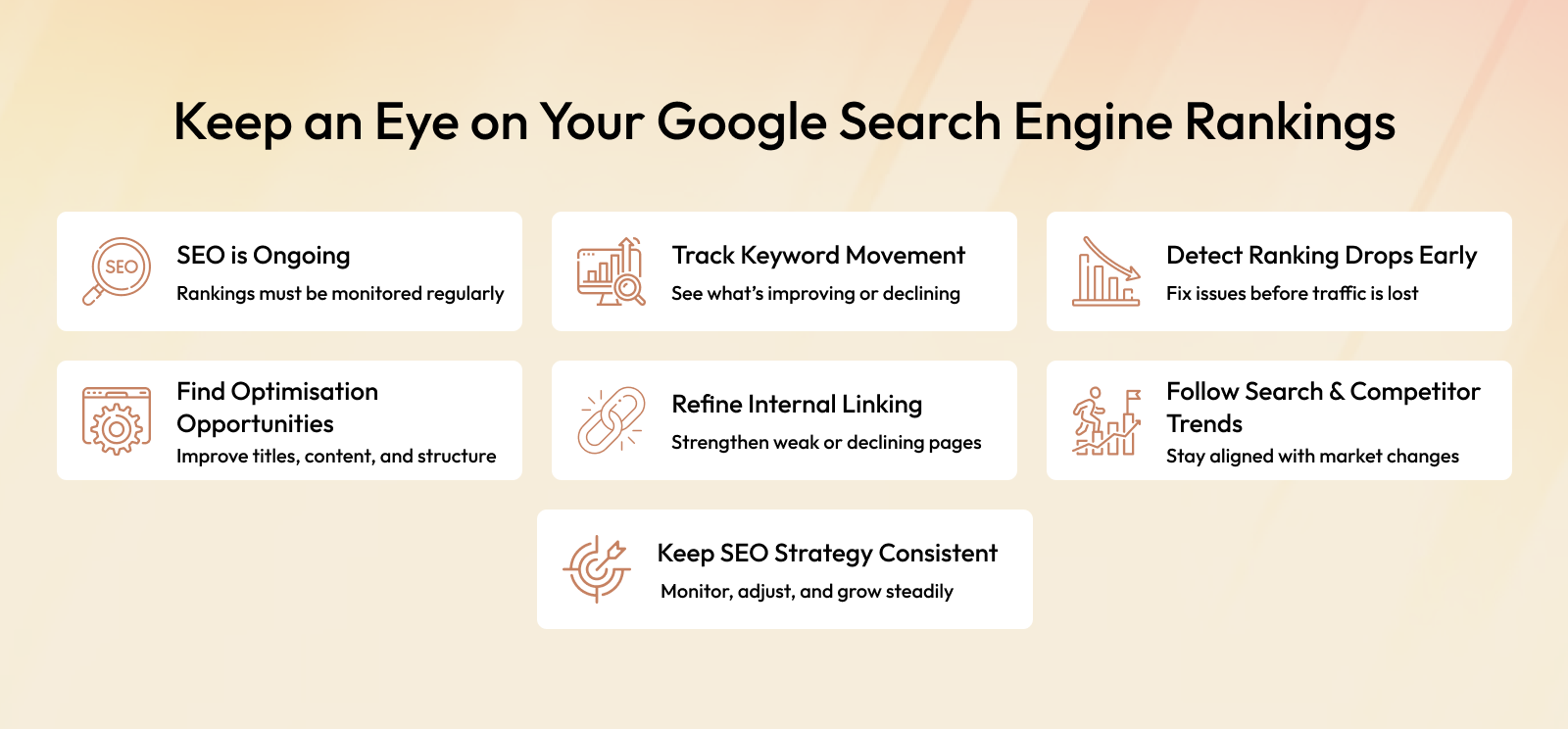
SEO is ongoing. After publishing content or launching new products, you must regularly monitor search rankings. This helps you understand which keywords are improving, which are declining, and where optimisation is needed. Ranking movement also reveals search trends and competitive changes.
Tracking performance allows you to refine titles, content, structure, and internal links. Without monitoring, you miss opportunities to improve - or recover from declines.
Monitoring ensures SEO progress remains consistent and strategic.
Key Stats:
- Detects ranking drops early
- Identifies improvement opportunities
- Helps refine SEO strategy over time
Impact:
Detect changes early.
Optimize Google CTRs (Click-Through Rates)
CTR measures how many people click your search result compared to how many see it. Even if you rank well, a poor title or description may result in fewer clicks. Optimising CTR means making titles clear, relevant, engaging, and informative - without being misleading.
Improving CTR increases traffic without needing higher rankings - making it one of the most efficient SEO techniques.
Key Stats:
- Increases organic traffic without ranking change
- Improves search visibility and engagement
- Signals relevance to search algorithms
Impact:
Higher traffic without ranking change.
Republish Outdated Content
Old or outdated content loses relevance and ranking value. Updating content with new information, improved formatting, updated keywords, and better structure helps restore performance.
Republishing shows search engines that your website remains active and current - which supports SEO strength.
Key Stats:
- Restores relevance and ranking potential
- Improves user trust
- Supports long-term SEO stability
Impact:
Search engines favour fresh content.
Regularly Prune Irrelevant Content
Low-quality or outdated pages may harm overall SEO. Removing or consolidating weak content improves average site quality.
Pruning ensures your website remains focused, useful, and efficient to crawl.
Key Stats:
- Improves overall site authority
- Removes ranking-weak pages
- Focuses value on strong content
Impact:
Cleaner site = better performance.
Keep an Eye on Google Search Console Crawl Errors
Crawl errors indicate search engines cannot properly access certain pages. This may happen due to broken links, incorrect redirects, blocked resources, or server issues.
Fixing crawl errors ensures smooth indexing - which is essential for ecommerce stores with large inventories.
Key Stats:
- Prevents index loss
- Improves site health
- Ensures full search visibility
Impact:
Fixing crawl errors ensures all important pages remain indexed and discoverable, preventing sudden ranking and traffic loss.
Fix Broken Links
Broken links create a poor user experience and damage SEO trust. They signal outdated maintenance and frustrate visitors.
Regularly scanning and repairing links keeps your website reliable, professional, and search-friendly.
Key Stats:
- Improves navigation and credibility
- Protects SEO performance
- Reduces bounce risk
Impact:
Repairing broken links improves user experience, strengthens trust signals, and protects your website’s overall SEO performance.
Build High-Quality Backlinks
Backlinks are links from other reputable websites that point to your ecommerce store. Search engines treat these links like votes of confidence. The more trustworthy and relevant websites that link to you, the more reliable and authoritative your site appears - which helps improve rankings. For ecommerce, backlinks are particularly powerful because they not only support SEO but also bring referral traffic and brand visibility.
High-quality backlinks usually come from industry blogs, media sites, brand mentions, supplier websites, business directories, product reviews, partnerships, and educational content. The goal is quality over quantity. A single link from a respected website is far more valuable than dozens of links from weak or spammy sites. Avoid shortcut techniques like buying links - these can harm SEO and your brand reputation.
Good backlink-building strategies include publishing helpful content, collaborating with industry writers, getting featured in articles, using a Link building marketplace, providing testimonials, building relationships with influencers, and earning links through genuine brand value. Backlinks should grow naturally as your store builds trust.
In simple words - backlinks show search engines that your brand matters.
Key Stats:
- High-authority backlinks strongly influence search rankings
- Referral traffic from backlinks often converts better than ads
- Natural link-building improves long-term SEO stability
Impact:
Strong backlinks increase authority, improve rankings, and bring high-quality traffic from trusted external sources.
Category Page SEO
Category pages play a major role in ecommerce SEO because they group similar products together and act as gateways into your store. A well-optimised category page clearly explains what the category is about, who it is meant for, and how shoppers can choose the right product. This helps search engines understand the page topic while also guiding customers. A strong category page usually includes an introduction paragraph, meaningful headings, keyword-rich content, filters, FAQs, breadcrumbs, and internal links. When users land on a well-structured category page, they can easily browse through multiple products without confusion - improving both engagement and conversions.
Category pages also rank better for broader, high-volume search terms such as “women’s ethnic wear,” “organic skincare,” or “running shoes for men.” These keywords often attract customers at the research stage. By providing helpful descriptions instead of just product grids, you improve search relevance and user trust. In 2026, search engines prioritise experience-driven browsing - meaning helpful category pages perform significantly better than empty ones.
Key Stats:
- Category pages often bring 3–5x more organic traffic than product pages
- Visitors are 40% more likely to continue browsing on structured category pages
- Adding descriptive content can improve conversions by 15–25%
Impact:
Category page SEO improves discoverability, browsing comfort, and purchase confidence - resulting in higher organic traffic and sales.
Product Page SEO
Product Page SEO ensures every product in your ecommerce store can be easily discovered through search engines while also providing clear, trustworthy information to your customers. A strong product page should include a descriptive title, natural keyword usage, detailed explanation, features, benefits, size or usage guidance, care instructions, FAQs, images, reviews, and schema markup. The goal is to help users fully understand the product so they can make confident purchase decisions without confusion.
Search engines - including AI and voice platforms - reward product pages that clearly explain what the item is, who it is for, and why it is useful. Instead of short, vague descriptions, write detailed but readable content in simple language. This also reduces returns and increases satisfaction. Product pages should load quickly, display clearly on mobile, and provide trust signals such as ratings and delivery info. When done correctly, product page SEO strengthens ranking, credibility, and conversions together.
Key Stats:
- Detailed product descriptions increase conversions by 20–30%
- Reviews improve purchase likelihood by 2–3x
- Using structured data can lift click-through rate by 10–25%
Impact:
Optimised product pages rank higher, educate customers better, and convert visitors into confident buyers.
Voice Search & AEO Optimization
Voice Search & AEO (Answer Engine Optimization) prepare your ecommerce website for conversational searches made through assistants like Google Assistant, Siri, and Alexa, as well as AI-driven search tools. Instead of short text searches, users speak full questions such as “Which shoes are best for daily walking?” or “Where can I buy certified gold jewellery online?” To rank in these results, your content must be written in natural, human-sounding language - not robotic keyword strings.
Optimising for voice means using question-based headings, FAQ sections, conversational descriptions, and clear answers. Page speed, security, mobile experience, and structured data also play a major role. Search engines prefer content that directly answers questions in simple words. This approach also aligns with modern AI search behaviour, where users expect direct responses - not complex pages they must decode.
Key Stats:
- More than 40% of users rely on voice search daily
- Voice queries are typically 3–4x longer than typed searches
- AI-assisted search now influences 30%+ of ecommerce purchases
Impact:
Voice and AEO optimisation ensures your store appears in conversational and AI-driven search results, expanding reach across future-ready search channels.
Practical SEO Tips for Ecommerce Success
Practical SEO success is not about shortcuts - it is about consistent, user-focused improvement. Ecommerce websites that rank well in 2026 focus on clarity, trust, and value. This means writing content in simple language, keeping pages fast and mobile-friendly, building authority through quality backlinks, using secure browsing, improving navigation, and updating pages regularly. Search engines reward websites that genuinely help users, not those trying to trick the algorithm.
Successful ecommerce SEO also requires patience. Organic ranking builds over time as your website proves reliability and expertise. Reviewing analytics, fixing technical issues, refreshing outdated content, and responding to changing search behaviour are all part of a healthy SEO routine. When SEO services are integrated into your everyday marketing strategy - rather than treated as a one-time task - your ecommerce store grows steadily with dependable organic traffic.
Key Stats:
- Organic search contributes over 50% of total ecommerce traffic for many stores
- Websites updated regularly maintain 30–40% stronger ranking stability
- SEO delivers significantly higher long-term ROI than paid advertising alone
Impact:
Consistently applying practical SEO habits creates sustainable organic growth, lowers acquisition costs, and strengthens long-term ecommerce profitability.
Final Thoughts: Preparing Your Ecommerce Store for SEO Success in 2026
Ecommerce success in 2026 is no longer driven only by paid ads or marketplace visibility. The brands that will truly grow are the ones that own their traffic, own their customers, and own their long-term digital presence. Ecommerce SEO plays a central role in this journey. When your website is fast, secure, mobile-friendly, well-structured, and filled with useful content, search engines trust you - and more importantly, customers trust you too.
This checklist is designed to simplify SEO for business owners, founders, D2C brands, wholesalers, and growing ecommerce teams. Even if you are not technical, you can still follow these steps to improve rankings, attract organic traffic, lower customer acquisition costs, and build a brand that customers remember.
SEO is not about shortcuts or overnight results. It is about creating genuine value, delivering great user experiences, and helping customers make confident buying decisions. When done right, SEO becomes your most reliable, most cost-efficient, and most sustainable growth engine.
Platforms like Shopaccino make this journey easier by supporting SEO-ready ecommerce websites with strong performance, mobile-first design, easy product management, and built-in optimisation flexibility - helping you implement many of these best practices smoothly.
As search becomes more conversational, AI-driven, and experience-focused, ecommerce brands that invest in SEO today will lead tomorrow. Start implementing this checklist step-by-step, measure your progress, keep improving - and your organic growth will compound over time.
Your ecommerce website should not just exist online.
It should be discoverable, trusted, and preferred.
FAQs
Ecommerce SEO is the process of optimising your online store so that your product and category pages rank higher in search engines like Google — helping you attract free, organic traffic instead of relying only on paid ads.
Most ecommerce websites start seeing improvements within 3–6 months. However, results depend on competition, content quality, domain age, technical setup, and consistency.
Paid ads bring quick traffic, but stop the moment you stop spending. SEO builds long-term, sustainable traffic and trust — and significantly reduces customer acquisition cost over time.
Yes. Unique, detailed, helpful product descriptions improve rankings, customer trust, and conversions. Avoid copying supplier descriptions.
Long-tail keywords are specific search phrases like “best organic baby soap for sensitive skin” — they convert better because they match real buying intent.
Most ecommerce traffic comes from mobile users — and Google ranks websites based on mobile performance. A poor mobile experience means lost rankings and sales.
Core Web Vitals measure website performance, including loading speed (LCP), interaction response (INP), and layout stability (CLS). Better scores mean better rankings and user experience.
Yes. Quality backlinks signal trust and authority to search engines — helping your store rank higher.
Voice search uses conversational queries. Ecommerce websites now need natural-language content, FAQs, and clear answers to rank in voice and AI-driven results.
Yes. Shopaccino supports SEO-friendly ecommerce websites with fast performance, mobile-ready design, structured data options, and custom optimisation features.