
Ecommerce Software for Multi-Warehouse Businesses: The Complete 2026 Guide
Quick Answer: Ecommerce software for multi-warehouse businesses manages inventory across
multiple storage locations in real time, routes orders to the nearest or best-stocked warehouse automatically, and
prevents overselling by maintaining a single unified stock view. The right system reduces delivery times, lowers
shipping costs, and removes the manual coordination that breaks down when fulfilment spans more than one
location.
Here is a problem that every growing ecommerce business hits eventually. Your first warehouse was
enough when you had one product range and shipped to one region. Then you added a second location to reduce delivery
times in another market. Then a third for a new product category. And now you have three warehouses, no single view
of your total stock, and a team spending hours every week manually deciding which warehouse should fulfil which
order.
This is not a logistics problem. It is a ecommerce software problem. The right platform does not just track inventory across locations — it thinks for you. It knows which warehouse has the stock, which is closest to the buyer, and which routing decision reduces your shipping cost without increasing your delivery time. When it works properly, your team stops making fulfilment decisions and starts managing exceptions.
This guide covers everything a multi-warehouse business needs to know about choosing, configuring, and getting real value from ecommerce software designed for distributed inventory management.
What Are the Core Challenges of Managing Multiple Warehouses Without the Right Software?

Before evaluating solutions, it helps to name the specific problems clearly. These are the most common and costly challenges that multi-warehouse businesses face when their ecommerce software is not built for distributed inventory.
Inventory Visibility Breakdown
When each warehouse manages its own stock records independently, your total inventory picture is always a lag behind reality. A product that shows as available in your store may have sold through at the only warehouse that held it, while the other location's stock is not reflected. The result is overselling — orders confirmed for stock that does not exist at the location that would fulfil them.
The operational fallout is significant: cancelled orders, disappointed buyers, expedited re-fulfilment costs, and the customer service overhead of managing every communication around the failure. Each overselling incident is not just a cost. It is a trust event that makes a buyer less likely to return.
Manual Order Routing
Without automated routing logic, someone on your team makes a fulfilment decision for every order. Which warehouse has the stock? Which is closest to the buyer? Which minimises shipping cost without exceeding the promised delivery window? At 20 orders a day, this is manageable. At 200, it is a full-time role. At 500, it is an operational bottleneck that limits how fast you can grow.
Split Shipment Complexity
When a single order contains products held across multiple warehouses, the software must decide whether to ship from one location at higher stock transfer cost, or split the shipment and ship from two locations at higher logistics cost. Without intelligent split-shipment management, this decision defaults to manual — and manual decisions at volume produce inconsistent outcomes.
Stock Transfer Inefficiency
Balancing stock across warehouses proactively — moving inventory from an overstocked location to one that is running low on a fast-moving SKU — requires visibility across the entire inventory network. Without it, you discover imbalances after orders fail to fulfil rather than before, when a transfer could have prevented the problem.
Reporting Fragmentation
When each warehouse operates in a separate system, your performance reporting is fragmented. You cannot easily see total fulfilment cost per order, average processing time across locations, or which warehouse is underperforming. Without this data, operational improvement is based on anecdote rather than measurement.
The operational cost of managing multiple warehouses without unified software is not just the direct inefficiency. It is the compounding effect of errors, manual decisions, and fragmented data that accumulate at every step of the order lifecycle.
What Is Multi-Warehouse Ecommerce Software and Why Does It Matter?
Multi-warehouse ecommerce software is a platform that manages inventory, orders, and fulfilment across two or more physical storage locations simultaneously. Rather than treating each warehouse as a separate operation, it creates a unified commerce layer where all stock is visible together, orders are routed intelligently, and the buyer always sees accurate availability regardless of which location actually holds the product.
For single-warehouse businesses, most ecommerce platforms work adequately. The moment a second location enters the picture, the gaps become visible fast. Overselling happens because two warehouses are each showing the same product as available. Shipping costs spike because orders are not routed to the closest location. Fulfilment delays accumulate because the team is manually assigning orders rather than using automated routing logic.
According to a report by the Warehousing Education and Research Council (WERC), businesses operating three or more fulfilment locations without centralised inventory management experience order error rates 2.3 times higher than those with unified systems. The cost of those errors — returns, re-fulfilment, customer service overhead — consistently exceeds the investment in proper multi-warehouse software.
Multi-warehouse ecommerce is not a scale problem for large enterprises only. Any business operating from two or more stock locations needs software designed for it. Managing multiple warehouses on a single-location platform creates compounding errors that grow with order volume.
How Does Multi-Warehouse Ecommerce Software Actually Work?
Understanding the mechanics helps you evaluate platforms against your real operational needs rather than their marketing claims.
Unified Inventory Pool
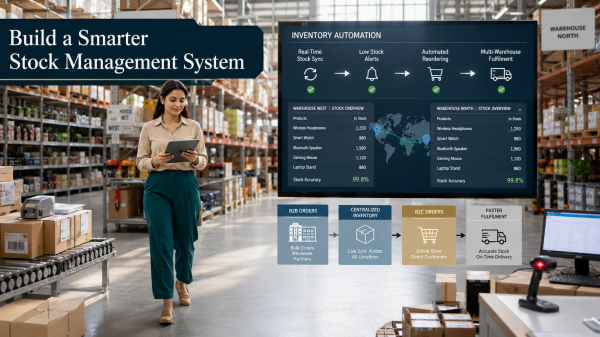
The foundation of any multi-warehouse inventory management software is a single inventory database that reflects stock levels across all locations in real time. When a product sells from Warehouse A, the count updates immediately across the entire system — not after a batch sync, not after a manual update. The platform's storefront always shows what is actually available, across all locations combined.
This is what prevents overselling. The moment an order allocates stock from Warehouse A, that quantity is reserved and no longer available for another order. If Warehouse B has additional stock of the same SKU, it remains available. The system manages this automatically without any human intervention.
Intelligent Order Routing
When an order arrives, the system evaluates which warehouse should fulfil it based on configurable rules. The most common routing logic includes:
- Proximity routing: Route to the warehouse closest to the delivery address to minimise delivery time and shipping cost
- Stock-first routing: Route to the warehouse with the highest available quantity to reduce the risk of running out mid-fulfilment
- Cost routing: Route based on the total fulfilment cost including shipping, handling, and any transfer fees
- Priority routing: Assign specific product categories or buyer accounts to preferred warehouses based on business rules
- Split fulfilment: Automatically split orders across two warehouses when no single location holds all items, with a clear split-shipment notification to the buyer
Real-Time Stock Updates Across Channels
A business operating multiple warehouses typically also sells across multiple channels — their own website, a wholesale portal, marketplaces, and potentially a retail location. Every channel needs to see the same stock reality. When Warehouse B ships a product, the stock reduction must reflect immediately across all channels to prevent the same unit being sold twice through different routes.
This cross-channel, cross-warehouse real-time sync is the technical challenge that separates multi-warehouse capable ecommerce software from platforms that approximate the capability through scheduled batch updates.
Transfer Order Management
When a warehouse is running low on a product that is overstocked elsewhere, the system should be able to generate a transfer order — moving stock from one location to another — with the receiving warehouse's count updated only when the stock physically arrives and is confirmed. This prevents phantom inventory — stock that has been transferred but not yet received being counted as available.
What Features Should Multi-Warehouse Ecommerce Software Have?
Not all platforms that claim multi-warehouse capability deliver it with the same depth. Here is what to evaluate and why each feature matters.
|
Feature |
Why It Matters |
What Happens Without It |
|---|---|---|
|
Real-time inventory sync |
Prevents overselling across all channels |
Orders confirmed for unavailable stock |
|
Automated order routing |
Optimises delivery time and shipping cost |
Manual routing decisions create bottlenecks |
|
Split shipment management |
Handles orders spanning multiple locations |
Manual splits or missed orders |
|
Transfer order management |
Moves stock between warehouses accurately |
Phantom inventory and restock failures |
|
Per-warehouse stock alerts |
Flags low stock at specific locations |
Stockouts discovered after order failure |
|
Location-based pricing rules |
Applies correct shipping cost per origin |
Margin erosion from underpriced shipping |
|
Multi-channel stock visibility |
Same stock view across web, wholesale, POS |
Duplicate sales across channels |
|
Warehouse performance reporting |
Identifies underperforming locations |
Decisions made on anecdote not data |
|
ERP and WMS integration |
Connects ecommerce to warehouse operations |
Manual data reconciliation between systems |
How Does Multi-Warehouse Management Work for B2B and Wholesale Businesses?
Multi-warehouse management is particularly complex for B2B and wholesale businesses because the commercial layer adds requirements that pure logistics software does not address.
A wholesale business selling to retail accounts across multiple regions may need to route orders from specific warehouses based on buyer account rules — a key account in the north always fulfilled from the northern warehouse, regardless of stock levels, to meet their contractual delivery commitment. A manufacturer with a regional distribution agreement may need to restrict which warehouses supply which buyer segments.
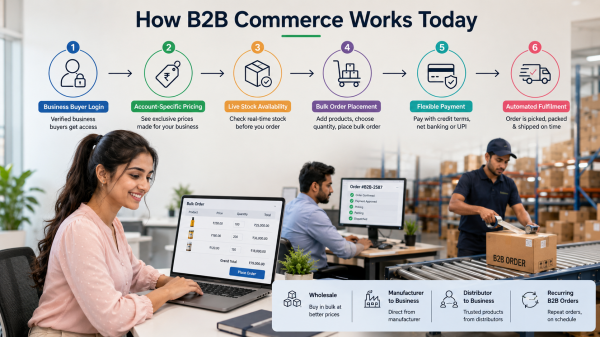
B2B ecommerce software with multi-warehouse capability needs to handle these commercial rules alongside the logistical ones. The routing logic is not just “closest warehouse” — it is “closest warehouse that is authorised to supply this buyer account on these terms.” That commercial dimension requires the ecommerce and order management layers to communicate with the warehouse routing layer, which is why generic logistics tools often fall short for B2B operations.
Account-Level Warehouse Assignments
The most sophisticated multi-warehouse setups for B2B allow specific buyer accounts to be assigned to specific warehouses as a default, with fallback rules for when that warehouse cannot fulfil. This gives large wholesale accounts the delivery consistency they expect while maintaining operational flexibility when stock imbalances or capacity issues arise.
Credit Term and Invoice Management Across Locations
When a single B2B order is fulfilled from multiple warehouses, the invoicing logic becomes complex. Does the buyer receive one invoice or two? Are credit terms applied per shipment or per order? The order management system must consolidate this into a single clear commercial transaction for the buyer regardless of the logistical complexity behind it.
For B2B businesses, multi-warehouse software is not just a logistics tool. It is a commercial operations layer that must understand both where stock is and which warehouse is commercially authorised to supply which buyer.
What Are the Benefits of Getting Multi-Warehouse Ecommerce Software Right?
The benefits compound across multiple dimensions simultaneously, which is why the ROI of proper multi-warehouse ecommerce software is typically higher than businesses expect when they start evaluating the investment.
Faster Delivery to Buyers
Routing each order to the closest stocked warehouse reduces the average transit distance and therefore the average delivery time. For consumer ecommerce, this translates directly into better buyer satisfaction scores and fewer late delivery complaints. For wholesale buyers, it means more reliable replenishment cycles and fewer stockouts on their shelves caused by late supplier deliveries.
Lower Shipping Costs at Scale
Shipping cost is a function of distance and weight. Automated proximity routing consistently reduces the average distance shipped per order compared to manual routing, which defaults to using the primary warehouse regardless of buyer location. At 500 orders per week, even a £1.50 reduction in average shipping cost per order saves £39,000 annually — without any change to the product or the buyer.
Reduced Overselling and Fulfilment Errors
Real-time inventory allocation across warehouses eliminates the category of errors caused by stock being committed to two orders simultaneously. The reduction in fulfilment error rate translates directly into lower returns processing cost, lower customer service overhead, and fewer expedited re-fulfilment expenses.
Operational Scalability
When warehouse routing is automated, adding a new warehouse location does not require a proportional increase in the operations team. The system absorbs the new location into its routing logic. Your team manages exceptions rather than making routine fulfilment decisions for every order.
Data-Driven Stock Distribution
With unified reporting across all warehouse locations, you can identify which SKUs are overstocked in one location and understocked in another, and make proactive transfer decisions rather than reactive emergency restocks. Over time, this data-driven approach to stock distribution reduces both overstock carrying costs and stockout-related lost sales.
How to Evaluate and Choose the Right Ecommerce Software for Multiple Warehouses
Platform selection for multi-warehouse operations requires a more rigorous evaluation process than single-location ecommerce. The stakes of choosing poorly are higher because the operational complexity means problems compound rather than presenting as isolated issues.
Test With Your Real Complexity
Every platform demo shows multi-warehouse working smoothly with two warehouses, three SKUs, and clean routing scenarios. Your operation has different characteristics — perhaps six warehouses, hundreds of SKUs, complex B2B buyer account rules, and split shipment scenarios that happen regularly. Request a trial environment and configure it with your actual complexity before committing. Problems that are invisible in a demo become structural in production.
Evaluate Routing Logic Depth
Ask specifically how routing decisions are made. Is it rule-based with configurable priorities, or is it a fixed algorithm you cannot adjust? Can you set account-level warehouse assignments? Can you define fallback routing when the primary warehouse cannot fulfil? The depth of the routing logic directly determines how well the software fits your actual distribution requirements.
Verify Integration Capability
Your warehouse management software (WMS), your ERP, your accounting system, and your ecommerce platform all need to share inventory data in real time. Evaluate the integration approach carefully — is it a native connection, an API integration, or a third-party connector? Each approach has different reliability, latency, and maintenance characteristics. A connector that syncs every 15 minutes is not real-time inventory management. It is scheduled batch management with a shorter interval.
Check B2B and B2C Support Together
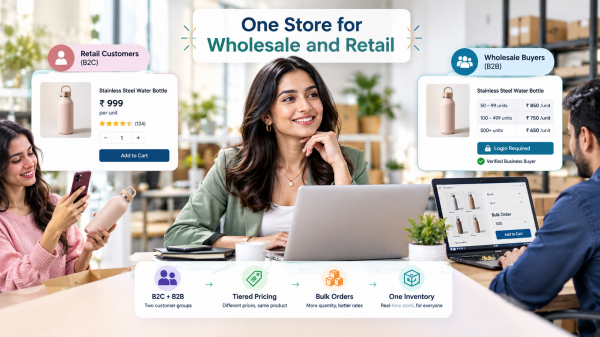
If you sell both wholesale and retail, confirm that the multi-warehouse logic applies consistently across both channels. Some platforms handle B2C multi-warehouse well but revert to manual assignment for B2B orders because the two commerce models are served by different systems. A unified platform that applies the same routing intelligence to both channels eliminates this gap.
Understand the Total Cost at Your Order Volume
Multi-warehouse ecommerce software is sometimes priced per warehouse location, per SKU, per order, or as a percentage of processed order value. Understand the pricing model at your current volume and at two to three times your current volume. Some platforms that appear affordable at small scale become expensive as the operation grows.
The right evaluation question is not which platform has the most features. It is which platform handles your specific routing requirements, your buyer account rules, and your channel mix without workarounds that will break at higher volume.
What Does a Well-Configured Multi-Warehouse Ecommerce Setup Look Like in Practice?
Let us look at a real-world scenario to make this concrete. A home decor brand operates three warehouses — one in the north, one in the south, and one centrally located for manufacturing overruns. They sell both direct-to-consumer through their website and wholesale to interior design studios and furniture retailers.
Before implementing proper multi-warehouse management software, their operations team spent two hours every morning manually assigning the previous day's orders to warehouses using a spreadsheet. Overselling incidents happened roughly twice a week. Their average shipping cost was 23% higher than necessary because the routing defaulted to the central warehouse for most orders regardless of buyer location.
After migrating to a platform with native multi-warehouse capability, the morning routing task was eliminated entirely. Orders routed automatically based on proximity and stock availability. Overselling incidents dropped to near zero because stock was reserved at the moment of order placement. Shipping costs reduced by 18% in the first quarter as proximity routing consistently outperformed the old central warehouse default.
The B2B channel benefited additionally. Key wholesale accounts were assigned to their nearest warehouse as default, with an automatic fallback to the central warehouse if their primary location was out of stock on any item. Buyers noticed faster delivery and fewer partial shipments. Order frequency from those accounts increased over the following two quarters.
Platforms like Shopaccino are built to support exactly this kind of unified commerce operation — multi-warehouse management integrated natively with both the B2C storefront and the B2B wholesale portal, with routing rules that apply consistently across both channels. For businesses that sell across both models, this unified architecture eliminates the data reconciliation problems that come from connecting separate systems.
How Does Multi-Warehouse Software Connect With Your Existing Tech Stack?

A multi-warehouse ecommerce operation does not run on ecommerce software alone. It runs on an ecosystem of connected
systems, and the quality of those connections determines whether the operation is genuinely unified or merely
appearing to be.
ERP Integration
Your ERP system holds the source of truth for inventory, purchase orders, and financial records. When your ecommerce platform receives a customer order, the inventory reservation must flow to the ERP immediately. When a purchase order is received at a warehouse and increases stock, the ERP update must flow to the ecommerce platform immediately. Any delay in this bidirectional sync creates a window during which your storefront shows inaccurate availability.
Warehouse Management System (WMS) Integration
Your WMS manages the physical operations within each warehouse — receiving, putaway, picking, packing, and dispatch. When your ecommerce platform routes an order to a warehouse, the WMS must receive the pick instruction immediately and confirm dispatch when the shipment leaves. This confirmation triggers the tracking notification to the buyer and updates the order status in the ecommerce platform. Without tight WMS integration, your digital order status lags behind your physical fulfilment reality.
Carrier and Logistics Integration
Shipping label generation, carrier selection, and tracking number assignment should all be automated at the point of order routing. When an order is assigned to a warehouse, the correct carrier should be selected based on the delivery destination and service level, the label generated, and the tracking number communicated to the buyer — all without manual intervention. This is where significant staff time is saved in high-volume operations.
Running Multiple Warehouses Well Is a Software Problem First
The businesses that operate multi-warehouse ecommerce successfully are not the ones with the most warehouses or the largest operations teams. They are the ones that built the right ecommerce software infrastructure before the complexity of managing multiple locations became the constraint on their growth.
Every overselling incident, every manual routing decision, every split shipment handled through a spreadsheet — these are not operational inefficiencies you manage around. They are signals that the software layer is not fit for the operation it is running. And unlike hiring, training, or logistics investment, software infrastructure is a problem that gets more expensive to solve the longer you wait.
The right multi-warehouse ecommerce software does five things simultaneously: it shows your real inventory across all locations at all times, it routes every order to the optimal warehouse automatically, it manages split shipments without manual intervention, it connects your commercial layer — pricing, buyer accounts, credit terms — with your logistical layer, and it gives you the data to make proactive decisions about stock distribution rather than reactive decisions about stock failures.
If your current platform requires manual workarounds for any of those five things, the cost of those workarounds is already embedded in your operations. The question worth asking is not whether to fix it, but how many more orders to process manually before doing so.
Multi-warehouse operations are where ecommerce businesses earn their margin advantage through operational excellence. The technology to do this properly exists, is accessible at mid-market price points, and delivers measurable return from the first quarter. Build the infrastructure now, and your warehouses become a competitive advantage rather than a management burden.
The most operationally efficient multi-warehouse businesses are not the ones that hired the most logistics managers. They are the ones that automated the decisions that logistics managers should not have been making manually in the first place.
FAQs
Multi-warehouse ecommerce software manages inventory, orders, and fulfilment across two or more physical storage locations from a single platform. It maintains a real-time unified stock view, routes orders to the optimal warehouse automatically, prevents overselling across channels, and provides centralised reporting on performance across all locations. It removes the manual coordination that single-location platforms cannot support.
Automated order routing evaluates each incoming order against configurable rules — proximity to the delivery address, current stock levels, fulfilment cost, and account-level preferences — and assigns the order to the most appropriate warehouse without manual intervention. The routing decision happens in real time at order placement, and the pick instruction flows immediately to the selected warehouse's management system.
Overselling is the highest-frequency risk — confirming orders for stock that does not exist at the fulfilling location. Manual routing decisions at scale are the highest-cost risk — a full-time operational role that limits growth. Fragmented inventory reporting is the highest strategic risk — preventing proactive stock distribution decisions and leaving imbalances undiscovered until they cause order failures
Yes, if the platform is built to support both commerce models natively. The routing logic must apply consistently to both B2C consumer orders and B2B wholesale orders, including account-level warehouse assignments, commercial routing rules specific to trade buyers, and unified invoicing across split shipments. Platforms that handle the two models in separate systems often cannot apply consistent routing intelligence across both channels
The clearest signals are: manual order routing taking significant staff time daily, overselling incidents occurring regularly, stock availability in your store not matching actual warehouse levels in real time, and inability to see total inventory across all locations in a single view. If any of these describe your current operation, your ecommerce software is not built for multi-warehouse distribution at your scale.