B2B Ecommerce Trends, Technologies & Opportunities
|
⚡ QUICK ANSWER — What are the top B2B ecommerce trends right now? The top B2B ecommerce trends in 2026 include self-serve buyer portals, mobile-first ordering, customer-specific pricing, multi-warehouse management, flexible payment terms, and private wholesale storefronts. These trends are helping manufacturers, wholesalers, and distributors reduce manual work, speed up order cycles, and scale without adding headcount. |
Picture this: it's 9 p.m. and one of your biggest retailers sends a message on WhatsApp — they need 300 units of
your top SKU by tomorrow morning. In the old world, that meant a frantic call, a manually typed order, someone
rechecking stock on a spreadsheet, and half a night of follow-up.
In the new world, that retailer logs into your B2B ecommerce portal, sees their negotiated price, confirms stock is available across your warehouses, places the order in two minutes, and gets an auto-generated invoice in their inbox before they sleep.
This shift is not futuristic. It is happening right now — and the businesses adopting these B2B ecommerce trends are pulling ahead of competitors who are still running their wholesale operations on calls, emails, and Excel sheets.
Whether you are a manufacturer in Surat, a distributor in Delhi, a wholesaler in Ludhiana, or an exporter preparing to go global — this guide is for you. We have mapped out the trends, the technologies, and exactly where platforms like Shopaccino fit into helping Indian B2B businesses grow.
What Is B2B Ecommerce — And Why Is It Growing So Fast?
B2B ecommerce is the process of buying and selling goods and services between businesses through an online platform. Think manufacturers selling to distributors, wholesalers selling to retailers, or suppliers fulfilling corporate procurement orders — all digitally, without manual back-and-forth.
Unlike B2C (selling to individual consumers), B2B commerce has distinct requirements:
- Bulk or repeat orders with volume-based pricing tiers
- Multiple buyer types — dealers, distributors, retailers, corporate accounts — each with different pricing
- Payment terms like credit limits, net-30, or buy-now-pay-later arrangements
- Complex catalogues with hundreds or thousands of SKUs, variants, and pack sizes
- Restricted access — only approved buyers should see wholesale prices
The numbers back the urgency. The global B2B ecommerce market was valued at over USD 18 trillion in 2023 and is forecast to grow at a CAGR of 14%+ through 2031, according to the International Trade Administration (trade.gov). In India specifically, B2B digital commerce is growing even faster — propelled by GST digitisation, improved logistics infrastructure, and the MSME sector's accelerating digital adoption.
What is driving this? Buyers have changed. Today's procurement managers and business owners — many of them
millennials and Gen Z — expect the same convenience from their business purchasing experience as from their personal
shopping. They want to order online, track deliveries, manage invoices, and reorder with a click.
Top B2B Ecommerce Trends Reshaping How Businesses Buy and Sell in 2026
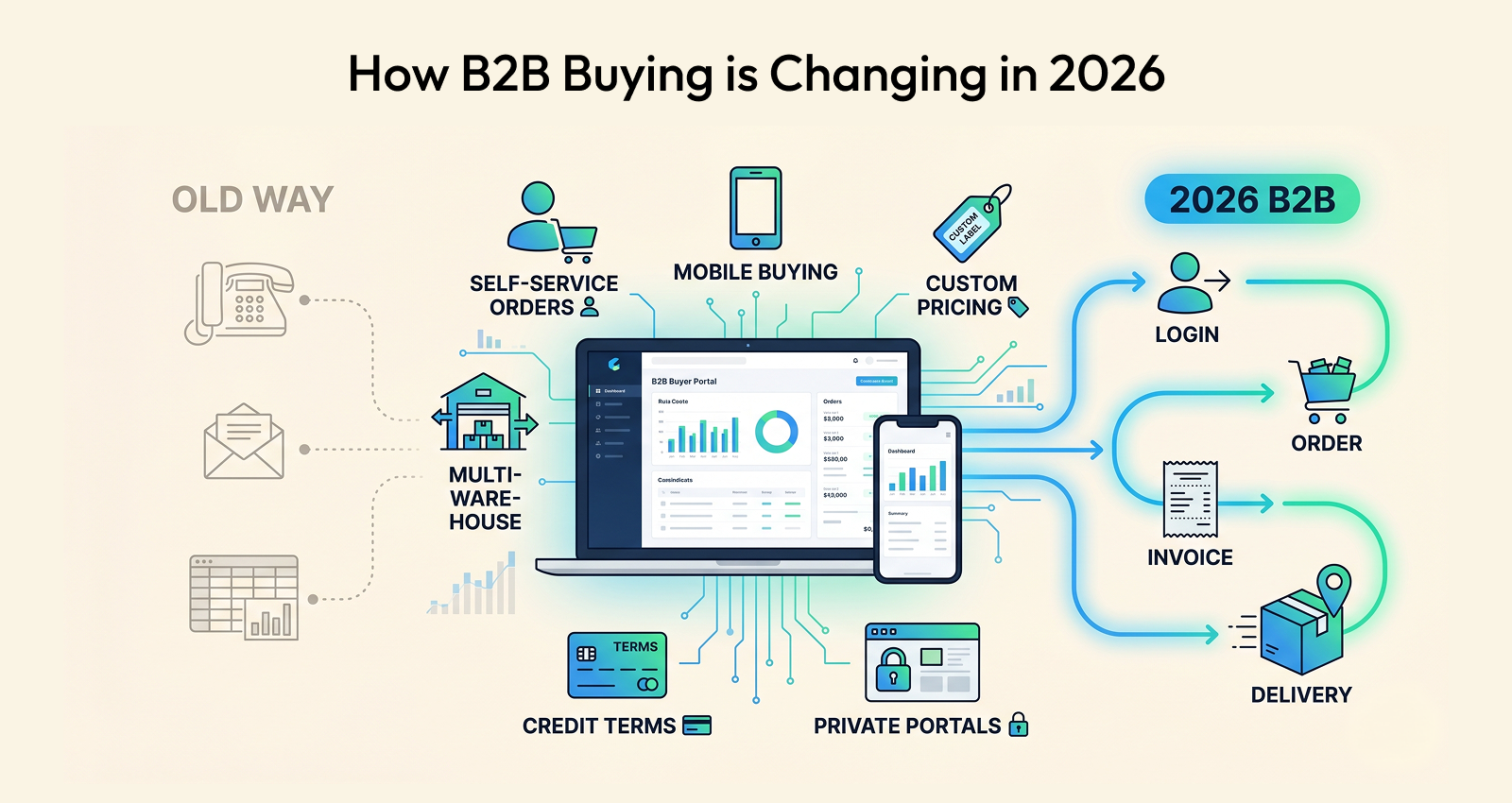
These are the B2B ecommerce trends that matter most in 2026 — the ones with real operational impact for manufacturers, wholesalers, distributors, and exporters.
1. Self-Serve Buyer Portals Are Replacing Phone and Email Orders
The single biggest shift in B2B digital commerce is the move to self-service. Research by McKinsey shows that over 70% of B2B buyers now prefer to handle routine reorders and account management online — without involving a sales rep.
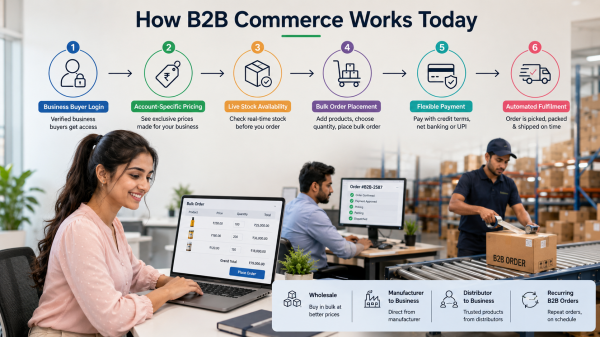
A self-serve wholesale ecommerce platform gives each buyer their own login. They see their negotiated prices, check stock availability, access their order history, download invoices, and place new orders — 24 hours a day, 7 days a week. No waiting. No manual errors.
For the seller, this means lower cost-to-serve, fewer errors, and a sales team freed up to focus on growth — not
processing routine reorders.
2. Customer-Specific and Group-Based Pricing Is Now Expected
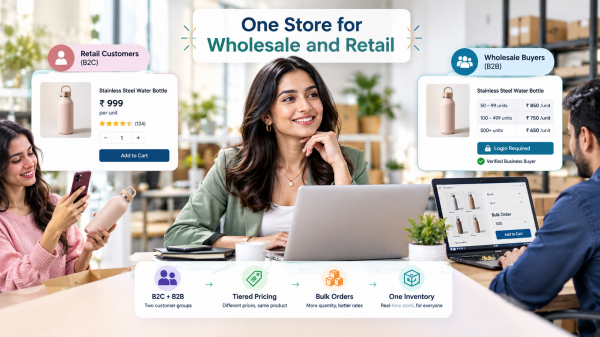
In B2B, one price does not fit all. A distributor buying 1,000 units gets a different rate than a retailer buying 50. A long-term dealer expects different terms than a new account. Managing this through spreadsheets and phone negotiations is slow, inconsistent, and error-prone.
The trend is clear: businesses are moving to customer-specific pricing managed automatically by their ecommerce platform. Each buyer logs in and sees only their price — without any manual intervention from the seller's team.
This also extends to volume-based pricing tiers — where the price per unit automatically
adjusts based on order quantity — and group discounts for different segments like
dealers, resellers, or corporate accounts.
3. Mobile-First Ordering Is Non-Negotiable
Over 80% of internet users in India access the web primarily via mobile. Your B2B buyers — field sales reps placing orders on behalf of clients, store owners walking their shop floor, procurement managers on the move — are on their phones.
A mobile-first B2B ecommerce experience is no longer a premium feature. It is a baseline expectation. If your wholesale portal is slow, hard to navigate on a small screen, or requires desktop access to place an order — you are creating friction that pushes buyers toward competitors.
The best-performing B2B businesses in 2026 offer a dedicated mobile app — not just a responsive website — that lets buyers place orders, check stock, and view their account from anywhere.
4. Multi-Warehouse Inventory Management Is Driving Operational Efficiency
Manufacturers and distributors operating across multiple locations have historically struggled with one core problem: visibility. Which warehouse has stock? Which should fulfil this order? Is the system updated, or is someone still manually adjusting a spreadsheet?
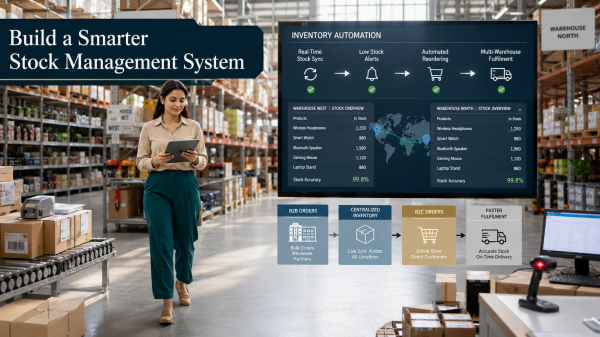
The trend toward multi-warehouse inventory management in B2B ecommerce solves this. A centralised platform tracks stock across all locations in real time, auto-allocates orders to the nearest or most appropriate warehouse, and prevents overselling — a problem that erodes buyer trust fast.
This is particularly relevant for businesses in industries like marble and stone, electronics, or industrial goods —
where stock is spread across production facilities, regional warehouses, and third-party fulfilment
centres.
5. Flexible Payment Terms and Credit Management Are Becoming Standard
Cash flow is the lifeblood of B2B commerce. Businesses offering only upfront payment online are leaving orders on the table. The B2B payment landscape is evolving rapidly — buyers expect credit terms, and sellers need tools to manage those terms without manual tracking.
In 2026, leading wholesale ecommerce platforms allow sellers to define credit limits per account, set net payment terms, and let approved buyers place orders without immediate payment. The platform tracks outstanding balances automatically — no spreadsheet required.
This directly supports conversion: when a trusted dealer can place a large order against their credit limit at 11
p.m. without waiting for manual approval, orders happen that otherwise would not.
6. Private,
Restricted-Access Storefronts Are Replacing Open Catalogues
In B2B, not every price should be public. A manufacturer who shows retail and wholesale pricing to everyone simultaneously invites price undercutting, channel conflict, and unhappy dealers. The trend is toward private B2B portals — login-only storefronts where wholesale pricing, product availability, and catalogue access are restricted to approved buyers only.
This protects margins, maintains channel integrity, and creates a more professional buying experience. When a dealer
logs in and sees pricing built specifically for their account, it reinforces the relationship.
7.
Location-Based Catalogues and Pricing for Region-Specific Selling
For businesses with regional pricing, area-specific product availability, or zone-based distributor networks, location-based B2B ecommerce is a major emerging capability. A buyer in Mumbai sees different stock and pricing than a buyer in Ahmedabad — automatically, based on their delivery pincode or district.
This is especially powerful for manufacturers and distributors managing exclusive regional dealerships or
territory-based pricing agreements. It eliminates manual pricing negotiation for each region and keeps channel
relationships intact.
8. Going Global: Multi-Currency and Cross-Border B2B Commerce
Indian manufacturers and exporters are increasingly finding international buyers — through marketplaces, trade shows, and inbound digital enquiries. The challenge has always been operationalising international B2B sales: pricing in foreign currencies, managing different tax configurations, and offering a professional buying experience to overseas buyers.
The trend toward global B2B ecommerce platforms is enabling even small manufacturers to present a world-class digital storefront to international buyers — with multi-currency checkout, region-specific pricing, and automated order management.
What Technologies Are Powering Modern B2B Ecommerce Operations?
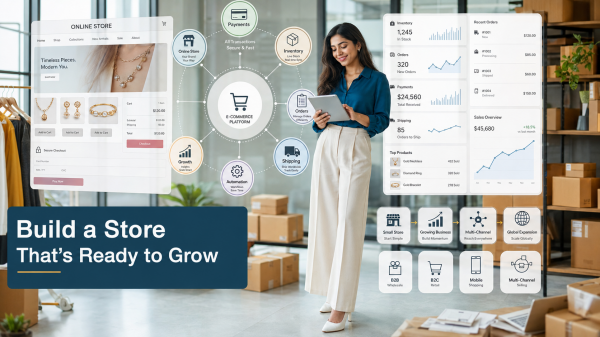
Behind every efficient B2B ecommerce operation is a stack of connected technologies. Here is what matters most in 2026:
ERP and Inventory Integration via APIs
The biggest operational headache in B2B commerce is fragmented data — orders in one system, stock in another, customer records in a spreadsheet. API-driven integration connects your ecommerce platform to ERP systems (like Tally, Zoho Inventory, SAP, or GoFrugal), automatically syncing product data, pricing, stock levels, and order status in real time.
For businesses managing large SKU catalogues or multiple warehouses, this integration is the difference between a
portal that is always accurate and one that creates constant manual correction work.
GST-Compliant
Automated Invoicing
For Indian B2B businesses, GST invoicing is not optional — it is a legal requirement. Manually generating GST-compliant invoices for every bulk order is time-consuming, error-prone, and creates reconciliation headaches at quarter end.
Modern B2B ecommerce platforms auto-generate GST invoices at the point of order placement. Buyers receive their
invoice immediately. Sellers have a clean, audit-ready record. Both parties save hours every
month.
Bulk Order Management and Minimum Order Quantity (MOQ) Controls
Wholesale businesses live and die by order volumes. Accepting an order for 2 units when your minimum is 50 creates operational inefficiency and margin loss. MOQ enforcement at the platform level — automatic, not manual — ensures every order that enters your system meets your commercial requirements.
Alongside MOQ, bulk order grids allow buyers to select multiple variants, sizes, or SKUs
in one fast-ordering view — dramatically reducing the time it takes to build a large order.
Dealer
and Distributor Network Management
Managing a network of dealers, distributors, or channel partners through calls and WhatsApp is unscalable. Dealer management within a B2B ecommerce platform gives each partner their own login, custom pricing, order visibility, and permissions — while the manufacturer or wholesaler retains full control from a central dashboard.
Sales agents can also be assigned accounts, allowing them to place orders on behalf of their clients — keeping the
relationship intact while digitising the order process.
Analytics and Sales Reporting
Dashboard
Data-driven decisions require data. A B2B analytics dashboard gives business owners visibility into which buyers are most active, which products are trending, where revenue is growing, and which accounts have not ordered recently (a churn risk indicator).
This kind of insight is transformative for wholesale businesses that previously operated on gut feel and experience. When you can see which dealer is your most valuable account and which SKU is driving the most revenue, planning becomes significantly more precise.
B2B Ecommerce Opportunities by Industry — Where Is the Growth?
Not every industry is at the same stage of B2B digital adoption. Here is where the most significant opportunities exist for Indian businesses in 2026:
|
Industry |
Key Opportunity |
Relevant Shopaccino Feature |
|---|---|---|
|
Fashion & Textiles |
Wholesale dealer portals, seasonal catalogue management, size/variant bulk ordering |
Variant-based bulk ordering, customer group pricing, private portal |
|
Electronics |
Distributor networks, volume discounts, real-time stock visibility |
Multi-warehouse management, MOQ controls, API sync with ERP |
|
Home Decor & Furniture |
Trade buyer programmes, regional pricing, export orders |
Location-based pricing, multi-currency checkout, dealer logins |
|
Marble & Stone |
Per-slab pricing, export documentation, region-specific availability |
Custom pricing, multi-warehouse, restricted B2B access |
|
Beauty & FMCG |
Salon/retailer wholesale, private label ordering, loyalty rewards |
Customer group pricing, loyalty programme, repeat order tools |
|
Industrial & MRO |
Credit-based procurement, bulk repeat ordering, large account management |
Credit limits, payment terms, order history and reorder tools |
How Should Small and Mid-Sized Businesses Start Their B2B Ecommerce Journey?
The most common mistake businesses make is assuming B2B ecommerce requires a massive investment and months of development. It does not — if you choose the right platform. Here is a practical, step-by-step approach for SMBs:
Step 1: Audit Your Current Order Process
Before setting up anything, map out how orders currently arrive — calls, WhatsApp, email, physical visits — and identify the top three friction points. These are your first automation targets. Common pain points include pricing confirmation delays, manual invoice generation, and stock availability uncertainty.
Step 2: Digitise Your Product Catalogue
Your catalogue is the foundation of your B2B portal. Upload your SKUs, variants, pack sizes, images, and specifications. For complex products — like those in engineering, fashion, or home decor — take time to get this right. A well-structured digital catalogue reduces buyer confusion and increases order accuracy.
Step 3: Set Up Customer Groups and Pricing
Organise your buyers into logical groups — distributors, dealers, retailers, institutional buyers — and assign each group their pricing rules, minimum order quantities, and catalogue visibility. This is the step that unlocks the full power of a B2B wholesale ecommerce platform.
Step 4: Onboard Your Top Accounts First
Do not try to migrate everyone at once. Start with your 10–20 most active accounts. Walk them through the portal. Gather their feedback. Refine the experience. Once they are ordering digitally — and seeing the benefits — word spreads naturally through your network.
Step 5: Train Your Sales Team to Embrace the Portal
Sales reps sometimes see a self-serve portal as a threat. Reframe it clearly: the portal handles routine reorders so they can spend time on new accounts, upselling, and relationship management — the work that actually drives growth. Sales reps can also use the platform to place orders on behalf of clients, keeping the relationship human while removing the manual effort.
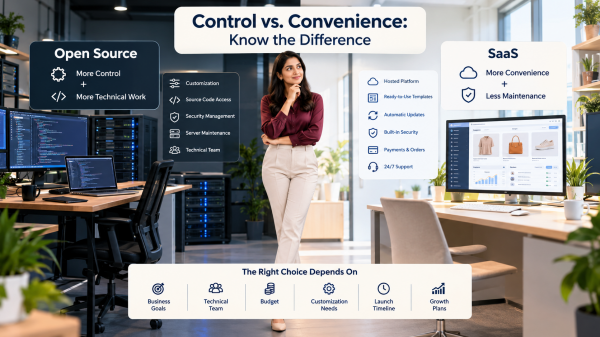
Why B2B Ecommerce Trends Favour Platforms Over Custom Builds
A decade ago, building a custom B2B portal was a ₹20 lakh to ₹1 crore project that took 6 to 18 months. Only large enterprises could afford it — and smaller businesses simply could not compete digitally.
That has changed. Purpose-built B2B ecommerce platforms now deliver enterprise-grade features at SMB-friendly pricing. Here is the comparison that matters:
|
Factor |
Custom Build |
Shopaccino Platform |
|
Time to launch |
6–18 months |
Days to a few weeks |
|
Upfront investment |
₹20L – ₹1Cr+ |
Affordable monthly subscription (from ~$20/month) |
|
Maintenance burden |
Requires ongoing developer team |
Managed by the platform — no dev needed |
|
Feature updates |
Custom development required each time |
Rolled out automatically across all users |
|
B2B-specific tools |
Must be scoped and built from scratch |
Pre-built: custom pricing, MOQ, dealer logins, multi-warehouse, GST invoicing |
|
Mobile app |
Additional development cost |
Included — branded iOS and Android app |
|
Going global |
Multi-currency requires custom build |
Multi-currency checkout included |
What Makes Shopaccino the Right B2B Ecommerce Platform for Indian
Businesses?
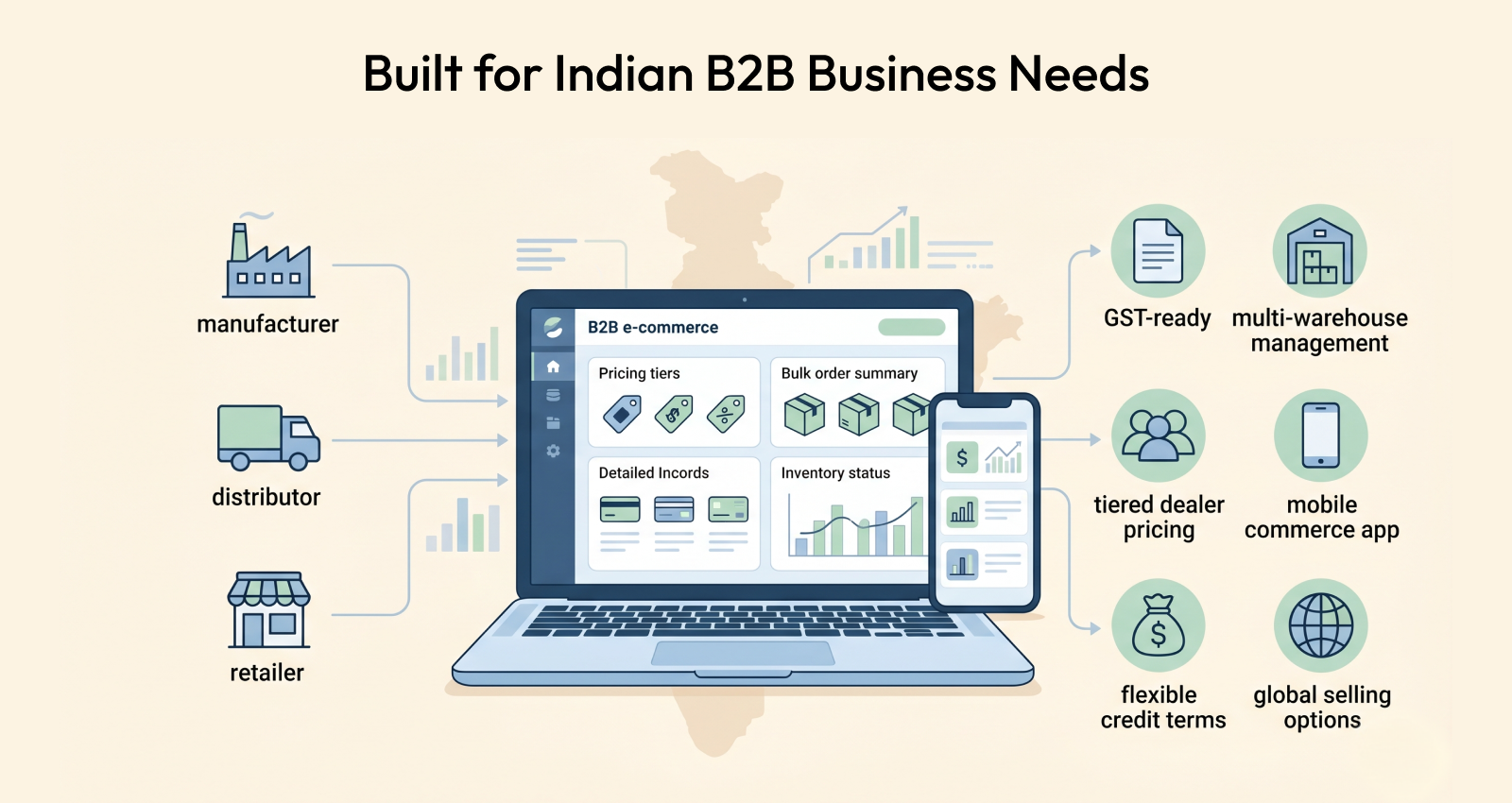
Shopaccino is built with the Indian business reality in mind — GST
compliance, multi-warehouse operations, dealer network management, mobile-first buyers, and the need for a
platform that a non-technical business owner can manage independently.
Here is a summary of the core B2B capabilities that align directly with the B2B ecommerce trends covered in this guide:
- Restricted B2B portal: Only logged-in, approved buyers see wholesale prices. B2C and guest users are automatically blocked.
- Customer group pricing: Set different prices, discounts, and MOQs for dealers, distributors, retailers, and corporate accounts — automatically applied at login.
- Multi-warehouse inventory: Real-time stock tracking across locations, with order allocation based on delivery region.
- Mobile app (iOS & Android): Branded app for buyers, distributors, and sales teams to place and manage orders from anywhere.
- Credit limits and payment terms: Allow trusted buyers to order against credit limits with defined payment terms — no manual tracking.
- Location-based pricing and catalogues: Display different products and prices based on buyer's delivery pincode, district, or town.
- GST-compliant automated invoicing: Invoices generated automatically at order placement — ready for download by buyers and sellers.
- Multi-currency checkout: Serve international buyers with pricing in their local currency.
- API integrations: Sync product data, inventory, and orders with ERP, inventory management, and logistics systems.
- Dealer and sales rep management: Dedicated logins for channel partners; sales reps can place orders on behalf of clients.
- Bulk ordering tools: MOQ enforcement, variant-based ordering grids, and minimum cart value controls.
- Analytics dashboard: Full visibility into sales, order performance, and customer activity across B2B and B2C channels.
Shopaccino also supports a unified B2B and B2C platform — meaning manufacturers and wholesalers who sell both wholesale and directly to end consumers can manage both from the same dashboard, without running two separate systems.
The Data That Makes the B2B Ecommerce Case Undeniable
For those who still need hard numbers to justify the move to digital B2B commerce, here is what the research shows:
- 80% of B2B sales interactions will take place through digital channels by the end of 2026, up from just 13% in 2019. (Source: Gartner)
- 73% of B2B buyers prefer self-service options for reordering and routine account management. (Source: Forrester Research)
- Businesses with digital B2B portals report up to 30% lower cost-to-serve per order versus phone and email-based processing.
- India's B2B ecommerce market is projected to reach USD 90 billion by 2030, driven by MSME digitisation and improving logistics infrastructure.
- Average B2B order values online are 3–5x larger than B2C orders — making conversion improvements highly valuable.
For authoritative data on ecommerce growth, the International Trade Administration at trade.gov publishes detailed market analysis on global B2B digital commerce trends and forecasts.
The B2B Ecommerce Opportunity Window Is Open — But Not Forever
The B2B ecommerce trends in 2026 point to one clear conclusion: the businesses that digitise their wholesale operations now will build structural advantages that compound over time — better buyer data, lower operational costs, stronger relationships, and the ability to scale without proportionally increasing headcount.
Your buyers are already expecting a digital experience. Many of them are already ordering digitally from your competitors. The question is whether your business is meeting them there.
The good news for Indian manufacturers, wholesalers, and distributors is that the tools to make this transition are available, affordable, and designed specifically for how B2B businesses in India actually operate. You do not need a large IT team, a massive budget, or months of development time.
You need a platform that understands B2B — with custom pricing, dealer portals, multi-warehouse management, GST invoicing, mobile ordering, and credit management built in from day one. That is what Shopaccino is built to deliver.
FAQs
The most impactful B2B ecommerce trends in 2026 are self-serve buyer portals, customer-specific pricing, mobile-first ordering, multi-warehouse inventory management, flexible payment terms and credit limits, private restricted storefronts, and multi-currency cross-border selling. Each of these reduces manual effort while improving the buyer experience.
B2B ecommerce involves transactions between businesses — manufacturers to distributors, wholesalers to retailers. It requires features B2C does not: customer-specific pricing, MOQ enforcement, credit terms, restricted access, bulk ordering tools, and dealer network management. The buyer is a business, with commercial requirements that differ fundamentally from individual consumers.
Yes. Purpose-built platforms like Shopaccino are specifically designed for SMBs — with B2B features like custom pricing, dealer portals, GST invoicing, and multi-warehouse management included at affordable monthly pricing. A 14-day free trial lets you validate the fit before committing. No developers or large upfront investment are required.
Shopaccino offers a comprehensive B2B feature set including restricted buyer portals, customer group pricing, MOQ controls, multi-warehouse inventory management, dealer and distributor logins, GST-compliant automated invoicing, mobile apps for iOS and Android, credit limit management, location-based catalogues, multi-currency checkout, and API integrations with ERP and inventory systems.
Most businesses can launch a functional B2B store on Shopaccino within days — not months. The platform requires no coding or development. You upload your catalogue, configure your customer groups and pricing rules, set up your payment and shipping options, and invite your buyers. For complex catalogues, a few weeks allows thorough setup and testing before going live.