Future of Online Shopping: How AI, AR & Voice Commerce Will Change Buying
Online shopping has already transformed the way people discover and buy products, but what lies ahead will change buying behavior even more fundamentally. The next phase of ecommerce is not about adding more products or running bigger discounts—it is about changing how customers experience shopping itself.
The future of online shopping is being shaped by three powerful technologies: Artificial Intelligence (AI), Augmented Reality (AR), and Voice Commerce. Together, they are redefining how customers search, evaluate, and purchase products online.
What makes this shift important is not just the technology itself, but the way it aligns with evolving customer expectations. Shoppers today want convenience, personalization, speed, and confidence before making a purchase. Traditional ecommerce experiences are no longer enough to meet these demands.
To understand where ecommerce is heading next, it’s important to look at why this transformation is happening—and what it means for businesses preparing for the future of ecommerce.
Why Online Shopping Is Entering a New Era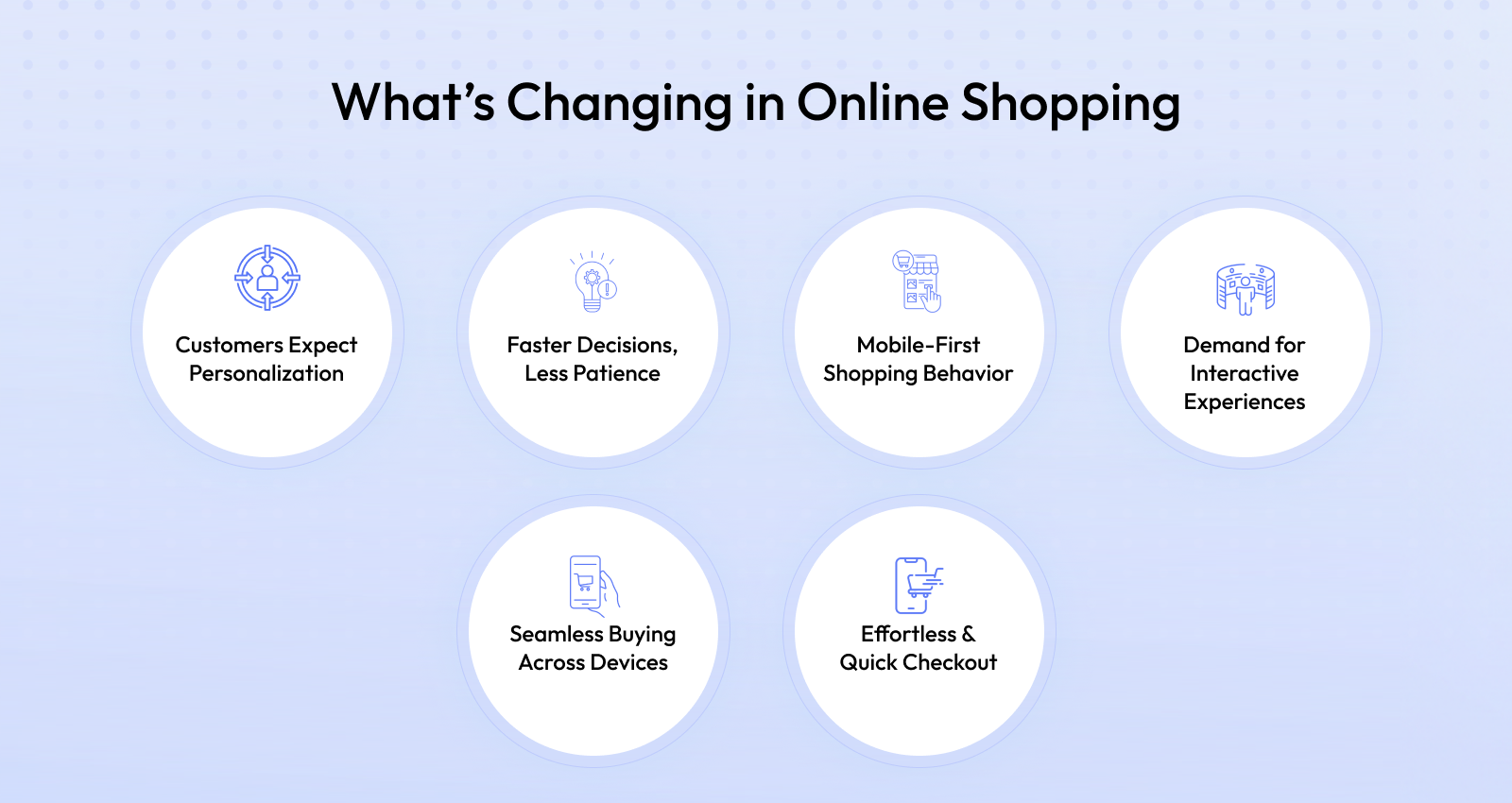
E-commerce has moved far beyond simply listing products on a website. Over the years, customers have become more digital, more informed, and more impatient.
Today’s shoppers expect:
- Personalized product recommendations
- Faster decision-making
- Interactive product experiences
- Seamless buying across devices
- Minimal effort during checkout
When these expectations are not met, customers abandon carts, switch brands, or delay purchases altogether.
This growing gap between customer expectations and traditional e-commerce experiences is the reason new technologies are becoming essential rather than optional.
The Shift from Transactional E-commerce to Experience-Driven Shopping
Earlier, e-commerce was primarily transactional. Customers searched for a product, compared prices, and completed a purchase. The focus was on availability and cost.
The future of e-commerce, however, is experience-driven.
Modern buyers want:
- Guidance instead of guesswork
- Visualization instead of imagination
- Conversation instead of navigation
AI, AR, and voice commerce are emerging precisely because they address these needs in ways traditional ecommerce cannot.
How Customer Behavior Is Driving the Future of Ecommerce
Technology adoption in ecommerce does not happen in isolation. It is always driven by customer behavior.
Several behavioral shifts are shaping the future of online shopping:
Shorter Attention Spans
Customers want answers quickly. Long browsing journeys and complex navigation reduce conversions.
Mobile-First Mindset
Most users shop on smartphones, making speed, simplicity, and hands-free interaction more important.
Trust and Confidence Before Buying
Customers hesitate when they can’t fully understand or visualize a product online.
Desire for Personalization
Generic product listings no longer feel relevant. Shoppers expect tailored experiences.
AI, AR, and voice commerce directly respond to these behavioral changes.
AI in Ecommerce: Making Shopping Smarter, Not Harder
Artificial Intelligence is becoming the backbone of modern e-commerce. Rather than replacing human decision-making, AI in e-commerce enhances it by reducing friction and improving relevance.
AI enables ecommerce platforms to:
- Understand customer preferences
- Predict buying intent
- Personalize recommendations
- Optimize pricing and offers
Instead of showing the same products to every visitor, AI allows stores to adapt dynamically to each shopper.
This level of personalization is quickly becoming a baseline expectation in the future of ecommerce.
Why AI Is Critical for the Future of Online Shopping
The biggest challenge in e-commerce is helping customers find the right product quickly.
AI solves this by:
- Analyzing browsing and purchase history
- Suggesting relevant products in real time
- Improving search accuracy
- Reducing decision fatigue
As AI systems learn from user behavior, shopping experiences become faster, more intuitive, and more engaging.
In the future of online shopping, AI will not be a feature—it will be the engine behind most customer interactions.
AR in Ecommerce: Bridging the Gap Between Online and Physical Shopping
One of the biggest limitations of online shopping has always been the inability to physically see or experience a product before buying. This uncertainty leads to hesitation, returns, and dissatisfaction.
This is where AR in ecommerce changes everything.
Augmented Reality allows customers to visualize products in real-world environments before making a purchase. Whether it’s seeing how furniture fits in a room or how a product looks on a person, AR reduces guesswork and increases confidence.
Why AR Is Transforming Buying Decisions
AR addresses one of the biggest barriers to online purchases: the lack of visualization.
By enabling customers to:
- View products in their actual space
- Interact with products virtually
- Understand size, fit, and appearance
AR creates experiences that closely mimic in-store shopping.
As a result, businesses using AR often see:
- Higher conversion rates
- Lower return rates
- Better customer satisfaction
In the future of ecommerce, AR will play a major role in categories where visualization matters most.
Voice Search Ecommerce: Changing How Customers Discover Products
Typing search queries is no longer the only way customers find products. With the rise of smart assistants and voice-enabled devices, voice search ecommerce is becoming an important part of the buying journey.
Voice commerce allows users to:
- Search for products hands-free
- Reorder frequently purchased items
- Get instant answers and recommendations
This shift is especially relevant for mobile users and multitasking shoppers.
Why Voice Commerce Matters in the Future of Online Shopping
Voice commerce changes not just how people search, but how they think about shopping.
Instead of browsing multiple pages, users expect:
- Direct answers
- Clear recommendations
- Fast purchase options
This means ecommerce platforms must adapt product data, search logic, and content for conversational queries.
As voice adoption grows, optimizing for voice-based buying will become essential in the future of ecommerce.
The Combined Impact of AI, AR, and Voice Commerce
While each technology is powerful on its own, their combined impact is what truly defines the future of online shopping.
Together, they:
- Reduce friction in discovery
- Improve confidence in buying decisions
- Make shopping more intuitive
- Create personalized, immersive experiences
The result is a shopping journey that feels less like navigating a website and more like interacting with a smart assistant.
Why Businesses Must Prepare Now
Many ecommerce businesses assume these technologies are still “future trends.” In reality, they are already shaping customer expectations.
Brands that delay adoption risk:
- Falling behind competitors
- Losing relevance with modern shoppers
- Struggling with conversion and retention
Preparing for the future of ecommerce is not about chasing trends—it’s about aligning with how customers want to shop.
How AI, AR, and Voice Commerce Are Reshaping the Buying Experience
The future of online shopping is not defined by a single technology. It is shaped by how multiple technologies work together to remove friction, increase confidence, and make buying feel effortless. In this part, we move from why ecommerce is changing to how AI, AR, and voice commerce are already transforming real buying journeys.
These technologies are no longer experimental. They are actively influencing how customers discover products, evaluate options, and complete purchases.
How AI in Ecommerce Is Changing the Way Customers Buy
Artificial Intelligence is at the center of modern ecommerce transformation. Instead of offering the same experience to every visitor, AI enables ecommerce platforms to adapt in real time to individual users.
From Generic Stores to Personalized Shopping Journeys
Traditional ecommerce treats every customer the same. AI changes this by learning from behavior and context.
AI in ecommerce helps platforms:
- Understand browsing patterns and preferences
- Predict what customers are likely to buy next
- Show relevant products instead of endless catalogs
- Personalize offers, content, and recommendations
This personalization reduces decision fatigue and shortens the path to purchase.
In the future of ecommerce, personalization will not be a competitive advantage—it will be an expectation.
AI-Powered Search and Discovery
One of the most common frustrations in online shopping is poor search accuracy. Customers know what they want but struggle to find it.
AI-powered search improves discovery by:
- Understanding intent, not just keywords
- Handling natural language queries
- Showing smarter, context-aware results
- Reducing zero-result searches
As AI improves search relevance, customers spend less time searching and more time buying.
Predictive AI: Anticipating Customer Needs
AI does not just react—it predicts.
Predictive AI analyzes:
- Past purchases
- Browsing behavior
- Time, location, and device data
Based on this, e-commerce platforms can:
- Recommend products before customers search
- Send timely reminders or suggestions
- Optimize pricing and promotions dynamically
This proactive approach defines the future of online shopping, where platforms assist customers rather than overwhelm them.
AR in Ecommerce: Bringing Products Closer to Reality
One of the biggest challenges of online shopping has always been uncertainty. Customers hesitate because they cannot physically interact with products.
AR in ecommerce addresses this gap by blending digital products with real-world environments.
How AR Improves Buying Confidence
Augmented Reality allows customers to:
- Visualize products in their own space
- See size, fit, and appearance accurately
- Interact with products virtually before buying
This is especially impactful for categories where look, fit, or placement matters.
By reducing uncertainty, AR increases confidence—and confident customers convert better.
AR Use Cases Across Ecommerce Categories
AR is not limited to one industry. Its impact spans multiple ecommerce segments.
Common AR applications include:
- Trying products virtually before purchase
- Viewing products in real environments
- Exploring product details interactively
- Understanding scale and dimensions clearly
As AR adoption grows, customers will increasingly expect visualization as part of the standard shopping experience.
This makes AR a key driver of the future of e-commerce.
Voice Search Ecommerce: Redefining Product Discovery
Voice commerce represents a shift in how customers interact with ecommerce platforms. Instead of typing, users now speak naturally to search, compare, and buy products.
Voice search ecommerce is growing because it aligns with how people naturally communicate. For ecommerce brands expanding into multilingual markets, tools like Persian Text To Speech can enhance voice commerce experiences by enabling localized, natural-sounding audio interactions that feel native to regional customers.
How Voice Commerce Changes Customer Expectations
Voice-based shopping changes the flow of discovery.
Customers expect:
- Direct answers instead of long lists
- Clear recommendations instead of browsing
- Faster actions with minimal effort
This shifts ecommerce from navigation-driven to conversation-driven experiences.
In the future of online shopping, customers will ask questions—and expect intelligent answers instantly.
Voice Commerce and Mobile-First Buying
Voice commerce is especially relevant in mobile-first markets where users multitask and prefer hands-free interactions.
Voice-enabled shopping supports:
- Quick reorders
- Product comparisons
- Simple purchase commands
As voice adoption increases, ecommerce platforms must optimize product data and content for conversational queries.
How AI, AR, and Voice Commerce Work Together
The true power of these technologies lies in how they complement each other.
Together, they create a smarter buying journey:
- AI personalizes what customers see
- AR helps customers visualize what they buy
- Voice commerce simplifies how they search and act
This combination reduces friction at every stage of the funnel—from discovery to decision to checkout.
Impact on Conversion, Returns, and Retention
The combined effect of AI, AR, and voice commerce directly impacts core ecommerce metrics.
Businesses adopting these technologies often see:
- Higher conversion rates
- Lower product return rates
- Improved customer satisfaction
- Stronger repeat purchase behavior
This is why these technologies are central to the future of ecommerce, not optional add-ons.
Why Businesses Must Adapt Their Ecommerce Strategy
Customer expectations are evolving faster than ever. What feels innovative today will feel basic tomorrow.
Businesses that do not adapt risk:
- Losing relevance
- Falling behind competitors
- Struggling with engagement and conversions
Preparing for the future of online shopping requires more than adopting tools—it requires rethinking the entire customer experience.
How Businesses Must Prepare for the Future of Ecommerce
The future of online shopping is no longer a distant concept. AI, AR, and voice commerce are already reshaping customer expectations, and the pace of change will only accelerate from here. The real question for businesses is not whether these technologies will matter—but how prepared they are to adopt them meaningfully.
In this final part, we look at what the future of ecommerce means for businesses, how ecommerce platforms must evolve, and how brands can start preparing today without overwhelming complexity.
Why the Future of E-commerce Demands Platform Evolution
As shopping becomes more intelligent, immersive, and conversational, ecommerce platforms can no longer function as static storefronts. They must evolve into adaptive systems that respond to customer intent in real time.
The future of ecommerce requires platforms to:
- Handle personalization at scale
- Support interactive and visual experiences
- Enable conversational discovery and buying
- Deliver fast, seamless experiences across devices
Platforms that fail to adapt will struggle to meet rising expectations, regardless of product quality or pricing.
From Feature-Based Platforms to Experience-Driven Platforms
In the past, ecommerce platforms were judged by features—product listings, carts, and checkout. In the future, platforms will be judged by how well they support customer experience.
Experience-driven ecommerce platforms focus on:
- Intelligent product discovery
- Personalized journeys instead of static pages
- Flexible content and product presentation
- Continuous optimization based on behavior
AI, AR, and voice commerce are not isolated features—they require a platform foundation that supports experimentation and evolution.
Preparing for AI-First Ecommerce Experiences
AI will increasingly influence almost every touchpoint of online shopping. Businesses that prepare early will gain a significant advantage.
To be AI-ready, ecommerce businesses must:
- Structure product data clearly
- Capture and use customer behavior insights
- Enable personalized recommendations
- Optimize search and navigation continuously
AI works best when platforms allow data-driven decision-making without heavy manual intervention. Not every AI feature needs to be built from scratch. Standard tools like product recommendations and smart search are often available through the ecommerce platform itself. Other ideas are more specific to one brand, such as a voice assistant that answers questions about sizing or delivery, or a search bar that understands the names customers actually use for products. This is where businesses usually weigh ready-made features against building something custom. Teams that offer development services with AI can connect these tools to the product data and order history a store already has, so the assistant answers from real information rather than guessing. Many of them start with a small proof of concept, which lets a business test the idea on its own data before committing a larger budget.
In the future of online shopping, stores that feel “smart” will outperform those that feel static.
Making AR a Practical Part of Ecommerce Strategy
While AR sounds advanced, its real value lies in practicality. Businesses should not adopt AR for novelty, but to solve real customer problems.
AR is most effective when it:
- Reduces hesitation before purchase
- Helps customers visualize products accurately
- Lowers return rates caused by mismatch or misunderstanding
As AR adoption increases, customers will begin to expect visualization—especially for products where size, fit, or appearance matter.
This makes AR a strategic investment for businesses focused on long-term customer satisfaction.
Optimizing for Voice Commerce and Conversational Buying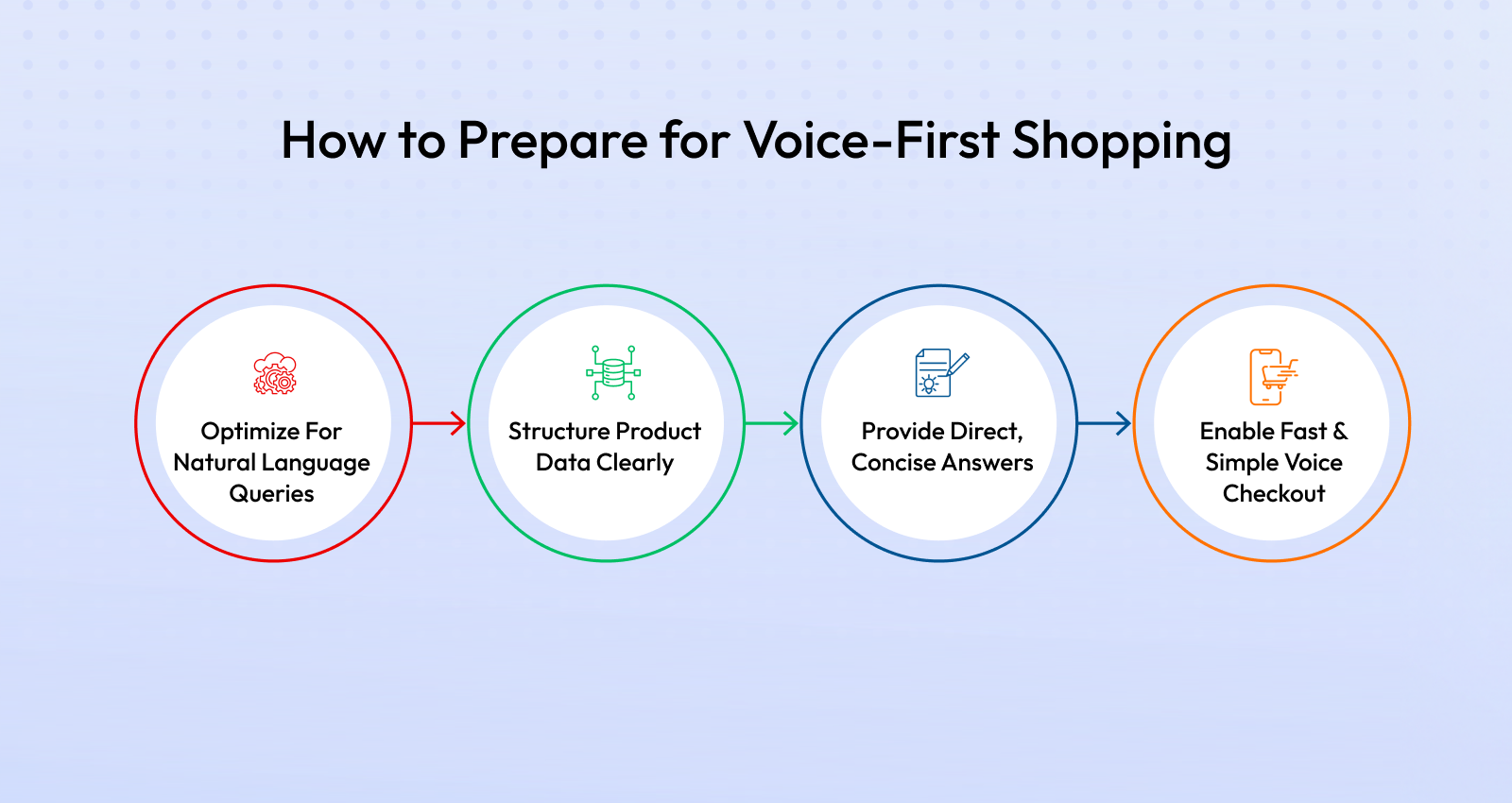
Voice commerce represents a shift in how customers interact with ecommerce platforms. Instead of browsing menus, users ask questions and expect immediate, relevant answers.
To prepare for voice search ecommerce, businesses should:
- Optimize product data for conversational queries
- Focus on clear, concise product descriptions
- Structure content to answer natural language questions
Voice commerce will not replace traditional browsing entirely, but it will become a powerful complementary channel—especially for repeat purchases and mobile users.
Why Omnichannel Experience Will Define the Future
The future of ecommerce is not limited to one device or one interaction style. Customers will move fluidly between:
- Browsing on mobile
- Visualizing products with AR
- Searching or reordering via voice
- Completing purchases across channels
Ecommerce platforms must support this connected experience without friction.
Businesses that unify these touchpoints will build stronger trust and loyalty over time.
How Platforms Like Shopaccino Support Future-Ready Ecommerce
To prepare for the future of ecommerce, businesses need platforms that are stable, scalable, and flexible enough to adapt as new technologies become relevant. A platform like Shopaccino provides a strong ecommerce foundation—enabling brands to build fast, reliable online stores today while staying ready to integrate future innovations as customer expectations evolve
What the Future of Online Shopping Means for Businesses
The future of online shopping will reward businesses that:
- Embrace personalization instead of generic selling
- Focus on experience, not just transactions
- Reduce friction at every stage of buying
- Adapt continuously to changing customer behavior
AI, AR, and voice commerce are not trends to watch—they are shifts to prepare for.
Final Takeaways
- The future of online shopping is experience-driven, not transactional
- AI in ecommerce enables smarter, personalized buying journeys
- AR in ecommerce reduces uncertainty and increases confidence
- Voice search ecommerce changes how customers discover and buy
- Platforms must evolve to support intelligent, immersive commerce
Closing Thoughts
Ecommerce is entering a phase where technology does not just support selling—it shapes how customers think, decide, and interact with brands.
Businesses that prepare for the future of ecommerce today will not only convert better but build stronger relationships with customers tomorrow.
The future of online shopping is intelligent, immersive, and conversational—and it has already begun.
FAQs
The future of online shopping focuses on personalized, immersive, and effortless buying experiences. Customers will expect faster discovery, better product understanding, and minimal effort while shopping, driven by smarter technology and more intuitive ecommerce experiences
AI in ecommerce helps customers find relevant products faster, improves search accuracy, and personalizes recommendations. It supports decision-making by reducing confusion and effort, rather than replacing human judgment or emotional buying behavior.
AR in ecommerce helps customers visualize products in real-life contexts, reducing uncertainty before purchase. This improves buying confidence, lowers return rates, and bridges the gap between online and physical shopping experiences.
Voice search ecommerce changes how customers discover products by enabling conversational, hands-free interactions. It supports quick searches, reorders, and simple buying actions, especially for mobile users and repeat purchases.
No. While large brands adopt them faster, smaller businesses can also prepare by building strong ecommerce foundations. Platforms that support scalability and flexibility allow businesses of all sizes to adapt as these technologies become more accessible.
Future-ready ecommerce experiences reduce friction, improve clarity, and build confidence. Personalized journeys, better visualization, and faster discovery help customers make decisions more easily, which directly improves conversion rates and customer satisfaction.
No. Businesses should focus on readiness, not rushed adoption. Preparing clean data, flexible platforms, and strong user experience allows brands to integrate AI, AR, or voice commerce when it aligns with customer needs and business goals.
Businesses should invest in scalable platforms, optimize mobile experiences, improve product data quality, and focus on customer-centric design. This foundation ensures they can adapt smoothly as ecommerce technology and buyer expectations evolve.