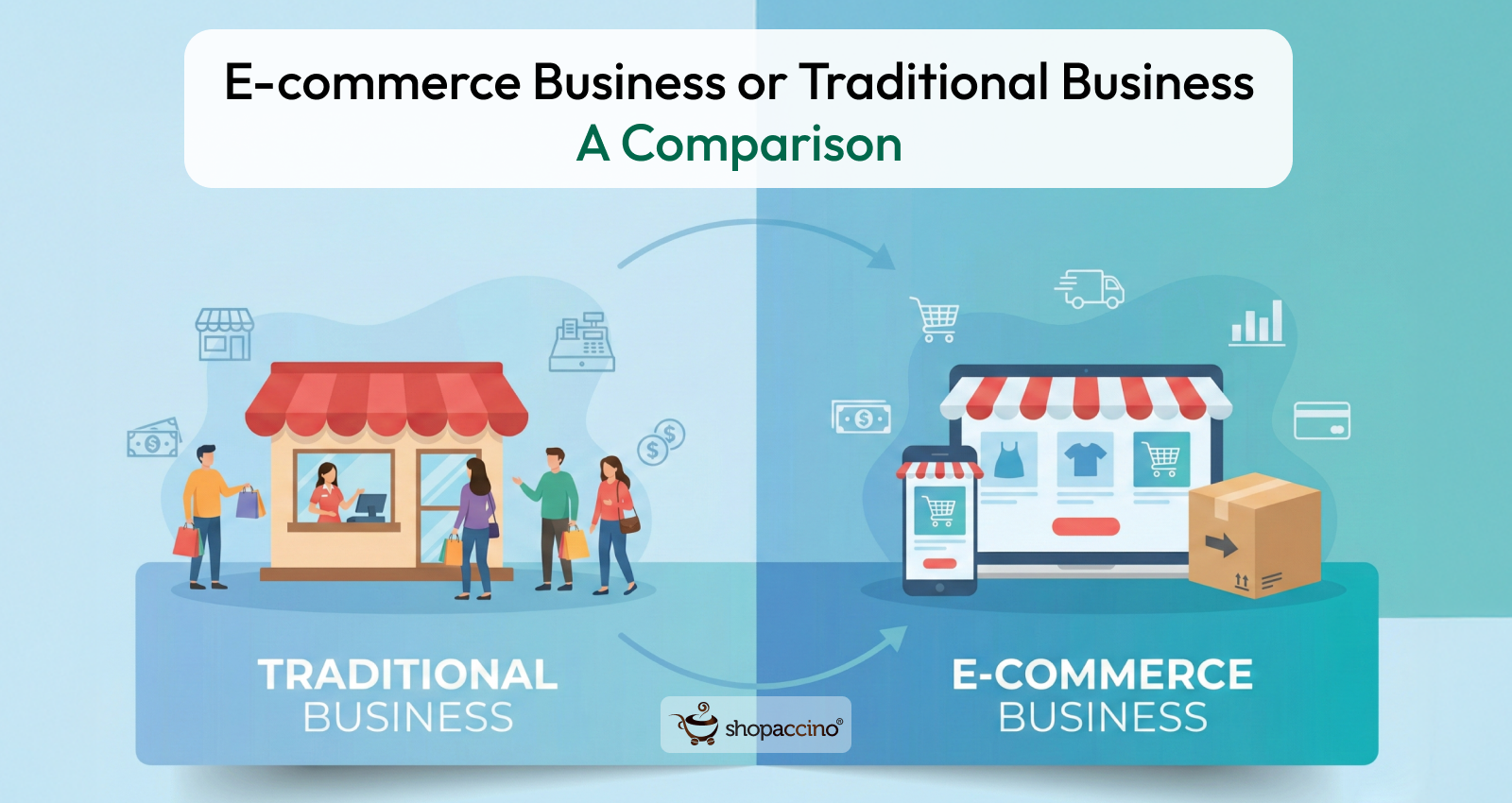
E-commerce Business or Traditional Business : A Comparison
Retail is splitting into two paths. Physical stores still account for the majority of global sales, but e-commerce is growing at double-digit rates year after year and is projected to cross multi-trillion-dollar volumes within this decade. For modern entrepreneurs, the question is no longer whether to go online, but how to choose between e-commerce, traditional retail, or a hybrid of both.
The core difference: an e-commerce business sells online through a website or app with low setup cost (typically $1,500 to $5,000), runs 24/7, and can scale globally without physical stores. A traditional business operates from a physical location, requires high investment ($30,000 to $250,000 to start), and is limited by geography but offers face-to-face trust and immediate product ownership.
This complete comparison guide explains:
- What e-commerce and traditional business actually mean (with real-world examples)
- 10 key differences side-by-side (cost, reach, scalability, profit, risk)
- Realistic setup cost breakdowns for both models
- Which model is more profitable for different business types
- How successful brands (Warby Parker, Allbirds, Casper) chose e-commerce — and what you can learn
- The hybrid (omnichannel) model that combines both for maximum growth
Let us start with the basics. This detailed guide explains:
- What is e-commerce and traditional business
- Key differences with real examples
- Advantages of e-business over traditional business
- Cost, risk, and scalability comparison
- Which business model is better for long-term growth
What is a Traditional Business? Definition, Examples & Features
A traditional business is a physical setup where goods or services are sold through a shop, office, or showroom. Customers must visit the location to explore products and complete purchases.
This model has been used for decades and relies heavily on location, foot traffic, and in-person interaction.
Key Features of Traditional Business
- Physical store or office presence
- Limited to a specific geographic location
- Fixed working hours
- Requires staff and infrastructure
- Face-to-face customer interaction
Examples of Traditional Business
- Retail clothing stores
- Local grocery shops
- Furniture showrooms
- Electronics stores
What is an E-commerce Business? Definition, Types & Examples?
An e-commerce business (also known as e-business) involves buying and selling products or services online using a website, mobile app, or digital marketplace.
Customers can browse products, place orders, and make payments digitally without visiting a physical store.
With increasing internet usage and smartphone adoption, e-commerce has become one of the fastest-growing business models worldwide.
Key Features of E-commerce Business
- Online store accessible via website or app
- 24/7 availability
- No geographical limitations
- Automated order and payment processing
- Integration with shipping and logistics partners
Examples of E-commerce Business
- Online clothing brands
- D2C product websites
- Marketplace sellers
- Subscription-based online stores
E-commerce vs E-business: What is the Difference?
E-business refers to all types of business activities conducted online, including selling products, managing operations, customer service, and digital transactions.
E-commerce is a part of e-business that specifically focuses on buying and selling products online.
In simple terms, all e-commerce businesses are e-businesses, but not all e-business activities involve direct selling.
Understanding this difference helps businesses adopt a broader digital strategy beyond just online selling.
Difference Between E-business and Traditional Business
The difference between e-business and traditional business is that e-business uses digital platforms to conduct business activities such as selling, marketing, and customer service, while traditional business operates through physical stores and manual processes.
E-business allows businesses to reach a global audience, operate 24/7, and reduce operational costs. In contrast, traditional business depends on physical presence, limited working hours, and higher infrastructure investment.
This difference makes e-business more scalable and flexible compared to traditional business.
E-commerce vs Traditional Business: 10 Key Differences Explained
The key difference between e-commerce and traditional business is how products are sold and how customers interact with the business.
E-commerce businesses operate online, allowing customers to browse and purchase products from anywhere using the internet. They offer advantages like global reach, lower operational costs, and 24/7 availability.
Traditional businesses operate through physical stores, where customers need to visit in person. These businesses depend on location, foot traffic, and fixed working hours.
In simple terms, e-commerce focuses on convenience and scalability, while traditional business focuses on physical experience and personal interaction.
E-commerce vs Traditional Business: Detailed Comparison Table
Here is a detailed comparison of e-commerce vs traditional business based on cost, reach, scalability, and operations.
|
Factor |
E-commerce Business |
Traditional Business |
|
Business Model |
Online selling via website/app |
Physical store selling |
|
Customer Reach |
Global audience |
Local or regional audience |
|
Investment |
Low to moderate |
High initial investment |
|
Operating Hours |
24/7 availability |
Limited business hours |
|
Setup Time |
Quick and flexible |
Time-consuming |
|
Scalability |
Easy to scale |
Limited by space |
|
Marketing |
Digital marketing (SEO, ads, social media) |
Offline marketing (print, TV, banners) |
|
Customer Interaction |
Online (chat, email, support) |
Face-to-face |
|
Inventory |
Flexible (dropshipping/vendor model possible) |
Requires physical stock |
|
Data Tracking |
Advanced analytics available |
Limited tracking |
This comparison highlights how e-commerce provides scalability and flexibility, while traditional business depends more on physical presence and higher operational investment.
Top 6 Differences Between Ecommerce and Traditional Business
Examples of E-commerce and Traditional Business
Understanding real-world examples makes the difference between these two models clearer.
Examples of E-commerce Business include online clothing stores, D2C brands, and marketplace sellers who operate through websites or apps.
Examples of Traditional Business include local grocery shops, retail stores, showrooms, and service-based businesses that require physical presence.
These examples highlight how e-commerce focuses on digital convenience, while traditional business relies on physical interaction.
1.Business Reach and Accessibility
Traditional businesses are limited by geography. A store located in a specific area can only attract nearby customers.
In contrast, e-commerce businesses can reach customers globally. Anyone with internet access can visit your store, making expansion easier and faster.
2.Investment and Cost Structure
Traditional businesses require significant upfront investment, including:
- Rent or property purchase
- Interior setup
- Staff hiring
- Inventory storage
E-commerce businesses eliminate many of these costs. Entrepreneurs can start with:
- A website
- Minimal inventory
- Third-party logistics support
3.Time Flexibility and Availability
Physical stores operate within fixed hours, typically from morning to evening.
E-commerce stores, however, operate 24/7, allowing customers to shop anytime, including weekends and holidays.
4.Scalability and Growth Potential
Scaling a traditional business requires:
- More space
- More staff
- More inventory
E-commerce businesses can scale quickly by:
- Adding more products online
- Expanding to new markets digitally
- Automating operations
5.Customer Experience and Interaction
Traditional businesses offer personal interaction, which helps build trust.
E-commerce businesses provide convenience, speed, and personalized experiences through:
- Recommendations
- Chat support
- Reviews and ratings
6.Marketing Approach
Traditional marketing includes:
- Newspapers
- TV ads
- Flyers and banners
E-commerce relies on:
- Search engine optimization (SEO)
- Social media marketing
- Paid ads (Google, Meta)
- Email marketing
7 Advantages of E-commerce Over Traditional Business
One of the most searched questions is: “What are the advantages of e-business over traditional business?”
To answer this properly, we need to go beyond listing points and understand why e-commerce performs better in today’s market.
Brands That Started E-commerce First
Successful Brands That Started Online (E-commerce First)
Many of the world's biggest consumer brands today started as pure e-commerce plays, not retail. They prove that going online first is often the smarter, lower-risk path to building a billion-dollar brand:
Brand | Category | Founded | Why E-commerce Worked |
|---|---|---|---|
Warby Parker | Eyewear | 2010 | Home try-on bridged online + offline trust gap; disrupted Luxottica monopoly |
Allbirds | Footwear | 2014 | Sustainability story + direct-to-consumer model bypassed traditional shoe retail |
Casper | Mattresses | 2014 | Bed-in-a-box + 100-night trial solved the 'cannot test online' barrier for high-ticket items |
Glossier | Beauty | 2014 | Built community through Into The Gloss blog before launching products |
Dollar Shave Club | Men's Grooming | 2011 | Subscription model + viral video marketing; sold to Unilever for $1B in 5 years |
Gymshark | Activewear | 2012 | Fitness influencer marketing built a global brand without traditional retail |
Bombas | Socks & Apparel | 2013 | One-for-one giving model + premium product story drove rapid e-commerce growth |
Away | Luggage | 2015 | Premium luggage sold direct, bypassing department store markups |
Common pattern: these brands chose e-commerce because it allowed faster launch, lower investment, direct customer data, brand storytelling, and worldwide reach from Day 1 — none of which traditional business offers.
Note: Founding years are included because they are historical facts that never change. This is different from saying 'in 2026' which becomes outdated.
Global Reach Without Physical Expansion
In a traditional business, growth is directly tied to location. If a store is located in one city, its customer base is mostly limited to that area. Expanding to new regions requires opening new stores, which involves high investment, time, and operational complexity.
E-commerce completely removes this limitation. A business can launch a website once and start selling across multiple cities, states, or even countries without setting up physical infrastructure. This ability to reach a global audience from day one is one of the biggest advantages of e-commerce.
For example, a small clothing brand in India can sell to customers in the US or UAE through an online store, something that would be extremely difficult with a traditional setup.
Lower Investment and Reduced Financial Risk
Traditional businesses require significant upfront investment. Costs include renting or purchasing space, designing the store, hiring staff, and maintaining inventory. These fixed expenses create financial pressure, especially in the early stages.
E-commerce businesses, on the other hand, allow a much leaner start. Entrepreneurs can begin with a basic website, limited inventory, and gradually scale operations. Many businesses even adopt models like dropshipping, where products are sourced only after receiving an order, reducing inventory risk.
This flexibility makes e-commerce more accessible for startups and small businesses, and it directly answers why many entrepreneurs prefer online business over traditional setups.
24/7 Availability and Continuous Sales
A physical store operates within fixed hours, which limits sales opportunities. Once the store is closed, no transactions can take place.
E-commerce businesses operate continuously. Customers can browse products, place orders, and make payments at any time, including late nights, weekends, and holidays. This constant availability increases the chances of generating more sales without increasing operational costs.
This is particularly important in today’s fast-paced world, where customers expect convenience and instant access.
Scalability and Business Growth
Scaling a traditional business is a complex process. It often requires expanding physical space, hiring more employees, and increasing inventory, all of which involve significant investment.
E-commerce businesses are inherently scalable. Adding new products, entering new markets, or increasing order volume can be managed digitally with minimal additional infrastructure. Tools like automation, cloud-based systems, and digital marketing make it easier to handle growth efficiently.
This scalability is one of the key reasons why many high-growth brands prefer e-commerce as their primary business model.
Data-Driven Decision Making
Traditional businesses often rely on experience and assumptions to make decisions. While this can work, it lacks precision.
E-commerce businesses provide access to detailed data such as customer behavior, product performance, conversion rates, and traffic sources. This data helps businesses make informed decisions, optimize marketing strategies, and improve customer experience.
For example, an online store can track which product is viewed the most but not purchased, and then improve pricing or presentation to increase conversions.
Cost-Effective and Targeted Marketing
Marketing in traditional businesses often involves mass communication methods like newspapers, banners, or television ads. These methods are expensive and not always targeted.
E-commerce businesses use digital marketing, which allows precise targeting based on user behavior, interests, location, and demographics. This makes marketing more efficient and cost-effective.
For instance, a business can run ads only for users who have previously visited their website or shown interest in similar products, increasing the chances of conversion.
5 Advantages of Traditional Business (Where Offline Still Wins)
Although e-commerce has many advantages, traditional businesses still hold value in certain areas. Understanding this balance is important for both users and search engines.
Physical Product Experience and Trust
One of the biggest strengths of traditional business is the ability for customers to physically see and interact with products before purchasing. This builds confidence, especially for products like clothing, furniture, or electronics.
For many customers, this physical experience reduces uncertainty and increases trust in the purchase decision.
Immediate Ownership of Products
In traditional business, customers can buy a product and take it home instantly. There is no waiting time, no shipping delay, and no uncertainty about delivery.
This is particularly beneficial for urgent purchases or essential goods.
Personal Interaction and Relationship Building
Face-to-face interaction allows businesses to build stronger relationships with customers. Personalized service, direct communication, and human connection can create loyalty that is difficult to replicate online.
Disadvantages of E-commerce Business (And How to Overcome Them)
To create trustworthy and high-ranking content, it is important to address limitations as well.
Lack of Physical Interaction
One of the main drawbacks of e-commerce is that customers cannot physically inspect products before buying. This can lead to hesitation, especially for high-value items.
Dependence on Logistics and Delivery Systems
E-commerce businesses rely heavily on shipping partners. Delays, damages, or delivery issues can impact customer satisfaction and brand reputation.
High Competition in Online Space
The barrier to entry in e-commerce is low, which increases competition. Businesses must invest in branding, marketing, and customer experience to stand out.
Disadvantages of Traditional Business in the Digital Age
Traditional businesses face several limitations that restrict growth and efficiency.
High Fixed Costs
Expenses such as rent, salaries, and utilities continue regardless of sales performance. This increases financial pressure, especially during slow periods.
Limited Market Reach
A physical store can only serve customers within a specific area. Expanding beyond that requires significant investment.
Operational Limitations
Fixed working hours and dependency on staff make operations less flexible compared to e-commerce.
Cost Comparison Table
Cost Item | Traditional Business | E-commerce Business |
|---|---|---|
Setup Cost | $30,000 - $250,000 | $1,500 - $5,000 |
Monthly Rent / Hosting | $1,500 - $10,000 (retail rent) | $30 - $300 (platform fees) |
Staff Costs (monthly) | $3,000 - $25,000+ | $0 - $3,000 (lean team) |
Marketing (initial) | $2,000 - $10,000 (print, signage) | $500 - $5,000 (digital ads) |
Inventory | $20,000+ minimum stock | $1,000+ (or zero with dropshipping) |
Licensing / Registration | Business license, retail permits | Business license, sales tax permit |
Total to Launch | $55,000 - $300,000+ | $3,000 - $15,000 |
Time to Launch | 3 - 6 months | 2 - 6 weeks |
Approximate USD figures based on typical small business markets. Costs vary by region: emerging markets may be 40-60% lower; premium urban locations may be 50-100% higher.
How to Start an E-commerce Business: 7-Step Setup Guide
After understanding the cost and profitability differences, the next logical question for most users is:
How to start an e-commerce business and what does it cost?
Setting up an e-commerce business is comparatively simpler than a traditional business, but it still requires a structured approach to ensure long-term success.
Starting an e-commerce business requires a structured approach that includes planning, technology setup, and marketing execution. Unlike traditional business, the process is more flexible, cost-effective, and scalable.
Below is a step-by-step process to set up an e-commerce business successfully.
Step 1: Choose the Right Business Model
The foundation of your e-commerce business starts with selecting a suitable model. This decision directly impacts your investment, operations, and scalability.
Common e-commerce models include:
- Direct-to-consumer (D2C)
- Dropshipping
- Marketplace selling
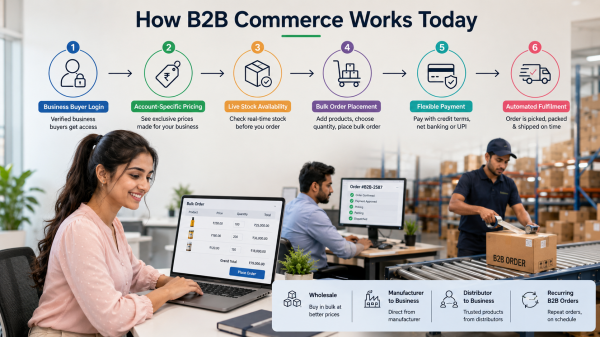
- B2B or wholesale
For example, if you want to minimize investment, dropshipping allows you to sell products without holding inventory. On the other hand, D2C gives you full control over branding and customer experience.
Step 2: Build a Professional E-commerce Website
Your website acts as your digital storefront. Using a reliable ecommerce website builder can help you create a professional, scalable, and user-friendly online store without heavy investment.
A high-performing e-commerce website should be:
- Mobile-responsive
- Fast-loading
- Easy to navigate
- Secure for transactions
You can either use a ready-made e-commerce platform or build a custom store. Choosing a custom store may increase your eCommerce web development timeline but offers a long-term solution and greater scalability.
Step 3: Set Up Payment Gateway Integration
To enable smooth transactions, integrating a secure payment system is essential. Customers should be able to pay using:
- UPI
- Credit and debit cards
- Net banking
- Digital wallets
A seamless payment experience directly improves conversion rates and builds trust.
Step 4: Arrange Logistics and Order Fulfillment
Delivery plays a crucial role in customer satisfaction. You need to partner with reliable logistics providers to ensure timely and safe delivery of products.
This includes:
- Shipping management
- Order tracking
- Return handling
Efficient logistics can significantly improve customer retention and brand reputation.
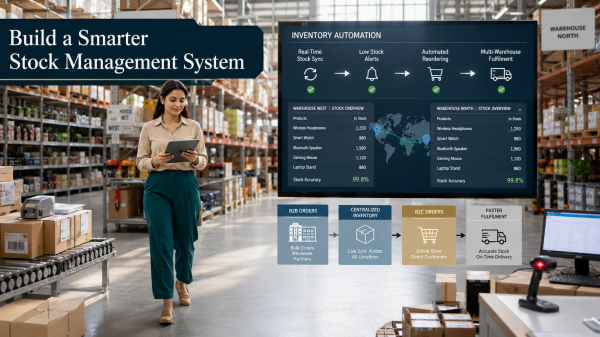
Step 5: Plan Inventory Management Strategically
One of the biggest advantages of e-commerce is flexibility in inventory.
Instead of investing heavily in stock, you can:
- Start with limited inventory
- Source products from vendors
- Use dropshipping to eliminate storage costs
This reduces financial risk and improves cash flow management.
Step 6: Launch Digital Marketing to Acquire Customers
Once your store is ready, attracting customers becomes the priority.
E-commerce businesses rely heavily on digital marketing channels such as:
- Search engine optimization (SEO)
- Social media marketing
- Paid advertising
- Email campaigns
Unlike traditional marketing, digital channels allow precise targeting and performance tracking.
Step 7: Analyze Performance and Optimize Continuously
Successful e-commerce businesses constantly monitor their performance.
Key metrics include:
- Website traffic
- Conversion rates
- Customer behavior
- Sales trends
This data-driven approach helps in improving decision-making and scaling the business efficiently.
Risk Comparison: Which Business Model is Safer?
Risk in traditional business is primarily financial. High initial investment and ongoing expenses increase the chances of loss if the business does not perform well.
E-commerce reduces this risk by allowing businesses to start small and scale gradually. While there are risks related to competition and logistics, they are generally more manageable compared to the financial risks of traditional setups.
Future of E-commerce vs Traditional Business
The future of business is not about choosing only one model—it is about understanding how consumer behavior is evolving.
Over the past decade, there has been a clear shift toward digital platforms. Increasing internet penetration, smartphone usage, and convenience-driven buying behavior have made e-commerce a dominant force.
E-commerce businesses are expected to continue growing because they offer:
- Convenience and speed
- Wider product selection
- Easy price comparison
- Home delivery
At the same time, traditional businesses are not disappearing. Instead, they are adapting by integrating digital elements into their operations.
For example, many offline stores now offer:
- Online ordering
- Click-and-collect services
- Digital payments
- Social media engagement
Hybrid Model: Combining E-commerce and Traditional Business
One of the most important modern business strategies is the hybrid or omnichannel model.
Instead of choosing between e-commerce and traditional business, many successful brands combine both.
What is a Hybrid Business Model?
A hybrid model integrates both online and offline channels, allowing customers to interact with the business in multiple ways.
For example:
- A customer discovers a product online and buys it in-store
- A customer visits a store but later purchases online
- A business uses physical stores for experience and online platforms for scale
Why Hybrid Model is the Future
The hybrid approach solves the limitations of both models:
- It combines trust (offline) with convenience (online)
- It increases customer touchpoints
- It improves brand visibility and sales opportunities
Businesses that adopt this approach are better positioned to meet changing customer expectations.
Which is Better: E-commerce or Traditional Business?
E-commerce is generally better than traditional business in terms of scalability, cost efficiency, and global reach, while traditional business is better for physical experience and personal interaction.
If your goal is:
- Low investment
- Fast growth
- Wider audience reach
E-commerce is the better choice.
If your business depends on:
- Physical product experience
- Local customer base
- In-person service
Traditional business may be more suitable.
However, in today’s market, most businesses benefit from having an online presence, even if they operate offline.
E-commerce vs Traditional Business: Which Should You Choose?
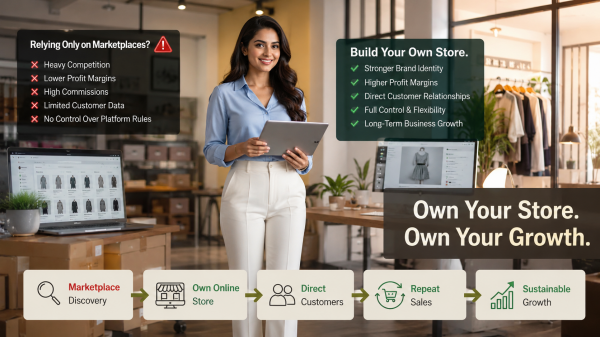
If you're weighing sales channels, compare selling on a marketplace vs your own ecommerce site before you commit.
To make the right decision, consider the following:
Choose E-commerce Business If:
- You want to start with low investment
- You want to sell beyond your local area
- You are comfortable with digital tools
- You want scalable growth
Choose Traditional Business If:
- Your product requires physical inspection
- Your target customers are local
- You rely on personal interaction
Best Option for Most Businesses Today
Start with e-commerce or combine both models.
This approach gives you:
- Flexibility
- Growth opportunities
- Better risk management
Conclusion
The comparison between e-commerce and traditional business clearly shows that both models have their own advantages and limitations.
Traditional businesses offer trust, personal interaction, and physical experience, while e-commerce businesses provide scalability, convenience, and cost efficiency.
However, the rapid growth of digital technology has made e-commerce a more future-ready and adaptable business model.
For most modern entrepreneurs, starting an e-commerce business or adopting a hybrid approach is the smartest way to build a sustainable and scalable business.