Google Ads vs Facebook Ads for Ecommerce: Which Gives Better ROI?
Running an ecommerce business today is no longer just about listing products online. With thousands of stores competing for the same customers, visibility has become as important as the product itself. This is where online advertising plays a major role.
For most ecommerce sellers, one question keeps coming up again and again:
Google Ads vs Facebook Ads for ecommerce — which gives better ROI?
Some sellers swear by Google Ads because customers are already searching. Others trust Facebook Ads because they help discover new buyers and build brands. The truth is not as simple as choosing one platform over the other.
In this detailed guide, we’ll break everything down in plain, easy-to-understand language, so even if you are not from a technical or digital background, you’ll clearly understand:
- How both platforms work
- Where your money goes
- What kind of results you can realistically expect
- And most importantly, which is the best advertising platform for ecommerce for your business
Understanding ROI in Ecommerce Advertising (In Simple Terms)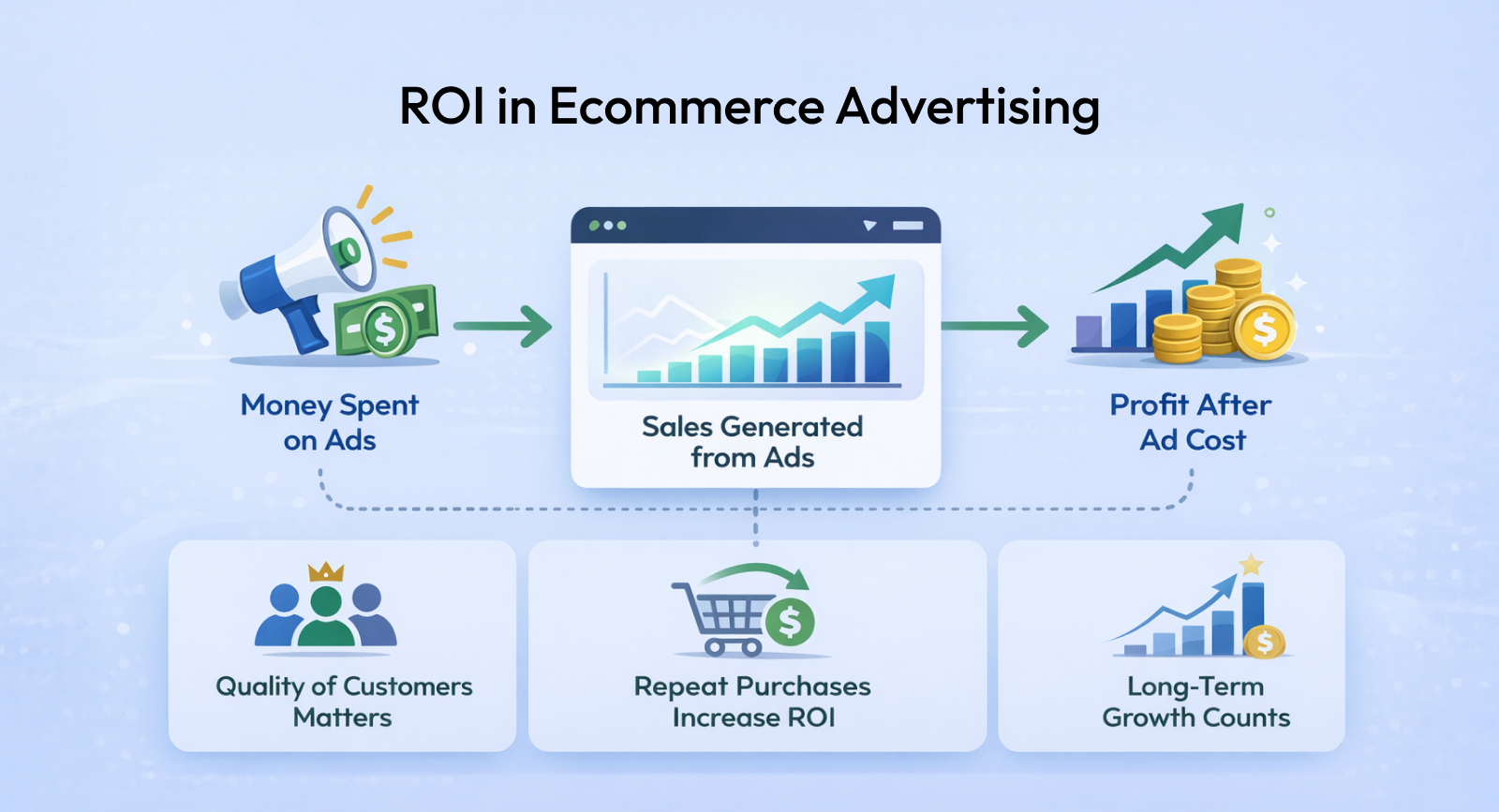
Before comparing platforms, let’s clarify one thing: ROI.
ROI stands for Return on Investment.
In ecommerce advertising, ROI answers one simple question:
“For every rupee I spend on ads, how much money do I get back?”
If you spend ₹10,000 on ads and make ₹40,000 in sales, your ROI is strong. But if you spend ₹10,000 and make only ₹12,000, your ROI is weak — even if traffic increased.
However, ROI in ecommerce is not just about immediate sales. It also includes:
- Quality of customers
- Chances of repeat purchases
- Brand recall
- Long-term growth
That’s why when we compare google ads vs facebook ads for ecommerce, we need to look beyond clicks and impressions.
How Google Ads Works for E-commerce Businesses
Google Ads is based on search intent.
This means your ads appear when people are actively looking for something.
Example:
A customer searches:
“Buy wooden dining table online”
This person is not browsing casually. They already want to buy. Google Ads allows your store to appear exactly at that moment.
Why This Matters for Ecommerce ROI
This high intent is the biggest strength of Google Ads. Customers coming from Google are often:
- Ready to purchase
- Comparing prices
- Looking for trusted sellers
That’s why many ecommerce brands see strong and predictable ROI from Google Ads, especially for products with clear demand.
Common Google Ads Formats Used in Ecommerce
- Search Ads (text ads on Google results)
- Shopping Ads (product image, price, brand)
- Display Ads (banner ads across websites)
For ecommerce, Search and Shopping Ads usually deliver the best results.
How Facebook Ads Work for E-commerce Businesses
Facebook Ads work very differently. Instead of search intent, they rely on interest and behavior.
People don’t go to Facebook or Instagram to buy. They go to:
- Scroll
- Watch videos
- Connect with friends
Facebook Ads introduce products while users are browsing, based on:
- Age
- Interests
- Past behavior
- Engagement history
Example:
A person who follows fitness pages may see ads for sports shoes or gym wear, even if they weren’t planning to shop.
Why Facebook Ads Matter for Ecommerce
Facebook Ads are powerful for:
- Creating awareness
- Showing products visually
- Reaching new audiences
- Retargeting people who visited your website but didn’t buy
This makes Facebook Ads extremely useful for ecommerce brands that want to grow, not just sell once.
Google Ads vs Facebook Ads for Ecommerce: The Core Difference
The biggest difference between the two platforms is customer mindset.
|
Aspect |
Google Ads |
Facebook Ads |
|
Customer intent |
Very high |
Medium |
|
Buying stage |
Ready to buy |
Discovery phase |
|
Best for |
Immediate sales |
Brand building + sales |
|
Learning curve |
Moderate |
Beginner-friendly |
So when people ask facebook ads vs google ads which is better, the real answer depends on what stage your customer is in.
Which Platform Gives Better ROI for E-commerce?
This is where most sellers get confused. Let’s break it down clearly.
When Google Ads Gives Better ROI
Google Ads usually performs better when:
- People already search for your product
- Your pricing is competitive
- Your product solves an immediate need
- Your website checkout is smooth
Examples:
- Electronics
- Home appliances
- Daily-use items
- Replacement products
In such cases, google ads vs facebook ads for e-commerce often favors Google Ads for ROI.
When Facebook Ads Give Better ROI
Facebook Ads perform better when:
- Your product looks attractive
- Buying is emotional or impulse-based
- You want to educate customers
- Repeat purchases matter
Examples:
- Clothing & fashion
- Beauty & skincare
- Home décor
- Handicrafts
In these cases, Facebook Ads can become the best ads for ecommerce over time, even if the first sale takes longer.
Best Advertising Platform for Ecommerce Depends on Business Stage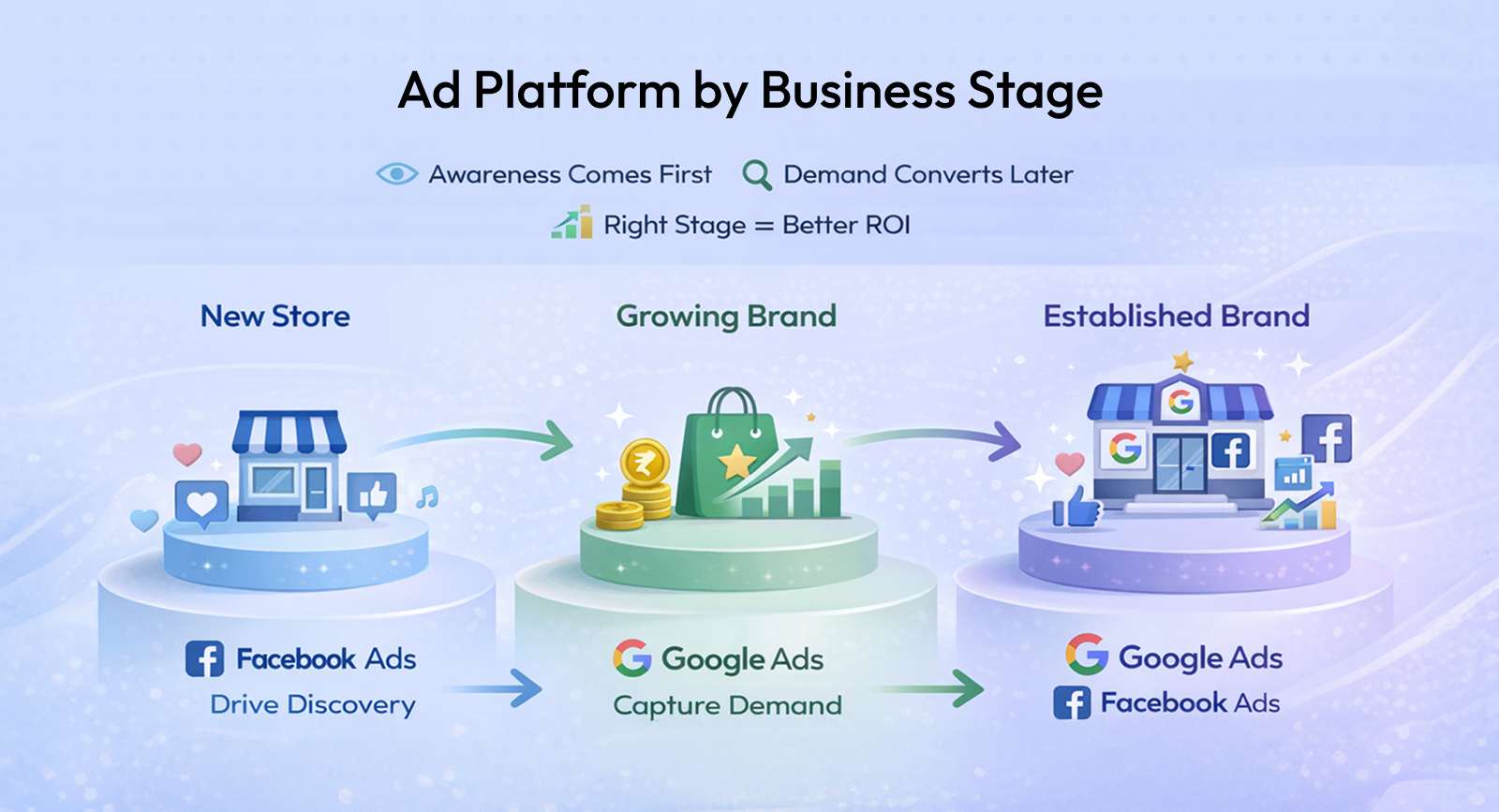
There is no one-size-fits-all answer.
For New Ecommerce Stores
Facebook Ads are usually easier to start with:
- Lower daily budgets
- Flexible targeting
- Better engagement
For Growing Ecommerce Brands
Google Ads help capture demand:
- High-intent buyers
- Stable conversions
- Predictable ROI
For Established Brands
Using both platforms together often becomes the best advertising platform for e-commerce, because:
- Facebook builds demand
- Google converts demand
Cost Comparison: Google Ads vs Facebook Ads
Cost plays a major role in ROI.
Google Ads Cost Reality
- Competitive keywords cost more
- CPC varies by industry
- ROI depends heavily on conversion rate
Facebook Ads Cost Reality
- Lower entry cost
- Creative quality matters more
- Performance improves with testing
This is why many brands use Facebook Ads for online advertising for e-commerce in the early stage and Google Ads for scaling sales.
The Smart Ecommerce Advertising Strategy (Used by Top Brands)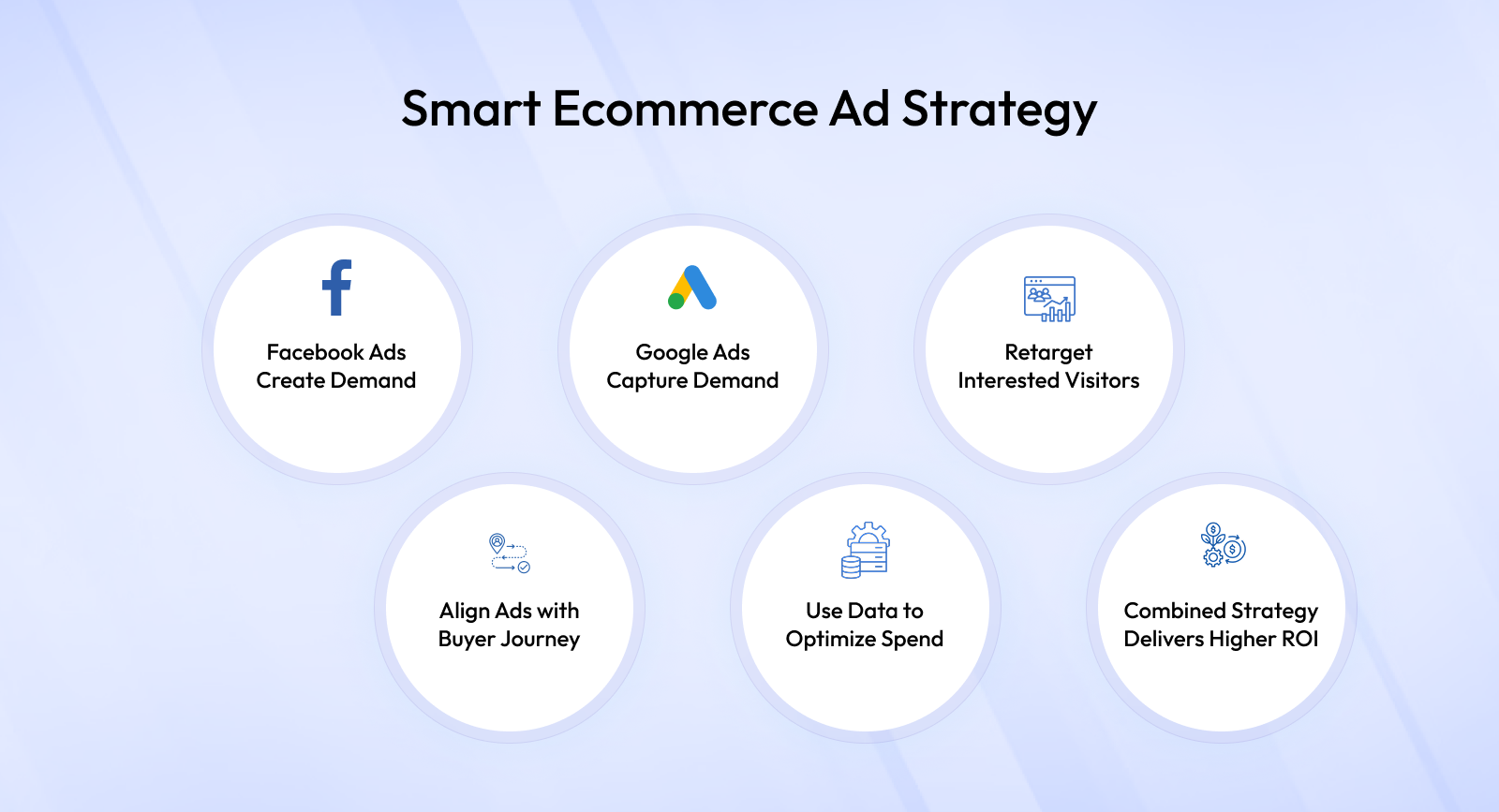
Successful ecommerce brands don’t ask:
“Google Ads or Facebook Ads?”
They ask:
“How can I use both efficiently?”
A common strategy:
- Facebook Ads for awareness, engagement, and retargeting
- Google Ads for search demand and ready buyers
This approach solves the google ads vs facebook ads for ecommerce debate completely and improves overall ROI.
Common Mistakes That Kill Ecommerce Ad ROI
Many sellers blame platforms when the real problem lies elsewhere:
- Poor product images
- Slow website
- No trust signals
- No retargeting strategy
- Unrealistic expectations
No advertising platform can fix a weak store foundation.
SEO, AEO & SGE Optimization (Why This Matters)
This blog is structured to:
- Answer comparison queries clearly (AEO)
- Provide deep explanations for AI summaries (SGE)
- Use natural keyword placement (SEO)
Primary keyword is used naturally:
- google ads vs facebook ads for E-commerce
Secondary keywords are blended contextually:
- best advertising platform for e-commerce
- best ads for ecommerce
- online advertising for e-commerce
- facebook ads vs google ads which is better
This helps the blog rank for multiple intent-based searches.
Final Thoughts: Google Ads vs Facebook Ads for Ecommerce
If you’re looking for a single winner, here’s the honest truth:
there is no universal winner.
Google Ads help you capture existing demand from customers who are already searching.
Facebook Ads help you create demand by introducing your brand and products to new audiences.
Smart ecommerce brands don’t choose between platforms—they use both strategically, based on their business stage and growth goals.
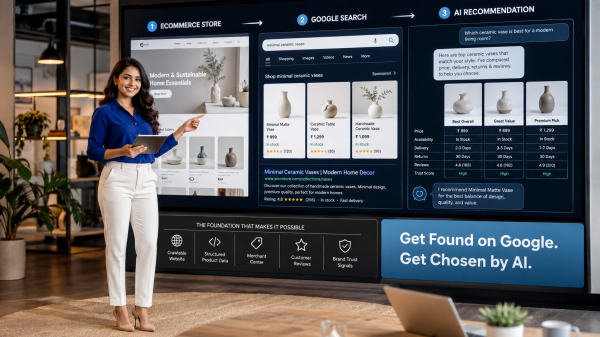
What matters most is having a strong ecommerce foundation underneath your ads. A platform like Shopaccino helps ecommerce businesses make the most of both Google Ads and Facebook Ads by offering a fast, conversion-friendly storefront, smooth checkout experience, and built-in tools for managing products, orders, and customer journeys effectively.
So instead of asking:
“Google Ads vs Facebook Ads for ecommerce — which is better?”
Ask this instead:
“Is my ecommerce setup ready to convert the traffic I’m paying for?”
When your advertising strategy and ecommerce platform work together, ROI follows naturally.
FAQs
Google Ads usually performs better for immediate sales because ads appear when customers are actively searching for products. This high purchase intent often leads to faster conversions compared to social media advertising.
Yes, Facebook Ads can generate ROI for new ecommerce stores by helping them reach new audiences, build brand awareness, and test product-market fit, even if sales take longer initially.
Facebook Ads are generally more budget-friendly for small businesses due to lower entry costs and flexible daily budgets, while Google Ads may require higher spending for competitive keywords.
Google Shopping Ads often work better for ecommerce because they show product images, prices, and brand names directly in search results, helping users make quicker purchase decisions.
ROI from Facebook Ads usually improves over time as campaigns collect data, audiences are optimized, and creatives are refined. Many ecommerce brands see consistent results after a few weeks of testing.
Yes, using both platforms together is often the most effective approach. Facebook Ads help create awareness and retarget audiences, while Google Ads convert high-intent buyers searching for specific products.
Both platforms support remarketing, but Facebook Ads are particularly effective for visual retargeting, while Google Ads perform well for search-based remarketing and product reminders.
Factors such as website speed, product pricing, checkout experience, trust signals, and post-click user experience often have a greater impact on ROI than the advertising platform alone.