Why Mobile-First Ecommerce Websites Convert Better in 2026
Mobile commerce is no longer “the future” of ecommerce — it is the present reality.
In 2026, consumers don’t just browse products on mobile devices; they discover, compare, decide, and purchase entirely from their phones.
Yet, despite explosive growth in mobile ecommerce, many online stores still struggle with one critical challenge:
Low mobile ecommerce conversion rate
Brands attract traffic through ads, SEO, and social media — but a significant percentage of mobile users drop off before completing a purchase. Understanding why this happens and how to fix it is the difference between stagnant revenue and sustainable growth.
This in-depth guide breaks down:
- What defines a good mobile ecommerce conversion rate
- Key online shopping trends shaping buyer behavior
- How mobile ecommerce design impacts conversions
- Proven strategies to improve online store conversion rate on mobile
- What winning brands are doing differently in 2026
What Is Mobile E-commerce & Why It Dominates Online Shopping in 2026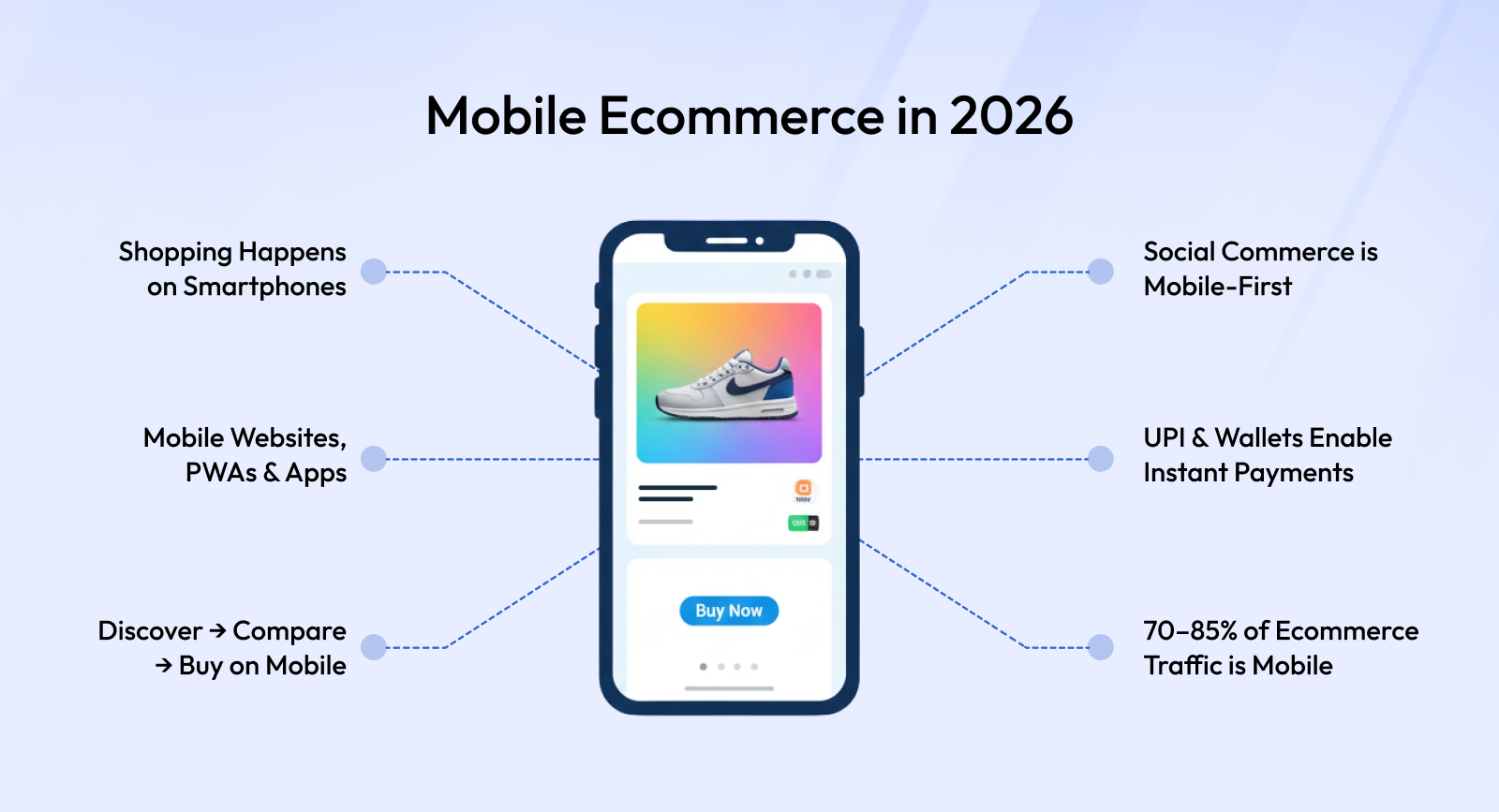
Mobile ecommerce refers to buying and selling products or services through smartphones and tablets using:
- Mobile-optimized websites
- Progressive web apps (PWAs)
- Native Android & iOS shopping apps
In 2026, mobile ecommerce is the primary commerce channel, not a secondary one.
Why mobile dominates online shopping today
- Smartphones are always within reach
- Consumers research and shop during micro-moments
- Social commerce happens almost entirely on mobile
- Digital wallets and UPI have removed payment friction
For many brands, 70–85% of total traffic now comes from mobile, yet conversion rates often lag behind desktop. This gap is where opportunity lives.
Mobile ecommerce refers to buying and selling products or services through smartphones and tablets using:
- Mobile-optimized websites
- Progressive web apps (PWAs)
- Native Android & iOS shopping apps
In 2026, mobile ecommerce is the primary commerce channel, not a secondary one.
Why mobile dominates online shopping today
- Smartphones are always within reach
- Consumers research and shop during micro-moments
- Social commerce happens almost entirely on mobile
- Digital wallets and UPI have removed payment friction
For many brands, 70–85% of total traffic now comes from mobile, yet conversion rates often lag behind desktop. This gap is where opportunity lives.
Read Also : Build Your Fashion Shopping App Without Coding
Understanding Mobile Ecommerce Conversion Rate (And Why It’s Lower Than Desktop)
Understanding online shopping trends is essential to designing mobile experiences that convert.
1. Mobile-First Discovery Is the Norm
In 2026, e-commerce discovery happens before buying intent is fully formed. Mobile users are influenced while scrolling social feeds, watching short-form videos, or receiving recommendations in private messaging apps. These micro-moments define brand perception instantly. If a shopper clicks from Instagram or Google and lands on a slow, cluttered, or confusing mobile page, interest drops within seconds. Brands that fail to optimize mobile discovery journeys end up wasting traffic acquisition budgets, even when product demand exists. Mobile-first discovery demands fast, visually clear, and frictionless landing experiences.
Shoppers discover products through:
- Instagram Reels
- YouTube Shorts
- WhatsApp recommendations
- Google mobile search
Impact on Mobile Traffic Quality:
- Reduces irrelevant bounce traffic
- Improves engagement from social channels
- Converts discovery clicks into intent
- Maximizes ad and content ROI
2. Speed Is the New Brand Trust Signal
Speed is no longer a technical metric — it is a trust signal. In 2026, mobile users subconsciously associate slow-loading pages with unreliable brands. Even a one-second delay disrupts buying momentum and increases hesitation. With 5G and high-speed devices becoming common, user tolerance for lag is near zero. Fast-loading pages create confidence, keep users focused, and allow shoppers to move seamlessly from browsing to checkout. Brands that prioritize mobile speed gain a psychological advantage over competitors before price or product comparison even begins.
Mobile users expect:
- Page load under 3 seconds
- Instant image rendering
- Smooth scrolling
Impact on User Trust & Engagement:
- Builds instant brand credibility
- Reduces impatience-driven exits
- Increases session depth
- Improves purchase confidence
Every additional second of delay reduces online store conversion rate significantly.
3. One-Handed Shopping Behavior
Most mobile shopping in 2026 happens in real-life moments — commuting, waiting, multitasking — using one hand. When navigation elements, CTAs, or menus are hard to reach, friction increases instantly. Users don’t consciously analyze usability issues; they simply leave. Thumb-friendly layouts reduce effort and allow shoppers to act impulsively. Brands that design for actual human behavior rather than desktop habits remove invisible barriers that silently kill conversions. One-handed usability directly influences how long users stay engaged and how easily they complete actions.
Most users browse and shop using one thumb.
Designs that ignore thumb-friendly navigation:
- Increase bounce rate
- Reduce add-to-cart actions
- Kill impulse purchases
Impact on User Experience & Actions:
- Increases add-to-cart taps
- Reduces navigation friction
- Encourages impulse buying
- Lowers usability-driven drop-offs
Read Also : Best eCommerce Platform for Growth-Driven Businesses
4. Checkout Expectations Have Changed
Modern mobile shoppers expect checkout to be fast, flexible, and effortless. In 2026, users no longer tolerate forced sign-ups, lengthy forms, or limited payment choices. Digital wallets, UPI, and autofill have reshaped expectations. Any friction during checkout feels outdated and untrustworthy. Brands that simplify checkout respect the user’s time and decision-making speed. When checkout flows feel smooth and familiar, users are more confident completing purchases, even for first-time brands.
Shoppers now expect:
- Guest checkout
- Autofill addresses
- UPI, wallets, BNPL
- Minimal form fields
Impact on Checkout Completion Rate:
- Reduces cart abandonment
- Speeds up purchase flow
- Improves first-time buyer success
- Increases payment success rate
Mobile Ecommerce Design: The Silent Conversion Killer or Booster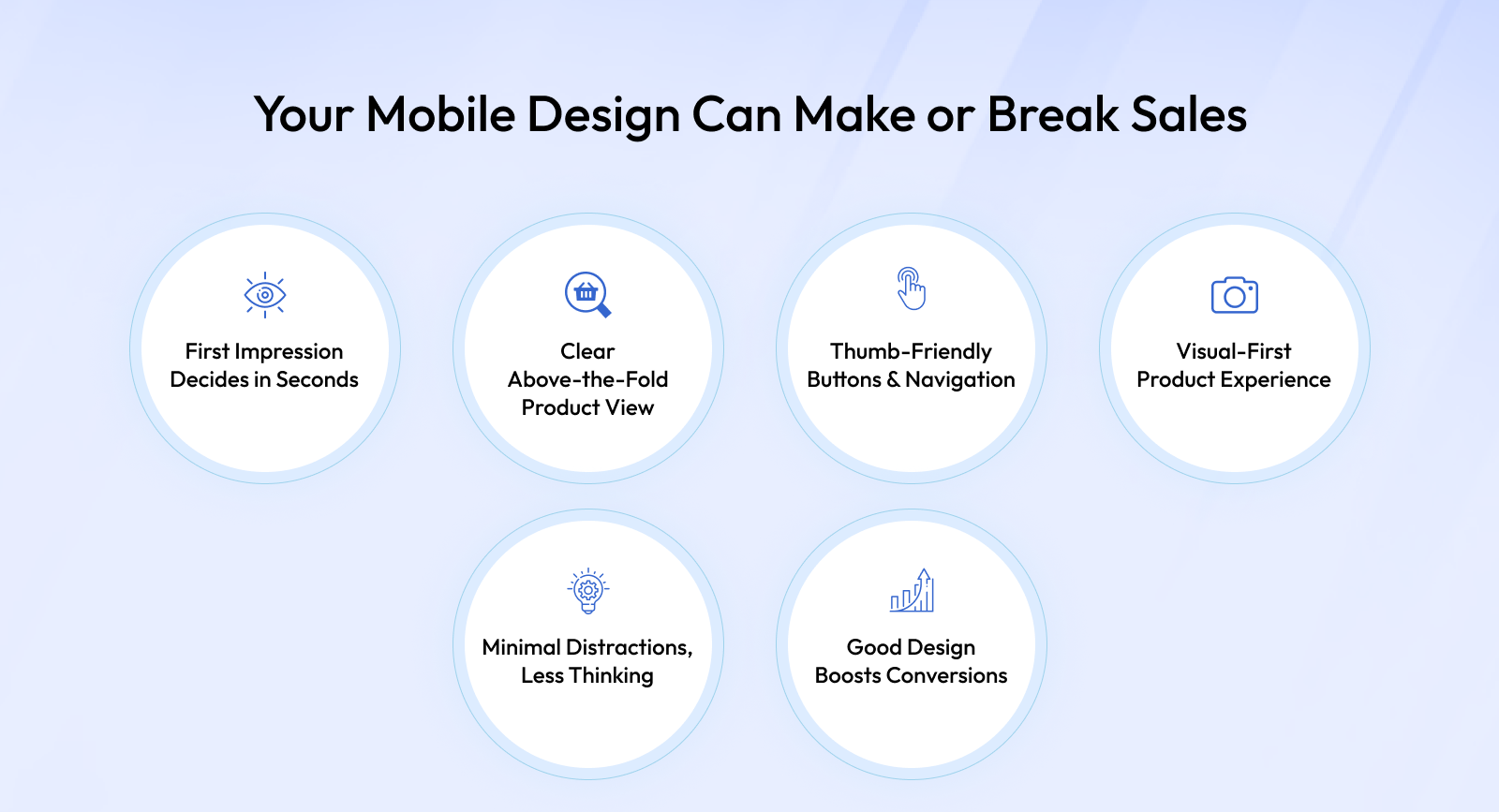
Mobile ecommerce design directly influences buyer psychology. Poor design doesn’t just look bad — it creates friction, confusion, and hesitation.
Key mobile ecommerce design principles that increase conversion
1. Above-the-Fold Clarity
Mobile users decide within seconds whether to stay or leave. Above-the-fold clarity ensures shoppers immediately understand what the product is, why it matters, and what action to take. In 2026, attention spans are shorter due to content overload. If users need to scroll or think to understand value, conversions drop sharply. Clear pricing, strong visuals, and visible CTAs reduce hesitation and guide users naturally toward action.
Users should instantly see:
- Product value
- Price
- CTA (Add to Cart / Buy Now)
If users need to scroll to understand the product, conversions drop.
2. Thumb-Friendly Navigation
Navigation design directly affects usability on mobile devices. Buttons placed too high or too small increase effort and frustration. In 2026, brands that place CTAs within natural thumb zones enable faster interactions. Sticky buttons and large tap areas make shopping feel intuitive rather than forced. When navigation matches how users physically hold their phones, the shopping experience feels effortless and encourages action.
- Bottom-placed CTAs
- Large tap targets
- Sticky add-to-cart buttons
Design for how humans actually hold phones.
3. Visual-First Product Pages
Mobile shoppers rely more on visuals than text. High-quality images, swipeable galleries, and short videos help users quickly evaluate products without reading long descriptions. In 2026, visuals act as proof, reducing uncertainty and building confidence. Brands that invest in visual storytelling communicate quality faster and emotionally connect with shoppers, especially on smaller screens.
Mobile shoppers rely heavily on visuals:
- High-quality images
- Swipeable galleries
- Short product videos
Less text. More clarity.
4. Minimal Cognitive Load
Every extra decision drains user attention. Pop-ups, complex menus, and excessive information overwhelm mobile shoppers. In 2026, winning brands remove distractions and guide users step-by-step. Clean layouts reduce mental effort, allowing shoppers to focus on buying rather than navigating. Simplified experiences feel premium and trustworthy, directly influencing purchase behavior.
Avoid:
- Pop-ups stacking on pop-ups
- Long paragraphs
- Complex menus
Every extra decision reduces the chance of purchase.
Why Mobile-Optimized Checkout Matters More Than Ever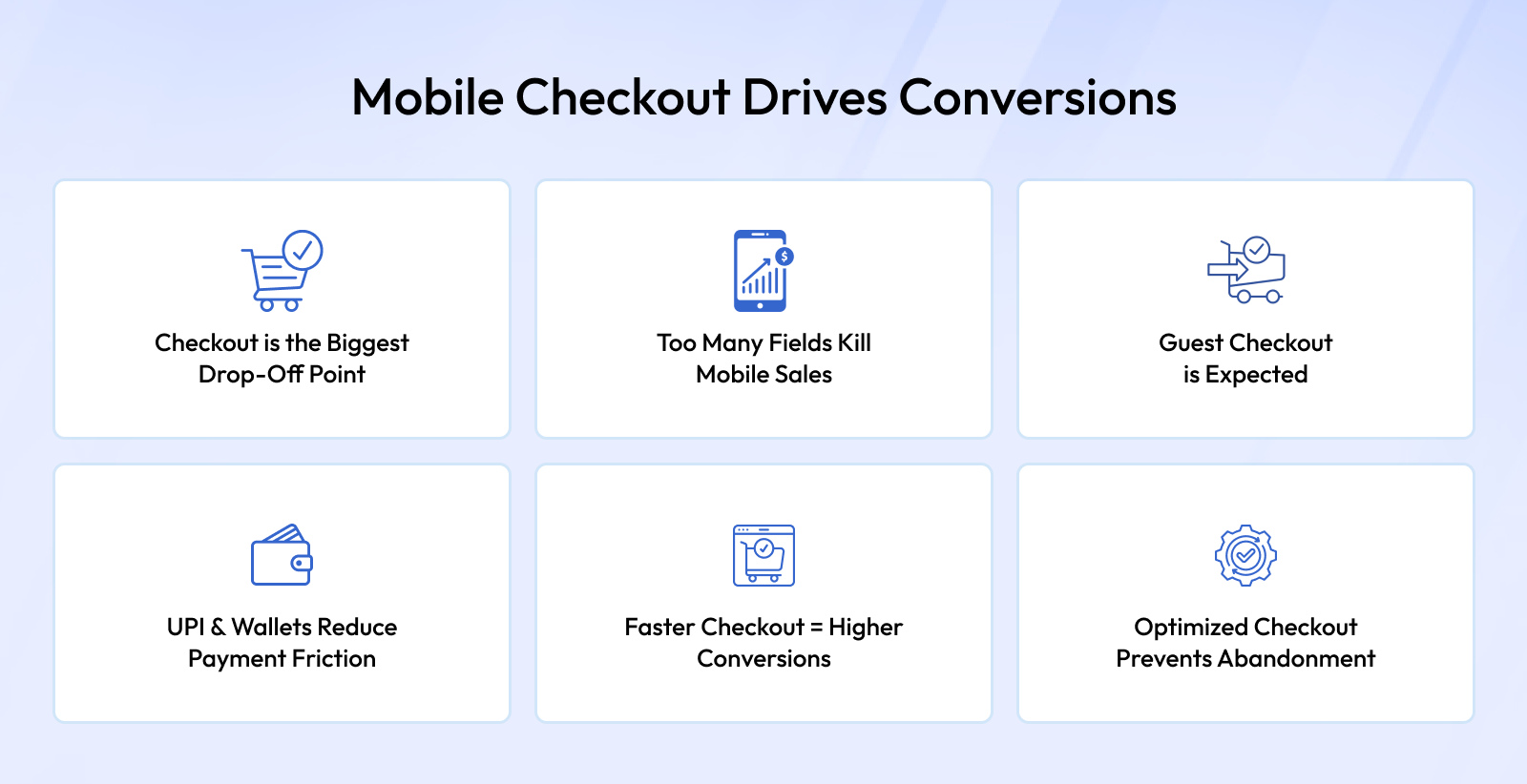
Checkout is where most mobile conversions are lost.
Common mobile checkout problems
- Forced account creation
- Too many form fields
- Limited payment options
- Slow OTP or verification flows
High-converting mobile checkout best practices
✔ One-Page Checkout
Reduce steps. Reduce friction.
✔ Multiple Payment Options
UPI, wallets, cards, BNPL — let users choose.
✔ Autofill & Smart Defaults
Don’t make users type unnecessarily.
✔ Clear Error Handling
If something fails, explain it instantly.
Proven Ways to Increase Mobile Ecommerce Conversion Rate in 2026
Here are battle-tested strategies used by high-performing brands:
1. Personalize the Mobile Experience
Personalization makes mobile shopping feel relevant and human. Showing location-based pricing, recently viewed products, and tailored recommendations reduces search effort. In 2026, users expect brands to remember preferences. Personalization builds trust and shortens buying journeys.
- Location-based pricing
- Personalized recommendations
- Recently viewed products
Personalization boosts trust and relevance.
2. Use Smart Abandoned Cart Recovery
Mobile abandonment is often situational, not intentional. Notifications, WhatsApp reminders, and urgency-based incentives help bring users back. In 2026, timely recovery strategies reclaim lost revenue without heavy discounts.
Mobile users abandon carts frequently.
Winning brands:
- Send WhatsApp reminders
- Use push notifications
- Offer limited-time incentives
3. Optimize for Mobile SEO
Mobile search drives high-intent traffic. Fast pages, structured data, and mobile-friendly content ensure users land on optimized experiences. In 2026, SEO success depends on mobile performance, not desktop rankings.
Mobile users often arrive via search.
Ensure:
- Fast mobile pages
- Clean URLs
- Schema markup
- Mobile-friendly product content
Better traffic = better online store conversion rate.
4. Build Trust Instantly
Mobile users decide quickly. Reviews, secure payment badges, return policies, and delivery timelines reduce fear. In 2026, trust elements are conversion essentials, not add-ons.
Mobile shoppers decide fast.
Display:
- Reviews & ratings
- Return policy
- Secure payment badges
- Clear delivery timelines
Trust equals conversion.
5. Test Continuously
Mobile CRO is never finished. Small tweaks in CTA placement, images, or checkout steps create measurable gains. In 2026, data-driven testing separates average stores from high-growth brands.
Small changes create big wins:
- CTA placement
- Button colors
- Checkout steps
- Product image order
Mobile CRO is ongoing — not one-time.
Read Also : How Great UX Turns Ecommerce Traffic into Sales
Mobile Ecommerce vs Desktop: The Conversion Reality
|
Metric |
Mobile |
Desktop |
|
Traffic Share |
Higher |
Lower |
|
Conversion Rate |
Lower |
Higher |
|
Session Duration |
Shorter |
Longer |
|
Impulse Buying |
Higher |
Lower |
|
Growth Potential |
Massive |
Saturated |
Brands that close the mobile conversion gap win long-term.
How High-Growth Brands Approach Mobile Ecommerce in 2026
Successful brands treat mobile as:
- The primary storefront
- The main conversion engine
- The center of customer experience
They invest in:
- Mobile-first design
- App-like speed
- Simplified checkout
- Data-driven optimization
The result? Higher mobile ecommerce conversion rate, stronger retention, and scalable growth.
Final Thoughts: Mobile Is Where Ecommerce Is Won or Lost
Mobile ecommerce is no longer optional — it’s where buying decisions happen.
If your store:
- Looks good on desktop but struggles on mobile
- Has traffic but poor mobile sales
- Has high cart abandonment on phones
Then your growth is being capped by experience, not demand.
By aligning with modern online shopping trends, investing in conversion-focused mobile ecommerce design, and continuously optimizing checkout and UX, brands can dramatically improve their online store conversion rate in 2026 and beyond.
FAQs
Because shoppers now discover, compare, and buy on their phones. Mobile-first sites are built for speed, thumb-friendly navigation, and quick decisions—while desktop-first sites often feel slow and frustrating on mobile, causing drop-offs.
A good mobile conversion rate typically ranges between 1.5% to 3%, depending on industry. High-performing brands that optimize speed, design, and checkout often outperform desktop-focused competitors despite higher mobile traffic.
Mobile users face more friction—small screens, slower networks, complex forms, and poor checkout design. When these issues are fixed with mobile-first UX and simplified checkout, the gap reduces significantly.
Design directly impacts trust and usability. Clear CTAs, visual-first product pages, and minimal distractions make it easier for users to act. Poor design creates hesitation—even if the product and price are right.
The most common mistakes include forced account creation, too many form fields, limited payment options, and slow verification flows. Each extra step increases cart abandonment on mobile.
Yes. Most ecommerce traffic comes from mobile, and checkout is where mobile sales are won or lost. Even small improvements in mobile checkout can create a larger revenue impact than desktop optimizations.
They remove typing, reduce errors, and speed up payments. Familiar and trusted payment methods make users feel confident completing purchases—especially on smaller screens and first-time visits.
Absolutely. Mobile SEO brings high-intent users to your store. Fast-loading pages, clean structure, and mobile-friendly content ensure visitors land on experiences that actually convert.
Yes. Changes like CTA placement, button size, image order, or reducing checkout steps often lead to measurable conversion gains. Mobile CRO is about removing tiny frictions that silently block purchases.
No. Mobile user behavior, devices, and expectations keep evolving. High-growth brands continuously test and optimize mobile experiences to stay competitive and conversion-focused.