How Selling Multiple Dairy Products in One App Increases Daily Revenue
For many dairy businesses, milk is the foundation of daily income. It is reliable, routine-based, and deeply integrated into customers’ lives. But relying only on milk also creates a natural ceiling on revenue. Once a customer’s milk quantity is fixed, daily earnings stop growing—even if demand exists for other dairy products.
This is where many dairy businesses unknowingly limit themselves.
Customers who trust a dairy for milk are often willing to buy more: curd for lunch, paneer for dinner, butter for breakfast, ghee for cooking, or buttermilk for summer afternoons. When these products are not available through the same ordering system, customers simply buy them elsewhere. The opportunity is lost—not because of lack of demand, but because of lack of access.
A milk delivery app development changes this dynamic. By allowing dairies to sell multiple dairy products in one place, the app turns a single-product business into a daily basket-based business. Instead of increasing delivery costs or customer acquisition, revenue grows organically from existing customers.
This blog explains why selling only milk restricts growth, what dairy customers expect today, and how offering curd, butter, paneer, and more through one app increases daily revenue without adding operational complexity.
Challenging Area: Why Selling Only Milk Limits Dairy Revenue
Milk is a habit product, but it is also a fixed-quantity product. This creates several growth challenges for dairy businesses.
Revenue Plateaus Quickly
Most households consume a predictable quantity of milk. Once that number is reached, there is little scope for daily upselling.
Missed Cross-Selling Opportunities
Customers buying milk often need curd, butter, paneer, or ghee—but when these are not listed, they purchase from local stores or other apps.
Dependence on New Customers
To grow revenue, dairies relying only on milk must constantly acquire new customers, increasing marketing and operational effort.
Underutilised Delivery Routes
Delivery vehicles already visit customers daily. Carrying only milk underuses delivery capacity.
Higher Risk During Seasonal Fluctuations
Milk demand can fluctuate due to holidays, fasting periods, or travel. Additional products help balance revenue during such times.
Their Customer Challenging Area: What Dairy Customers Expect Today
Modern dairy customers value convenience and trust more than variety alone. Their expectations have evolved.
One App for All Dairy Needs
Customers prefer ordering all dairy essentials together rather than juggling multiple vendors.
Add-On Flexibility
They want the option to add curd, paneer, or butter occasionally without changing subscriptions.
Trusted Quality
If milk quality is good, customers naturally trust the same brand for other dairy products.
Simple Ordering Experience
Customers do not want complicated menus or separate ordering processes for each product.
Consistent Delivery
They expect all dairy items to arrive together, on time, with the same reliability as milk.
Solution: How a Dairy App Enables Multi-Product Selling
A milk delivery app is not limited to milk. It is a full dairy commerce platform when used effectively.
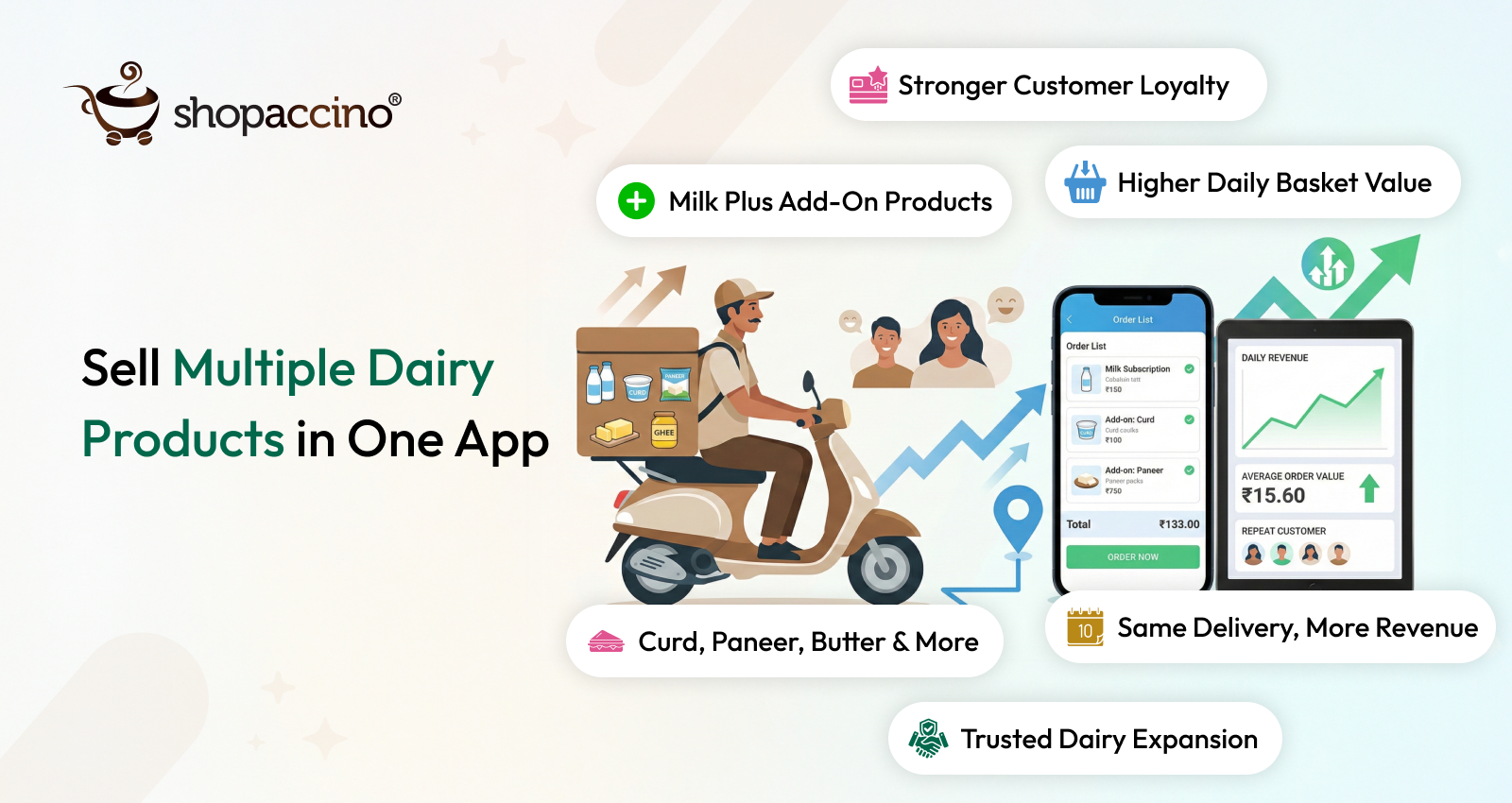
Platforms like Shopaccino allow dairy businesses to list, manage, and sell multiple dairy products through the same app used for milk subscriptions.
Centralised Product Catalogue
Milk, curd, paneer, butter, ghee, and buttermilk can all be listed in one digital catalogue.
Subscription + One-Time Orders
Customers can subscribe to milk while ordering other dairy products as needed.
Daily Basket Expansion
Each additional product increases the average order value without increasing delivery cost.
Simple Add-On Experience
Customers can add products to their daily delivery with a few taps.
Inventory Visibility
The dairy can control availability, quantities, and delivery days for each product.
How to Implement Multi-Product Selling in a Dairy App (Step-by-Step)
Step 1: Identify High-Demand Dairy Products
Start with commonly used items such as curd, paneer, butter, ghee, or buttermilk.
Step 2: Create Clear Product Listings
Each product should have a name, unit size, price, and delivery availability clearly defined.
Step 3: Enable Add-On Ordering
Allow customers to add products alongside their regular milk delivery.
Step 4: Manage Inventory Digitally
Update daily availability to avoid overselling or last-minute cancellations.
Step 5: Educate Customers
Use notifications or in-app banners to inform customers about additional products.
Step 6: Track Sales Performance
Monitor which products sell best and adjust offerings accordingly.
Benefits: How Multi-Product Selling Increases Daily Revenue
Higher Average Order Value
Adding even one extra product per customer significantly boosts daily earnings.
Better Use of Existing Customers
Revenue grows from current customers without additional acquisition cost.
Improved Delivery Efficiency
More products delivered per stop increase route profitability.
Stronger Customer Loyalty
Customers buying multiple products are less likely to switch vendors.
Revenue Stability
Multiple products reduce dependence on milk alone.
Easier Business Expansion
A diversified product range makes the dairy more resilient and scalable.
Conclusion
Selling only milk keeps dairy businesses stuck at a predictable revenue level. While milk builds daily relationships, it does not fully utilise the trust customers place in the brand. Curd, paneer, butter, and other dairy products naturally belong in the same buying journey.
A milk delivery app enables this shift seamlessly. Without changing delivery routes or adding marketing costs, dairies can increase daily revenue simply by expanding the basket size of existing customers.
With platforms like Shopaccino, dairies can transform from single-product suppliers into complete daily dairy providers—earning more per customer while delivering the same trusted service.
FAQs
Yes. A milk delivery app like Shopaccino lets you list milk, curd, paneer, butter, ghee, and buttermilk in one catalogue, so customers can order everything through the same subscription without switching apps.
No. Since delivery vehicles already visit customers daily for milk, adding more products increases the order value per stop without adding extra delivery trips or cost.
Once milk quantity is fixed, revenue per customer plateaus. Offering add-on products like curd and paneer increases the average order value from the same customer base, growing revenue without new customer acquisition.
No. Customers can keep their regular milk subscription and simply add products like curd or paneer as one-time or occasional add-ons within the same order.
Yes. All ordered dairy products are delivered together with the regular milk delivery, so customers get one consistent, on-time drop instead of multiple separate deliveries.