Mastering Multi-Warehouse Management for eCommerce
As eCommerce continues to expand across regions, markets, and customer segments, brands now manage far more complexity than ever before. Whether a business is shipping from multiple retail outlets, stocking products in third-party warehouses, or fulfilling orders from domestic and international facilities, multi-warehouse management has become a critical part of modern online operations.
For MSMEs, exporters, wholesalers, manufacturers, and fast-growing D2C brands, the shift from a single warehouse to multiple storage locations brings both opportunity and responsibility. It allows businesses to serve customers faster, reduce shipping costs, and stay competitive—but only if the system behind it is well organized. Without structure, multi-warehouse operations can quickly become overwhelming, leading to stock confusion, delayed deliveries, and customer dissatisfaction.
A modern, integrated platform—such as Shopaccino—helps simplify this complexity with real-time tracking, automated routing, location-based inventory display, and a centralized dashboard for all warehouses. This blog explains why multi-warehouse management is essential, what challenges businesses face, how customer expectations have evolved, and how the right system can help brands operate efficiently across locations.
Challenging Area: Why Multi-Warehouse Management Feels Complicated
Managing multiple warehouses is not simply about storing stock in different locations. It requires a well-connected structure that synchronizes every unit of inventory and matches it with real-time demand. Many MSMEs struggle because:
Manual stock updates create confusion
When inventory is tracked manually in spreadsheets or separate systems, mismatches occur. One warehouse might show availability while another runs out, causing incorrect order assignment.
Difficulty routing orders to the correct warehouse
As orders come in, businesses must decide which warehouse should fulfill them. Without automation, this becomes slow and error-prone.
Overselling or stockouts across locations
If the eCommerce store doesn’t reflect accurate warehouse stock, customers may place orders for items unavailable in their region.
High shipping costs without smart warehouse allocation
Shipping from the wrong warehouse increases delivery time and cost—especially for nationwide or cross-border customers.
Managing returns across different locations
Handling returns for multiple warehouses becomes complex unless mapped to the right place.
Lack of unified control
Owners often find it hard to monitor all warehouses, teams, and stock movements from one place, leading to inefficiency.
No visibility of warehouse performance
Without analytics, identifying which warehouse is performing well, running slow, or facing stock issues is difficult.
These challenges show that multi-warehouse management is not just a logistics decision—it’s a digital infrastructure requirement.
Their Customer Challenging Area: What Shoppers Expect Today
Customers today shop online with very high expectations, especially in terms of stock availability and delivery speed. With multiple warehouses, the pressure increases:
Fast delivery wherever they live
Buyers expect quick delivery regardless of their location. They assume the brand has stock nearby.
Real-time stock visibility
If a product is out of stock, customers want to know immediately—before they waste time filling out checkout forms.
Accurate delivery timelines
Customers lose trust if the expected delivery date changes after they place an order.
Smooth return and replacement processes
No buyer wants confusion about which warehouse handles their return or replacement.
Location-based inventory suggestions
Shoppers expect the store to automatically show items available for their pincode or region.
Reliable order tracking
Whether domestic or international, customers want seamless updates through every step.
If brands cannot meet these expectations, even strong products fail to achieve high conversion rates or repeat sales.
Solution: How Integrated Platforms Simplify Multi-Warehouse Operations
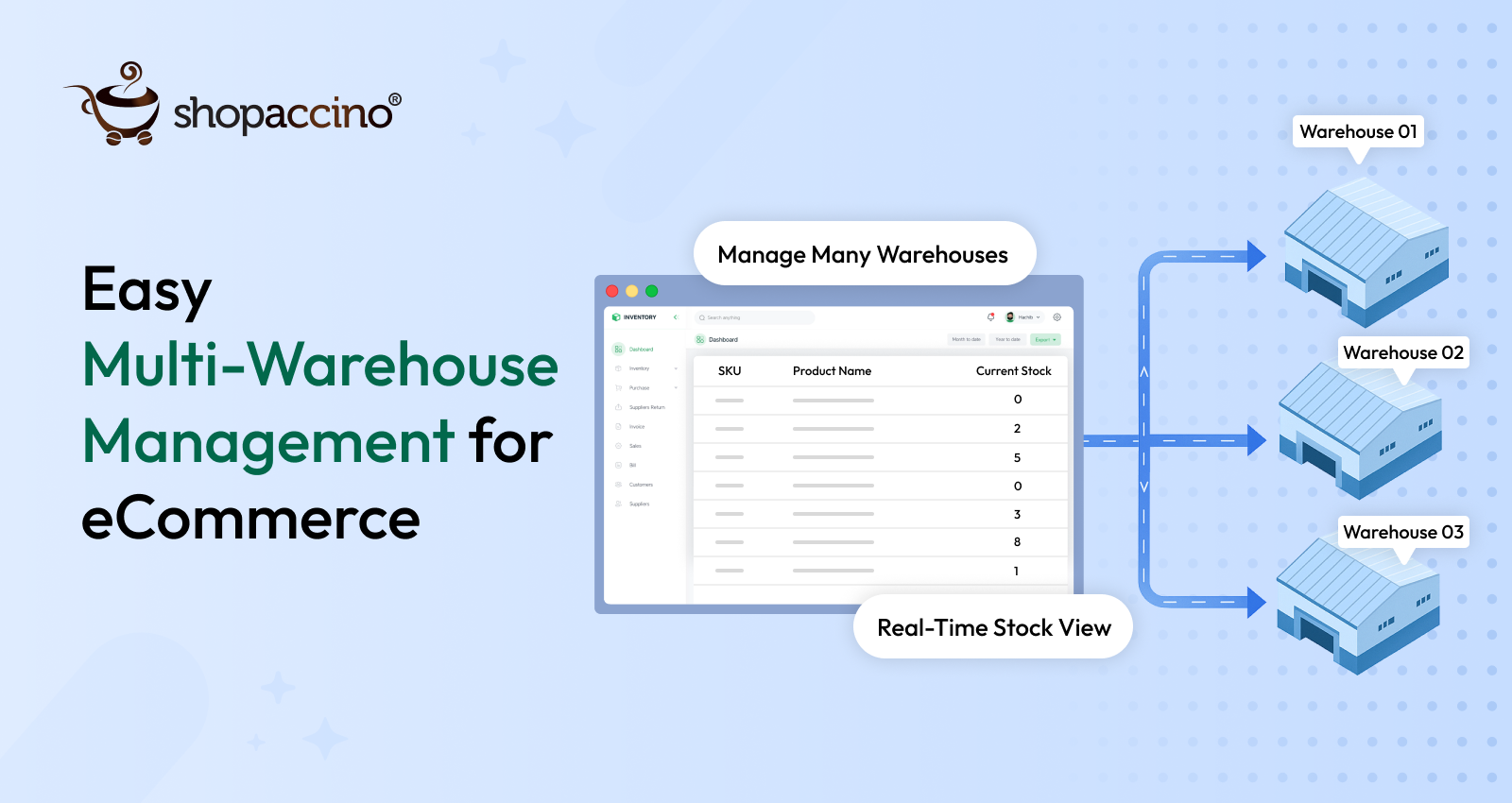
A connected eCommerce platform like Shopaccino helps businesses streamline multi-warehouse management by connecting stock, orders, logistics, and teams under one system.
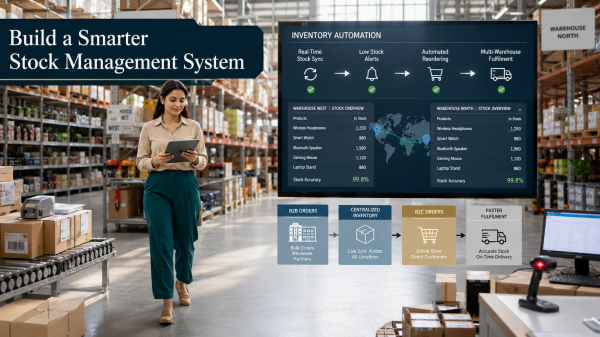
Real-time inventory sync across all warehouses
Every update—stock addition, dispatch, return—is reflected instantly across the platform. This prevents overselling and ensures accurate availability.
Automatic order routing
Orders are automatically assigned to the warehouse closest to the customer or the one with available stock, saving time and reducing shipping cost.
Location-based product visibility
Customers see only the products available in their region, creating a smoother buying experience and fewer order cancellations. See how Shopaccino's Multi-Warehouse Locations feature maps stock to regions automatically.
Centralized inventory dashboard
Businesses can view stock levels, warehouse performance, and alerts from one place, enabling better decision-making.
Multi-warehouse fulfillment for faster delivery
By distributing stock strategically, brands improve delivery time and customer satisfaction.
Efficient return management
Returns get mapped back to the correct warehouse, reducing confusion and misplacement.
Separate warehouse permissions for staff
Team access can be restricted by warehouse, improving accountability and workflow clarity.
Together, these features create a smooth multi-warehouse ecosystem without operational chaos.
How to Implement Multi-Warehouse Management (Step-by-Step)
Implementing multi-warehouse operations successfully requires a clear, systematic approach:
Step 1: Identify warehouse locations based on demand
Start by understanding order patterns. Choose warehouse locations closer to high-order regions to reduce delivery time.
Step 2: Define warehouse roles and staff permissions
Each warehouse may have different teams handling stock, packing, and dispatch. Assign user roles for each location through your platform.
Step 3: Upload inventory for each warehouse separately
Instead of combining stock, add the right quantities to each warehouse so the system can route orders accurately.
Step 4: Enable automatic order assignment
Use your platform’s automatic routing features to send orders to the nearest warehouse or the one with the correct SKU available.
Step 5: Enable pincode or region-based visibility
Let customers view only the products available in their area to reduce order cancellations.
Step 6: Set up return mapping
Decide which warehouse handles returns for which region. This helps avoid mixing up stock or overloading one location.
Step 7: Track warehouse performance with analytics
Monitor:
- Stock turnover
- Delivery time
- Orders processed
- Returns handled
- Slow-moving inventory
Data helps optimize warehouse usage over time.
Step 8: Keep all warehouses in sync
Real-time syncing prevents double-selling, reduces errors, and ensures customers always see accurate information.
By following these steps, brands can scale from a single warehouse to a nationwide or global distribution system effortlessly.
Benefits of Strong Multi-Warehouse Management
A well-structured multi-warehouse setup unlocks powerful benefits:
Faster delivery and improved customer satisfaction
Customers receive their orders sooner, increasing repeat purchases.
Lower shipping costs
Orders are shipped from the nearest warehouse, reducing courier expenses.
Reduced load on single warehouse
Inventory is balanced across locations, improving operational stability.
Higher stock accuracy
Real-time updates prevent issues like overselling or incorrect availability.
Better performance insights
Businesses can track which warehouse performs best, helping with future planning.
More scalable operations
Adding new warehouses becomes easy when the system is already built to support multiple locations.
Improved local reach
Whether expanding across states or countries, multiple warehouses help brands grow region by region.
Conclusion
Multi-warehouse management is no longer an advanced feature reserved for large enterprises. Today, MSMEs, manufacturers, exporters, wholesalers, and D2C brands need it to stay competitive and meet the expectations of modern shoppers. With the right technology, even a small business can run a large-scale, multi-location fulfillment system effortlessly.
Platforms like Shopaccino empower businesses with real-time syncing, automated routing, location-based visibility, and advanced analytics. With these tools, brands can reduce logistics costs, improve delivery times, and scale across regions without operational stress.
In a world where speed, accuracy, and customer experience define eCommerce success, mastering multi-warehouse management gives businesses a clear advantage. For a practical breakdown of the tools and setup steps involved, see our guide on how to manage multiple warehouses efficiently using smart eCommerce tools.
FAQs
It is a system that lets businesses store and manage inventory across multiple locations while syncing stock and routing orders accurately.
Yes, if they want to deliver faster, reduce shipping costs, or serve customers across states or countries.
Automation assigns orders, updates stock, and manages routing without manual effort, reducing errors.
With location-based visibility, customers see stock only from the warehouse servicing their region.
Yes. Shipping from the nearest location significantly reduces delivery charges.
Shopaccino offers real-time sync, automatic routing, separate warehouse permissions, and pincode-based visibility to simplify operations.
Yes, once the system is in place, adding new warehouses becomes quick and straightforward.