
How to Sell Courses Online and Build a Profitable E-Learning Business
The online learning industry is growing faster than most traditional education markets. Millions of learners worldwide now prefer flexible, self-paced education over fixed classroom schedules. For businesses, educators, coaches, and independent creators, this shift represents a real and immediate commercial opportunity.
Knowing how to sell courses online is no longer just about recording videos and uploading them somewhere. It is about building a professional, fully functional online course website that you own, control, and scale on your own terms. The platform you build your business on determines how much revenue you keep, how well you rank on Google, and how completely you own your student relationships.
This guide explains what you need to run a course-selling website properly, what features matter most, and how Shopaccino helps you build and manage that website without writing a single line of code.
Why Selling Courses Online is a Growing Business Opportunity

Online education is not a trend that is slowing down. According to Statista, the global e-learning market is projected to reach $325 billion by 2025. That growth is being driven not by large institutions alone but increasingly by independent course creators, training companies, coaches, and businesses launching their own digital learning platforms.
Why businesses are moving to direct-to-student selling
Selling directly through your own online education website gives you something a marketplace never will: control. Control over pricing, over your brand, over the student relationship, and over every rupee or dollar of revenue you earn. When a student buys from your website, they become your customer, not the platform's.
That distinction matters enormously for long-term business building. Your customer data, your email list, your repeat purchase potential, all of it sits with you instead of being locked inside a third-party system you do not own.
Who benefits most from launching a course website?
- Educators and trainers: professionals who want to scale their knowledge beyond one-to-one delivery
- Corporate training providers: businesses offering onboarding, compliance, or skills programmes to external clients
- Coaches and consultants: experts who want to add a scalable product alongside their service offering
- eCommerce businesses: brands adding a training or educational product line to their existing catalogue
- Institutes and academies: structured educational organisations moving to a direct online model
Why You Need Your Own Website to Sell Courses Online
Many course creators start by listing on a marketplace. It is a fast way to test demand. But relying on a marketplace as your primary sales channel has real structural limitations that compound as your business grows.
Selling on a Marketplace | Selling on Your Own Website |
Platform takes 20% to 30% per sale | You keep 100% of every sale |
Platform owns your student data | You own every customer record |
Your brand competes on their search | Your SEO builds equity on your domain |
Pricing and offers are controlled by platform rules | Full flexibility on pricing and promotions |
Algorithm changes affect your visibility | You control your traffic strategy |
Limited marketing and email access | Direct access to every enrolled student |
No differentiation from thousands of similar courses | Fully branded experience, unique to you |
Brand control and trust
Students who land on your branded course creator website with your domain, your design, and your messaging experience a professional impression that a marketplace listing cannot replicate. That first impression is the difference between a visitor who trusts you enough to enrol and one who clicks away.
SEO and organic discoverability
Every blog post, course page, and resource published on your own domain builds your website's authority in search engines over time. On a marketplace, the SEO benefit goes to the platform, not to you. Your own e-learning website accumulates that authority permanently.
“A marketplace gives you an audience on loan. Your own website builds one that you keep forever.”
Features Required in an Online Course Selling Website
Not every website builder is equipped to handle the specific requirements of a course-selling website. Before you build, understand which features are essential for running a smooth, professional operation.
Core functional requirements
- Course listing and catalogue pages: clean, structured pages where students can browse and filter available courses
- Secure student login: enrolled students access purchased content through a personal student login with account history and course progress
- Payment gateway integration: a secure payment gateway supporting credit and debit cards, local payment methods, and multi-currency checkout for global students
- Digital product delivery: digital product delivery is triggered automatically the moment a student pays, with no manual step from the seller
- Mobile-friendly design: a fully mobile-friendly website is non-negotiable when the majority of learners access content on smartphones
- SEO-friendly architecture: clean URLs, editable meta tags, fast load times, and structured data support for better search visibility
- Analytics integration: website analytics that show traffic sources, conversion rates, revenue by course, and student behaviour
- GST invoicing: on-demand, auto-generated GST invoicing on every transaction for business tax compliance
- Secure checkout: a frictionless, trustworthy checkout flow that reduces cart abandonment and protects payment data
How Shopaccino Helps You Build an Online Course Website
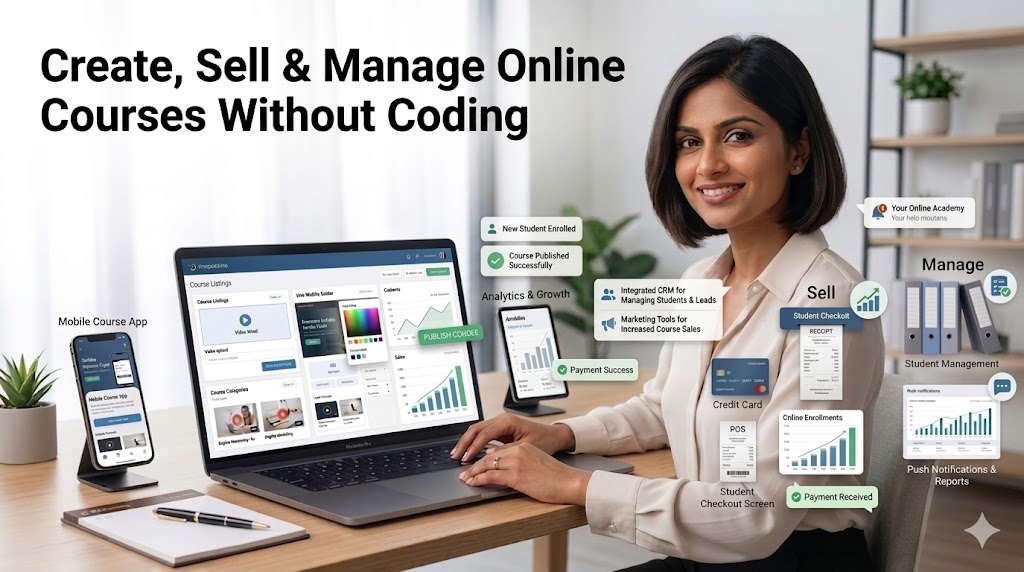
Shopaccino is an industry-focused SaaS eCommerce platform built to serve the specific operational needs of online businesses worldwide. It is not a generic website builder. It is a purpose-built online store builder designed around the real workflows of businesses selling digital and physical products directly to customers.
For course creators and educators, Shopaccino provides the complete online training platform infrastructure: a professional storefront, product management, payment processing, digital delivery, and business analytics, all without requiring any coding knowledge.
What Shopaccino provides for course businesses
- eCommerce website builder: build a fully branded online course website using customisable themes with your own domain
- Responsive design: all themes are built for a mobile-friendly website performance across every device size
- Digital product selling: upload courses as digital products with automatic digital product delivery on purchase confirmation
- Payment gateway integration: connects to multiple gateways for seamless online payments in multiple currencies
- SEO tools: built-in SEO tools for editing meta tags, URLs, sitemaps, and page titles across every course page
- Product and catalogue management: organise your course catalogue with categories, pricing tiers, and detailed descriptions
- Coupon and discount management: create promotional codes and limited-time offers to drive course enrollment campaigns
- Order management: track every purchase, manage access, and handle customer queries from one dashboard
- Google Analytics integration: connect your store to website analytics tools to monitor performance and conversion data
- GST invoicing: auto-generated GST invoicing on every transaction to keep your accounts compliant
Zero transaction fees: Shopaccino charges no commission on your sales. Every rupee you earn stays with you
Why Shopaccino fits course businesses: Unlike generic website builders or course-only platforms, Shopaccino is built for businesses that need a complete eCommerce operation. You get a branded storefront, full ownership of your student data, integrated global payments, and automated delivery, without paying per-sale commissions or losing control of your customer relationships. |
Steps to Create a Course Selling Website with Shopaccino
Setting up your course-selling website on Shopaccino follows a straightforward sequence. Here is the practical flow from account setup to the first live course:
- Register and choose your plan: sign up on Shopaccino, select the plan that fits your business size, and connect your custom domain
- Select and customise your theme: choose a professional theme from the library and apply your brand colours, fonts, logo, and layout preferences
- Add your courses as products: upload each course as a digital product with title, description, price, preview image, and the digital file or access link
- Write outcome-focused course descriptions: describe exactly what the student will be able to do after completing the course. Specific outcomes convert better than feature lists
- Configure pricing and access options: set one-time pricing, subscription pricing, or bundle pricing depending on your course model
- Set up payment gateways: connect your preferred payment gateways to accept cards, local payment methods, and international transactions
- Configure automated delivery: set up your digital product delivery so students receive immediate access upon payment
- Add store policies: publish your refund policy, terms of use, and privacy policy clearly before going live
- Optimise course pages for SEO: add meta titles, descriptions, and keyword-relevant headings to every course page
- Go live and test the purchase flow: complete a test transaction to confirm payment, delivery, and confirmation emails all work correctly before promoting
Designing a Professional Online Course Website
Design is not decoration on a course creator website. It is the layer that builds trust and guides a visitor toward enrolment. Students make credibility decisions within seconds of landing on a page.
Course landing pages
Every course must have a dedicated landing page that answers five questions — in this exact order:
- What will the student be able to do after completing this course?
- Who is this course designed for — beginner, professional, or both?
- What is included — lessons, hours, projects, certifications?
- What do other students say — real outcomes, not generic praise?
- How does the student enrol, and at what price?
Lead with the outcome, not the syllabus."Start accepting freelance clients within 30 days" outperforms "Module 1: Introduction to Freelancing." Students buy results — not curriculum documents.
Every course page must include these four trust signals:
Instructor Profile A real photo, a clearly stated relevant background, and specific experience that answers: "Why is this person the right teacher for this topic?" Vague bios reduce confidence. Specific credentials build it.
Student Testimonials Outcome-based quotes only. "I got my first client 3 weeks after finishing this course" converts. "Great course, highly recommend" does not. Real results sell the next enrolment.
Course Preview A short free lesson or trailer — 2 to 5 minutes — that shows the student exactly what the learning experience feels like before they commit money. This single element can increase enrolment rates significantly.
Refund Policy Clearly state your terms on the landing page itself — not buried in a footer. A visible 7-day money-back guarantee typically increases conversions more than it increases refund requests. It removes the last hesitation before purchase.
Navigation and mobile optimisation
Navigation rule: Any student should be able to reach any course in no more than 2 clicks from the homepage. Your navigation menu must include at minimum: Home · Courses · About · Contact.
Optimised mobile view
Every course landing page and checkout flow must work without friction on mobile. The majority of course purchases today happen on smartphones — a broken mobile checkout loses the sale at the final step.
Managing Payments, Access, and Customer Experience
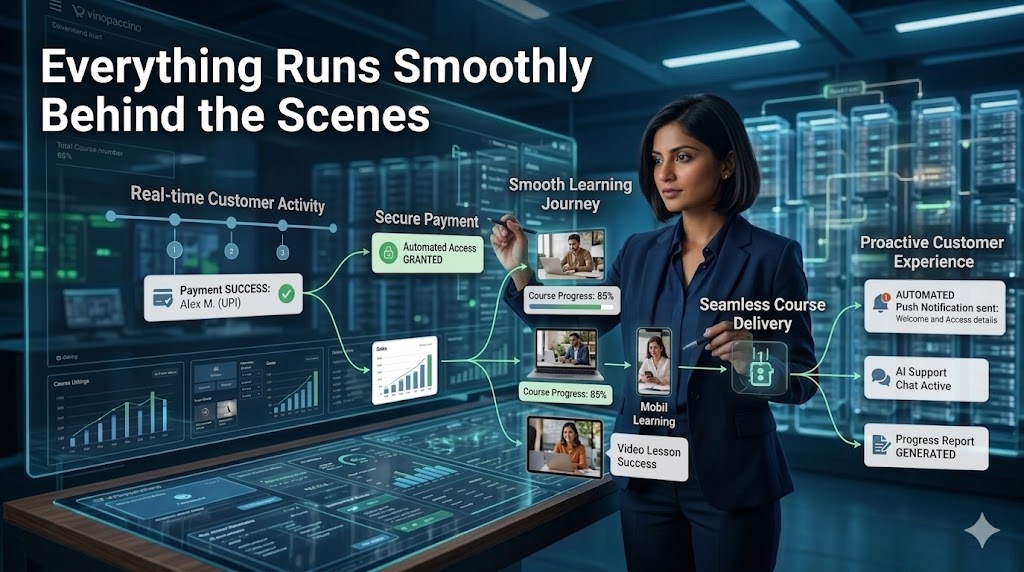
The operational side of an online coaching website or video course platform is where most technical anxiety lives for new course businesses. A well-configured Shopaccino store handles most of it automatically.
Payment models
Shopaccino supports the main payment structures used by course businesses:
- One-time purchase: student pays once, receives lifetime or defined-period access to the course
Automated delivery and student access
When a student completes checkout on your Shopaccino store, the platform automatically delivers their course access. No manual email from you. No follow-up required. The student receives their login credentials or download link within seconds of payment confirmation. This digital product delivery automation is active at all hours, across all time zones, on every device.
SEO Tips for Online Course Websites
A well-structured online learning platform should not depend entirely on paid advertising for traffic. Organic search is the most cost-effective and durable source of qualified course buyers. These are the practical SEO steps that move a course-selling website toward higher Google rankings.
Course page optimisation
- Title tag: include your target keyword within the first 60 characters. Example: 'Learn Freelance Writing | Beginner to First Client Course'
- Meta description: 120 to 155 characters. Describe the student outcome, include the keyword, and end with a reason to click
- H1 heading: one per page, aligned with the primary search query the page is targeting
- Course description text: write naturally for students, but include semantic keyword variations throughout the copy
- Image optimisation: compress every image and add descriptive alt text that includes relevant keyword context
- URL structure: use clean, readable URLs such as /courses/freelance-writing-beginners rather than /product?id=1138
Blogging and content strategy
A consistent blog on your online education website serves two purposes. It captures organic traffic from informational queries your potential students are searching for, and it establishes your expertise before the course purchase decision. Each post should target one specific question, include a natural mention of a related course, and be structured for featured snippet selection with a direct answer in the opening paragraph.
How Shopaccino supports SEO
Shopaccino provides built-in SEO tools that allow you to edit meta titles and descriptions on every page, set clean SEO-friendly URLs, generate automatic sitemaps for Google indexing, and manage structured data settings. These features make it straightforward to maintain a technically sound e-learning website without needing a separate SEO plugin or developer.
Marketing Your Online Course Website
Traffic to your course selling website does not appear automatically. A deliberate, channel-specific marketing strategy is what converts your well-built website into a consistent revenue stream.
Content marketing and blogging
Every blog post you publish on a topic related to your courses brings organic visitors who are already interested in what you teach. A post that ranks for a question your potential student is Googling becomes a permanent door into your website.
Email marketing
Email marketing helps you build a direct and long-term relationship with your audience. Start growing your email list from day one by offering valuable resources such as free guides, lesson previews, discount offers or exclusive content in exchange for email sign-ups. Focus on sending helpful and engaging emails consistently before promoting your products or courses. A strong connection with your subscribers improves trust, engagement and conversions during launches or promotional campaigns.
With Shopaccino, you can easily connect powerful email marketing platforms like Mailchimp, Klaviyo, Brevo and Wigzo to automate campaigns, send personalised offers and improve customer retention.
Social media
- LinkedIn: B2B courses, professional skills, corporate training audiences
- Instagram: visual creative courses, lifestyle, coaching, health and wellness
- YouTube: educational content across all categories, strongest trust-builder for course creators
- Facebook Groups: community building around course topics, high engagement in coaching and education niches
Paid advertising and retargeting
Paid advertising helps you reach potential customers quickly and drive targeted traffic to your website or course pages. Running campaigns on Google and Meta platforms allows you to attract users who are actively searching for your products, services or learning solutions. Retargeting campaigns are especially effective for reconnecting with visitors who explored your website but did not complete a purchase or enrolment, helping improve conversions and reduce customer acquisition costs.
With Shopaccino, you can easily integrate Google Ads and Meta Pixel to track customer behaviour, run targeted advertising campaigns, measure performance and optimise retargeting strategies for better sales and engagement.
Discount campaigns and affiliate programmes
Shopaccino's built-in coupon management lets you run time-limited enrolment offers that create urgency and drive course enrollment spikes during launch periods. A structured affiliate programme, where partners earn a commission for every student they refer, delivers qualified traffic at zero upfront advertising cost.
Scaling Your Online Course Business
Scaling a online course business is about building product depth and operational systems that generate proportionally more revenue without proportionally more work.
Course Catalogue Management
A well-structured course catalogue lets you grow your offerings over time without overwhelming new visitors. Each course sits in its own category, making it easy for students to discover related topics and continue their learning journey. As your catalogue grows, every new course increases the average revenue per visitor — returning students explore more, spend more, and refer more.
Improving conversion rates
Before scaling any traffic channel, establish your baseline course page conversion rate. Improving that rate through better page copy, stronger social proof, or a more prominent course preview delivers more revenue from the same amount of traffic. Conversion optimisation consistently produces higher returns than simply increasing ad spend.
Tracking and analytics
Your Shopaccino website analytics dashboard shows you the metrics that matter for scaling: which courses convert best, which traffic sources bring the highest-quality visitors, where students are dropping off before enrolling, and which promotional campaigns produced the best return. Make data-driven decisions on which courses to promote, which pricing changes to test, and where to focus marketing budget next.
How to Sell Courses Online: Start with the Right Foundation
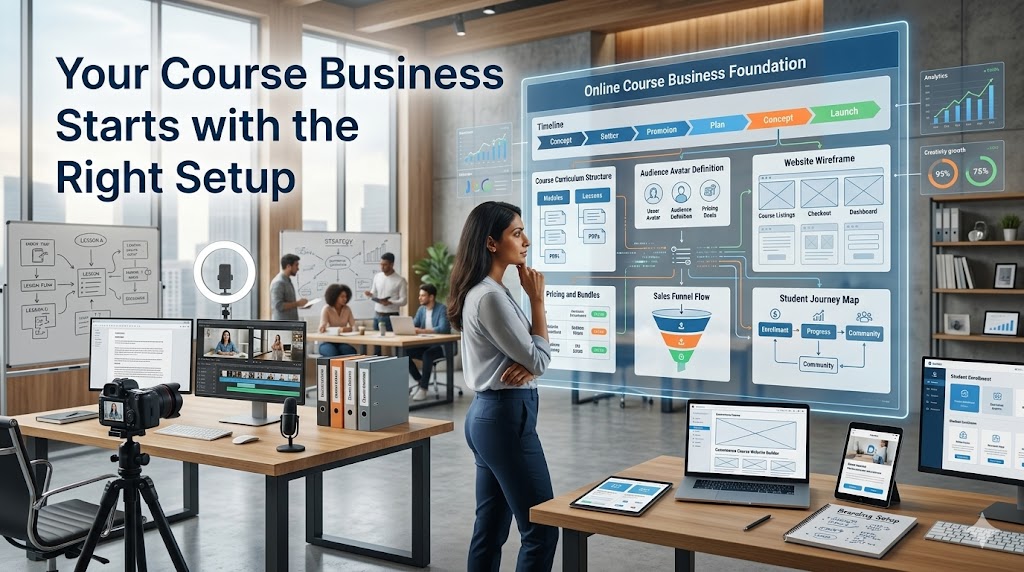
The online learning platform opportunity is real, it is growing, and it is accessible to any creator, educator, business, or organisation willing to build properly. The difference between a course business that grows consistently and one that stalls after the first launch almost always comes down to one decision: whether you built it on infrastructure you own or infrastructure you borrowed.
Selling courses online through your own professionally built website gives you brand authority, student ownership, full revenue, and long-term SEO equity. Shopaccino provides the eCommerce platform to make that website a reality, with the features, payment infrastructure, and business management tools a serious online course business requires.
The setup is straightforward. The path from first course to scalable business is clear. What remains is starting.
FAQs
To sell courses online from your own website, you need a SaaS eCommerce platform that supports digital product listings, payment gateway integration, secure student access, and automated course delivery. Set up your store on Shopaccino, upload each course as a digital product with a complete description and pricing, connect your payment gateways, and configure automated delivery. Your students pay and receive immediate access without any manual step from you.
The best platform to sell online courses depends on whether you want marketplace reach or website ownership. Marketplaces deliver some built-in traffic but take significant revenue percentages and own your student data. A dedicated eCommerce platform like Shopaccino gives you a fully branded course selling website, zero transaction fees, global payment support, automated digital delivery, and complete ownership of your student relationships and business data.
Yes. Shopaccino is a no-code SaaS online store builder that lets you build a professional online course website using customisable themes, drag-and-drop content management, and a straightforward product upload process. No developer is required to set up your store, configure payment gateways, or manage your course catalogue
Yes. Shopaccino supports sell online classes and digital products with automated digital product delivery, payment gateway integration, course access management, GST invoicing, website analytics, and SEO tools. It is built for businesses that want full ownership of their eCommerce operation without paying per-sale commissions to a marketplace.
Yes. Shopaccino integrates with multiple payment gateways to support online payments via credit and debit cards, local payment methods, and multi-currency checkout for international students. All transactions are processed through a secure payment gateway with standard fraud protection and automatic GST invoicing on every purchase.
SEO is essential for any online education website that wants long-term organic traffic without depending entirely on paid ads. Well-optimised course pages and supporting blog content rank in Google search results and bring in qualified students continuously. Shopaccino provides built-in SEO tools to manage meta tags, URLs, auto-sitemaps, and optimised page structure across your entire site.
Yes. All Shopaccino themes are built with responsive design, ensuring your online learning platform works correctly on smartphones, tablets, and desktops without any additional configuration. A mobile-friendly website is non-negotiable for course businesses, as the majority of students browse and purchase on mobile devices.
The most effective combination for a course selling website is: SEO-driven blog content for long-term organic traffic, email marketing to your subscriber list for direct conversions, one social media platform where your target students are active, and retargeting campaigns for visitors who viewed your courses but did not enrol. Shopaccino supports email marketing integrations and provides coupon management tools for running promotional campaigns directly from your store dashboard.