Ready-Made vs Custom Ecommerce Website: Where Should You Spend Your Budget?
Here is an uncomfortable truth about ecommerce budgets: the most expensive website is rarely the one that sells the most. Plenty of businesses pour a year of savings into a custom build, launch late, and then have nothing left to bring shoppers through the door. Others pick a cheap template, outgrow it in eighteen months, and pay twice to move.
So the real question is not which option is better in general. It is where every dollar of your ecommerce website budget will earn the most back. This guide breaks down the true cost of a ready-made vs. custom ecommerce website, the hidden expenses most people miss, and a simple way to split your money so the store you launch can actually grow.
Quick Answer For most businesses, a ready-made ecommerce platform is the smarter place to spend first. It launches in weeks, costs a predictable monthly fee, and frees most of your budget for marketing, products and customer experience. A custom ecommerce website is worth it only when your business has workflows, integrations or scale that no platform can support, and you can fund development every year, not just at launch. |
Key Takeaways
- The launch price is the smallest part of what you will pay. Judge both options on total cost of ownership over three years.
- A custom build typically costs many times more than a ready-made store over three years once hosting, security and maintenance are counted.
- Ready-made platforms win on speed to market, security patching and built-in features like checkout, tax and SEO tools.
- Custom development wins when you need unique pricing logic, deep system integrations or full source code control.
- Modern SaaS ecommerce platforms now cover many needs that once required custom code, including B2B pricing, multi-currency selling and branded mobile apps.
What Is the Difference Between a Ready-Made and a Custom Ecommerce Website?

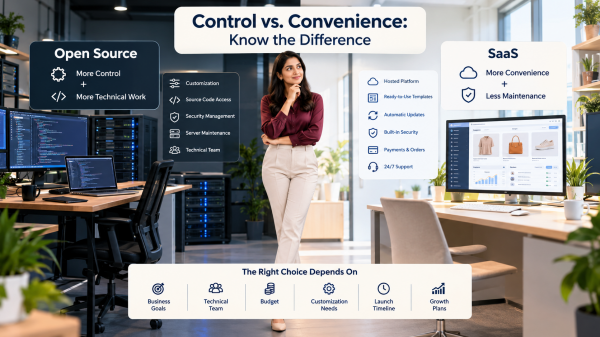
A ready-made ecommerce website runs on an existing platform you rent, while a custom ecommerce website is software built from scratch that you own and maintain.
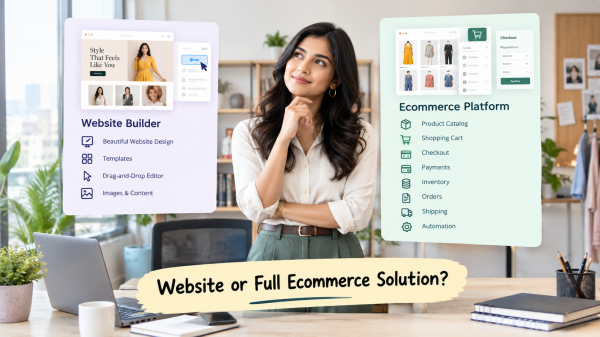
A ready-made ecommerce platform (also called an off-the-shelf ecommerce solution or SaaS store builder) gives you hosting, checkout, payments, inventory, themes and security as a package. You configure it, add your products and brand, and pay a subscription. The platform team handles servers, updates and most of the technical heavy lifting.
Custom ecommerce development means a development team designs and codes your store around your exact requirements. You get full control over every feature, every page and the source code. You also take on everything the platform would have handled: hosting, patches, bug fixes, compliance and new features.
Think of it like renting a fully furnished office versus building your own office block. One lets you start working on Monday. The other gives you exactly the building you want, along with the plumbing bills.
How Much Does a Ready-Made vs Custom Ecommerce Website Cost?
A ready-made store usually costs a few hundred to a few thousand dollars to set up plus a monthly fee, while a custom ecommerce website often costs tens of thousands to build and keeps costing money every year after launch.
Exact numbers depend on your region, catalog size and features, but the typical ranges below show where the money goes. All figures are in US dollars and are indicative, not quotes.
Cost Item | Ready-Made Platform | Custom Ecommerce Website |
|---|---|---|
Setup or build | $500 to $5,000 (theme, setup, product upload) | $25,000 to $150,000+ (design, development, testing) |
Platform or hosting | $30 to $400 per month subscription | $100 to $1,500 per month for servers, CDN and backups |
Security and compliance | Included in the subscription | Paid separately: audits, patches, SSL, monitoring |
Maintenance and updates | Handled by the platform | Often 15% to 20% of build cost every year |
Apps and integrations | $0 to $300 per month, depending on add-ons | Built per integration, often $2,000 to $15,000 each |
Team needed | Store manager, marketer | Developers, QA, project manager, DevOps |
Time to launch | A few days to 6 weeks | 4 to 12 months |
The custom ecommerce website development cost that agencies quote is usually the build price only. That is where most budget planning goes wrong.
What does the three-year picture look like?
Here is an illustrative total cost of ownership for a mid-sized store with around 2,000 products, one payment gateway, a shipping integration, and an accounting connection.
Three-Year Cost | Ready-Made Platform | Custom Website |
|---|---|---|
Initial setup or build | $3,000 | $60,000 |
Subscription or hosting (36 months) | $7,200 | $14,400 |
Apps or integration upkeep | $5,400 | Included in maintenance |
Maintenance and feature updates | Included | $32,400 (18% of build per year) |
Security audits and compliance | Included | $9,000 |
Design refresh | $2,000 | $8,000 |
Estimated total | $17,600 | $123,800 |
The gap of over $100,000 in this example is money that could have gone into ads, content, photography, inventory or customer service. That is the core trade-off. A custom build buys control. A ready-made platform buys budget freedom.
What Hidden Costs Do Business Owners Miss?
Both options carry hidden costs, but custom builds hide them in maintenance and ready-made platforms hide them in add-ons and fees.
Hidden costs of a ready-made platform
- App stacking: Paying for five or six plugins to fill gaps can quietly double your monthly bill.
- Transaction fees: Some platforms charge a percentage on every sale on top of payment gateway charges. On high volume, this adds up fast.
- Theme limits: A design change your theme does not support may need a paid developer anyway.
- Migration cost: If you pick a platform that cannot grow with you, moving products, customers and SEO rankings later is expensive.
Hidden costs of a custom ecommerce website
- Rebuilding the basics: Abandoned cart recovery, discount rules, tax calculation, product reviews and SEO settings all come free on most platforms. On a custom build, someone has to code each one.
- Developer dependency: If the agency or developer who built your store leaves, the next team needs time and money just to understand the code.
- Security and compliance: Any store that handles card data must meet the Payment Card Industry Data Security Standard. The PCI Security Standards Council sets these requirements, and on a custom build, proving compliance is your job.
- Scope creep: "Just one more feature" is the most expensive sentence in custom development. Timelines and budgets often stretch well past the first estimate.
Ready-Made Ecommerce Platform: Pros and Cons
A ready-made platform is the fastest, most predictable way to start selling, with less control over deep customization.
Pros
- Fast launch: You can go live in days or weeks instead of months.
- Predictable cost: A fixed monthly plan makes budgeting simple.
- Security handled for you: Servers, SSL, patches and payment security are managed by the platform.
- Built-in features: Checkout, inventory, shipping, coupons, analytics and SEO tools are ready on day one.
- Regular upgrades: New features roll out without extra development cost.
- Lower skill barrier: Your team can run the store without writing code.
Cons
- Customization limits: Very unusual workflows may not fit the platform's structure.
- Vendor dependence: You rely on the platform's roadmap, uptime and pricing decisions.
- Add-on creep: Missing features can mean paid apps and a rising monthly bill.
- No source code ownership: You own your data and brand, but not the underlying software.
Custom Ecommerce Website: Pros and Cons
A custom ecommerce website gives you complete control and flexibility, at the price of a high upfront cost, a long timeline and permanent maintenance responsibility.
Pros
- Total design freedom: Every page, flow and interaction works exactly as you want.
- Unique business logic: Complex pricing, configurators or approval workflows can be built to fit.
- Deep integrations: Connect directly to legacy ERP, warehouse or manufacturing systems.
- Code ownership: You control the software and are not tied to a vendor's pricing.
- No per-sale platform fees: At very high volume, this can offset the higher running cost.
Cons
- High upfront investment: Builds commonly run into five or six figures.
- Slow time to market: Months of development before your first sale.
- Ongoing maintenance: Bug fixes, upgrades and new features never stop costing money.
- Security is your responsibility: Breaches, patches and audits sit with you.
- Higher risk: Missed deadlines and budget overruns are common on large builds.
Ready-Made vs Custom Ecommerce Website: Side-by-Side Comparison
Factor | Ready-Made Platform | Custom Website |
|---|---|---|
Upfront cost | Low | High |
Ongoing cost | Predictable monthly fee | Variable, often rising |
Time to launch | Days to weeks | Months |
Customization | Moderate to high, within platform limits | Unlimited |
Scalability | Handled by platform infrastructure | Depends on your architecture and hosting |
Security | Managed by platform | Your responsibility |
SEO tools | Built in | Must be planned and built |
Code ownership | No | Yes |
Technical team | Not required | Required, long term |
Best for | Most retail, D2C, B2B and growing brands | Enterprises with unique, complex operations |
When Is a Custom Ecommerce Website Worth the Money?
Custom development is worth it when no platform can support how your business makes money, and you have the budget and team to maintain the software for years.
A custom build usually makes sense if several of these are true for you:
- Your pricing or ordering logic is truly unique, such as live product configurators, complex rental models or multi-step approval chains.
- You must integrate deeply with an in-house or legacy system that no platform connects to.
- Your sales volume is so high that per-transaction platform fees cost more than running your own software.
- You already have, or can afford, an in-house development team.
- Owning the code is a strategic or regulatory requirement for your business.
If you checked only one of these, look harder at platforms with open APIs before committing. Many businesses discover that their "unique" requirement is already a standard feature somewhere.
When Should You Choose a Ready-Made Ecommerce Platform?
Choose a ready-made platform when you want to sell quickly, keep costs predictable and put most of your budget into growth instead of code.
- You are launching a new store or moving an existing business online and want revenue within weeks.
- Your needs are common ecommerce needs: catalog, checkout, payments, shipping, discounts and reports.
- You do not have a development team and do not want to hire one.
- You want security, uptime and updates managed by specialists.
- You would rather spend on marketing, inventory and customer experience than on servers.
This describes the majority of retailers, D2C brands, distributors and manufacturers selling online today.
Which Option Is Better for SEO and Site Speed?
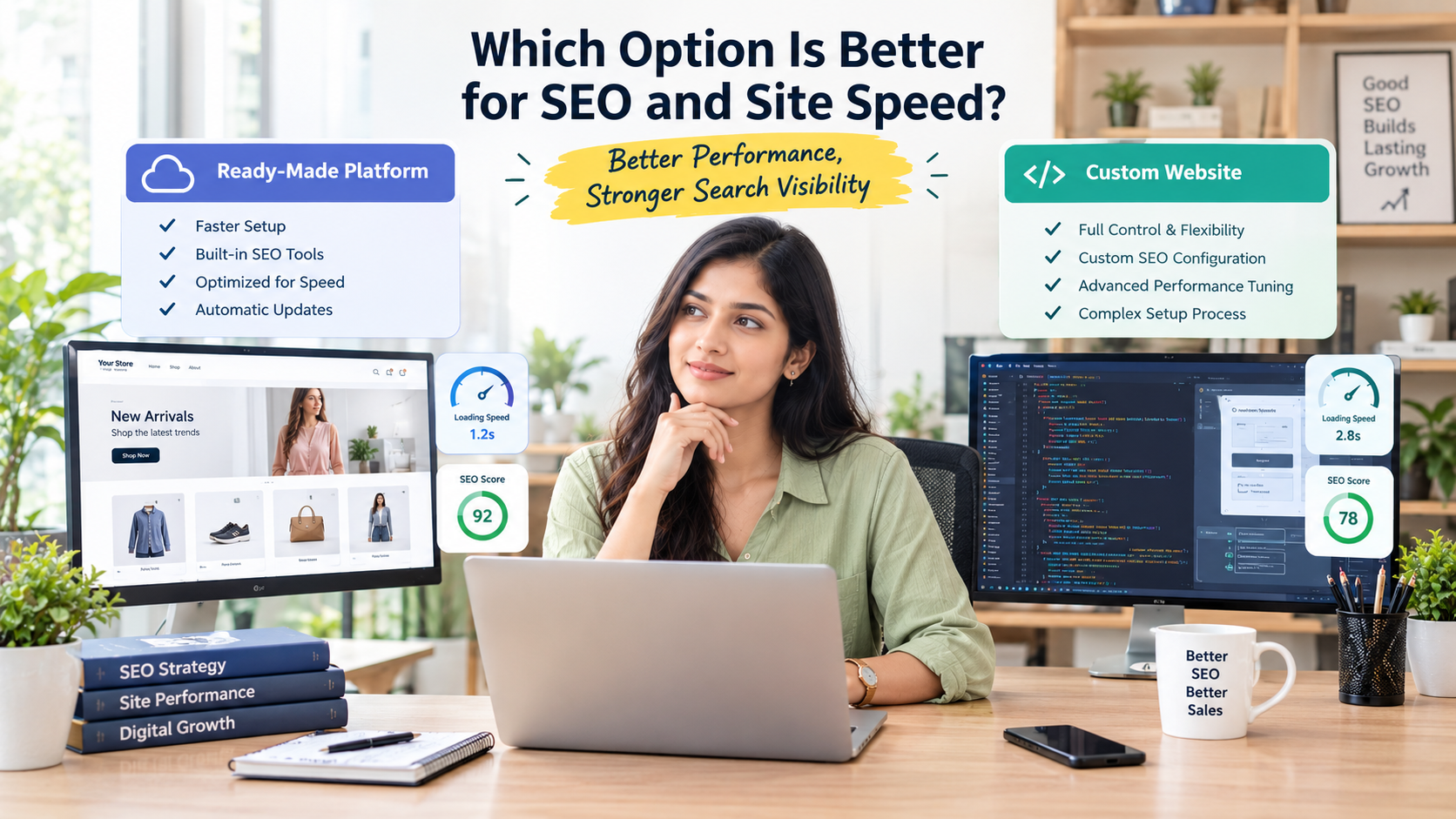
Neither option ranks better by default; what matters is page speed, clean structure and good content, and ready-made platforms deliver the basics faster.
Google measures user experience through Core Web Vitals. According to Google Search Central, a good experience means Largest Contentful Paint within 2.5 seconds, Interaction to Next Paint under 200 milliseconds and Cumulative Layout Shift below 0.1. A well-built custom site can hit these targets. So can a properly configured platform store.
The difference is effort. Good platforms ship with editable meta titles, clean URLs, XML sitemaps, image compression, canonical tags and schema markup. On a custom build, each of these must be specified, coded and tested. If your developer misses one, you may not notice until rankings drop.
Is There a Middle Path Between Ready-Made and Custom?
Yes. Extensible SaaS platforms and headless commerce let you start on a ready-made base and customize only the parts that set you apart.
This is where most smart budgets end up today. Instead of building everything, you use a platform for the commodity parts (checkout, payments, inventory, hosting, security) and invest in customization only where it creates a real advantage, such as a custom storefront design or a specific integration.
Headless commerce takes this further by separating the storefront from the backend. It suits brands with strong development resources that want a unique front end. For most businesses, though, a feature-rich platform with APIs and custom design options delivers the same result at a fraction of the cost.
Shopaccino is built for this middle ground. It is a ready-made ecommerce platform for established businesses selling online, offline or both, in their home market and across borders. Many features that businesses assume need custom development come built in: wholesale catalogs, customer-specific pricing and quote workflows through B2B ecommerce, multi-currency and multi-language selling, loyalty programs, order management, and a branded ecommerce mobile app for iOS and Android. With a 0% platform transaction fee, your costs stay predictable as sales grow.
How Should You Split Your Ecommerce Website Budget?
Spend the smallest sensible share on the platform and the largest share on getting customers, because a store nobody visits earns nothing.
Online competition keeps rising. The U.S. Census Bureau reported that ecommerce made up 17.1% of total US retail sales in the second quarter of 2026. More stores online means traffic has to be earned, and earning it costs money.
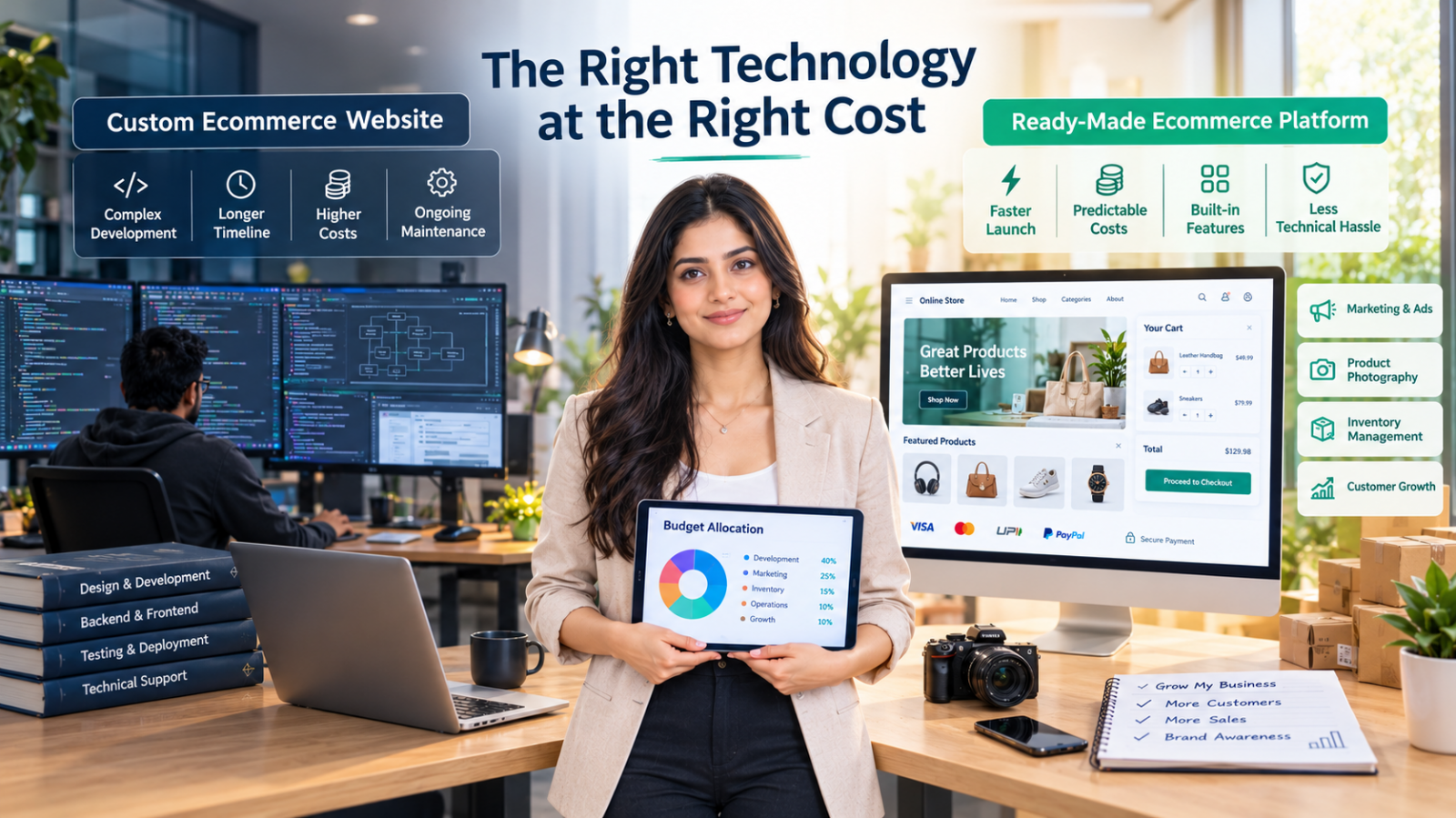
Here is a practical first-year split for each path, based on a total budget of $40,000:
Budget Area | Ready-Made Path | Custom Path |
|---|---|---|
Platform, build and hosting | 15% ($6,000) | 75% ($30,000) for a small build |
Design, branding and photography | 15% ($6,000) | 5% ($2,000) |
Marketing, ads and SEO | 45% ($18,000) | 10% ($4,000) |
Content and product descriptions | 10% ($4,000) | 5% ($2,000) |
Reserve for improvements | 15% ($6,000) | 5% ($2,000) |
Look at the marketing row. On the ready-made path, you have more than four times as much to spend on bringing in customers. On the custom path, the same budget buys a modest build and very little left to promote it. For a growing business, that difference often decides whether the first year is profitable.
FAQs
A custom ecommerce website is better only when your business needs features, integrations or control that no platform provides. For most retail, D2C and B2B businesses, a ready-made platform delivers the same selling power at a much lower cost and with faster launch times.
A custom ecommerce website commonly costs $25,000 to $150,000 or more to build, depending on features and region. Annual maintenance often adds 15% to 20% of the build cost, plus hosting, security and integration upkeep.
A ready-made ecommerce website usually costs $500 to $5,000 to set up, plus a monthly subscription that typically ranges from about $30 to $400. Paid apps and transaction fees can add to this, so compare plans carefully.
Yes. Most platforms let you export products, customers and orders. Plan redirects for every URL to protect your search rankings, and expect the move to take several weeks of work.
Reputable ready-made platforms manage SSL, server security, software patches and payment security for you. This is often safer for small and mid-sized businesses than running a custom site without a dedicated security team.
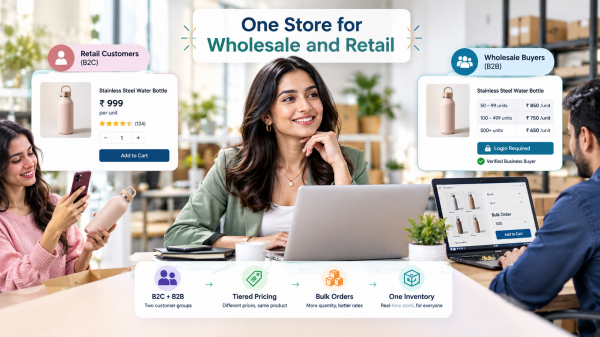
Many modern platforms can. Shopaccino, for example, supports wholesale catalogs, customer-specific pricing, quote requests, multi-currency checkout and international shipping on the same store as your retail customers.
Neither is better by default. Search rankings depend on site speed, structure and content. Ready-made platforms include most SEO tools out of the box, while custom sites need every SEO feature planned and built by developers.