The Hidden Costs of Running an Ecommerce Store: Beyond Your Platform Subscription
Your ecommerce platform costs $29 a month. Your ecommerce store does not.
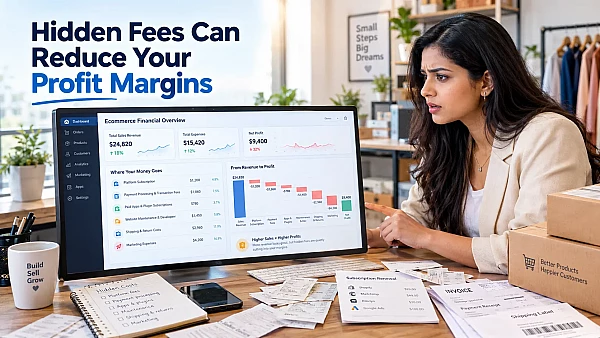
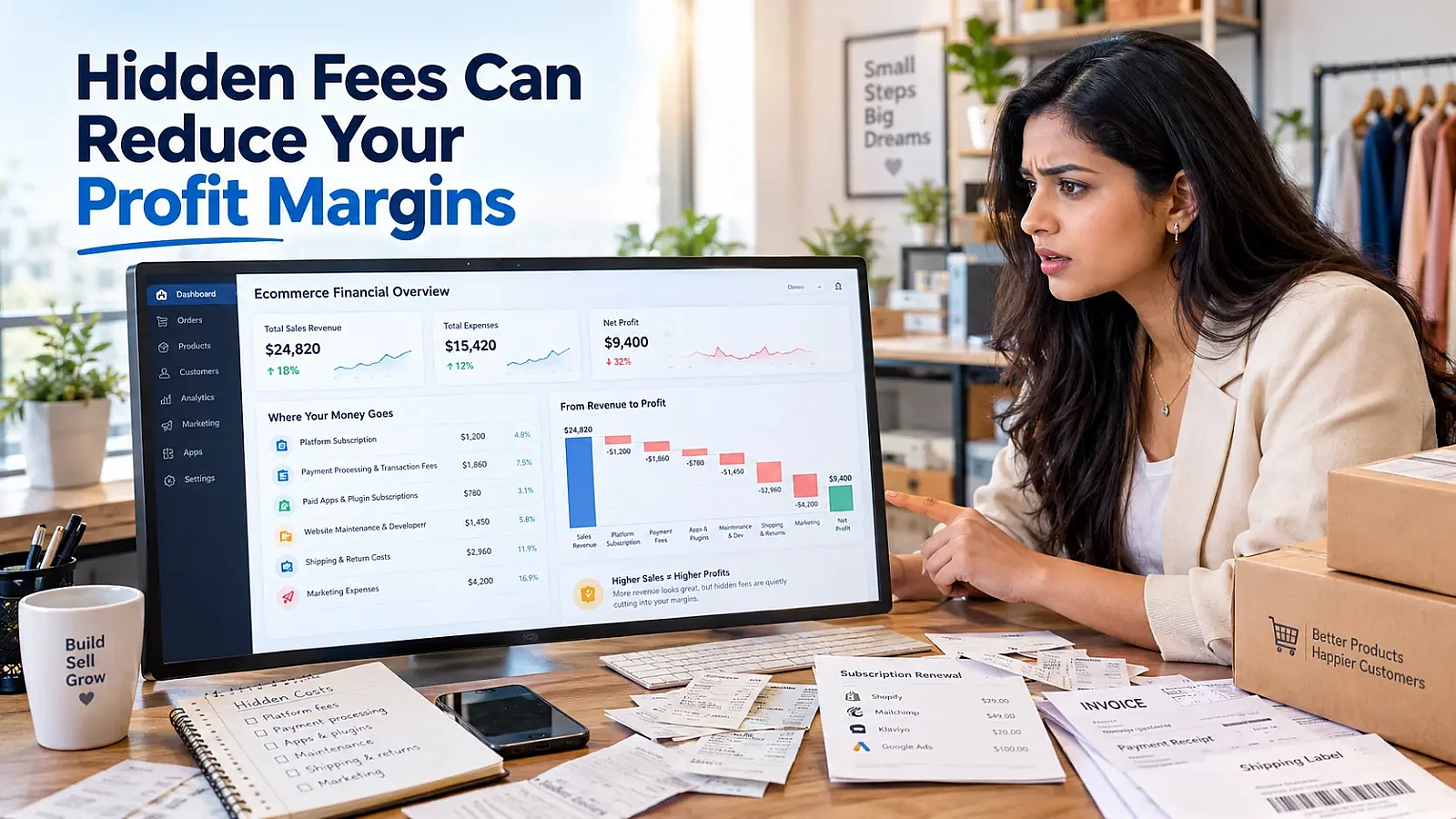
That gap between the price on the pricing page and the money that actually leaves your account every month is where profit quietly disappears. A transaction fee here, a $19 app there, a developer invoice for a "small fix," a weekend spent matching stock counts by hand. None of it looks dangerous on its own. Added up over a year, it can be bigger than your subscription several times over.
This guide breaks down the hidden costs of ecommerce one by one, shows you how they stack up with a real worked example, and gives you a simple way to calculate what your store truly costs to run. Whether you sell to consumers, run a wholesale operation, or do both, you will walk away knowing exactly where to look.
Quick answer: The hidden costs of ecommerce are every expense beyond your platform subscription that you need to keep an online store running and growing. The biggest ones are transaction fees and payment processing charges, paid apps and plugins, custom development and maintenance, integrations, hosting and security, shipping and returns, staff time spent on manual work, marketing, downtime, and the cost of switching platforms later. Together they often make up the majority of your true ecommerce total cost of ownership.
Key Takeaways
- Your subscription is usually the smallest line in your ecommerce budget, not the biggest.
- Platform transaction fees and paid apps are the two hidden costs that grow fastest as your sales grow.
- Manual work has a real price. Five hours a week of stock and order fixes can cost thousands of dollars a year.
- Always compare platforms on a three-year ecommerce total cost of ownership, never on the monthly price alone.
- An all-inclusive platform with 0% platform transaction fees, like Shopaccino, makes your costs far easier to predict.
What Are the Hidden Costs of Running an Ecommerce Store?
The hidden costs of running an ecommerce store are the recurring and one-time expenses that never appear on your platform's pricing page but are still required to sell online.
Think of your subscription like the rent on a shop. Rent matters, but you still pay for electricity, staff, security, and the occasional broken shelf. Online selling works the same way, except those costs stay invisible until the invoice arrives.
Most store owners plan for four things: the platform, the payment gateway, delivery, and ads. Everything else tends to sneak in later. That is why so many sellers feel their margins shrinking even when revenue is going up.
Why Is Your Platform Subscription the Smallest Number on the Bill?
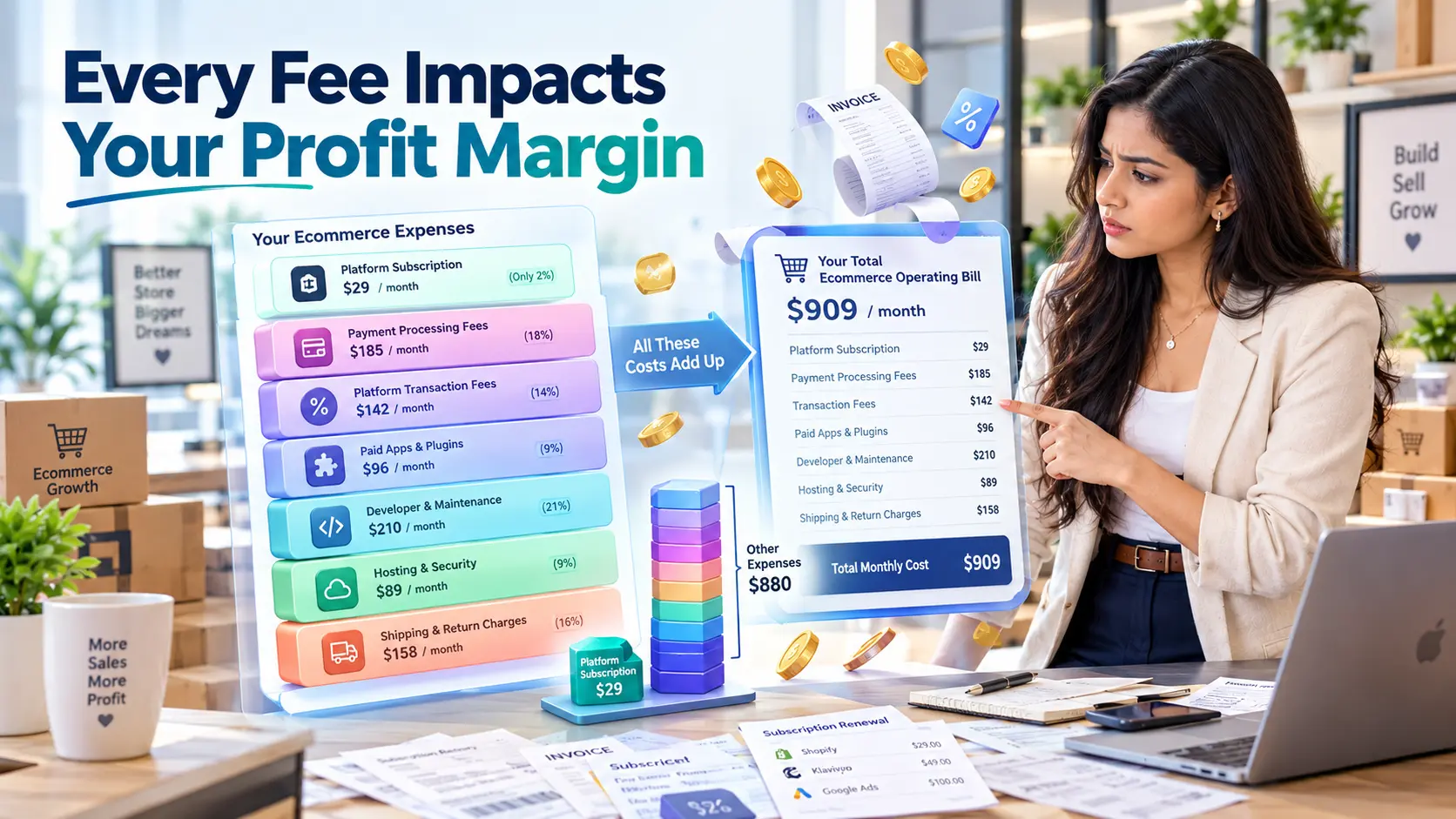
Because most platforms keep the headline price low and earn the rest through fees, add-ons, and upgrades you only discover after you launch.
A low entry price wins the comparison table. Then the real e-commerce platform fees show up in other places:
- A percentage of every sale if you use your own payment gateway
- Core features, like product reviews or wholesale pricing, locked behind higher plans
- App marketplaces where every missing feature costs another monthly subscription
- Limits on staff accounts, products, or storage that force an upgrade as you grow
Which Hidden Costs Do Most Online Store Owners Miss?
Most owners underestimate eleven cost areas, and the first three alone can double what you thought you were paying.
1. Transaction Fees and Payment Processing Charges
Every sale you make can be taxed twice: once by your payment gateway and sometimes again by your platform.
Payment processing fees are unavoidable. Your gateway charges a percentage plus, in many cases, a fixed amount per order. That part is normal. The part that hurts is when your ecommerce platform adds its own percentage on top, often because you chose a gateway other than theirs.
A 2% platform fee sounds small. On $250,000 in annual sales, it is $5,000 a year for doing nothing extra. Add currency conversion charges on international orders, refund fees that are not returned, and chargeback penalties, and payments quickly become your biggest variable cost.
2. Paid Apps, Plugins, and Extensions
Apps fill the gaps in your platform, and each gap comes with its own monthly bill.
Need abandoned cart emails? That is an app. Product filters? Another app. Reviews, loyalty points, SEO tools, wholesale pricing, bulk uploads, GST or VAT invoices? Each one can be a separate subscription. Six apps at $25 a month is $1,800 a year, and most growing stores run far more than six.
Ecommerce app costs also carry hidden extras. Apps from different developers can conflict, slow your pages down, and need updating at different times. When one breaks, you pay someone to find out which.
3. Themes, Design, and Custom Development
A free theme gets you live, but making it look and work like your brand usually means paying a designer or developer.
Premium themes are a one-time cost. Customising them is not. Changing a product page layout, adding a size chart, or building a custom checkout field often needs code. Developer rates vary widely by region, but even a few small requests a month add up to a serious annual figure.
The bigger risk is dependency. If the one freelancer who built your store disappears, every change waits.
4. Hosting, Security, and Compliance
If your platform does not include hosting, SSL, backups, and security monitoring, you pay for them separately, and you carry the risk if they fail.
Self-hosted and open source platforms look free until you add server costs, a content delivery network, SSL certificates, backup storage, and security patches. Card data rules also apply to every business that accepts card payments. The PCI Security Standards Council sets the PCI DSS requirements that govern how card data must be protected, and staying compliant takes time and money.
Privacy laws add another layer. Under the EU's GDPR, the European Commission notes that fines can reach up to 4% of a company's worldwide annual turnover for serious breaches. You do not need to be based in Europe for this to matter. You only need European customers.
5. Integrations and Data Sync
Connecting your store to accounting, ERP, inventory, and shipping systems is rarely plug and play, and the connection itself needs ongoing care.
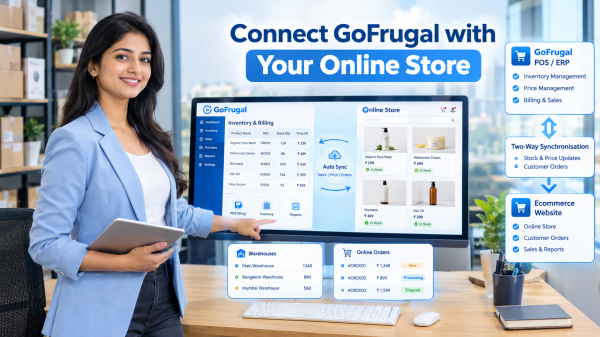
Most growing businesses run more than one system. Your store needs to talk to your accounting software, your courier partners, your warehouse, and, for larger operations, your ERP. Each link can mean a connector fee, a middleware subscription, or a custom build.
Then comes upkeep. When one system updates its API, the connection can break quietly, and nobody notices until a customer buys something you do not have.
6. Maintenance, Updates, and Bug Fixes
A store is never finished, and keeping it running smoothly is a cost that never stops.
Platforms release updates. Browsers change. Payment gateways retire old versions. Each change can affect your store. On fully managed SaaS platforms, much of this is handled for you. On self-managed setups, every update is your responsibility, and a skipped update can become a security hole.
Website maintenance cost is the line most often left out of first-year budgets, mainly because it does not show up until month four or five.
7. Shipping, Packaging, and Returns
Shipping is visible, but the costs around it, like packaging, failed deliveries, and returns, are where margins leak.
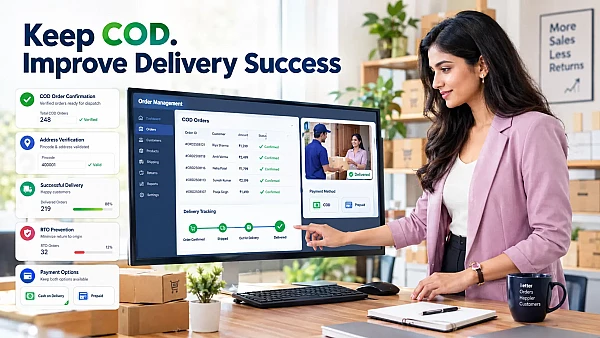
You plan for courier rates. You might not plan for branded boxes, packing material, weight disputes, cash on delivery charges, failed delivery attempts, and return shipping. Returns are especially expensive because you pay to ship the product twice and may not be able to resell it at full price.
Built-in shipping integrations will not remove these costs, but they stop you overpaying through manual booking and guesswork.
8. Staff Time and Manual Work
The most expensive hidden cost is often the hours your team spends doing work software should be doing.
Updating stock in two places. Copying orders into accounting tools. Answering "where is my order?" messages a notification could have handled. It feels free because your team is already on payroll. It is not.
Here is a quick test. If one staff member spends five hours a week on manual order and stock fixes, at $15 an hour, that is $3,750 a year. Most teams spend more than five hours.
9. Marketing and Customer Acquisition
Launching a store does not bring traffic, and the cost of getting each customer often grows over time.
Paid ads, SEO, content, influencer fees, and discount codes all come out of your margin, often alongside separate tools for email, SMS, loyalty, and referrals.
The smartest way to control customer acquisition cost is to keep the customers you already have. Built-in loyalty points, referral programmes, and abandoned cart recovery cost far less than buying the same customer again through ads.
10. Downtime and Slow Pages
Every minute your store is down or loading slowly, you are paying for traffic that cannot buy.
This cost never appears on an invoice. A crash during a holiday sale, a slow mobile checkout, or a payment page that times out sends shoppers straight to a competitor. You still paid for the ad click that brought them in.
Managed hosting, a content delivery network, and a platform built for high order volumes protect you from the sales you never see.
11. Switching Costs and Platform Lock-In
The day you outgrow your platform, you pay for everything you built on it a second time.
Migration means moving products, customers, orders, and URLs, rebuilding design work, reconnecting integrations, and protecting your search rankings while you do it. Some platforms make it hard to export your data or tie key features to their own paid modules.
The cheapest migration is the one you never need. Pick a platform that already supports where you want to be in three years, whether that is wholesale, global selling, multiple warehouses, or a branded mobile app.
How Much Does It Really Cost to Run an Online Store?
For most small and mid-sized businesses, the true cost of running an online store is many times the subscription price once fees, apps, and labour are counted.
Let us make this concrete. Here are two stores, each selling $240,000 a year. Store A picked the cheapest plan it could find. Store B picked an all-inclusive plan with 0% platform transaction fees. The numbers below are an illustration based on common pricing patterns, not quotes from any specific provider.
Annual cost line | Store A: "cheap" plan | Store B: all-inclusive plan |
|---|---|---|
Platform subscription | $468 | $690 |
Platform transaction fee (2% for using own gateway) | $4,800 | $0 |
Payment gateway processing (assumed 2.5%) | $6,000 | $6,000 |
Paid apps (reviews, cart recovery, SEO, filters, wholesale) | $1,800 | $300 |
Developer fixes and small changes | $2,400 | $600 |
Manual stock and order work | $3,750 | $1,500 |
Total yearly cost | $19,218 | $9,090 |
Store A saved $222 on its subscription. It lost $10,128 everywhere else.
Payment processing is the same for both. You cannot avoid gateway fees, but you can avoid a second cut on top. The biggest savings came from lines nobody compares on a pricing page: apps, developer time, and manual work.
How Do You Calculate Ecommerce Total Cost of Ownership?
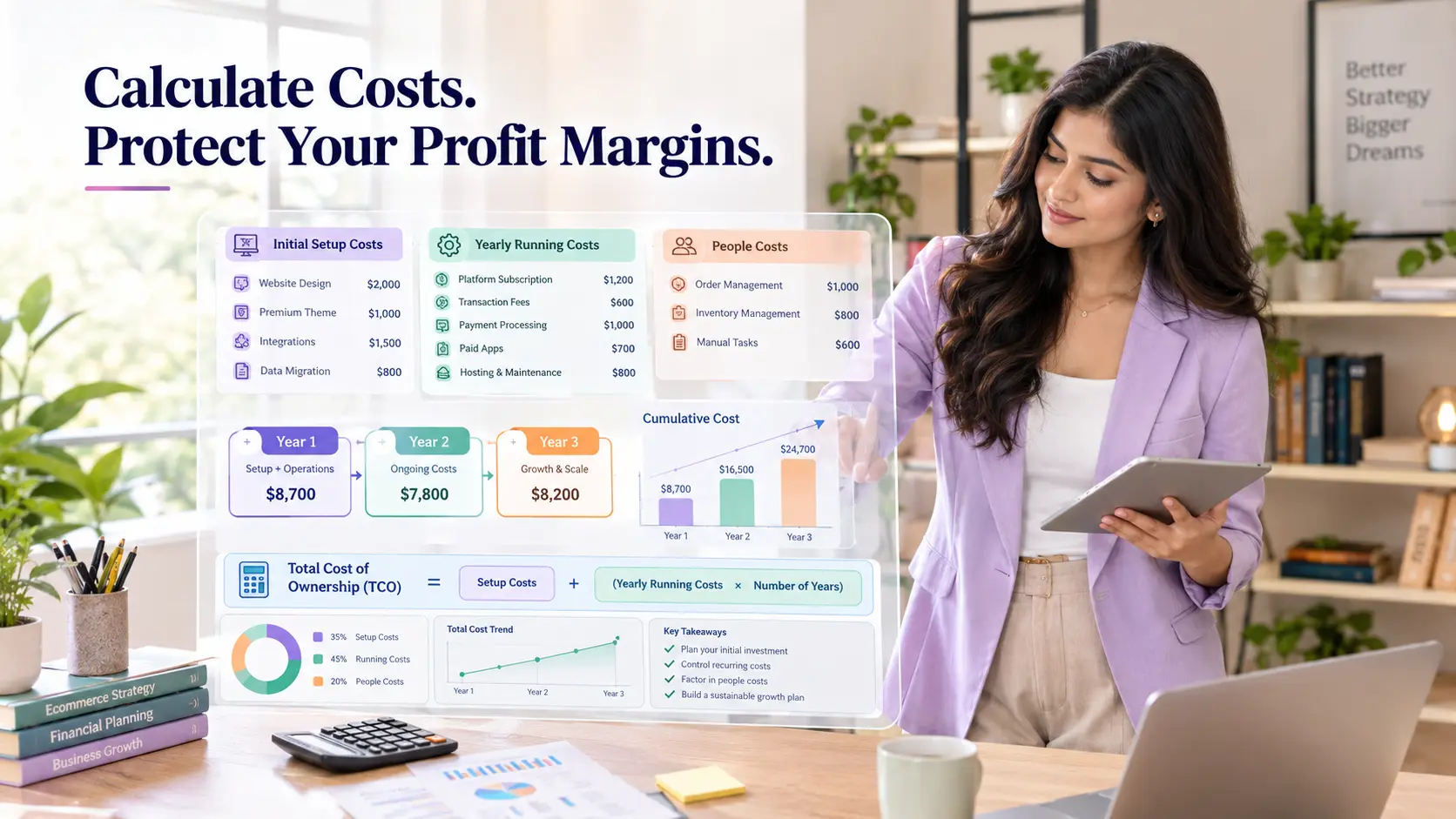
Add your one-time setup costs to your yearly running costs, then multiply the running costs by the number of years you plan to stay on the platform.
A simple formula works for most businesses:
Ecommerce total cost of ownership= Setup costs + (Yearly running costs × Number of years)
Follow these steps to build your own estimate:
- Pick a time frame. Use three years. It is long enough to show real costs and short enough to forecast.
- List setup costs. Theme, design, data migration, integrations, and training.
- List running costs. Subscription, platform fees, payment processing, apps, hosting, maintenance, and support.
- Add people costs. Estimate the hours your team spends on store tasks each week and multiply by an hourly rate.
- Model growth. Recalculate at 1.5x and 2x your current sales. Percentage-based fees grow with you. Fixed fees do not.
- Compare like for like. Use the same assumptions for every platform you evaluate.
When you run this exercise, the "expensive" platform and the "cheap" one often swap places.
How Can You Reduce the Hidden Costs of Ecommerce?
You reduce hidden costs by choosing a platform that includes what you need, automating repeat work, and reviewing your tools every few months.
- Audit your apps every quarter. Cancel anything unused or duplicated. Many stores pay for two tools doing the same job.
- Avoid platforms that charge a cut of your sales. Percentage fees punish growth. A flat subscription keeps your costs predictable.
- Choose built-in features over add-ons. Native inventory, SEO tools, coupons, and cart recovery mean fewer bills and fewer conflicts.
- Automate the boring work. Inventory sync, order notifications, and courier booking free your team for selling.
- Negotiate payment rates as volume grows. Gateways often offer better pricing to higher volume merchants. Ask.
- Plan for the business you want to be. If wholesale or international selling is on your roadmap, make sure your platform already supports it.
- Track your true cost per order. Divide your total monthly ecommerce spend by your monthly orders. Watch the trend, not just the total.
Questions to Ask Before You Sign Up With Any Platform
A few direct questions to a platform's sales team will reveal most hidden costs before you commit.
- Do you charge any fee on my sales if I use my own payment gateway?
- Which features in my list need a paid app or a higher plan?
- Are hosting, SSL, backups, and security updates included?
- What happens to my price when I add staff, products, or warehouses?
- Can I export all my products, customers, and orders if I leave?
- What support is included, and what costs extra?
If the answers are vague, treat that as an answer too.
How Does Shopaccino Help You Keep Ecommerce Costs Predictable?
Shopaccino is built to remove the most common hidden costs by including core features in every plan and charging 0% platform transaction fees.
Shopaccino is an ecommerce platform for established businesses that sell online, offline, or both, across domestic and global markets. Its pricing is designed so the number you see is close to the number you pay:
- 0% platform transaction fees on every plan. You connect your own payment gateway and keep your full sale value. Only your gateway's own processing charge applies.
- Hosting, CDN, SSL, and automated backups included. No separate server bills or security add-ons.
- Unlimited orders. Your plan does not penalise you for selling more.
- Built-in essentials. Inventory and tax management, abandoned cart recovery, coupons, and an SEO toolkit with schema, sitemaps, and meta tags come as standard.
- Room to grow without replatforming. Higher plans add accounting and ERP integrations, multi-currency and international payments, a complete B2B suite with MOQ and credit sales, and multi-warehouse management.
- Optional extras when you need them. A branded iOS and Android ecommerce mobile app and a web POS are available as add-ons, so you only pay for them if they fit your business.
That means fewer apps, fewer developer invoices, and a total cost you can actually forecast. See the full breakdown on the Shopaccino pricing page or start a 14-day free trial.
The Real Price of Selling Online
Your platform subscription is the easiest number to compare and the least useful one to compare on. The real story lives in the fees, apps, fixes, and hours sitting just outside the pricing table.
Before you choose or renew a platform, run the three year calculation. The answer will almost certainly change which platform looks "affordable."
If you would like to see what predictable ecommerce costs look like for your business, explore Shopaccino's plans or book a free demo with the team.
FAQs
The hidden costs of ecommerce are expenses beyond your platform subscription, including transaction and payment processing fees, paid apps, custom development, maintenance, integrations, hosting and security, shipping and returns, staff time, marketing, downtime, and future migration costs.
It depends on your size and platform, but for most small and mid-sized stores the subscription is only a small part of the bill once fees, apps, and labour are included. Calculate your own figure by adding every recurring tool, fee, and staff hour to your plan price.
No. Payment processing fees are charged by your payment gateway to handle the card or wallet payment. Platform transaction fees are an extra percentage some ecommerce platforms charge on each sale. Shopaccino charges 0% platform transaction fees, so only your gateway's fee applies.
Ecommerce total cost of ownership (TCO) is the full cost of launching and running your store over a set period, usually three to five years. It includes setup, subscription, fees, apps, maintenance, integrations, and staff time, not just the monthly plan price.
Choose a platform with built-in features and no platform transaction fees, cancel unused apps every quarter, automate inventory and order updates, negotiate payment rates as volume grows, and pick a platform that supports your future needs so you avoid costly migrations.
Not always. A low subscription can hide sales commissions, paid add-ons, and developer costs that make it more expensive overall. Compare platforms on total yearly cost, including fees and apps, before deciding which one is truly affordable.