Which Furniture Ecommerce Platform Is Best? 6 Top Options Compared for 2027
A sofa is not a T-shirt. It comes in a dozen fabrics, ships on a truck, takes four weeks to make, and costs more than most people spend online in a month. So why do so many furniture brands choose their store software the way a T-shirt seller would?
That mismatch is where a lot of furniture websites quietly lose money. Pick the wrong system and you end up paying for five apps to do what one platform should handle, explaining delivery charges over the phone, and watching shoppers leave at the shipping step.
This guide compares the six platforms furniture sellers actually shortlist, judged on the jobs a furniture store does every day, not on theme counts or flashy demos.
Quick answer: The best ecommerce platform for furniture is one that handles deep product variants, made-to-order lead times, bulky delivery rules and high-value checkout without a pile of paid add-ons. For most growing furniture brands that sell retail, wholesale or both, Shopaccino is the strongest all-round choice because swatches, custom orders, delivery zones, multi-warehouse stock and B2B pricing come built in. Shopify suits D2C brands that want a huge app store, BigCommerce suits very large catalogs, WooCommerce suits content-led brands with developer support, Adobe Commerce suits enterprises, and Wix suits small boutiques.
Key Takeaways
- Furniture needs features general stores rarely use: fabric swatches, configurable products, lead times, delivery zones, assembly fees and freight-friendly shipping.
- Every app you add to fill a gap raises your monthly bill and the chance that something breaks at checkout.
- Shopaccino ranks first here because the furniture workflow is native, not bolted on.
- If you sell to trade buyers and homeowners, choose a platform with B2B pricing built in from day one.
- Compare total cost of ownership (plan, apps, transaction fees and developer time), not the headline plan price.
Why Is Choosing a Platform for Furniture Harder Than It Looks?
Because furniture breaks almost every assumption that standard ecommerce software is built on.
Most store builders were designed for small parcels, simple variants and fast dispatch. Furniture is the opposite.
Think about one dining table. It might come in three sizes, four wood finishes and two leg styles. That is already 24 combinations, each with its own price, image and maybe its own lead time. Add matching chairs in eight fabrics and the numbers climb fast. A platform that limits.
options per product, or forces you to create separate listings, turns your catalog into a mess for shoppers and for your team.
Then comes the money side. Furniture has a high average order value, so buyers take their time. They compare, come back three times, ask for a fabric sample and want to know exactly when the piece will arrive.
Delivery is the third headache. You may only deliver to certain cities or zip codes, need two people to carry a wardrobe upstairs, or charge extra for assembly. Returns are costly, so clear expectations before checkout matter. Our guide on managing size, shipping and custom orders covers this side in depth.
Finally, many furniture businesses sell to two very different buyers. Homeowners pay retail. Interior designers, hotels, offices and dealers expect trade pricing, bulk discounts and sometimes credit terms. A retail-only platform pushes the trade side into spreadsheets and manual quotes.
What Should You Look for in the Best Platform to Sell Furniture Online?
The best platform to sell furniture online gets seven things right: variant depth, made-to-order support, delivery rules, visual merchandising, checkout trust, B2B readiness and honest total cost.
Use this as your checklist when you sit through any demo:
- Variant depth: Can one product hold every size, material, finish and fabric combination, with its own price and image?
- Made-to-order support: Can you mark some items as in stock and others as made to order, with a clear lead time on the product page?
- Delivery rules: Can shoppers check if you deliver to their area before they check out? Can you add assembly or special handling charges?
- Visual merchandising: Does the storefront show large, fast-loading images, zoom, lifestyle shots and room-by-room browsing on mobile?
- Checkout trust: Are EMI, buy now pay later, multiple payment methods and clear policies easy to show for a high-ticket purchase?
- B2B readiness: Can you give trade buyers their own prices, minimum order quantities and volume discounts without a second website?
- Total cost: What will you really pay each year once you add apps, payment fees and developer hours?
Here is a simple test. Ask every vendor to set up one sofa during the demo: three sizes, eight fabrics, two leg finishes, a four-week lead time, and delivery to only three zones. How many apps they need to open tells you more than any feature list.
Furniture Ecommerce Platform Comparison: The Top 6 at a Glance
Here is a side-by-side furniture ecommerce platform comparison before we look at each option in detail.
Platform | Best for | Furniture features built in | Main trade-off |
|---|---|---|---|
Shopaccino | Growing furniture brands selling retail, B2B or both | Swatches, custom orders, lead times, delivery zones, assembly, multi-warehouse, B2B pricing | Smaller third-party app marketplace than Shopify |
Shopify | D2C brands that want a large app ecosystem | Strong themes, easy checkout, huge app store | Deep variants, freight and B2B often need apps or higher plans |
BigCommerce | Retailers with very large catalogs | Faceted search, strong variant handling, B2B edition | Steeper learning curve, plans rise with sales |
WooCommerce | Content-led brands with developer help | Full control, unlimited customization | You manage hosting, security, updates and plugins |
Adobe Commerce | Enterprises with complex operations | Powerful catalog and B2B tools, multi-store | High build and running costs, long projects |
Wix | Small boutiques and handmade makers | Easy drag-and-drop design | Limited for large catalogs and complex delivery |
1. Shopaccino: Best Overall Ecommerce Platform for Furniture Brands
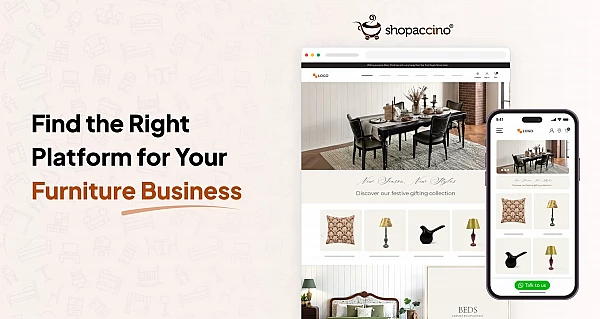
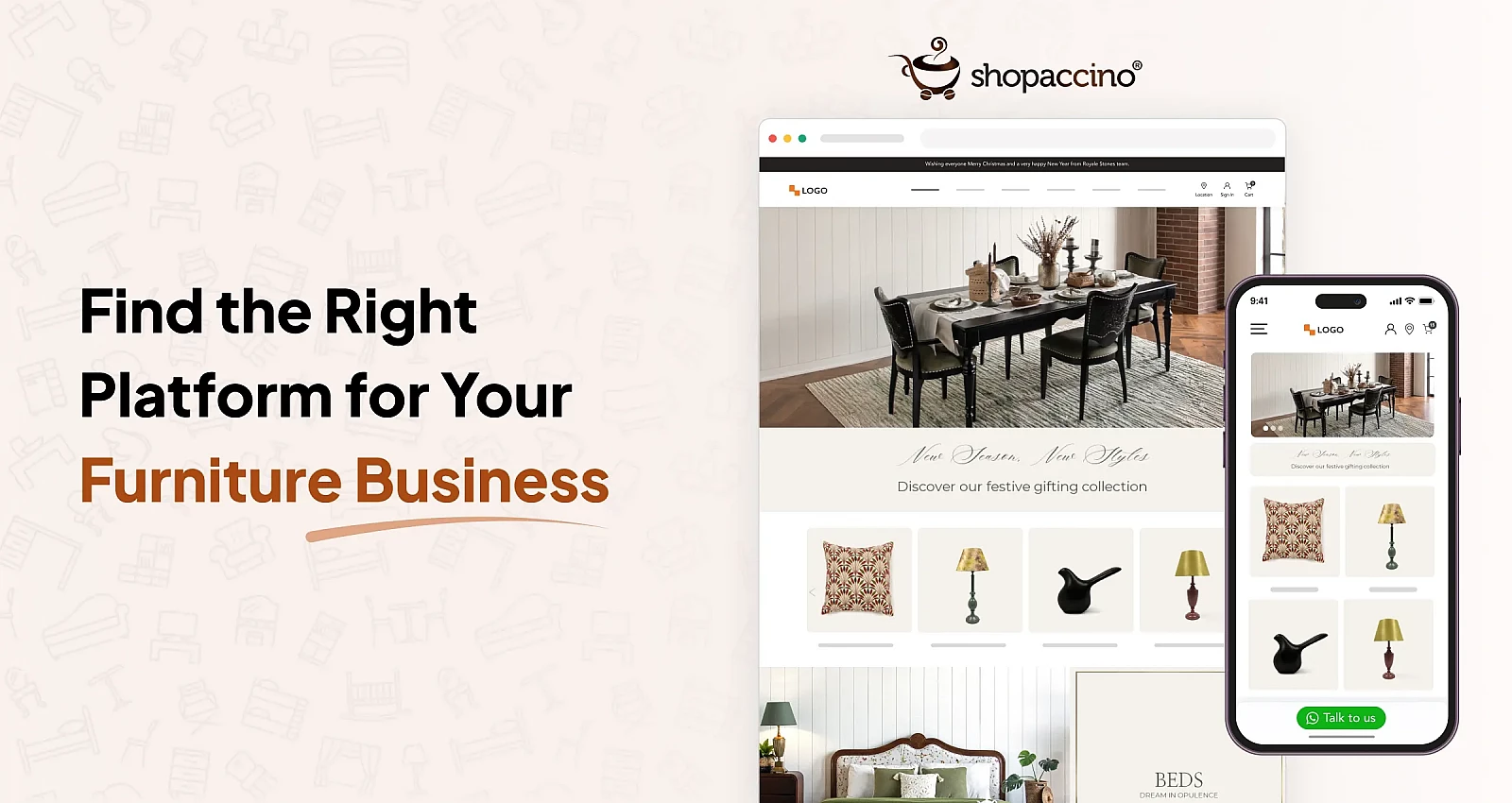
Shopaccino is the best ecommerce platform for furniture stores and brands because it was built around how furniture is actually sold, online and offline, retail and wholesale.
Where most platforms ask you to stitch together apps, Shopaccino gives you the furniture workflow out of the box. You can let shoppers order fabric swatches before they commit, offer size and style customization, and mark each product as in stock or made to order with its own lead time. Customers can check delivery availability by pin code or zip code before placing an order, and you can offer optional assembly with or without a charge.
The back end is where it really pulls ahead for growing brands. You can run stock across several warehouses with automatic order routing, connect accounting and inventory tools such as Zoho, Tally, Unicommerce, EasyEcom and Gofrugal, and plug in your own systems through product and order APIs. If you sell to trade buyers, the B2B suite adds business pricing, minimum order quantities, volume discounts and selling on credit, so homeowners and dealers can buy from the same store at different prices. We have covered that setup in detail in our guide on managing bulk and retail furniture orders separately.
Shopaccino also works for brands selling beyond their home market, with international payments, multi-currency and global shipping on its higher plans. Growth tools like WhatsApp automation, abandoned cart recovery and a built-in SEO toolkit are included. Every plan carries a 0% platform transaction fee, and stores typically go live in 2 to 5 days once your content is ready.
You can see the full feature set on the Shopaccino furniture ecommerce platform page.
Pros
- Furniture features such as swatches, customization, lead times, delivery zones and assembly are native
- Retail and B2B selling from one store, with trade pricing and credit
- Multi-warehouse stock with automatic routing on higher plans
- 0% platform transaction fee on every plan, plus a 14-day free trial
- Mobile-first storefronts designed for image-heavy products
Cons
- Smaller third-party app marketplace than Shopify
- Native mobile app and web POS come as paid add-ons
- Multi-warehouse and the full B2B suite sit on the higher plans
Best for: Furniture manufacturers, retailers and D2C brands that want one platform for online, showroom and trade sales without depending on a long list of apps.
2. Shopify: Best for D2C Furniture Brands That Love Apps
Shopify is a strong pick for direct-to-consumer furniture brands that want polished themes and a massive app store, as long as you budget for add-ons.
Setup is quick, the checkout is smooth, and premium themes make large furniture photography look great. Its app store has thousands of options, from AR "view in your room" tools to freight calculators and configurators.
The catch is that many core furniture needs live in apps rather than in Shopify itself. Products are limited to three option types, so a sofa with size, fabric, leg finish and cushion fill needs a configurator app. Delivery zones, assembly fees and lead-time messaging usually need apps too, each adding a monthly fee. Proper B2B features such as company accounts and trade price lists sit mainly on the costly Shopify Plus plan, and if you use a third-party payment gateway instead of Shopify Payments, an extra transaction fee applies.
Pros
- Easy to launch, with beautiful premium themes
- Huge app ecosystem and a large pool of experts
- Reliable hosting and a fast, trusted checkout
Cons
- Only three option types per product without an app
- Furniture delivery rules, assembly and configurators usually need paid apps
- Full B2B tools mostly need Shopify Plus
Best for: D2C furniture brands with simpler catalogs and a budget for apps.
3. BigCommerce: Best for Large Furniture Catalogs
BigCommerce suits furniture retailers with thousands of SKUs who need strong search, filtering and variant handling.
If you sell a wide range across sofas, beds, storage, outdoor and decor, BigCommerce handles big catalogs well. Faceted search lets shoppers filter by room, material, color, size and price without extra apps, and its product options can manage many more combinations than most entry-level builders. It also offers a dedicated B2B edition and a headless option for brands that want a custom front end.
The downside is complexity. The admin has a steeper learning curve, often needing a BigCommerce partner. Plans are tied to yearly online sales, so growth moves you to a higher tier automatically.
Pros
- Built-in faceted search and filtering
- Handles large, complex catalogs well
- B2B edition and headless options for scale
Cons
- Steeper learning curve than Shopify or Shopaccino
- Plan cost rises automatically as sales grow
- Furniture-specific touches like swatch ordering need setup or apps
Best for: Established multi-category furniture retailers with big catalogs and in-house or agency tech support.
4. WooCommerce: Best for Content-Led Furniture Brands With Developers
WooCommerce is a good fit if you already run on WordPress, publish a lot of content and have a developer you trust.
WooCommerce is a free plugin that turns a WordPress site into a store. Because it is open source, you can build almost anything: room planners, fabric selectors, custom quote forms and detailed buying guides that sit right next to your products. Brands that win traffic through blogs and inspiration content often like this setup.
That freedom comes with responsibility. You pay for hosting, premium extensions and developer time, and you own security, backups, speed and updates. A slow site with heavy furniture images can hurt both sales and rankings.
Pros
- Full control over design and features
- Strong for content marketing and blogging
- Large plugin library for product add-ons and shipping
Cons
- Hosting, security and maintenance are on you
- Costs add up through premium plugins and developer hours
- Performance can drop as plugins and images grow
Best for: Furniture brands with in-house technical skills that want maximum control.
5. Adobe Commerce (Magento): Best for Enterprise Furniture Businesses
Adobe Commerce is built for large furniture companies with complex catalogs, several brands or regions, and a serious tech budget.
Formerly Magento, Adobe Commerce handles huge layered catalogs, multiple storefronts, shared B2B catalogs, quote requests and deep ERP connections. Large furniture groups running several brands across countries often end up here.
For everyone else, it is usually more than needed. Licensing is quote-based, projects can take months, and you will need a specialist agency to build and maintain the store.
Pros
- Extremely flexible catalog and configuration options
- Strong native B2B tools and multi-store support
- Scales to very large, complex operations
Cons
- High licensing, build and maintenance costs
- Long implementation timelines
- Needs a specialist agency or in-house team
Best for: Enterprise furniture brands with multiple storefronts, regions and deep ERP needs.
6. Wix: Best for Small Furniture Boutiques
Wix works well for small furniture boutiques, handmade makers and showrooms that want a good-looking site with very little effort.
Wix's drag-and-drop editor lets you build an attractive store without coding. For a maker with a few dozen pieces, it does the job well.
The limits show as you grow. Complex variants, lead times, delivery zones and trade pricing are hard to manage, and many brands move to a dedicated platform once orders pick up.
Pros
- Very easy to set up and design
- Good for small catalogs and portfolio-style stores
- Built-in payments and basic marketing tools
Cons
- Weak for complex variants and furniture delivery rules
- Not built for large catalogs or B2B selling
- Brands often outgrow it quickly
Best for: Small boutiques and artisans testing online sales with a limited range.
Which Platform Fits Your Type of Furniture Business?
The right platform depends less on which one is "best" in general and more on how you sell.
- Showroom or retailer adding online sales: Choose Shopaccino. You get delivery zones, made-to-order handling and a web POS add-on, so your store and showroom work from the same stock.
- Manufacturer selling to dealers and homeowners: Choose Shopaccino for built-in B2B pricing and credit, or Adobe Commerce at enterprise scale. It also ends the need for manual quotations for every trade order.
- D2C brand with a small, focused range: Shopify or Shopaccino. Shopify if you want a large app store, Shopaccino if you want furniture features without stacking apps.
- Multi-category retailer with thousands of SKUs: BigCommerce or Shopaccino, depending on how much tech support you have.
- Brand that runs on content and WordPress: WooCommerce, with a good developer on call.
- Small maker or boutique: Wix to start, with a plan to move as you grow.
What Mistakes Do Furniture Brands Make When Choosing a Platform?
The most common mistake is choosing on the starting price and discovering the real cost six months later.
Here are the traps we see most often:
- Ignoring the app bill. A cheap plan plus a configurator, delivery app, B2B app and reviews app can cost more than an all-in-one platform.
- Forgetting delivery until launch. If shoppers find out you do not deliver to them after filling the cart, you lose the sale and their trust.
- Running trade orders on spreadsheets. Once wholesale grows, manual pricing and invoices slow everything down. Plan for B2B now, even if it starts small.
- Underestimating stock across locations. Furniture often sits in factories, warehouses and showrooms. Read our guide on multi-warehouse stock for furniture brands before you choose.
- Treating mobile as an afterthought. Most furniture browsing starts on a phone, even when the purchase happens later.
Final Verdict: Which Furniture Ecommerce Platform Is Best?
For most furniture brands in 2027, Shopaccino is the best ecommerce platform for furniture because it covers retail, B2B and complex delivery in one place.
The other five each have a clear place. But if you want swatches, made-to-order lead times, delivery zones, multi-warehouse stock and trade pricing without stitching together a dozen apps, Shopaccino is the platform built for how furniture really sells.
The easiest way to know for sure is to try it with your own products. Start the 14-day free trial or book a personalized demo and run the sofa test yourself.
FAQs
Shopaccino is the best ecommerce platform for furniture for most growing brands, because it includes swatches, custom orders, lead times, delivery zones, multi-warehouse stock and B2B pricing as standard. Shopify, BigCommerce, WooCommerce, Adobe Commerce and Wix can also work, depending on your size, catalog and tech skills.
Yes, Shopify works for furniture, especially for D2C brands with simple catalogs. However, deep product options, delivery zones, assembly fees and full B2B tools usually need paid apps or the Shopify Plus plan, which raises the total cost.
Shopaccino is a strong option for custom furniture because you can offer size and style choices, fabric swatches and separate lead times for made-to-order items without extra apps. WooCommerce and Adobe Commerce can also handle custom builds, but they need developer work.
Yes. Shopaccino lets you sell to homeowners and trade buyers from the same store, with business pricing, minimum order quantities, volume discounts and credit for B2B customers. Adobe Commerce and BigCommerce's B2B edition also support this, usually at a higher cost.
The real cost includes the platform plan, paid apps, payment and transaction fees, hosting and developer time. All-in-one platforms like Shopaccino, with a 0% platform transaction fee and furniture features built in, often cost less over a year than a cheaper plan with many add-ons.
You do not need them to start, but they can help shoppers feel confident about size and style. High-quality images, clear dimensions, fabric swatches and honest delivery timelines matter more early on. Our article on 3D visualization in furniture shopping explains when it is worth the investment.